
Can You Build Muscle Without Weights? The Evidence for Bodyweight Training
This article examines the scientific evidence behind no-equipment bodyweight training and explains why progressive overload—not heavy weights—is the real driver of muscle growth. It provides a decision framework for when bodyweight alone is sufficient and when to consider adding equipment.
Yes, an at home workout plan without equipment can build muscle. The honest version has a condition attached: it has to become hard enough, and then harder over time. Push-ups, squats, lunges, planks, bridges, and holds are not magic because they use your bodyweight. They work when they put enough tension on the target muscles and when the plan gives those muscles a reason to adapt instead of merely repeat last week.
That distinction matters because many beginners pause at the wrong doorway. They wonder whether they should wait until they can buy dumbbells, a bench, or a gym membership. The better first question is simpler: can the movement you are doing be progressed until the last few reps are genuinely difficult while your form still holds?
The push-up versus bench-press result beginners should actually notice
In January 2026, NPR covered a University of Cincinnati study that compared a push-up group with a bench-press group over one month. The reported result was the part that gets attention: there was no difference in bench-press strength gains between the two groups. The detail that should get even more attention is that both groups used harder variations over time, so the comparison was not “easy push-ups versus serious lifting.” It was progressive bodyweight training versus progressive weight training, over a short window, for one strength outcome.[1]
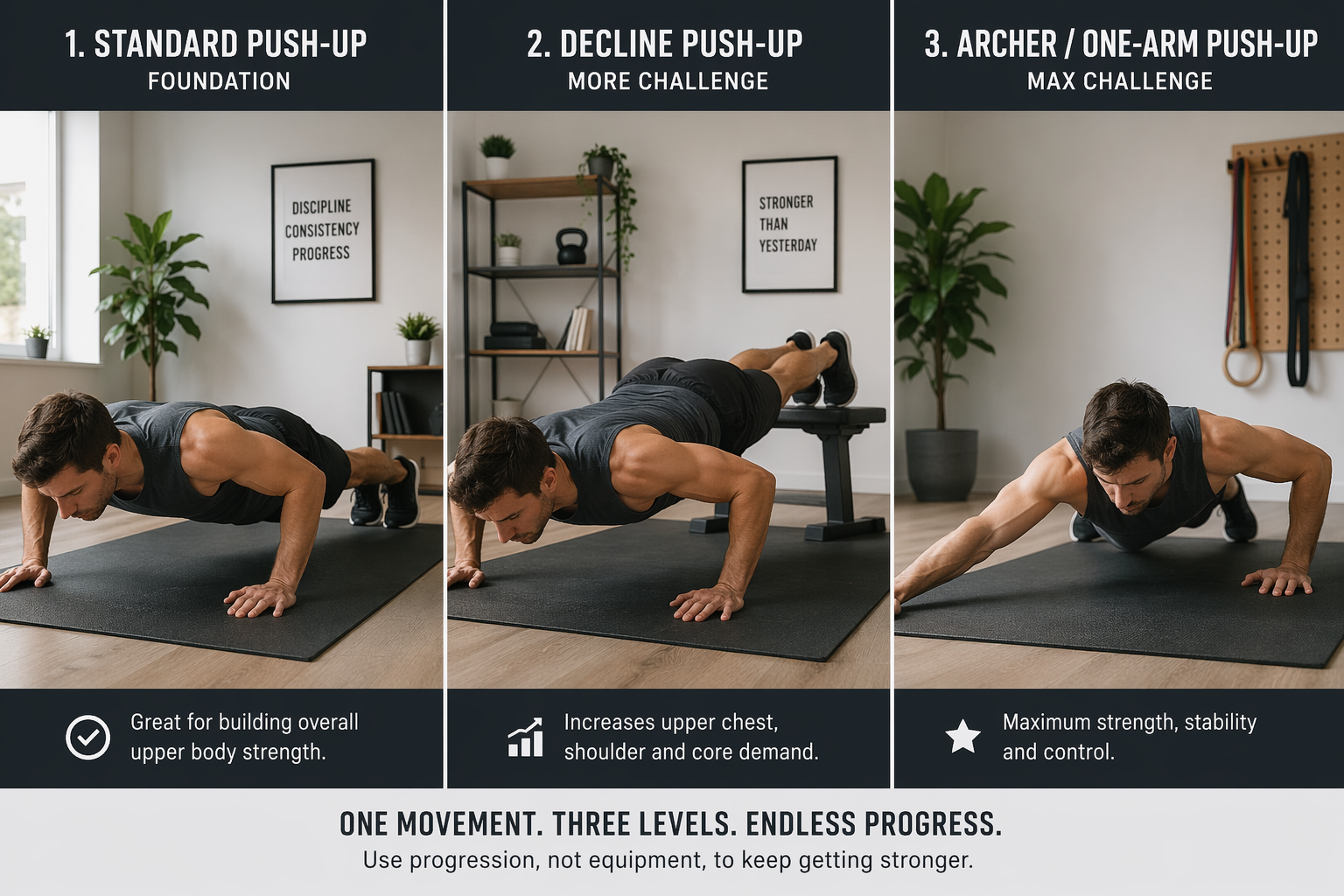
That is not the same as saying push-ups and bench presses are identical forever. The study was small and lasted one month, so it cannot settle every question about long-term hypertrophy, advanced strength, or every muscle group. But it does puncture a stubborn beginner assumption: the barbell is not the growth signal by itself. The body responds to challenge.
Exercise scientist James Steele put the broader evidence in plain language in the same NPR piece: “What studies we do have that have compared some sort of body-weight exercise to the equivalent of a free weight or a machine exercise all essentially show no difference between the two.”[1] That quote is useful because it does not require a beginner to pretend equipment has no purpose. It simply removes the idea that bodyweight exercise starts in a lower category.
The real requirement is progressive overload
Muscle growth is not awarded for owning heavier objects. It is a response to repeated, sufficient stress. In practical training language, that usually means progressive overload: the work becomes more demanding over time. With weights, the most obvious version is adding pounds to the bar or selecting a heavier dumbbell. At home, without equipment, the same principle has to be created through the exercise itself.
Earlier research points in the same direction. A 2020 BMC Public Health study found that untrained adults gained significant muscle size and strength after 12 weeks of bodyweight-only training.[2] A 2017 calisthenics study found that 8 weeks of calisthenics improved posture, BMI, and upper-body strength.[3] A 2018 calisthenics strength study also supports the idea that bodyweight training can improve strength when the exercises are demanding enough.[4] These studies do not prove that every random living-room circuit builds muscle. They support a narrower and more useful claim: bodyweight training can work when it is structured as training, not just movement.
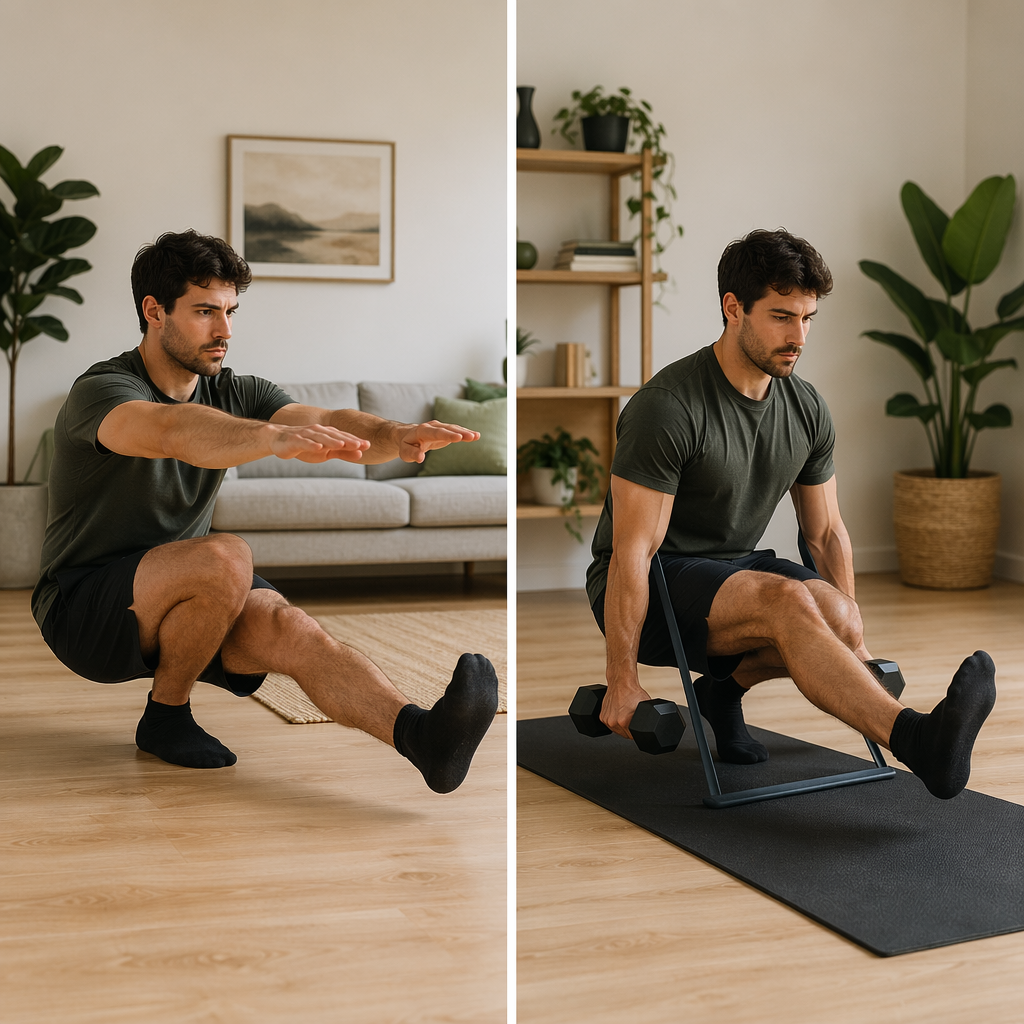
For a beginner, the test is not whether an exercise looks hard on video. The test is whether the target muscles are being brought close enough to failure. If you stop a set of squats because the timer beeped but your legs could have done 30 more reps, that set is probably not a strong muscle-building signal. If a set of split squats leaves only a few controlled reps in reserve, the same room, the same floor, and the same lack of equipment become much more relevant.
How bodyweight training gets harder without adding weights
The beginner mistake is to treat “no equipment” as “one version of each exercise.” That works for the first week or two, then everything either becomes too easy or turns into a blur of more reps. Good bodyweight training has more adjustment knobs than that.
| Progression method | What changes | Example |
|---|---|---|
| Leverage | The body is placed in a position where the working muscles handle more of the load | Incline push-up to floor push-up to decline push-up |
| Range of motion | The muscle works through a deeper or longer movement | Partial squat to full squat to rear-foot-elevated split squat |
| Unilateral work | One limb does more of the work | Glute bridge to single-leg glute bridge |
| Tempo | The lowering, lifting, or transition phase becomes slower | Three-second lowering phase on a push-up |
| Pauses | Momentum is removed at the hardest point | Paused split squat at the bottom |
| Isometric holds | Force is produced without visible movement | Wall sit, hollow hold, plank, or paused push-up hold |
| Proximity to failure | The set ends closer to the point where another clean rep is not possible | Stopping with 1–3 good reps left instead of 10 |
A push-up progression shows why this is not just theory. A new exerciser might begin with hands on a countertop. When that becomes too easy, the hands move to a lower surface, then to the floor. Later, the feet can be elevated, the lowering phase can be slowed, the bottom position can be paused, or the hands can shift toward archer push-ups. None of those changes require a purchase. All of them change the amount of work the chest, shoulders, and triceps must do.
Lower-body training needs the same kind of progression. Bodyweight squats often stop being challenging quickly for healthy beginners. That does not mean leg training has failed without weights. It means the exercise choice has to move forward: split squats, reverse lunges, step-ups if a safe step is available, single-leg Romanian deadlift patterns, squat pauses, and slower eccentrics can make the work much more demanding. Eventually, some people will outgrow these options for certain goals. That is a reason to add load later, not a reason to delay the first month.
Close to failure does not mean sloppy
Training close to failure means the set becomes difficult enough that only a small number of clean reps remain. It does not mean collapsing into the floor, bouncing through joints, or turning every session into a test of pain tolerance. For beginners, the useful target is usually technical difficulty: the last reps slow down, the working muscles are clearly challenged, and form can still be controlled.
This is where a plan helps. If every workout is improvised, it is hard to know whether you are progressing or just choosing different exercises. A simple training log can track the version of the exercise, reps, sets, tempo, and how many good reps you think were left at the end. If floor push-ups move from 3 sets of 6 to 3 sets of 12 with solid form, that is progress. If 3 sets of 12 becomes easy, the plan should not ask for 50 casual reps forever. It should change the exercise.
For readers who want the execution handled rather than building progressions from scratch, the 12-week at-home bodyweight workout plan is the natural next step. The point here is to understand why such a plan can work; the plan itself should do the week-to-week organizing.
Do holds count as strength training?
They can, especially when they are hard enough and placed with a purpose. NPR also cited UC Davis research from Keith Baar’s lab showing that even 10- to 30-second isometric bodyweight holds can help build healthier, stronger tendons.[1] That does not mean a plank is a complete muscle-building program. It does mean strength is not limited to visible up-and-down reps.
Tendons adapt more slowly than enthusiasm. A beginner who wants to rush from wall push-ups to advanced single-arm variations may have muscles that feel ready before connective tissue has caught up. Holds, pauses, and controlled eccentrics can make a no-equipment plan feel less flashy, but they often supply the kind of controlled tension that keeps progress from becoming a race.
When bodyweight alone is enough
Bodyweight training is enough when it can still create a challenging, trackable stimulus for the muscles you are trying to train. For many beginners, that window is not tiny. If push-ups are hard, split squats are hard, hinges are hard to control, planks expose weak trunk endurance, and single-leg variations are nowhere near mastered, the absence of dumbbells is not the limiting factor.
- You can make the main movements harder without losing form.
- Most working sets end within a few clean reps of failure.
- You can track progress from week to week.
- The plan trains the major movement patterns instead of only repeating one favorite exercise.
- Your space, budget, or schedule would make equipment a barrier rather than a useful tool right now.
This is also where cardio should not be confused with strength work. Walking, intervals, dance workouts, and low-impact cardio can support health and conditioning, but they do not replace progressive resistance work for every muscle group. If you want a separate structure for conditioning, use a dedicated 4-week at-home cardio progression plan alongside strength training rather than letting cardio blur into everything.
When equipment becomes useful
Adding equipment is not an admission that bodyweight training failed. It is often just the next clean progression. The problem is buying gear before you know what limitation you are solving. A set of dumbbells, a pull-up bar, bands, or a suspension trainer can be excellent if it removes a real bottleneck. It is clutter if it only postpones starting.
| If this is the limiting factor | Equipment may help because |
|---|---|
| Lower-body work is no longer challenging | External load can make squats, lunges, hinges, and carries easier to progress |
| Pulling movements are missing | A pull-up bar, bands, or suspension setup can add rows, pulldown patterns, and assisted pulling |
| Progressions jump too sharply | Small weights or bands can create smaller steps between difficulty levels |
| Tracking has become vague | Adjustable resistance gives clearer week-to-week loading targets |
| Exercise variety is the reason you are skipping sessions | A small amount of gear can make training more sustainable |
The cleanest path is phased. Start with bodyweight if that removes friction. Add the first piece of equipment only when you can name what it will improve. If that decision is coming soon, the beginner home exercise equipment build guide is a better next read than a random shopping list.
A practical decision before you start
Use this rule: start bodyweight training now if you can progress the exercises and work close to failure with good form. Add equipment when progression, loading, pulling options, variety, or tracking becomes the limiting factor.
A workout app can help if the main problem is consistency, reminders, or logging rather than exercise selection. For apartment spaces and minimal gear, a free workout app guide for limited home equipment can make the plan easier to follow. It still has to obey the same rule: the work must progress.
No-equipment training is not a waiting room for real fitness. It is real training when the exercises are chosen, progressed, and performed with enough effort to force adaptation. If those conditions are in place, the living room is enough to begin.
References
- Building strength without weights, NPR, Jan. 14, 2026.
- 2020 bodyweight-only training study, BMC Public Health, 2020.
- 2017 calisthenics study, 2017.
- 2018 calisthenics strength study, 2018.
This is general fitness education, not medical advice. For diagnosis or treatment of pain or injury, consult a qualified clinician.
Pick your next session
Browse all routines to find an appropriately-spaced next session.
Spot something off?
This content sits adjacent to health guidance — tell us if a citation or figure needs a correction.