
Which Samsung Galaxy Watch Is the Best Deal for Home Workouts?
This budget-tiered guide maps each Samsung Galaxy Watch model to specific home workout needs and price tiers, showing home exercisers how to avoid overpaying for features they won't use indoors.
- Price
- $170-200
- Noise rating
- Silent
The best deals on Samsung Galaxy Watch models for home workouts are not ranked by discount size. A $190 price cut on a rugged adventure watch can still be a worse buy than a cheaper watch that tracks treadmill walks, rowing intervals, yoga, bodyweight circuits, heart rate, and recovery well enough for an apartment gym.
As of July 23, 2026, the useful shopping question is simpler: how much of your home-gym budget should go to the wrist, and how much should stay available for dumbbells, a mat, a bench, bands, or a folding cardio machine? Current deal reporting puts the Galaxy Watch 8 as low as $249, the Galaxy Watch Ultra around $460, and previous-generation Galaxy Watch deals changing by retailer and configuration; the Galaxy Fit3 and Galaxy Watch FE sit in the lower price bands that matter most for home-only use.[1][2][3]
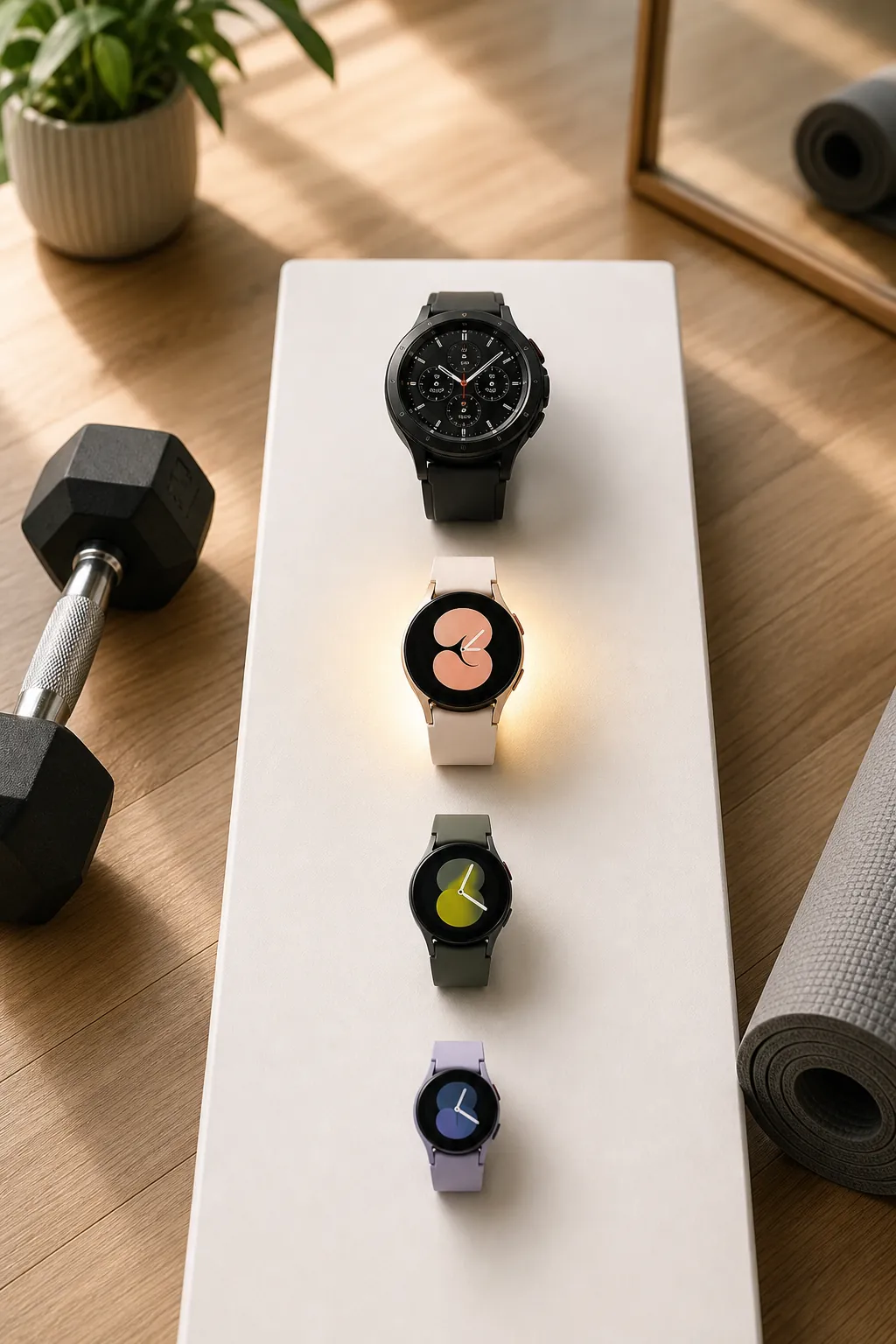
The July 23 Buying Grid
Prices below are a dated snapshot, not a promise. Samsung watch deals move with color, case size, trade-in offers, inventory, and retailer coupons. The point is to sort the models by what they add to indoor training before a sale banner does the thinking for you.
| FitAtHome budget tier | Model | Approx. price on July 23, 2026 | Best indoor use case | What you get for home workouts | What you may be paying extra for | Who should skip it |
|---|---|---|---|---|---|---|
| $0-100 | Galaxy Fit3 | $45.50 | Bodyweight circuits, yoga, treadmill walks, basic activity tracking | Heart rate, SpO2, 100+ workout types, up to 7.5-day battery life.[3] | You are not really paying for smartwatch features; this is a band, not a Wear OS watch. | Anyone who wants apps, Google Wallet, deeper smartwatch features, or a true Galaxy Watch. |
| $100-300 | Galaxy Watch FE | $170-200 | Most home exercisers who want a real smartwatch for strength, treadmill, rowing, yoga, and recovery basics | BioActive sensor, ECG, SpO2, body composition, and 90+ workout modes at a midrange price.[3] | Mostly extras it does not have: newer Galaxy AI coaching and antioxidant sensing. | Outdoor runners who want the newer coaching tools or shoppers who mainly care about the newest display. |
| $100-300 / $300+ depending on deal | Galaxy Watch 8 | $249-350 on deal | Home exercisers who also run outdoors or care about coaching and sleep/recovery features | Galaxy AI coaching, Sleep Coach, 3,000-nit display, antioxidant level tracking, and the newer Watch 8 platform.[1][5] | A premium over the FE for features that may not change indoor workout tracking enough to matter. | Someone trying to keep the full equipment budget near $300. |
| $300-800 | Galaxy Watch Ultra | $460-650; about $190 off MSRP in current deal reporting | Outdoor training, long hikes, open-water use, rougher conditions | Titanium build, 10ATM water resistance, and an 85dB emergency siren.[1][4] | Adventure hardware that does almost nothing for living-room strength circuits. | Most home-only exercisers. |
That table is the deal. If your workout happens beside a couch, on a folding treadmill, or under a pull-up bar in a doorway, the Galaxy Watch Ultra is not competing with the Watch FE just because its dollar discount is bigger. It is competing with the kettlebell, adjustable dumbbells, resistance bands, or cardio mat that the same money could have bought.
Why the Galaxy Watch FE Is the Value Pick for Home Workouts
The Galaxy Watch FE lands in the awkwardly useful place that spec-sheet shopping tends to underrate. It is not the newest watch. It is not the brightest watch. It is not the one Samsung uses to show off the freshest AI and wellness features. For indoor training, that is mostly fine.
At roughly $170-200, the Watch FE keeps the pieces a home exerciser is most likely to use: the BioActive sensor, ECG, SpO2, body composition, and more than 90 workout modes.[3] That covers the normal apartment-gym loop: start a strength workout, check heart-rate zones during a treadmill incline walk, log a rowing session, glance at recovery signals, and keep enough smartwatch convenience on the wrist that the device does not feel like a stripped-down band.
This is also where accuracy claims need a little discipline. A watch can be useful without being a lab instrument. Wrist-based sensors are best treated as trend tools for effort, consistency, and recovery context, not as perfect calorie counters or medical-grade workout judges. If you want the broader caveats before buying any wrist tracker, read our wearable fitness tracker accuracy primer.
For most home workouts, the FE's limits do not hit the main job. A bodyweight circuit does not need route mapping. A treadmill walk does not need a titanium case. A 30-minute dumbbell session does not become better because the watch can survive harsher outdoor conditions. The FE is the point where Samsung smartwatch utility and home-workout value meet.
The Watch FE vs. Watch 8 Question
The real temptation is not usually the Ultra. It is the Watch 8. At $249 on the low end of current deal reporting, the Watch 8 can look close enough to the FE that the upgrade feels harmless.[1] At $350, it starts to eat into the same money that could improve the actual training setup.
The Watch 8 adds Galaxy AI coaching, Sleep Coach, a 3,000-nit display, and antioxidant level tracking.[1][5] Those features are not fake upgrades. The brighter display can matter if you run outdoors. Coaching can matter if you want more structure than a basic timer and heart-rate graph. Sleep and recovery features can matter if the watch is part of a bigger effort to manage training load, bedtime, and morning readiness.
But the upgrade has to answer a home-workout question, not a launch-event question: what changes during a Tuesday night workout in the apartment? If the answer is mostly that the watch looks nicer, feels newer, and has wellness features you might open twice, the FE is still the better deal. If the answer is that you will use the running coach outdoors, compare sleep data every morning, and keep the watch on all day, the Watch 8 has a clearer case.
| Decision point | Galaxy Watch FE | Galaxy Watch 8 |
|---|---|---|
| Indoor strength and circuits | Strong fit; keeps core workout modes and sensors. | Also works, but the premium is hard to justify for this alone. |
| Treadmill walks and indoor cardio | Strong fit for heart-rate and workout logging. | Worth considering if coaching and recovery prompts will change behavior. |
| Outdoor running mixed with home training | Adequate for basic tracking. | Better fit because AI Running Coach and brighter display matter more outside.[1][5] |
| Recovery-focused user | Useful baseline data. | Better fit if Sleep Coach and newer wellness features will actually be checked. |
| Tight $300 equipment budget | Usually the better choice. | Only sensible if the watch is the priority purchase. |
There is one more trap here: do not assume the Watch 8 is proven more accurate for every home workout just because it is newer. The public materials support a feature upgrade story more clearly than a peer-reviewed, model-specific accuracy superiority story. For a closer look at where the Watch 8 does and does not justify confidence, use our Galaxy Watch 8 fitness tracking accuracy guide before paying extra for the newer model.
Where the Galaxy Fit3 Makes Sense
The Galaxy Fit3 is the under-$100 answer for someone who wants tracking, not a smartwatch. At $45.50, it is almost unfairly cheap next to the watches, and its heart-rate tracking, SpO2, 100+ workout types, and 7.5-day battery life are enough for many home circuits, yoga sessions, and treadmill walks.[3]
The catch is not subtle: it is a fitness band. If you want a Wear OS app ecosystem, richer smartwatch controls, wallet features, or a device that feels like a small phone companion, the Fit3 is not the real entry point. It is the practical choice when the goal is to spend almost nothing on the wrist and keep the rest of the money for training gear.
For a renter building from scratch, that can be the right call. A $45 band plus a better mat, heavier dumbbells, or a more stable bench may improve the actual workout more than a full smartwatch. If you are still deciding whether you need a band, watch, or ring at all, use our fitness tracker decision framework before shopping the Galaxy Watch line.
The Watch Ultra Is a Discount, Not a Home-Gym Deal
The Galaxy Watch Ultra is the easiest model to over-admire and the easiest one to reject for home-only use. Current deal reporting puts it around $460, about $190 off MSRP.[1] That sounds like the kind of discount that should win a deals article.
Then look at what the watch is built to solve: titanium construction, 10ATM water resistance, and an 85dB emergency siren.[4] Those are legitimate outdoor and adventure features. They are also mostly dead weight if your weekly training is a yoga mat, a folding treadmill, a rower, and dumbbells in the corner of a bedroom.
Buy the Ultra if your workouts regularly leave the apartment: trail runs, long outdoor sessions, rough weather, water exposure, or situations where the tougher build is not just a nicer object. For home-only training, the discount is solving the wrong problem.
How to Spend by Budget Tier
A wearable should not quietly become the most expensive piece of a modest home gym unless it is doing the most work. If your total setup is still missing basics, compare the watch price against the full training budget, not just against other watches. Our under-$1000 home gym guide uses the same kind of tradeoff: the best purchase is the one that changes the workouts you can actually do.
- $0-100: Buy the Galaxy Fit3 if basic heart-rate, SpO2, activity, and workout logging are enough. Put the saved money into equipment.
- $100-300: Buy the Galaxy Watch FE if you want the best Samsung smartwatch deal for home workouts. This is the safest value pick for most indoor users.
- $100-300, stretching upward: Buy the Galaxy Watch 8 only if the newer coaching, Sleep Coach, brighter display, or outdoor-running use will be part of your routine.
- $300-800: Skip the Galaxy Watch Ultra unless your training regularly includes outdoor or adventure conditions that justify the hardware.
There is also a timing question. Deal analysis points to previous-generation Galaxy Watch models often seeing 30-50% discounts during seasonal events, with Amazon Prime Big Deal Days on Oct. 7-8 and Black Friday in November expected to bring another 10-20% off some last-gen models.[2] If your current tracker still works and your workout budget is tight, waiting is reasonable. If you need a watch now, the FE is the model least likely to make you feel as if the sale talked you into the wrong category.
The Practical Buying Rule
Buy the Galaxy Fit3 only if a band is enough. Buy the Galaxy Watch FE for the best home-workout value. Buy the Galaxy Watch 8 if coaching, recovery features, outdoor running, or the brighter display will change how you train. Skip the Galaxy Watch Ultra unless your workouts regularly leave the apartment.
References
- It's Time to Save on These Samsung Galaxy Wearables, CNET.
- Best Galaxy Watch deals July 2026 - up to 50% off Samsung smartwatches, Cybernews, July 2026.
- The Best Samsung Watch We've Tested for 2026, PCMag.
- Compare Smartwatches, Samsung US.
- Samsung Galaxy Watch 8 vs. Watch 7: Is the New Model Worth $100 More?, PCMag.
Where this fits
Spot a spec or price issue?
Prices, specs, and safety notes change. If something here looks out of date, sign in or create a free account to flag it, or reach us via the About page.