
Galaxy Watch Ultra 2 vs Watch 9: Does the cheaper watch track just as well?
We compare the fitness tracking accuracy of the Galaxy Watch Ultra 2 and Watch 9 for indoor workouts. Our analysis shows the Watch 9 collects the same core data at a $290 lower price, making it the smarter choice for home-gym users.
- Price
- $379–$409
- Noise rating
- Silent
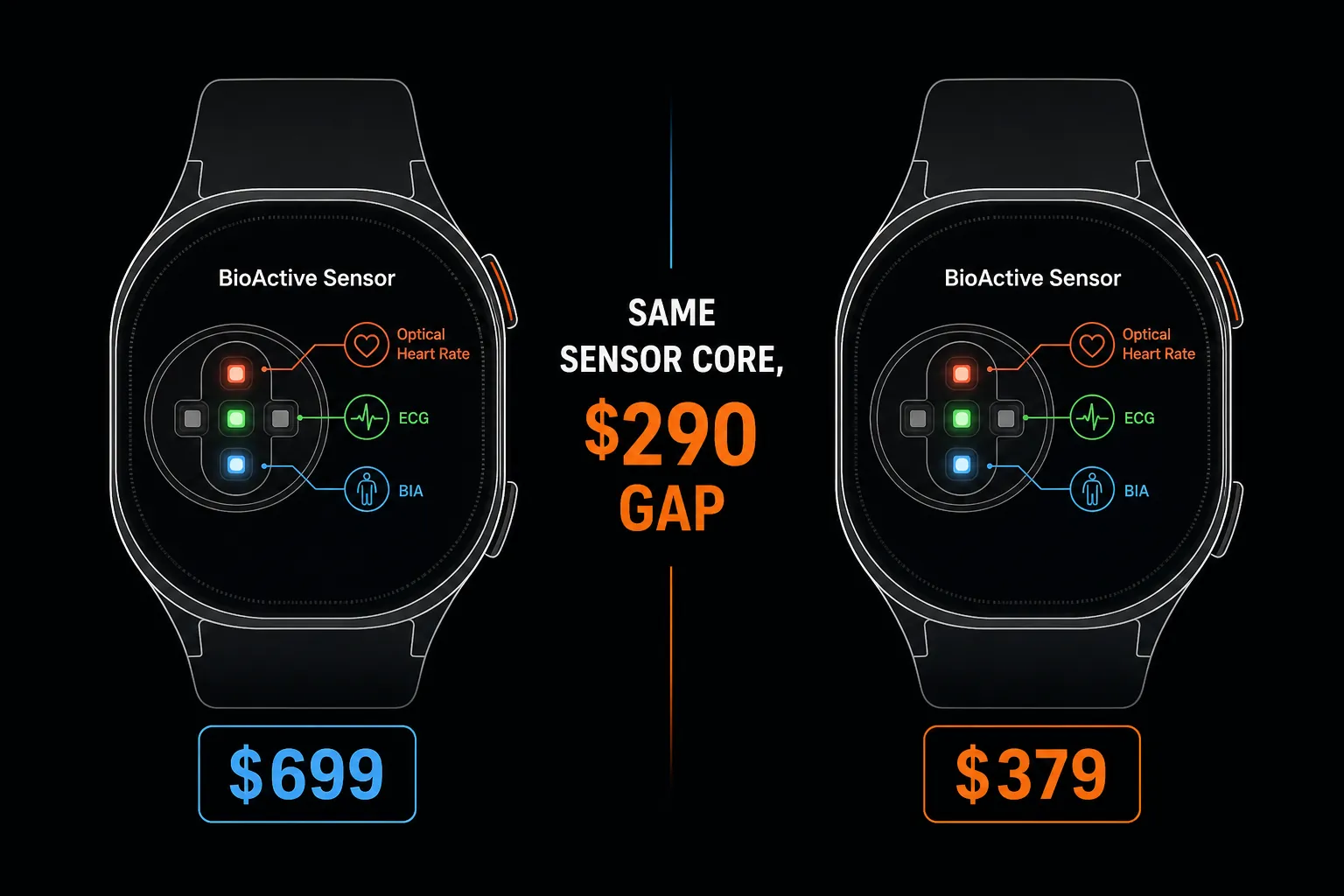
The Galaxy Watch Ultra 2 asks a home-gym buyer to pay $699 for a watch that looks ready for trail races, bright sun, rough weekends, and diving. The Galaxy Watch 9 starts at $379 to $409 and carries the same core fitness-tracking hardware: Samsung’s BioActive sensor array, optical heart-rate sensor, ECG, BIA body-composition sensor, dual-frequency L1+L5 GPS, and Snapdragon Wear Elite processor.[1] For treadmill intervals, dumbbell circuits, indoor cycling, and HIIT, that shared core matters more than the Ultra 2’s tougher case.
That makes the fitness-tracking comparison less dramatic than Samsung’s product lineup suggests. If the question is “which one is the more capable outdoor watch,” the Ultra 2 has real answers. If the question is “which one tracks my indoor workouts better,” the evidence points to practical equivalence, with one important caveat: independent Watch 9-specific fitness accuracy testing is not available yet because the watch was announced on June 22, 2026, ahead of general sale on August 7, 2026.[1]
| What matters for indoor training | Galaxy Watch Ultra 2 | Galaxy Watch 9 | Home-gym judgment |
|---|---|---|---|
| Starting price | $699 | $379–$409 | Watch 9 leaves $290–$320 for equipment |
| Core health sensor | Samsung BioActive sensor | Samsung BioActive sensor | No stated tracking hardware advantage for Ultra 2 |
| Heart rate, ECG, BIA | Included | Included | Same core measurements |
| GPS | Dual-frequency L1+L5 | Dual-frequency L1+L5 | Useful outdoors, less central indoors |
| Processor | Snapdragon Wear Elite | Snapdragon Wear Elite | Same platform for health features |
| Battery | 800mAh, up to 60 hours | 445mAh, about 35 hours | Ultra 2 has the strongest home-relevant advantage |
| Display | Up to 5,000 nits | Lower peak brightness | Major outdoor advantage, minor treadmill advantage |
| Build | Titanium, diving-ready, Trail Run mode with GPX routing | Lighter aluminum design | Ultra 2 earns its price only if those features get used |
The tracking core is the same where it counts
Samsung did not reserve the new health software stack for the Ultra 2. Vitals, Heart Health Score, Daily Cardio Load, Fitness Index, Energy Tracking, and Sleep Apnea Detection are available across both watches in the current comparison materials.[1] That matters because these are the features a home user actually sees after a week of training: sleep baselines, cardio-load trends, recovery signals, and workout logs.
The Ultra 2 does not appear to be buying a better heart-rate sensor for indoor use. It buys a bigger battery, a brighter screen, a tougher body, and outdoor/adventure features around that same sensor platform. Those things are not fake upgrades. They are just not the same as better treadmill, strength, cycling, or HIIT tracking.
This is where the price gap becomes hard to ignore. A $290 to $320 difference is not just a line in a spec table. In a small home gym, that can be the budget for resistance bands, a better mat, part of a walking pad, or a meaningful upgrade toward adjustable dumbbells. A watch can describe the workout. Equipment changes the workout.
What the accuracy evidence can and cannot prove yet
The honest version is this: we have Ultra and Ultra 2 test data, and we have hardware parity between the Ultra 2 and Watch 9, but we do not yet have a clean independent Watch 9 fitness lab result. So the Watch 9 accuracy case is an inference from shared sensors, shared processor, shared software features, and Samsung’s published specs, not a direct Watch 9 test result.[1]
That inference is still useful. Wearables do not become more accurate just because the case is titanium. For indoor training, the sensor contact, algorithm behavior, wrist movement, skin perfusion, strap tightness, and workout type usually matter more than whether the watch also has a trail-routing mode.
TechRadar’s Galaxy Watch Ultra 2 review found that the watch’s optical heart-rate readings under-read by up to 20 bpm against a Polar H10 chest strap during the first 10 to 15 minutes of exercise, then converged closer to the strap reading later in the workout.[2] That is not the clean “same as a chest strap” result anyone wants, but it is also not a reason to buy the Ultra 2 over the Watch 9. If both watches use the same relevant sensor generation, the early optical lag is a shared limitation to understand, not an Ultra-exclusive weakness or an Ultra-exclusive advantage.
For a steady indoor bike ride or a long treadmill zone-2 session, convergence after the warmup is usually acceptable. You are looking for trend lines, average effort, cardio load, and whether today’s session was harder than yesterday’s. For short intervals, the limitation matters more. If the watch under-reads at the start of a hard rep, the graph may soften the very spike you cared about.
That is why a chest strap still makes sense for people doing tight heart-rate-zone intervals or testing threshold work. But between these two Samsung watches, the cheaper model is not obviously giving up measurement quality for the indoor workouts most people repeat each week.
Why the first 10 minutes matter in a small gym
A home workout often starts messy. You step onto a treadmill, increase speed too quickly, pause to move a fan, then jump into intervals. Or you start a dumbbell circuit cold, with the watch sliding slightly as your wrist flexes. Optical sensors are most vulnerable when heart rate changes quickly and the watch is moving around on the wrist.
That early under-reading can change how the workout feels on paper. A hard first interval may look moderate. A warmup ramp may appear flatter than it was. If you train by perceived effort and use the watch mainly for post-workout trends, that is tolerable. If you stare at the number mid-interval and adjust speed based on it, it can mislead you.
The practical fix is not necessarily buying the Ultra 2. It is wearing the watch snugly above the wrist bone, giving the sensor a few minutes to settle, and treating fast-changing interval HR as approximate unless you pair a chest strap. The Ultra 2’s price does not erase the basic physics of optical heart-rate tracking.
The Watch 9 may even be easier to live with during jumpy workouts
The Watch 9 is much lighter than the Ultra 2. The 44mm Watch 9 is listed at 34g, while the Ultra 2 is listed at 61.5g.[1] That difference is not just comfort trivia if your workouts include burpees, kettlebell swings, pushups, mountain climbers, or dumbbell complexes.
A heavier watch can shift more during aggressive wrist movement, especially if the strap is not tight. Movement artifact is one of the things that makes optical heart-rate data noisy. The research materials do not prove the Watch 9 is more accurate than the Ultra 2 in HIIT, so it would be wrong to claim that. But it is fair to say the Ultra 2’s bigger, heavier build is not an obvious indoor tracking advantage.
For strength work, neither watch should be expected to understand the quality of a set the way a coach would. It can log duration, heart-rate response, calories estimated from sensor data, and trends over time. It cannot tell whether the last two reps of a goblet squat were shallow, whether your hinge changed during swings, or whether the workout was productive because you added five pounds to each dumbbell.
GPS is strong evidence for the sensor generation, but not the indoor deciding factor
Android Central’s 2024 Galaxy Watch Ultra fitness test found strong outdoor GPS performance from the same sensor generation: one run measured 3.11 miles against 3.11 miles on a Garmin, and another measured 5.04 miles against 5.01 miles, an error under 0.6% in those examples.[3] The same test reported steady-run heart-rate averages within 1 bpm of a COROS heart-rate monitor.[3]
That is encouraging if you also run outside. It suggests Samsung’s dual-frequency GPS hardware can hold its own in conditions where GPS matters. But it should not take over the buying decision for a treadmill user. GPS does not make a dumbbell circuit better. It does not measure indoor cycling distance from a spin bike. It does not solve optical HR lag during the first hard interval.
The Ultra 2 adds Trail Run mode with GPX routing, a brighter 5,000-nit display, diving readiness, and a titanium build.[1] Those are exactly the kind of features that should cost more. They are also exactly the kind of features many apartment and garage-gym users will pay for and never touch.
Battery is the Ultra 2’s best argument for home users
The Ultra 2 has an 800mAh battery, compared with 445mAh on the Watch 9, and is rated for up to 60 hours instead of roughly 35 hours.[1] That is the one Ultra 2 advantage that can matter indoors even if you never hike, dive, or run a trail.
The reason is not that a longer battery makes a single workout more accurate. It is that health features get better when the watch is actually on your wrist. Sleep tracking feeds baseline-style features such as Vitals and Daily Cardio Load, and those features need multiple nights of sleep data to become useful.[1] If you forget to charge a watch, leave it dead on a desk, and miss half your nights, the software has less to work with.
For someone who hates nightly charging, the Ultra 2’s battery can be worth real money. It makes continuous wear easier. It reduces the number of moments where you have to choose between charging during sleep or charging during the workout window. That is not a glamorous advantage, but it is a practical one.
For someone who already charges a watch while showering, working at a desk, or cleaning up after a workout, the battery gap shrinks. A home-gym user is usually close to a charger. The Ultra 2 still wins battery life; it just may not change the training outcome.
Body composition is shared, but do not buy either watch for one-off body-fat precision
Both watches include Samsung’s BIA body-composition feature through the shared BioActive sensor array.[1] It is useful enough as a trend tool if you measure under consistent conditions: same time of day, similar hydration, similar posture, and the same arm position. It is not a lab-grade body-fat answer strapped to your wrist.
TechRadar reported body-fat readings that varied from 9% to 19% depending on hydration and arm position during its Ultra 2 testing.[2] That range is too wide to treat a single reading as truth. If the number drops over months while your waist measurement, training log, and scale trend move in the same direction, it may be useful context. If it changes overnight, it may be hydration and measurement setup.
This is not a Watch 9 knock or an Ultra 2 knock. It is a reminder that shared sensors also mean shared limits. Paying more does not turn BIA into a DEXA scan.
What the extra $290 to $320 actually buys
The Ultra 2 earns its higher price when the buyer uses what makes it Ultra: the 60-hour battery, the 5,000-nit display, the titanium build, diving readiness, Trail Run mode, and GPX routing.[1] A runner who spends weekends outside, travels without reliable charging, wants the brightest possible screen, and beats up gear may reasonably choose it.
For an indoor-focused buyer, those advantages mostly sit outside the workout. The treadmill has no need for GPX. The indoor bike does not care about titanium. A 5,000-nit display is less compelling under ceiling lights than it is in harsh sun. Diving readiness is impressive, but it does not improve a dumbbell circuit.
The Watch 9 leaves money available for changes that are easier to feel: heavier adjustable dumbbells, a better resistance-band set, a walking pad, a foldable bench, a fan that makes summer training tolerable, or a chest strap if interval HR accuracy is truly important. Those are not as sleek as a titanium watch case, but they can make the next 100 workouts better.
A small verification note before buying
There is one minor spec wrinkle worth checking at purchase time: Samsung’s official site lists the Watch 9 at Bluetooth 5.3, while leaked specs had suggested 6.0.[4] That does not change the fitness-tracking comparison unless a buyer has a specific accessory requirement, but it is the kind of detail worth verifying on the final retail page.
The practical verdict
For home-gym and indoor workouts, the Galaxy Watch 9 is the smarter buy. It tracks the same core fitness data with the same main sensor stack and the same new Samsung health software features, while costing $290 to $320 less than the Galaxy Watch Ultra 2.[1]
That does not make the Ultra 2 overpriced for everyone. It is the better fit for buyers who will use the outdoor-rated durability, longer battery, brighter display, trail routing, or diving-ready build. It is also the easier recommendation for someone who routinely forgets to charge and wants the best chance of uninterrupted sleep and recovery tracking.
But if the watch will mostly sit on your wrist while you run on a treadmill, ride indoors, lift dumbbells, or do HIIT in a small room, the Ultra 2 does not currently show a fitness-tracking advantage that justifies the extra money. Buy the Watch 9, wear it consistently, understand the limits of optical HR and BIA, and spend the savings on something that changes the workout itself.
References
- Samsung Galaxy Watch Ultra 2 vs. Galaxy Watch 9: It's an easy choice, Android Central, 2026.
- Samsung Galaxy Watch Ultra 2 review, TechRadar, 2026.
- The Galaxy Watch Ultra (mostly) lives up to Samsung's lofty fitness promises, Android Central, 2024.
- Samsung official comparison page, Samsung.
Where this fits
Spot a spec or price issue?
Prices, specs, and safety notes change. If something here looks out of date, sign in or create a free account to flag it, or reach us via the About page.