
How to Stay Bear-Safe During Your Outdoor Fitness Routine
Hiking and trail running in bear country carry unique risks—moving faster and quieter increases the chance of surprising a bear. This article adapts bear safety protocols for outdoor fitness, covering timing, noise, gear, group size, and species-specific response plans so you can train safely on the trails.
- Budget tier
- $0-100
- Space type
- apartment
The first bear-safety adjustment for outdoor fitness is the one most runners least want to hear: the National Park Service says trail running in bear country is “highly discouraged” because running increases the chance of surprising a bear.[1] That warning is not written for dramatic effect. It goes straight at the thing that makes trail running, speed hiking, and rucking useful as training: efficient movement through terrain.
A slow hiking group talks, stops, clusters, and gives wildlife more time to hear and avoid them. A fit runner or fast hiker can move quietly around bends, over soft dirt, through brush, and into noisy water crossings before a bear has sorted out what is coming. The workout may feel controlled to the athlete. To a bear feeding, traveling, resting, or guarding cubs, it can arrive as a surprise.
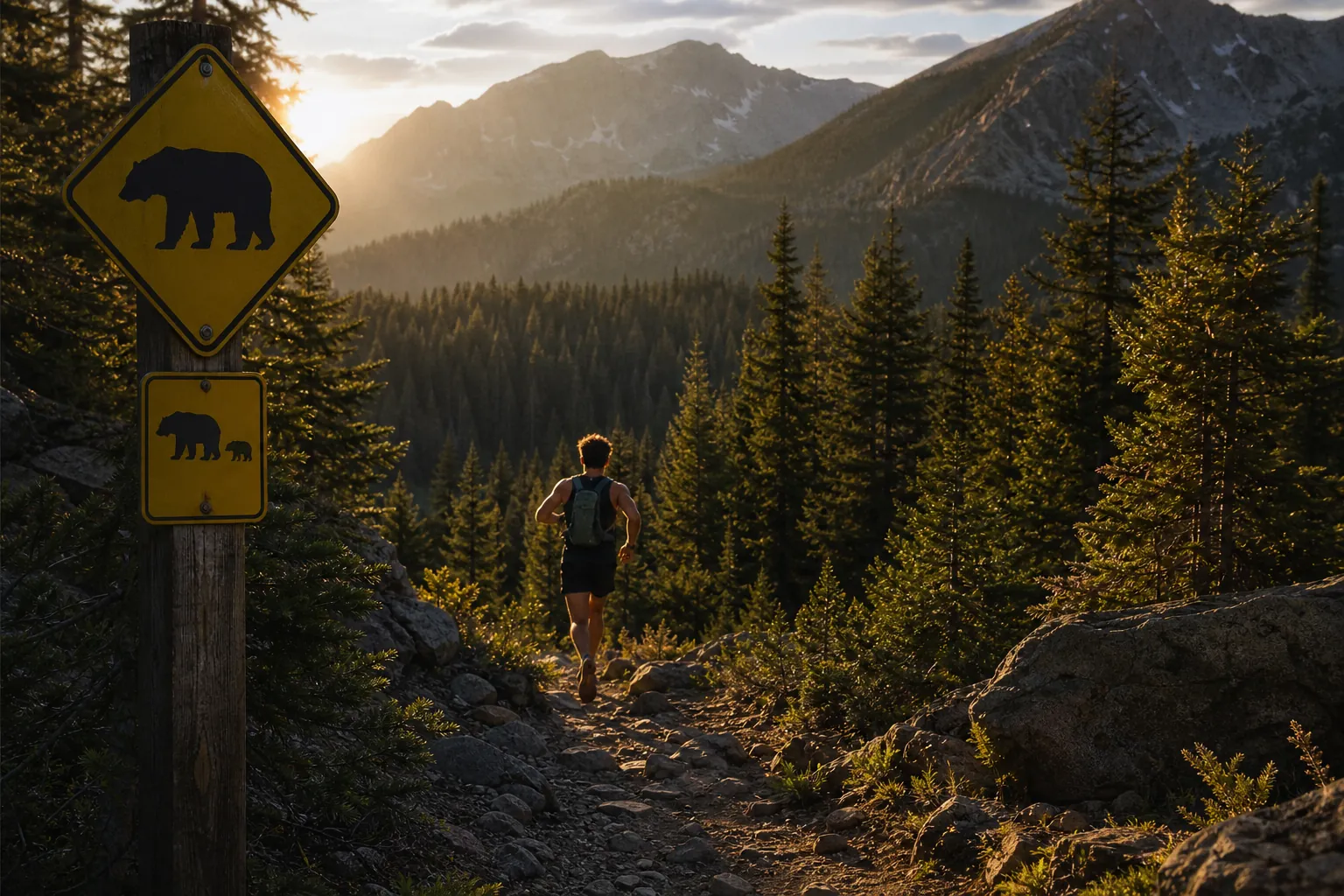
That does not mean every workout in bear country has to be canceled. It does mean the routine has to change before the trailhead, not after fresh scat appears in the tread. The practical question is not whether a runner can carry one piece of gear and keep the same habits. It is whether the workout can be adjusted enough that the bear is less likely to be startled and the athlete is less likely to improvise under stress.
Fast, Quiet Movement Is the Core Problem
Bear safety advice often assumes a backpacking pace: steady walking, full packs, trekking poles, and several people moving together. Outdoor fitness changes those assumptions. A runner covers more ground in the same time window, reaches blind corners sooner, and is often working hard enough that attention narrows to footing, breathing, watch pace, or the next climb.
The NPS tells visitors to be especially alert near noisy streams, dense vegetation, blind curves, and places where a bear may not detect people until they are close.[2] Those are exactly the features that can make a trail good training: rolling singletrack, shaded corridors, creekside climbs, switchbacks, and technical descents. A workout plan that ignores those features is not really a bear-country plan.
The first route edit is simple: identify the parts of the route where your normal training rhythm is the wrong rhythm. A fast downhill into brush, a tempo segment along loud water, or a ruck interval through berry patches is where pace discipline should give way to awareness. Slow before the corner, announce yourself before the sound barrier, and look farther ahead than the next foot placement.
Recent reports are part of the route choice, too. Backpacker reported that bear reports nearly doubled on the Appalachian Trail in 2025, a reminder that familiar trails do not carry the same risk profile every season or every week.[3] That does not turn one region’s report into a national trend. It does make the trailhead board, land-manager alerts, and local closures part of the workout screen, not background reading.
Make Noise That Actually Reaches the Bear
Noise is not a vibe; it is a delivery system. The point is to give a bear enough notice to move away before you are close. The NPS advises making noise by talking, singing, or clapping, especially where visibility is poor or natural sound may mask your approach.[2]
This matters more for runners than for casual hikers because passive noise can disappear inside speed and terrain. Bear bells are often treated like a permission slip, but Parks Canada research cited by the NPS found that bear bells were not effective at alerting bears, while the human voice was more effective.[2] A bell bouncing on a hydration vest is not the same as a clear human sound projected before a blind turn.
For training, the fix is not to chatter nonstop until the workout becomes miserable. It is to build noise into the sections that need it. Call out before bends. Clap before entering brush. Speak when approaching loud water, anything that looks like a carcass, berry patches, or limited sightlines. If you are doing hill repeats or intervals, make the first repetition a scan of the terrain rather than a blind launch.
- Keep both ears available; if you use headphones, leave them out in bear habitat or use a setting that does not mask trail sound.
- Use your voice before the terrain changes, not after you are already in the tight section.
- Treat water noise, wind, and thick vegetation as reasons to slow and announce yourself.
- Do not let a bell, watch alert, or trekking pole tap replace deliberate human sound.
This is where fitness ego can get expensive. A clean split through a blind corridor is not more disciplined than backing off the pace for thirty seconds. The disciplined choice is the one that matches the environment.
Use Timing and Route Conditions as Filters
Outdoor fitness often gets squeezed into dawn, dusk, lunch breaks, and shoulder-season windows. Those may be the only times a runner has, but in bear country they are not equal. The NPS advises being particularly cautious at dawn, dusk, and night, when bears may be more active.[1] If the route already includes poor sightlines, berry growth, recent bear reports, or loud water, stacking it with low-light timing is a choice, not a neutral scheduling detail.
The better adjustment is to separate workout goal from favorite route. Tempo does not require the brushiest trail. Weighted hiking does not require the drainage with the freshest sign. If the day’s conditions are wrong, move the intensity to a more open route, a busier trail, a road-to-trail connector, or a climb with longer sightlines. Save the wilder loop for a time when visibility, group size, and local reports line up better.
| Condition | Routine adjustment |
|---|---|
| Fresh bear sign, active reports, or posted warnings | Change route, go with others, or move the workout to a lower-risk area |
| Dawn, dusk, or night | Favor open sightlines and avoid fast solo movement through dense cover |
| Noisy water, wind, or thick vegetation | Slow down, call out, clap, and shorten the time spent moving silently |
| Intervals, descents, or hard efforts | Place them where visibility is better and reaction time is longer |
For ruckers, the added load can create a different problem: slower reaction and clumsier access. A heavy pack may make you feel more backcountry-ready, but it can also bury bear spray, restrict rotation, and make a quick stop less graceful. Before choosing a weighted route in bear country, check whether the load helps the objective or just makes the response plan harder.
Carry Bear Spray Like Emergency Equipment, Not Like a Good Intention
Bear spray belongs where your hand can reach it while you are moving, startled, breathing hard, and wearing the exact vest, belt, or pack you plan to use. In a surprise encounter, a canister inside the main compartment of a hydration pack is closer to wishful thinking than preparedness.
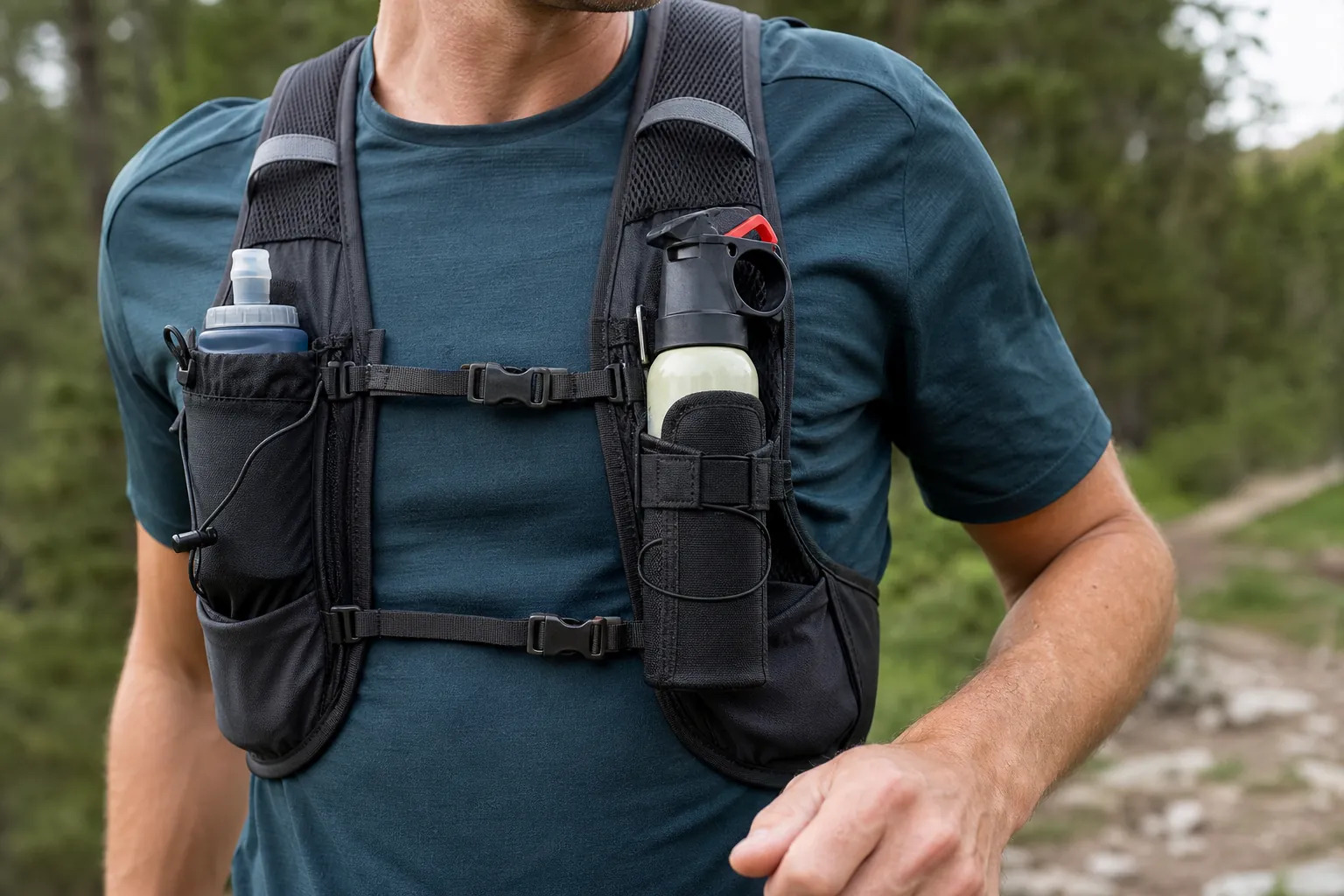
The common “98 percent effective” bear-spray line needs careful handling. Outside Online’s 2019 discussion of the Smith et al. bear-spray research notes the distinction Tom Smith has emphasized: the study found spray stopped undesirable bear behavior in 92 percent of cases, while 98 percent of people who used spray were uninjured.[4] Those are not the same claim. One measures the bear’s behavior; the other measures injury outcome for users.
That distinction should make a runner more serious about spray, not less. Bear spray is not a magic shield around your body. Wind, distance, timing, access, and panic all matter. It has to be carried where it can be drawn instantly, and the user has to know how the safety clip, grip, and spray direction work before the day it matters.
- Carry spray on the front of the body, not in a pack pocket behind you.
- Practice drawing it with gloves, cold hands, and your normal running or rucking setup.
- Check the expiration date and local rules before traveling.
- Do not bury it under a jacket after the temperature drops.
- Pair spray with earlier noise and route decisions; do not use it as an excuse to move silently.
Runner-specific advice from Trail Runner Magazine also puts bear spray and awareness in the practical category rather than the symbolic one: know the area, make noise, avoid surprising bears, and keep deterrent accessible.[5] None of that is glamorous. That is why it is useful.
Group Size Helps, but It Is Not Always the Whole Answer
Solo training is often the reality: work starts early, childcare ends late, and the only open hour may not match anyone else’s schedule. Still, group size changes the risk calculation. REI notes that hiking in a group of four or more reduces the likelihood of a bear attack.[6]
That does not mean every three-mile weekday run has to become a club event. It does mean the higher-risk variables should push the decision toward company: recent bear activity, low light, dense cover, salmon streams, berry season, remote trailheads, or a route where bailing out is difficult. A group is louder, more visible, and less likely to move like a single quiet animal through the woods.
Groups only help if they behave like groups. Four runners stretched over a half mile are not functioning as one unit. If the reason for grouping up is bear safety, regroup before blind sections, keep conversation audible, and do not let the fastest person turn every descent into a solo effort.
Dogs Change the Decision More Than Many Owners Want to Admit
A dog can make a trail feel less lonely, but it can also expand the encounter before the human understands what is happening. The NPS tells visitors to keep pets leashed where pets are allowed, and many bear-country areas restrict or prohibit dogs altogether.[1] University of Calgary researchers have reported that dogs were involved in 50 percent of the bear attacks they studied. For runners, that risk is not just etiquette. A dog moving ahead, ranging into brush, barking, or returning in alarm can pull the bear encounter back to the person attached to the leash.
The useful discomfort is this: if the route is risky enough that you are already debating spray access, timing, visibility, and recent reports, adding a dog rarely simplifies the situation. On some days the safer training choice is to leave the dog home, choose a non-bear-country route, or trade the run for a controlled walk where the leash stays short and attention stays high.
Know the Bear Response Before You Need It
The encounter plan starts before species identification. If you see a bear at distance, stop running. Do not close the gap for a photo, a split, or curiosity. Speak calmly, make yourself known, back away slowly if you can, and give the bear room. The NPS advises never approaching bears and never running from them.[1]
The response becomes more specific if the encounter escalates. NPS guidance distinguishes between black bears and brown or grizzly bears. If a brown or grizzly bear attacks defensively, the guidance is to play dead; if a black bear attacks, do not play dead and fight back. If any bear attacks in a predatory manner, fight back.[1] Those distinctions are not trivia. They are the reason a runner should know the local bear species before the workout starts.
A runner who trains across regions has to reset the plan. Black bear country in the Appalachians is not the same response environment as grizzly habitat in the Northern Rockies or Alaska. Local land managers, park pages, and trailhead notices are not paperwork; they tell you which playbook you are carrying into the trees.
Karen Williams’s iRunFar account of running in bear country is useful because it treats bear safety as part of the run itself, not as an abstract wilderness lecture. The runner-specific details are the ones that matter under load: stay alert, make noise, avoid surprise, and think through what you will do before the bear is close.[7]
A Practical Encounter Sequence
- Stop running as soon as you identify a bear or credible fresh sign close to the trail.
- Speak in a calm, human voice and avoid sudden movement.
- Create distance if the bear is not approaching, backing away without turning and running.
- Bring bear spray into your hand if the bear is close or closing distance.
- Use the species-specific response plan if contact occurs, following local bear-country guidance.
The sequence is intentionally plain. Under stress, complicated plans fall apart first. The best routine is one you have already rehearsed while wearing the kit you actually train in.
Redesign the Workout, Not Just the Gear List
A bear-aware outdoor fitness routine still looks like training. It may include climbs, mileage, load, intensity, and progression. What changes is the assumption that efficiency is always the goal. In bear country, the best workout may include deliberate noise, slower movement through blind terrain, a different start time, a more open route, a partner, or a decision to move the hard session somewhere else.
Before a run, speed hike, or ruck in bear habitat, the useful check is short: What has been reported recently? Where will sound and sightlines fail? Is bear spray instantly reachable? Which bear species live here? Is this a dog day, a group day, a route-change day, or a no-go day?
Outdoor fitness in bear country is not made safe by bravado or by one canister clipped somewhere on the body. It becomes more defensible when the workout moves through habitat differently: louder where it needs to be louder, slower where surprise is likely, better timed, better equipped, and rehearsed well enough that the athlete is not inventing the plan in front of a bear.
References
- Staying Safe Around Bears, National Park Service
- Hiking in Bear Country, National Park Service
- Bear Reports Nearly Doubled on the Appalachian Trail in 2025, Backpacker
- Does Bear Spray Work?, Outside Online, 2019
- 6 Bear Safety Tips for Trail Runners, Trail Runner Magazine
- Backpacking & Camping in Bear Country, REI
- Running With The Bears, iRunFar
Routines for this build
Spot a pricing or availability issue?
Equipment pricing and availability shift on real sales cycles. If something on this page looks out of date, let us know so we can verify and correct it.
Sign in or create a free account to attach your name to a correction, or reach us directly via the About page.