
Home Gym Flooring on a Budget: Best Options Under $3 per Square Foot
This guide helps budget-conscious home gym builders (50–400 sq ft) understand the real cost and tradeoffs of flooring under $3/sqft, including hidden expenses like adhesive, tape, and freight that other guides omit.
Trust check
This pick is scored against a public rubric, not affiliate revenue. Read the methodology, or check the safety & recall status of items in this build.
I have a question for you: how much does a sheet of paper cost?
Seems trivial, right? But suppose you print an important contract and the ink smudges ten seconds later. The paper cost became irrelevant the moment you had to reprint. That is exactly the trap with budget home gym flooring. The cheapest option per square foot looks like a steal until you drop a 32 kg kettlebell on it and the mat holds a permanent crater. Suddenly the $1.12 you saved feels like a bad joke.
The $1.12 Foam Trap
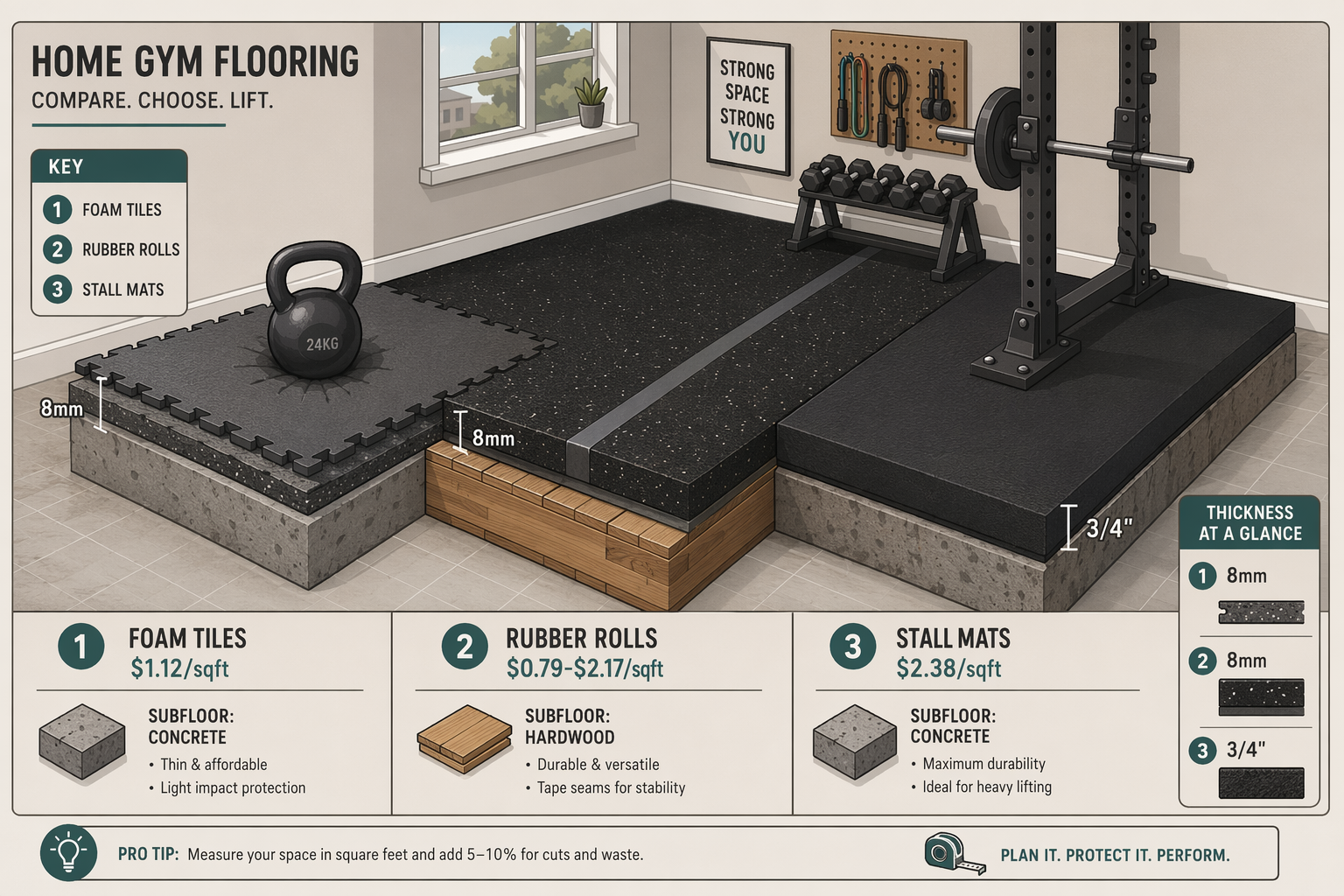
Let me start with the most common budget choice: the ProsourceFit Puzzle Exercise Mat. At $1.12 per square foot, it is the cheapest thing most people find when they search for home gym flooring. Foam tiles under $2 are everywhere, and they are easy to carry, cut with scissors, and snap together in twenty minutes. I will admit – for a yoga room or a kid's play area, they are fine.
But watch what happens when you actually use them for a home gym. A Garage Gym Reviews tester set a 15 kg kettlebell and then a 32 kg kettlebell on the foam mat. Both left permanent imprints. Not temporary dings – permanent compression of the foam cells. That means after a few weeks of deadlifts, kettlebell swings, or even heavy dumbbell work, your floor looks like a lunar landscape. And if you ever try to rearrange the mats, those craters stay. You can replace the affected tiles, but now you are buying more foam, and the cost per year starts climbing.
Now, if you only do bodyweight circuits, light cardio, or stretching, that $1.12 foam is still a legit option. But the moment you add any weight over 10 kg, you need to rethink. The indentation evidence is not a defect – it is a physical limit of the material. Foam compresses under sustained point loads, and it does not bounce back.
Horse Stall Mats: The Honest Budget Choice
If foam doesn't work, the natural next answer is rubber. The most famous budget rubber is the horse stall mat from Tractor Supply. At $56.99 for a 4x6 ft mat, that works out to $2.38 per square foot. From a durability standpoint, this is the best value in the game. Garage Gym Reviews founder Cooper Mitchell called it "the absolute best value that's available." I agree with him – for weightlifters who can handle the logistics.
Here is what the per-square-foot price does not tell you: each mat weighs 94 lbs. To cover a modest 100 sq ft gym, you need five mats. That is 470 lbs of rubber that you have to transport, carry into your space, and install. Unless you own a pickup truck and have a buddy, you are looking at freight charges that can add $50 to $100 to the total. And the initial rubber odor – it is real. It fades in a week or two, but in a spare bedroom or garage, that first week is unpleasant. I've lived through it; it's manageable but don't pretend it doesn't exist.
There is also a practical squeeze: if your space is exactly 4x6 ft multiples, great. If you have an odd-shaped corner, you have to cut the mat with a utility knife – doable, but not as easy as foam. And because the mat is thick and dense, taping the seams is not optional; you need double-sided carpet tape or seam sealer to prevent the mats from shifting. That is another $20–$60 in supplies, depending on how many seams you have. Most guides skip this, but it matters.
Still, for anyone dropping 200+ lb deadlifts or doing kettlebell swings, the stall mat is the honest budget choice. The total upfront cost – mats plus tape plus freight – might be $300 for a 100 sq ft gym, and it will last a decade. Compare that to foam which might need replacement after a year of heavy use. The numbers tilt strongly.
Over Two Years, the Numbers Shift
| Option | Upfront material cost | Installation supplies | Replacement after 1 year | 2-year total | Lifespan |
|---|---|---|---|---|---|
| Foam mats ($1.12/sqft) | $112 | Tape $30 | Yes – $112 | $254 | 1–2 years (light use) / <1 year (weights) |
| Stall mats ($2.38/sqft) | $238 | Tape $40 + freight $50 | No | $328 | 5+ years |
| 8mm rubber rolls ($2.17/sqft) | $217 | Tape $40 + freight $50 | No | $307 | 5+ years |
So here is the real budget conclusion: if you are doing bodyweight and light cardio, the foam works and you can stop reading. But if you are dropping weights, kettlebells, or doing any real lifting, the stall mat or a mid-range rubber roll will cost you less over two years, and your floor won't look like a cratered moon. The cheap stuff only looks cheap on the sticker.
Routines this build supports

12-Week At-Home Bodyweight Workout Plan (No Equipment Needed)
This 12-week bodyweight workout plan provides a progressive structure for beginners to build strength at home without any equipment. Each phase includes clear level-up gates so you know exactly when to advance to harder exercises.
12-Week Postpartum Exercise Plan for Core Recovery & Skin Firmness
This 12-week postpartum exercise routine guides you through a phased progression from pelvic floor reconnection to resistance training, designed to rebuild the muscle beneath loose belly skin while setting realistic expectations about what exercise can achieve.

Why 20-Minute Home Workouts Work for Beginners
A 20-minute home workout for beginners can deliver real fitness gains—when structured for intensity. This article explains the science behind short workouts and provides a complete follow-along routine.
Spotted a stale price or an item that's no longer available? Say so below — this is our correction channel, not just a discussion thread.
Comments
Join the discussion with an anonymous comment.