
A 3-Pillar Home Exercise Plan for Healthy Aging
A three-pillar home exercise plan based on CDC and ACSM guidelines helps older adults maintain strength, balance, and aerobic health using only minimal equipment like resistance bands, a sturdy chair, and walking shoes.
What the evidence says
Only 13.9% of U.S. adults age 65 and older met both the aerobic and muscle-strengthening activity guidelines in 2022. [1] That number is often treated as a motivation problem. I think it is also a translation problem. “Get 150 minutes, lift weights twice a week, and work on balance” sounds simple until someone is standing in a small living room with sore knees, no gym habit, and a well-meaning grown child sending links.
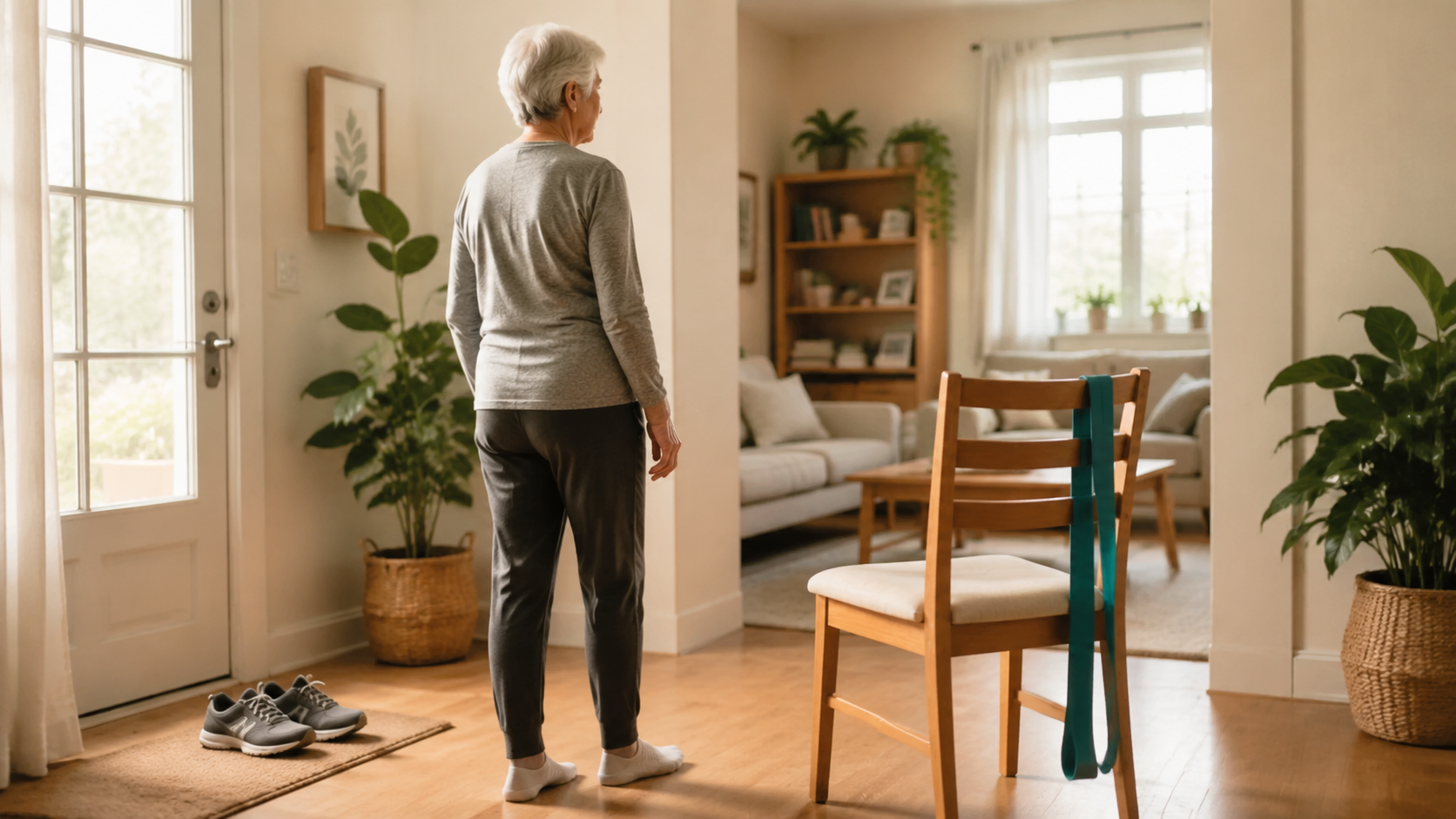
The useful version of exercise tips for healthy aging is not a heroic workout plan. It is a repeatable home routine built from three official pillars: moderate aerobic activity, strength training, and balance work. For many people, the starter equipment is enough: walking shoes, a sturdy chair, and a resistance band.
The Home Version of the CDC and ACSM Plan
The CDC guidance for adults 65 and older calls for at least 150 minutes a week of moderate-intensity aerobic activity, muscle-strengthening activity on at least 2 days a week, and balance activities as part of the weekly routine. [2] The important word for home exercisers is not “at least.” It is “activity.” The plan does not require a weight room, a class schedule, or machines lined up against a wall.
That home interpretation got stronger in 2026. ACSM’s public summary of its updated resistance training guidance says nontraditional resistance training methods, including elastic bands, bodyweight exercise, and home-based routines, can produce marked benefits in strength, muscle size, and physical function. [3] The full ACSM Position Stand is paywalled, so the fair reading here is limited to ACSM’s own public article and infographic, not a line-by-line independent review of the full paper.
| Pillar | Weekly Target | Home Tools | Plain-English Goal |
|---|---|---|---|
| Aerobic movement | 150 minutes of moderate activity | Walking shoes, hallway, sidewalk, walking pad, or treadmill | Breathe a little harder while still able to talk |
| Strength | 2 or more days | Sturdy chair, wall, resistance band, body weight | Practice the muscles used to stand, climb, carry, and steady yourself |
| Balance | Built into the week | Chair back, counter, clear floor space | Reduce wobble during ordinary movements such as turning, reaching, and stepping |
Pillar 1: Aerobic Movement That Actually Fits the Week
Moderate aerobic activity does not have to look athletic. A practical test is whether breathing and heart rate rise, but conversation is still possible. For many older adults, that means walking with purpose, marching gently in place during a TV break, using a walking pad at a comfortable speed, or doing short indoor walking loops when weather, sidewalks, or traffic make outdoor walking unpleasant.
The CDC’s 150-minute weekly target can be divided without making the calendar fussy: 30 minutes on 5 days, 20 to 25 minutes most days, or shorter bouts accumulated through the day. [2] A person who has been inactive does not need to open with 30 minutes. Ten careful minutes after breakfast and another ten after lunch may be a more honest starting point than one ambitious walk that leaves the knees irritated for two days.
- Keep walking shoes by the door so the first step is not hunting for equipment.
- Use a flat route first; hills and uneven pavement are progressions, not requirements.
- If balance is uncertain, walk near a counter, hallway wall, indoor track, or with a suitable assistive device.
- Stop and reassess if chest pain, severe shortness of breath, faintness, or unusual symptoms appear.
For people comparing indoor options, a walking pad vs. treadmill decision should start with safety features, step-on height, hand support, noise, storage, and whether the person will actually use it. A machine that folds neatly but feels rushed underfoot is not a healthy-aging tool.
Pillar 2: Strength Work With a Chair, a Wall, and a Band
Strength training is where many home routines become either too timid or too aggressive. Carrying groceries, rising from a low seat, stepping up a curb, and catching yourself after a small stumble all ask for muscle. The CDC recommends muscle-strengthening activities at least 2 days a week for older adults. [2] ACSM’s 2026 update is reassuring because it does not treat bands, bodyweight movements, and home routines as second-rate substitutions. [3]
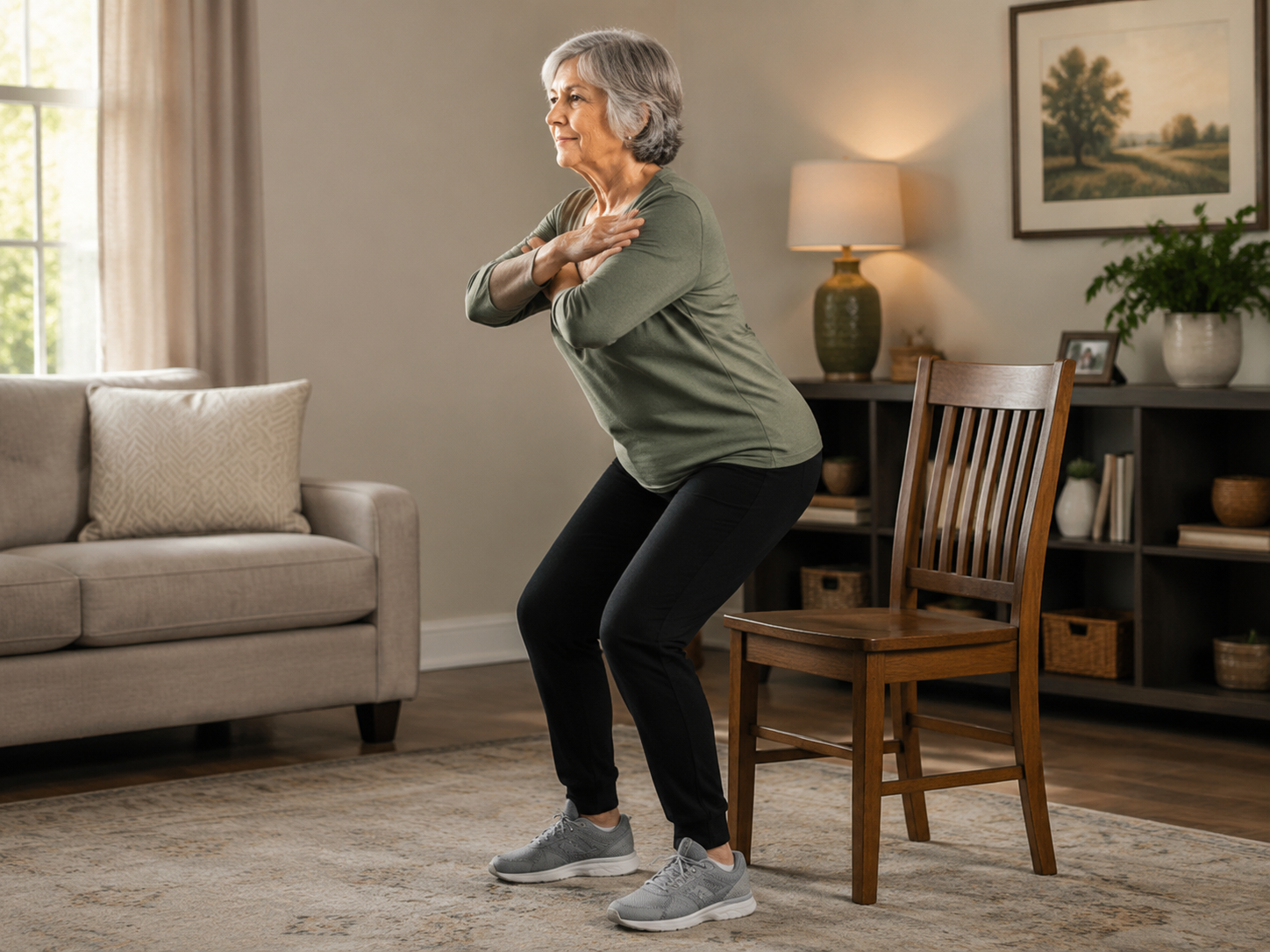
A basic home strength session can be short. Choose a day with no rush, place the chair on a non-slippery surface, and leave enough room to step without catching a rug edge. The first goal is clean movement, not fatigue.
| Exercise | Starting Dose | What to Watch |
|---|---|---|
| Sit-to-stand from a sturdy chair | 10 to 15 repetitions | Feet flat, chair stable, knees tracking comfortably |
| Wall push-up | A comfortable set that leaves 2 to 3 good repetitions in reserve | Hands on wall, body straight, no shoulder pinching |
| Seated or standing band row | A comfortable set with smooth pulling and slow return | Band secured safely, shoulders relaxed |
| Heel raises near a counter or chair | A controlled set, using support as needed | No bouncing, no gripping the chair so hard that posture collapses |
Sit-to-stands deserve their place near the center of the plan because they train a daily task directly. Stanford Medicine describes sit-to-stands as a useful movement for older adults, and ChoosePT includes 10 to 15 repetitions as an example dose in its healthy-aging exercise guidance. [4][5] If standing from a standard chair is too much, use a higher chair, place hands lightly on the chair arms if needed, or practice the first part of the motion under professional guidance.
Wall push-ups are often more useful than floor push-ups for this audience. The wall lets the person adjust difficulty by foot position, keep the neck relaxed, and avoid the awkward problem of getting down to and up from the floor. A resistance band adds pulling work, which the wall push-up does not provide. If the band feels too uncertain, the better answer is not a heavier band; it is a simpler setup.
Readers who want more options after the chair-and-band version is working can look at cable machine alternatives or compact home gym budget builds. But equipment should arrive after the habit is visible, not before. A drawer with one band that gets used twice a week beats a corner full of gear that has become furniture.
Pillar 3: Balance Practice Without Pretending Falls Are Simple
Balance work is not decorative. It is the part of the plan that notices turning too fast, stepping around a laundry basket, reaching into a cabinet, and walking from bedroom to bathroom half-awake. The CDC includes balance activities in its older-adult activity guidance because fall prevention is part of healthy movement, not an optional extra. [2]
Tai chi is one of the better-known examples. US News, citing AAOS, reports that tai chi can reduce fall risk by 47%. [6] That is a meaningful figure, but it should not be turned into a magic promise. Falls have many causes: medications, vision, footwear, household clutter, dizziness, strength loss, and health conditions can all matter. Balance training belongs in the plan because it reduces one part of the risk picture, not because one class or one exercise makes a person fall-proof.
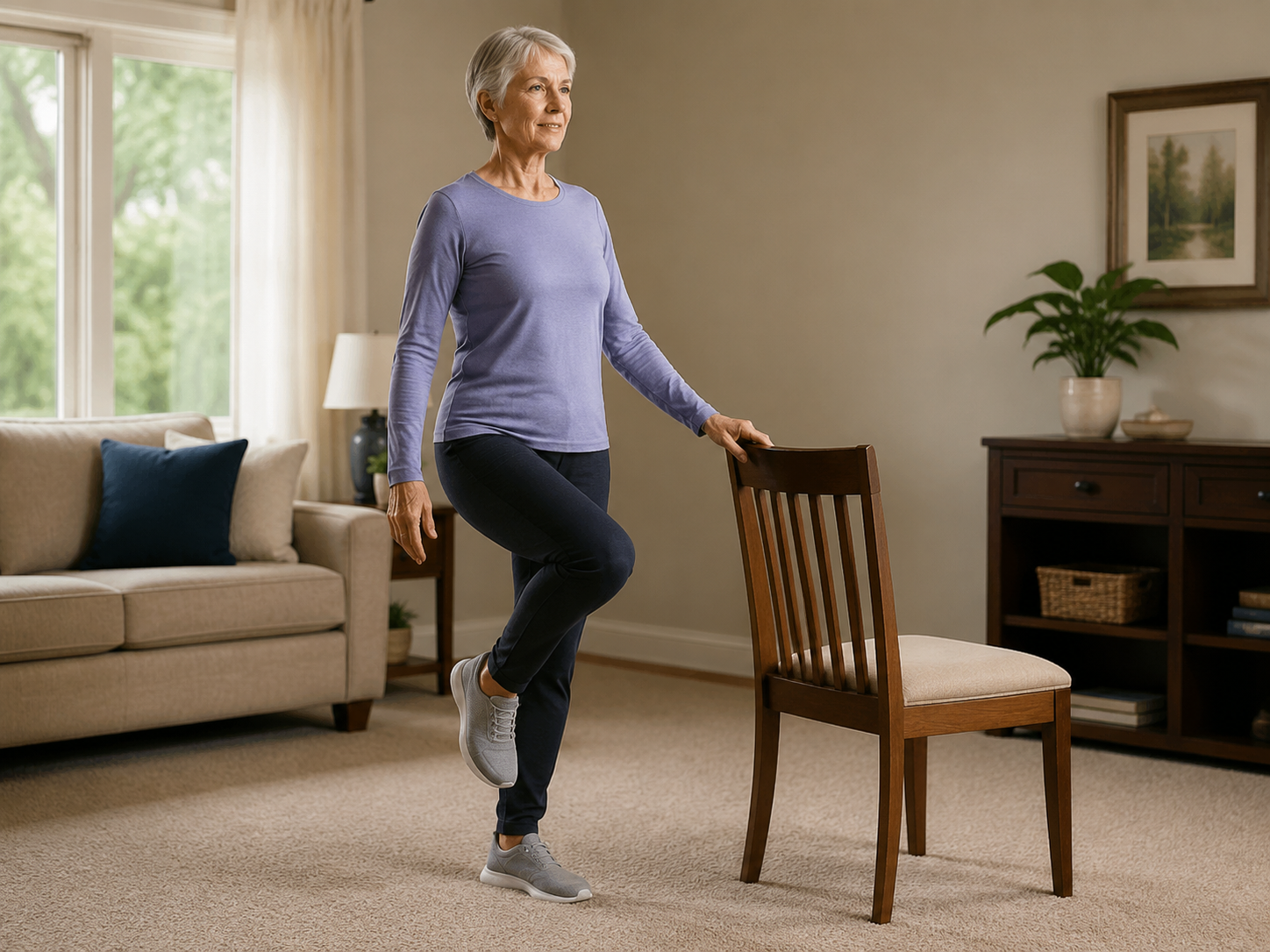
A safe starter movement is the single-leg stand beside a sturdy chair or counter. Lift one foot slightly, keep fingertips on the support if needed, and hold for 10 to 20 seconds. ChoosePT includes single-leg standing for 10 to 20 seconds in its exercise suggestions for healthy aging. [5] The lifted foot does not need to rise high. The point is controlled weight shift, not a dramatic pose.
- Practice near a counter, heavy table, or sturdy chair that will not slide.
- Clear loose rugs, pets, cords, and clutter before beginning.
- Use fingertips for support first; removing support is a progression.
- Do not practice balance when dizzy, rushed, overly tired, or alone if falling is a realistic concern.
How the Three Pillars Can Fit Into One Week
A complete week does not need to feel like a class schedule. The simplest version pairs walking with a few short strength and balance sessions. The details can change with energy, weather, appointments, and mobility level.
| Day | Aerobic | Strength | Balance |
|---|---|---|---|
| Monday | 20 to 30 minutes easy-to-moderate walking | Sit-to-stands, wall push-ups, band rows | Single-leg stands near chair |
| Tuesday | 20 to 30 minutes walking or indoor marching | Rest from strength | Brief supported balance practice |
| Wednesday | Shorter walk if needed | Rest from strength | Heel-to-toe weight shifts near counter |
| Thursday | 20 to 30 minutes walking | Repeat strength session, lighter if sore | Single-leg stands near chair |
| Friday | 20 to 30 minutes walking | Rest from strength | Gentle balance practice during routine tasks |
| Saturday | Optional walk, tai chi, or active household movement | Rest or very light strength practice | Supported balance only if steady |
| Sunday | Easy walk or rest, depending on the week | Rest | Reset the chair, shoes, and band for next week |
This table is a framework, not a prescription. Someone returning after surgery, managing chronic pain, or using a walker may need a physical therapist to adjust the plan. Someone already walking daily may add the missing strength and balance pieces before adding more minutes. The common mistake is piling everything into the first week and then interpreting soreness, fatigue, or fear as proof that exercise is not for them.
Start Smaller Than Your Enthusiasm
The first week should leave a person thinking, “I could do that again.” For an inactive older adult, that may mean 5 to 10 minutes of walking, one careful set of sit-to-stands, and a few supported balance holds. The body learns consistency better when the first dose is repeatable.
Warm-up and cool-down are not formalities. Begin with slower walking, shoulder rolls, ankle circles, or gentle seated marching. End by letting breathing settle. Older adults who have stiff joints, blood pressure concerns, balance uncertainty, or medication-related lightheadedness should not be hurried from the sofa into the hardest part of the routine.
- Increase one thing at a time: minutes, repetitions, band tension, or balance difficulty.
- Keep movements smooth enough that the last repetition still looks like the first.
- Treat sharp pain, new joint swelling, chest pain, faintness, or unusual shortness of breath as stop signs.
- Use a chair or counter before pride gets involved; support is a safety tool, not a failure.
- Ask a doctor or physical therapist before starting if there are existing medical conditions, recent surgery, chronic pain, dizziness, frequent falls, or uncertainty about safe intensity.
Recovery also belongs in the plan. A day without strength training is not wasted if walking, balance practice, sleep, hydration, and ordinary movement continue. For readers who tend to do too much after a good day, a post-workout recovery routine can be as important as the exercises themselves.
A Minimal Setup Is Enough to Begin
The minimum viable setup is modest: shoes that feel secure, a chair that does not wobble, a clear patch of floor, and a light-to-moderate resistance band. Add a timer if it helps. Add music if it makes walking less dull. Add equipment only when it solves a real problem.
Healthy-aging exercise is not one “senior workout.” It is a recurring blend of aerobic movement, strength practice, and balance work, scaled to the person in front of you. The official targets matter, but the living-room translation is what makes them usable: walk often enough to build the weekly minutes, strengthen twice a week with chair-and-band movements, practice balance with support nearby, and get professional guidance when symptoms, medical history, pain, dizziness, recent surgery, or fall risk make the safe starting point unclear.
References
- Trends in Meeting the 2018 Physical Activity Guidelines, 2014-2022, Centers for Disease Control and Prevention
- Physical Activity Guidelines for Older Adults, Centers for Disease Control and Prevention, reviewed Dec. 2025
- Resistance Training Guidelines Update 2026, American College of Sports Medicine, April 2026
- Healthy Habits for Successful Aging in Your 60s and 70s, Stanford Medicine, January 2026
- 7 Exercises to Try Over 50, ChoosePT
- Best and Worst Exercises for Older Adults for Balance, Strength and Longevity, U.S. News & World Report, 2026
Have a question this doesn’t answer?
This page stays within general education and does not diagnose or prescribe. If your question is about a specific injury or symptom, please see a clinician rather than continuing to search this site for an answer.