
How Home Exercise Lowers Stroke Risk – Evidence in Numbers
This article breaks down what the research actually says about how much at-home exercise you need to meaningfully reduce your stroke risk — with specific dose recommendations and the numbers behind them, so you can skip the hype and know what works.
- Evidence source
- ACSM
- Applies to
- general population
What the evidence says
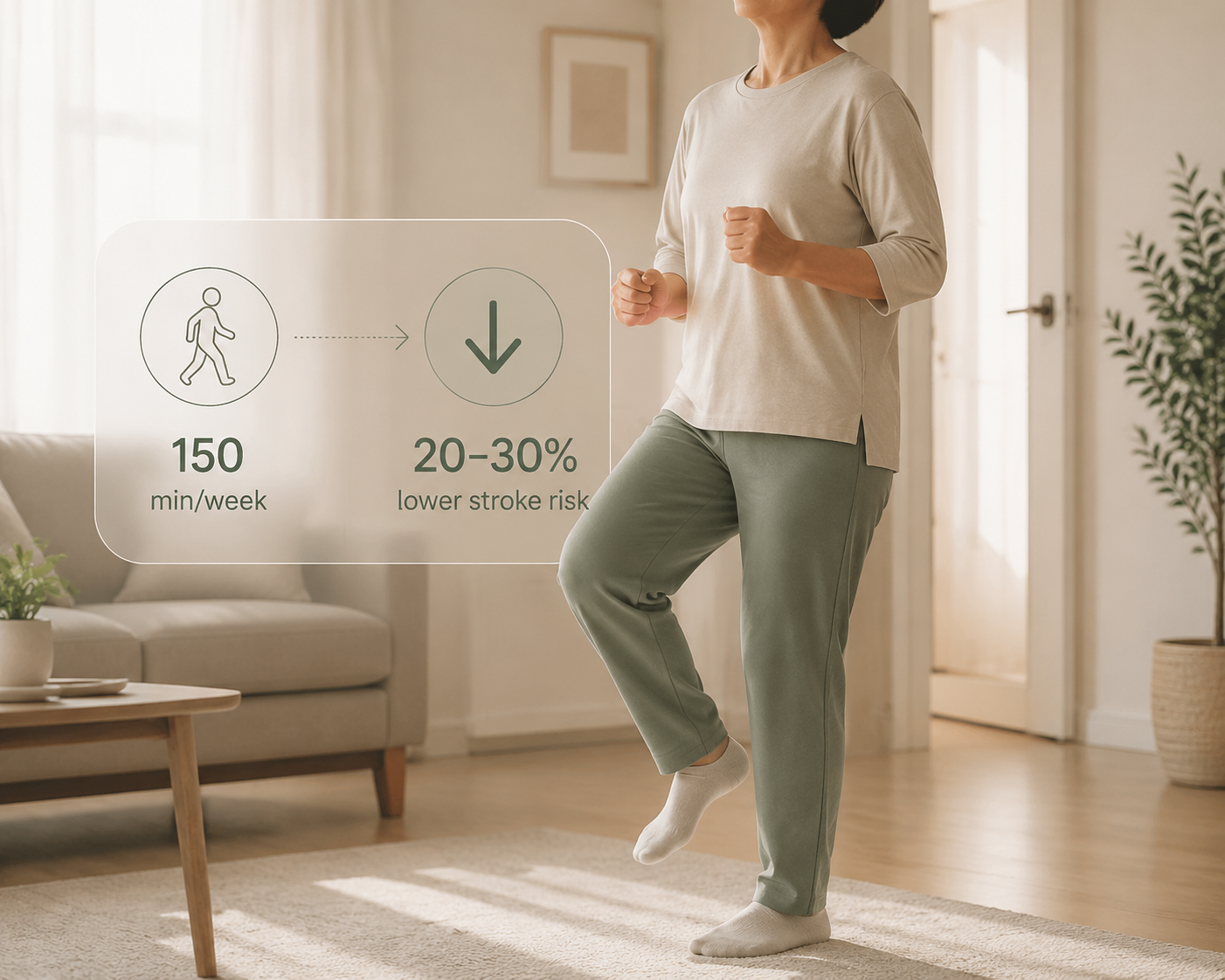
For stroke prevention at home, the most defensible starting number is not a gym challenge or a vague “move more.” It is 150 minutes a week of moderate activity. In plain scheduling terms, that is 30 minutes on 5 days of the week, and the World Stroke Organization describes that dose as being associated with a 25% reduction in stroke risk.[1] The American College of Sports Medicine uses the same weekly baseline for adult aerobic activity: 150 minutes of moderate-intensity aerobic activity, plus resistance training on 2 days per week.[2]
That number is useful because it is small enough to plan and large enough to matter. A 2024 meta-analysis in the Journal of Neurology, Neurosurgery & Psychiatry reported that any leisure-time physical activity was associated with an 18–29% lower stroke risk compared with inactivity.[3] A 2025 BMC Public Health study, using an instrumental-variable analysis of 416,032 adults from Korean Community Health Survey data, found a 16% reduction in first-ever stroke with regular moderate-to-vigorous physical activity.[4] The Korean data should not be read as a personalized prediction for a U.S. adult in 2026, but it points in the same direction as the broader literature: regular activity is consistently associated with meaningfully lower risk.
If you have chest pain, unstable symptoms, known cardiovascular disease, diabetes complications, very high blood pressure, recent neurological symptoms, or a history of stroke or transient ischemic attack, this is a doctor conversation before it is an exercise plan. The numbers here are general prevention evidence, not a substitute for individualized medical advice or post-stroke rehabilitation.
What 150 Minutes Means In A Real Home
Moderate activity does not require a treadmill, a class, or a clear hour. At home, it usually means movement that raises breathing and heart rate while still allowing you to speak in short sentences. For many adults, that can be hallway walking, walking in place, step-touch movements beside a counter, low-impact marching, repeated sit-to-stands from a chair, wall push-ups paired with marching, or a simple bodyweight circuit.
The practical target is accumulation. A 30-minute session is easy to understand, but it is not the only acceptable format. The AHA/ASA scientific statement on stroke prevention describes multiple short bouts, such as three 10-minute sessions across the day, as an alternative to one continuous session.[5] That matters for people who exercise between work calls, caregiving, joint stiffness, medication timing, or apartment noise limits.
| Weekly target | One workable home version | What it protects against |
|---|---|---|
| 150 minutes moderate aerobic activity | 30 minutes, 5 days per week | The main evidence-backed prevention dose |
| 150 minutes split into short bouts | Three 10-minute bouts on active days | Missed long sessions becoming missed weeks |
| 2 days of resistance training | Chair sit-to-stands, wall push-ups, resistance bands, light dumbbells if available | Loss of strength, poor glucose control, and low activity tolerance |
A week can be boring and still count. Monday, Wednesday, Friday, Saturday, and Sunday could each include 10 minutes of walking after breakfast, 10 minutes of chair or standing movements in the afternoon, and 10 minutes of easy marching or hallway laps in the evening. Nothing about that looks dramatic. That is the point. The prevention dose is not reserved for people who train like athletes.
Which Home Exercises Fit The Evidence
The strongest stroke-prevention evidence is usually organized around activity dose and intensity, not around branded workouts. That is good news for a small apartment. If the activity is safe for you, repeated consistently, and intense enough to feel moderate, it belongs in the same practical family as the exercise used in public-health recommendations.
- Walking indoors or outdoors: hallway laps, walking in place, or a neighborhood walk when weather and safety allow.
- Chair-based aerobic work: seated marching, seated arm raises, heel taps, and alternating reaches for people who need a lower-balance option.
- Bodyweight movements: sit-to-stands, wall push-ups, standing hip hinges, step-touch patterns, and gentle squats when tolerated.
- Resistance-band sessions: rows, presses, side steps, and controlled arm or leg movements that add strength work without large equipment.
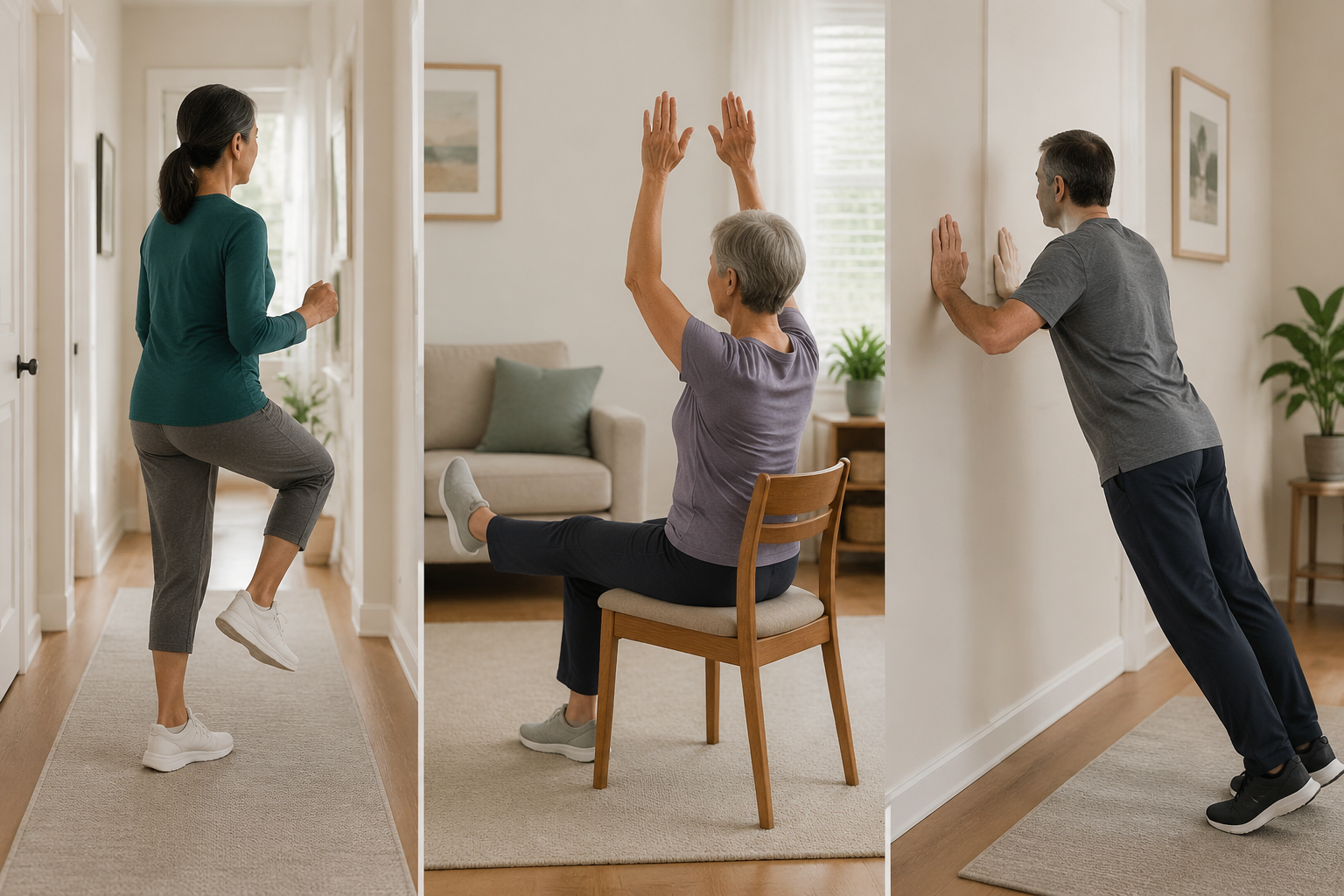
Resistance training is not a separate miracle category for stroke prevention, but it is not a distraction either. The American Heart Association’s 2024 scientific statement describes resistance exercise as safe and effective for cardiovascular health, and ACSM’s baseline adult recommendation includes resistance training on 2 days per week.[7][2] For a home exerciser, that can mean one or two sets of controlled sit-to-stands, wall push-ups, band rows, and supported calf raises. The goal is not to turn prevention into bodybuilding; it is to keep muscle, glucose handling, and daily function from becoming weak links.
Why The Stroke Numbers Are Plausible
Stroke risk is not controlled by exercise alone. Blood pressure, smoking, diabetes, cholesterol, atrial fibrillation, sleep, diet, medications, age, and family history all matter. Still, exercise acts on several pathways that are directly relevant to stroke prevention. A review discussing the INTERSTROKE findings and exercise mechanisms identifies blood pressure reduction, improved glucose regulation, improved endothelial function, and vascular effects including VEGF upregulation as plausible protective mechanisms.[6]
Blood pressure deserves special attention because it is one of the most important modifiable stroke risks. Moderate activity does not need to be heroic to be useful here. A repeatable walking routine can lower the pressure load on blood vessels over time. Better glucose regulation matters for adults with insulin resistance or diabetes risk. Improved endothelial function means the lining of blood vessels behaves more normally, which is relevant because stroke is a vascular event, not just a fitness problem.
These mechanisms do not prove that any one person’s 10-minute walk prevented a stroke. They do explain why the population numbers are believable. When a habit affects blood pressure, glucose handling, vascular function, and physical capacity at the same time, a 20–30% lower observed risk among active adults is not a surprising direction of effect.
The Bigger Prevention Claims Need Careful Reading
Some stroke-prevention numbers are larger than the 20–30% range, and they are worth understanding without letting them distort the weekly target. The World Stroke Organization states that 1 million strokes per year are linked to physical inactivity.[1] The INTERSTROKE-related review reports that five key modifiable risk factors, including physical inactivity, accounted for more than 80% of the global stroke burden, and it also notes that up to 80% of strokes may be preventable.[6] Those are population-level burden statements. They do not mean exercise alone prevents 80% of strokes.
The same restraint applies to higher-end activity claims. Henry Ford Health describes up to a 60% risk reduction with daily 30–60 minutes of moderate activity.[8] That is encouraging, especially for people who can be active most days, but “up to” is doing real work in that sentence. It should not make the 150-minute weekly baseline look weak. A sustainable 150 minutes is a credible prevention target; daily 30–60 minute activity is a more ambitious consistency pattern, not the minimum standard every person must meet before the effort counts.
How To Split The Week Without Losing The Dose
The cleanest plan is 30 minutes on 5 days. The most livable plan may be less tidy. What matters is that the minutes add up, the effort is moderate, and the routine is safe enough to repeat.
- If 30 minutes feels manageable: do one continuous home walk, low-impact video, or mixed walking-and-bodyweight session.
- If fatigue or schedule is the barrier: use three 10-minute bouts, separated across the day.
- If balance is uncertain: start with chair-based marching, seated reaches, supported standing work, or walking near a stable counter.
- If joints complain: reduce impact first, not consistency; slower marching, chair exercise, and shorter bouts can still preserve the habit.
- If you already walk: add 2 simple strength days rather than replacing the walking habit that is already working.
A hypothetical week could look like this: 10 minutes of hallway walking before work, 10 minutes of chair exercises after lunch, and 10 minutes of walking in place while dinner cooks, repeated on 5 days. Two of those days could include a short strength block with sit-to-stands and wall push-ups. The exact exercises can change. The defensible part is the accumulated dose.
What The Evidence Cannot Promise
The research supports a lower average risk among active people; it does not guarantee protection for an individual. A person with atrial fibrillation, uncontrolled hypertension, diabetes, smoking exposure, sleep apnea, or a strong family history may need medication, monitoring, nutrition changes, and clinician-guided targets in addition to exercise. Exercise is part of prevention, not a replacement for medical risk management.
The evidence also comes from different kinds of sources. The World Stroke Organization and ACSM numbers are public-health recommendations. The JNNP figure is from a meta-analysis comparing leisure-time activity with inactivity. The BMC Public Health result is a large contemporary analysis from Korean survey data. The AHA/ASA short-bout guidance remains useful, but it comes from a 2014 scientific statement, so it should be treated as established guidance rather than newly issued advice.[1][2][3][4][5]
For adults who can safely exercise, the doctor-ready takeaway is straightforward: accumulating 150 minutes per week of moderate home-based activity is a credible, evidence-backed stroke-prevention target associated with roughly 20–30% lower stroke risk, and shorter daily bouts are legitimate. Walking, chair exercise, bodyweight movements, and resistance bands are enough to build that dose when they are done consistently and at an appropriate intensity.
References
- Stroke and Exercise, World Stroke Organization
- Physical Activity Guidelines, American College of Sports Medicine
- Leisure-time physical activity and stroke risk: a systematic review and meta-analysis, Journal of Neurology, Neurosurgery & Psychiatry, 2024
- Association between moderate-to-vigorous physical activity and first-ever stroke: an instrumental variable analysis, BMC Public Health, 2025
- Guidelines for the Prevention of Stroke in Patients With Stroke and Transient Ischemic Attack, American Heart Association/American Stroke Association, 2014
- Physical Activity and Stroke Risk: A Review, PMC, 2011
- Resistance Exercise Training in Individuals With and Without Cardiovascular Disease: 2023 Update, American Heart Association, 2024
- How Consistent Exercise Can Help Reduce Your Risk Of Stroke, Henry Ford Health, 2022
Have a question this doesn’t answer?
This page stays within general education and does not diagnose or prescribe. If your question is about a specific injury or symptom, please see a clinician rather than continuing to search this site for an answer.