
How to Exercise Safely During Cancer Treatment
A practical guide to starting safe, equipment-minimal movement during cancer treatment — using the evidence-based '10-minute test' approach, household objects, and clear safety red flags from leading oncology organizations.
- Evidence source
- Penn State ONE Group, American Cancer Society
- Applies to
- people in active cancer treatment
What the evidence says
If you are in cancer treatment and the word exercise makes you feel tired before you even stand up, start smaller than the fitness advice you may have heard. The first goal is not to prove you can meet a weekly target. It is to find out whether a few minutes of light movement are tolerable today.
Penn State’s ONE Group gives one of the most usable starting points: try moving for 10 minutes; if you feel worse, stop and try again tomorrow.[1] That is not a loophole or a watered-down version of exercise during cancer treatment. It is a safer way to begin when your body is already dealing with chemotherapy, radiation, surgery recovery, medications, disrupted sleep, appetite changes, pain, or fear of doing the wrong thing.
This article is general education, not a personal exercise prescription. Your oncology team should set any individual restrictions, especially if you have surgical precautions, bone metastases, severe anemia, infection risk, neuropathy, a central line, balance problems, fever, uncontrolled pain, or symptoms that are new for you.
Before You Move, Know When To Stop
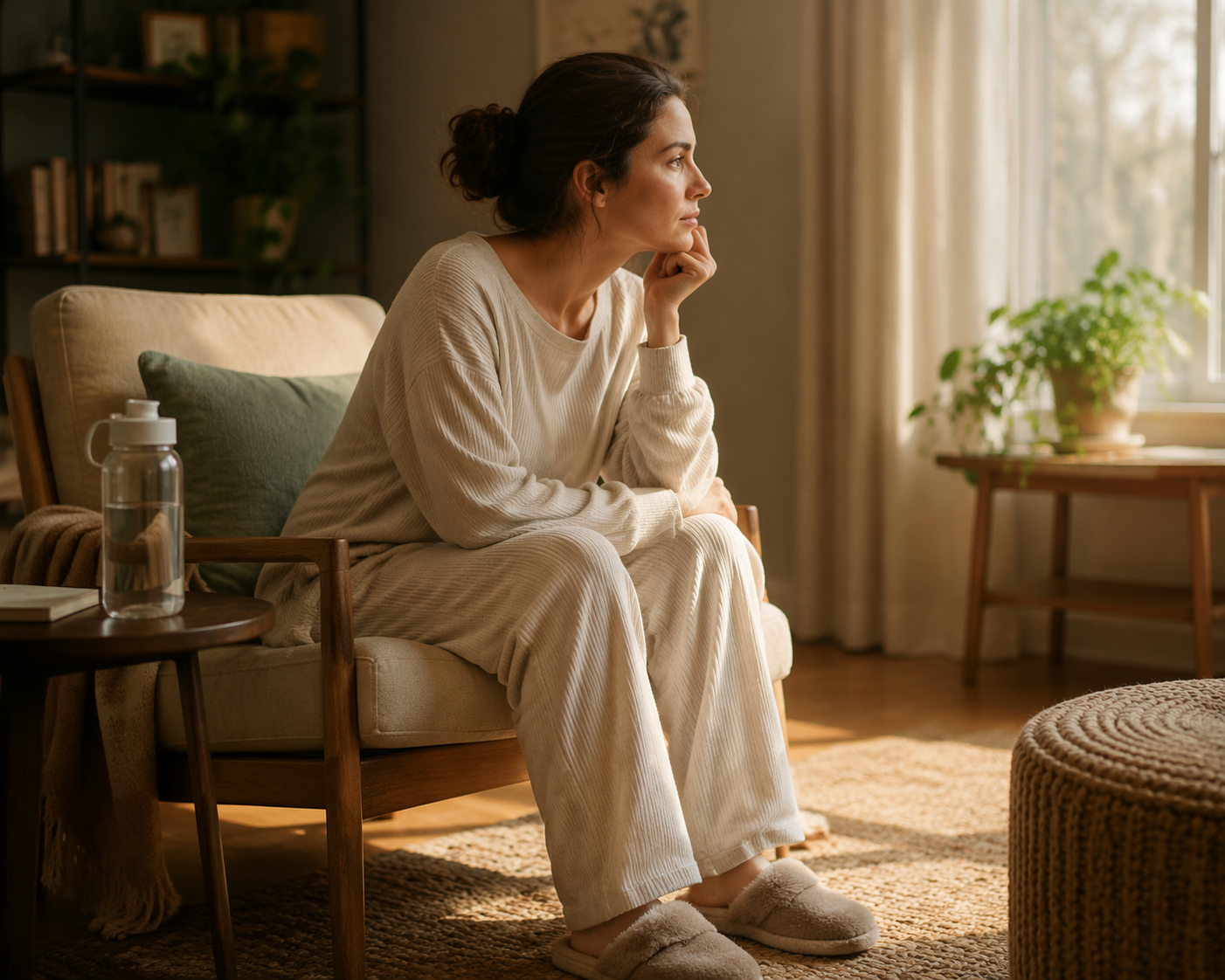
Safety has to come before movement examples. A short home session only helps if you have permission to stop early and get medical guidance when something feels wrong.
The American Cancer Society advises stopping activity and contacting your cancer care team if you have dizziness, new pain, blurred vision, worsening fatigue, fever, or other concerning symptoms.[2] Penn State’s patient guidance also emphasizes starting slowly, checking how you feel, and stopping if exercise makes symptoms worse.[1]
- Stop if you feel dizzy, faint, unusually short of breath, or unsteady.
- Stop if pain is new, sharp, increasing, or different from your usual baseline.
- Stop if your vision blurs, your heart feels irregular, or you feel chest pressure.
- Stop if fatigue gets worse instead of settling after rest.
- Do not start a home movement test if you have a fever or have been told to avoid activity that day.
For caregivers, this is the line that matters: encouragement should not become monitoring for compliance. A useful question is “Do you want company for a 10-minute test?” not “Did you get your exercise done?”
The 10-Minute Test
A 10-minute test is exactly what it sounds like. Pick one light activity. Do it gently for up to 10 minutes. Then notice whether you feel the same, a little better, or worse. If you feel worse, stop for the day and try again tomorrow, unless a red flag means you should contact your care team first.[1]
This is different from pushing through a workout. You are not trying to earn soreness, raise your heart rate as much as possible, or complete a routine because a chart said so. You are testing tolerance.
| What happens during or after the test | What to do next |
|---|---|
| You feel okay or slightly better | Repeat the same light amount another day, or add only a small amount when your care team says that is appropriate. |
| You feel more tired, nauseated, sore, or wiped out | Stop, rest, and try a shorter or easier version tomorrow if no warning signs are present. |
| You notice dizziness, new pain, blurred vision, worsening fatigue, fever, chest symptoms, or unusual shortness of breath | Stop and contact your oncology team or follow the urgent-care instructions they gave you. |
The test can be less than 10 minutes. On a rough day, two or three minutes of walking from room to room may be the honest starting point. The point is to avoid total inactivity without pretending that every treatment day is the same.
What Counts As A 10-Minute Test At Home
You do not need a gym, a machine, or a polished home setup to begin. Memorial Sloan Kettering Cancer Center’s Level 1 program says walking, bodyweight movement, and household items such as cans of food or water bottles can be enough for simple exercise during and after cancer treatment.[3]
For a 10-minute test, choose the option that feels least intimidating, not the one that looks most like a workout.
- Walk slowly indoors: down a hallway, around a room, or from one end of the home to the other.
- Stand up from a chair and sit back down a few times, using your hands for support if needed.
- Press your palms into a wall for a gentle wall chest press.
- Do a small squat near a counter or sturdy chair if your balance feels reliable.
- Lie down for gentle glute bridges only if getting to and from the floor is safe for you.
- Curl light water bottles or cans, keeping the movement slow and easy.
The World Cancer Research Fund’s home exercise guidance includes movements such as squats, lunges, wall chest presses, glute bridges, and arm curls, using body weight or a resistance band in a small home space.[4] That list is useful because it shows how little equipment is required. It is not a requirement to do all of them.
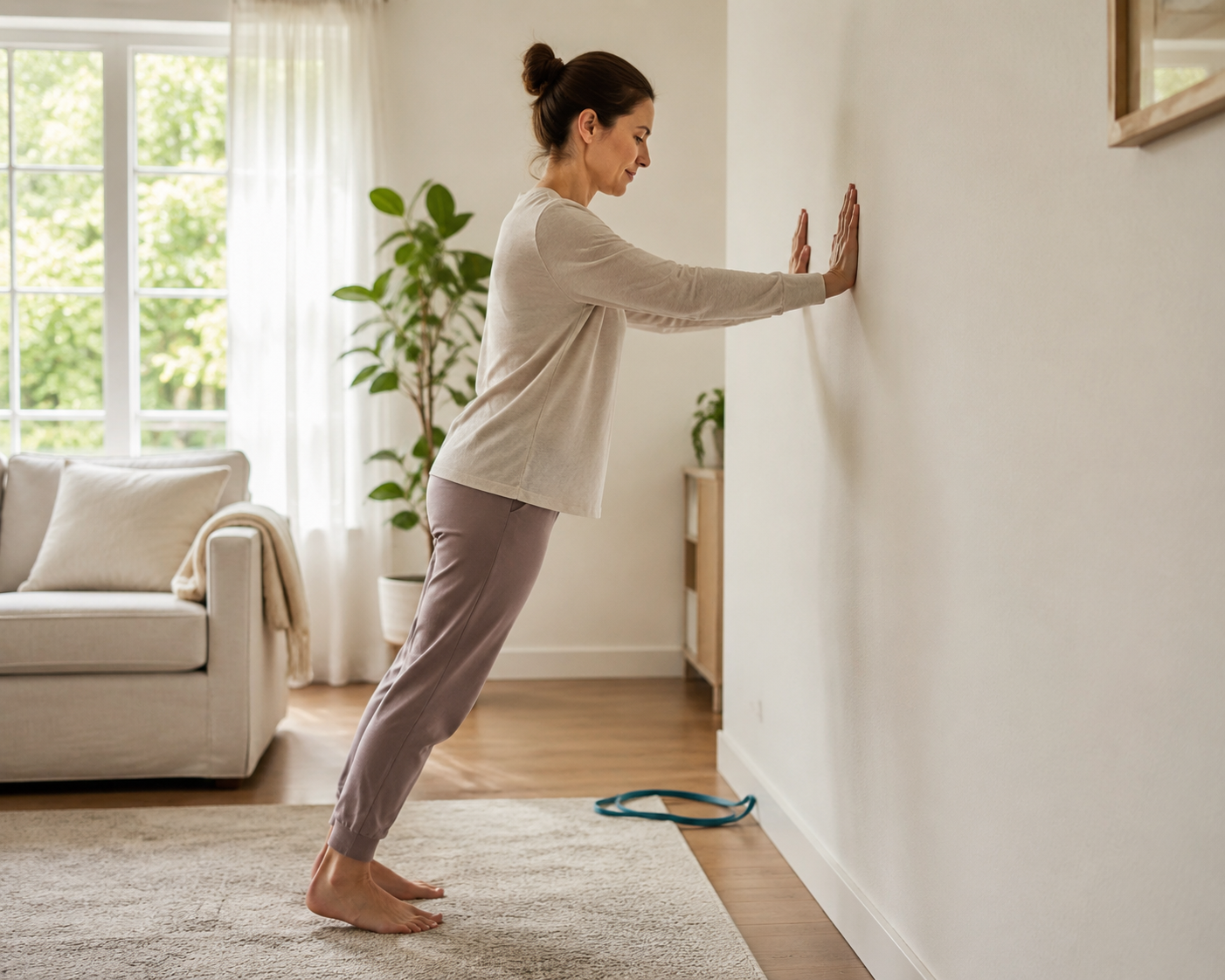
A practical version might look like this: two minutes of slow walking, one minute seated rest, a few chair stands, another rest, then gentle wall presses. If that fills 10 minutes including pauses, it counts. Rest breaks are not cheating; they are part of finding the dose your body can handle today.
If 10 Minutes Is Too Much
Split it. MD Anderson notes that short 10-minute blocks can be spread across the day, such as morning, afternoon, and evening, rather than done as one continuous session.[5] For someone in active treatment, that idea can be made even smaller: try a few minutes now, then decide later whether another few minutes is reasonable.
| Energy level today | A reasonable home test |
|---|---|
| Very low | Walk to the kitchen and back once or twice, then sit and reassess. |
| Low but steady | Try 5 minutes of indoor walking with pauses. |
| Moderate for you | Try up to 10 minutes of walking, chair stands, or wall presses. |
| Better day | Try two separate short blocks, with several hours between them. |
This is where home movement is genuinely helpful. You can stop the moment symptoms change. You do not have to drive home afterward. You do not have to explain to a class instructor why you are sitting down. You can test, rest, and keep the day intact.
How Hard Should It Feel?
For a first home test, aim for light effort. You should feel that you are doing something, but not that you are forcing your way through it.
MSKCC uses a simple talking check: at moderate intensity, you can talk but not sing; at vigorous intensity, you cannot say more than a few words without pausing for breath.[3] A sedentary patient in treatment does not need to chase vigorous effort. If the talk test says you are working too hard, slow down, sit, or stop.
- Light effort: you can talk comfortably and could continue a little longer.
- Moderate effort: you can talk, but singing would be difficult.
- Too hard for a starting test: you are breathless, bracing, dizzy, nauseated, or trying to “push through.”
A little effort is not the same as a warning sign. Mild warmth, gentle muscle work, or slightly quicker breathing can happen with movement. New pain, worsening fatigue, dizziness, blurred vision, fever, chest symptoms, or feeling suddenly unwell belongs in the stop category.[2]
What To Do Tomorrow
Tomorrow’s plan depends on today’s response. This is the part many exercise plans skip, and it is the part that makes home movement safer.
| Today’s response | Tomorrow’s choice |
|---|---|
| You felt okay during the test and did not feel worse afterward | Repeat the same 10-minute test before adding anything. |
| You felt okay during movement but were wiped out later | Try less time, fewer movements, or more rest between attempts. |
| You felt worse during the test | Stop for the day; try again tomorrow only if symptoms settle and no red flags appeared. |
| You had a red flag symptom | Do not troubleshoot it as a fitness problem; contact your oncology team. |
Progress may mean doing the same tiny session more consistently, not making it harder. During treatment, repeatability matters. If five minutes of easy walking leaves you able to eat, shower, or rest afterward, that is more useful than a 20-minute effort that costs you the rest of the day.
Where The 150-Minute Guideline Fits
Many cancer exercise resources eventually point toward the familiar adult target of 150 minutes of moderate activity per week, often broken into manageable pieces.[5] That target can be useful later, especially for people who are medically cleared, recovering well, and ready for a steadier routine.
It is a poor opening line for someone who is nauseated, immunocompromised, post-surgery, or afraid of making symptoms worse. For that person, “150 minutes” can sound like another way to fail. The more humane starting instruction is smaller: avoid complete inactivity if you safely can, test a light amount, and let the response guide the next step.
It is also worth being precise about what gentle home movement can and cannot prove. Light activity is a starting strategy for reducing sedentary time and building confidence. It should not be oversold as the same thing as a supervised oncology exercise program, and it should not be treated as a treatment for cancer-related fatigue on its own.
Some outcomes in exercise oncology have been studied more often in structured or supervised programs than in unsupervised living-room routines. The evidence base is also stronger for some cancer populations than others. That does not make home movement pointless. It means the claim should stay narrow: a safe 10-minute test is a realistic way to begin avoiding inactivity during cancer treatment, while your oncology team remains the authority on your personal limits.
A Caregiver’s Role
Caregivers can make this easier or harder. The helpful role is to reduce friction: clear a safe walking path, move a rug edge, bring water nearby, set a gentle timer, or sit in the room without turning the test into a performance.
- Say: “Do you want to try a few minutes and see how it feels?”
- Avoid: “You need to get your steps in.”
- Say: “Stopping is allowed.”
- Avoid: “You were able to do more yesterday.”
Treatment days are not interchangeable. A caregiver who understands that can help protect the patient from both inactivity and pressure.
A Simple First Attempt
If your oncology team has not given you restrictions that would rule this out, a first attempt could stay this plain:
- Choose a time when symptoms are usually calmer.
- Clear a small path or stand near a sturdy chair, counter, or wall.
- Move lightly for up to 10 minutes: slow walking, chair stands, wall presses, or another easy option.
- Stop immediately for warning signs or if you feel worse.
- Use today’s response to decide whether tomorrow should be the same, easier, shorter, or paused.
If treatment makes exercise feel overwhelming, the evidence-backed first move is not to chase a number. It is to avoid total inactivity with a safe 10-minute test, stop when your body tells you to stop, and let tomorrow’s body decide the next step.
References
- Exercise Safety During Cancer Treatment, Penn State College of Medicine ONE Group
- Physical Activity and the Person with Cancer, American Cancer Society
- Exercise During and After Cancer Treatment: Level 1, Memorial Sloan Kettering Cancer Center
- What exercises can I do at home during or after cancer treatment?, World Cancer Research Fund
- Exercise during cancer treatment, MD Anderson Cancer Center
Have a question this doesn’t answer?
This page stays within general education and does not diagnose or prescribe. If your question is about a specific injury or symptom, please see a clinician rather than continuing to search this site for an answer.