
Do You Need Electrolytes for Home Workouts?
Most home workouts require nothing more than plain water. Learn when electrolytes are actually needed based on ACSM thresholds, plus a simple DIY recipe for the sessions that demand them.
- Evidence source
- ACSM
- Applies to
- general population
What the evidence says
If you are standing next to a water bottle after a home workout wondering whether the electrolyte packet on the counter is something you actually need, the usual answer is no. For most moderate home workouts under 60 minutes in an air-conditioned room, plain water is enough. The American College of Sports Medicine draws the practical line at longer or harder exercise, especially when sweat loss is meaningful, and UnityPoint Health makes the same basic distinction between everyday water needs and sports-drink situations: duration, intensity, and heat matter more than the fact that you exercised at all.[1][2]
That is good news if your session is a 35-minute dumbbell workout, a mat circuit, or a band routine squeezed between work and dinner. You do not need another tub on the shelf just because the workout happened at home. You do need to pay attention when the same workout moves into a hot garage, turns into repeated HIIT intervals, or stretches past the hour mark.
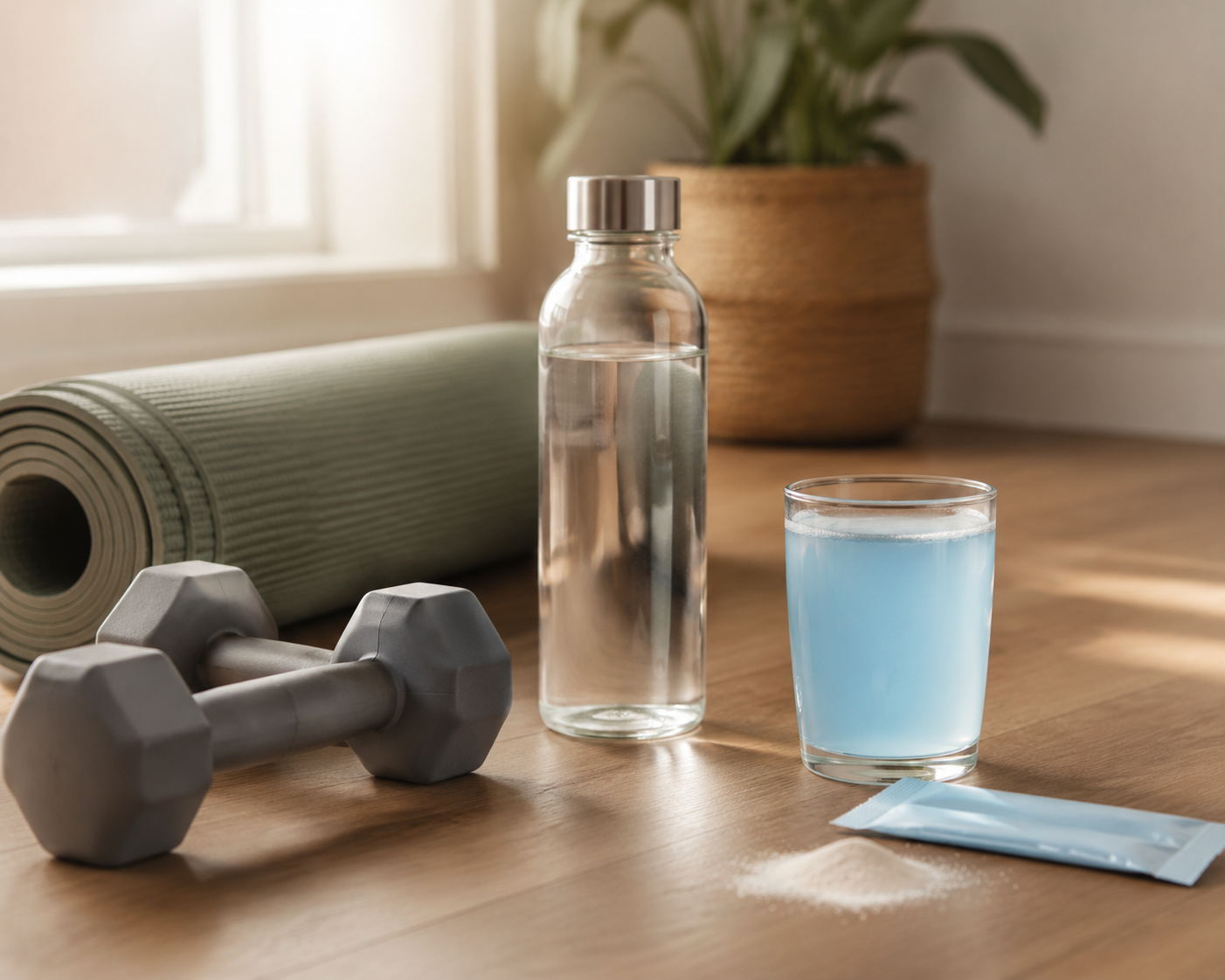
The Quick Home-Workout Hydration Decision
| Workout situation | Duration | Intensity | Room condition | Sweat level | Best drink choice |
|---|---|---|---|---|---|
| Typical dumbbell, band, mobility, or mat session | Under 60 minutes | Low to moderate | Climate-controlled | Light to moderate | Plain water |
| Steady strength session that runs long | Over 60 minutes | Moderate | Climate-controlled | Moderate to high | Water may still work, but electrolytes become more reasonable |
| HIIT circuit, hard conditioning, or dense full-body intervals | Often under or around 60 minutes | High | Climate-controlled or warm | High | Consider electrolytes if you are sweating heavily |
| Garage or patio workout in summer heat | Any session that produces heavy sweat | Moderate to high | Not climate-controlled | High | Electrolytes are more likely to be useful |
| Long, hot, hard session | Over 60 minutes | High | Hot or humid | High | Electrolytes or a sports drink are appropriate |
The table is the part to remember. A short home workout is not automatically a sports-drink workout. If the room is comfortable, the session is moderate, and you are finished inside an hour, water handles the job for most people.
The part that changes the answer is not a supplement label. It is the amount of fluid and sodium you are actually losing. A garage session in July can turn a normal dumbbell circuit into a very different hydration problem than the same workout in October.
Why Electrolytes Matter Only After Sweat Starts to Matter
Electrolytes are minerals involved in fluid balance and muscle function. Sodium gets most of the attention during exercise because it is lost in sweat and helps the body retain fluid. That does not mean every workout drains you enough to require a flavored powder.
For ordinary home training, the body is not usually facing a major replacement problem. You may sweat, but a moderate session in a cool room is not the same as a long run, a summer field practice, or a hard hour-plus conditioning block. Sports drinks can add carbohydrate, sodium, flavor, and calories; sometimes that is useful, and sometimes it is just extra sugar and cost attached to a workout that did not need it.[2]
This is also where taste needs to be separated from need. If a lightly flavored electrolyte drink helps someone drink consistently, that can be a preference. It is not proof that the workout physiologically required electrolytes.
The Exceptions Are Real, Especially in a Garage
Bad hydration advice usually fails in one of two directions. It either sells electrolytes for every 30-minute living-room workout, or it says “just drink water” as if heat and sweat do not exist. Home training has both realities.
A non-air-conditioned garage is the obvious exception. When the room is hot, your sweat rate can climb before the workout looks “long” on paper. A 45-minute dumbbell complex or bike interval session in summer heat may deserve the kind of hydration attention that a 45-minute strength session in a cool room does not.
HIIT-heavy sessions are another exception. The clock may say 38 minutes, but repeated hard intervals can produce heavy sweating and a higher fluid-replacement demand than a calmer full-body strength session of the same length. Heavy lifting can land in the same category when the work is dense, the rest periods are short, and the room is warm.
ACSM also notes a heat-specific strategy: about 500 mg of sodium 90 minutes before exercise may help with fluid retention when exercising in the heat.[1] That is not routine advice for a climate-controlled living-room workout. It is a caveat for the hot-session category, where sweat loss is already the main issue.
Before, During, and After: Simple Hydration Timing
For home workouts, hydration timing should be boring enough to repeat. The Academy of Nutrition and Dietetics recommends starting exercise well hydrated and replacing fluids afterward, with needs changing based on sweat loss, exercise length, and environment.[3] That fits home training better than trying to turn every session into a sports-nutrition project.
| When | What to do | When electrolytes enter the picture |
|---|---|---|
| Before | Drink normally through the day and do not start the workout thirsty. | Consider heat-specific sodium only for hot conditions, not routine indoor sessions. |
| During | Keep water nearby and sip as needed, especially if the session is longer or sweaty. | Use electrolytes when the workout is long, hot, hard, or producing heavy sweat. |
| After | Drink water with your normal post-workout food or snack. | Electrolytes may help if you lost a lot of sweat or are training again soon. |
A practical pre-workout check is simple: if your mouth is dry, your bottle is empty, and the room is already warm, fix that before the warm-up. If you are training after a normal day of drinking fluids and the room feels comfortable, you probably do not need to overthink it.
During the workout, water nearby beats perfect planning in another room. A bottle on the floor next to the mat is enough for most sessions. For longer circuits, garage workouts, and repeat-interval days, bring the drink you intend to use before you start; walking into the kitchen mid-session is how a two-minute break becomes checking your phone.
Afterward, water is usually still the default. If the session was part of a larger recovery plan, fluid can sit alongside food, sleep, and easy movement rather than replacing them. For a broader home recovery setup, see Your Complete Post-Workout Recovery Routine at Home. If you are comparing recovery drinks after harder sessions, Fairlife Milk vs Chocolate Milk vs Whey for Post-Workout Recovery is the more relevant question than whether every workout needs electrolytes.
A DIY Electrolyte Drink for Sessions That Actually Need One
When the session does justify electrolytes, you still do not have to buy a neon tub. Johns Hopkins Medicine shares a simple homemade sports drink approach using water, orange juice, honey, and salt.[5] The point is not that homemade is magically better. It is that electrolyte replacement can be practical and limited to the workouts that call for it.

- Use water as the base.
- Add orange juice for flavor and carbohydrate.
- Add honey for additional carbohydrate.
- Add a small amount of salt for sodium.
That belongs in the hot, long, or hard bucket: the summer garage lift, the longer conditioning day, the sweaty HIIT session, or a workout followed by another bout later. It does not need to become the default drink for every moderate home strength session.
What to Keep on Hand
The useful home setup is small: a water bottle you actually use, a way to keep drinks cold if you train in heat, and an electrolyte option for the sessions that cross the line. That option can be a packet, a tablet, or the homemade version. It does not need to sit next to your dumbbells as a daily requirement.
For ordinary under-60-minute workouts in a climate-controlled room, keep plain water. For long, hot, hard, or unusually sweaty sessions, use electrolytes. That is the whole decision, and it is enough to make before the next workout.
References
- 9 Facts About Hydration & Electrolytes, American College of Sports Medicine
- Water vs. Sports Drinks: What's Best for Our Bodies?, UnityPoint Health
- Hydrate Right, Academy of Nutrition and Dietetics
- Hydration Guide: What to Drink Before, During and After Exercise, Abbott
- Sports and Hydration for Athletes: Q&A with a Dietitian, Johns Hopkins Medicine
Have a question this doesn’t answer?
This page stays within general education and does not diagnose or prescribe. If your question is about a specific injury or symptom, please see a clinician rather than continuing to search this site for an answer.