
Coffee’s Role in Post-Workout Recovery and Heart Health
This article explains how consuming coffee after exercise can speed muscle glycogen recovery while supporting long-term heart health, based on recent clinical research. Learn the practical protocol, dosage considerations, and important caveats for active people who exercise at home.
The workout is over. The dumbbells are back against the wall, the treadmill belt has stopped, or the trainer ride has uploaded itself somewhere you may or may not check later. Now comes the less flashy part: getting enough fuel back in, cooling down, rehydrating, and not wrecking tonight’s sleep.
Coffee usually gets filed under “before exercise” because caffeine can make effort feel a little more available. But the more interesting question for active people is quieter: can a normal cup of coffee after training help recovery, not just motivation? The best answer is narrow but useful. Coffee does not replace carbohydrates after exercise. When it is paired with carbohydrate, though, it may help muscles restock glycogen faster.
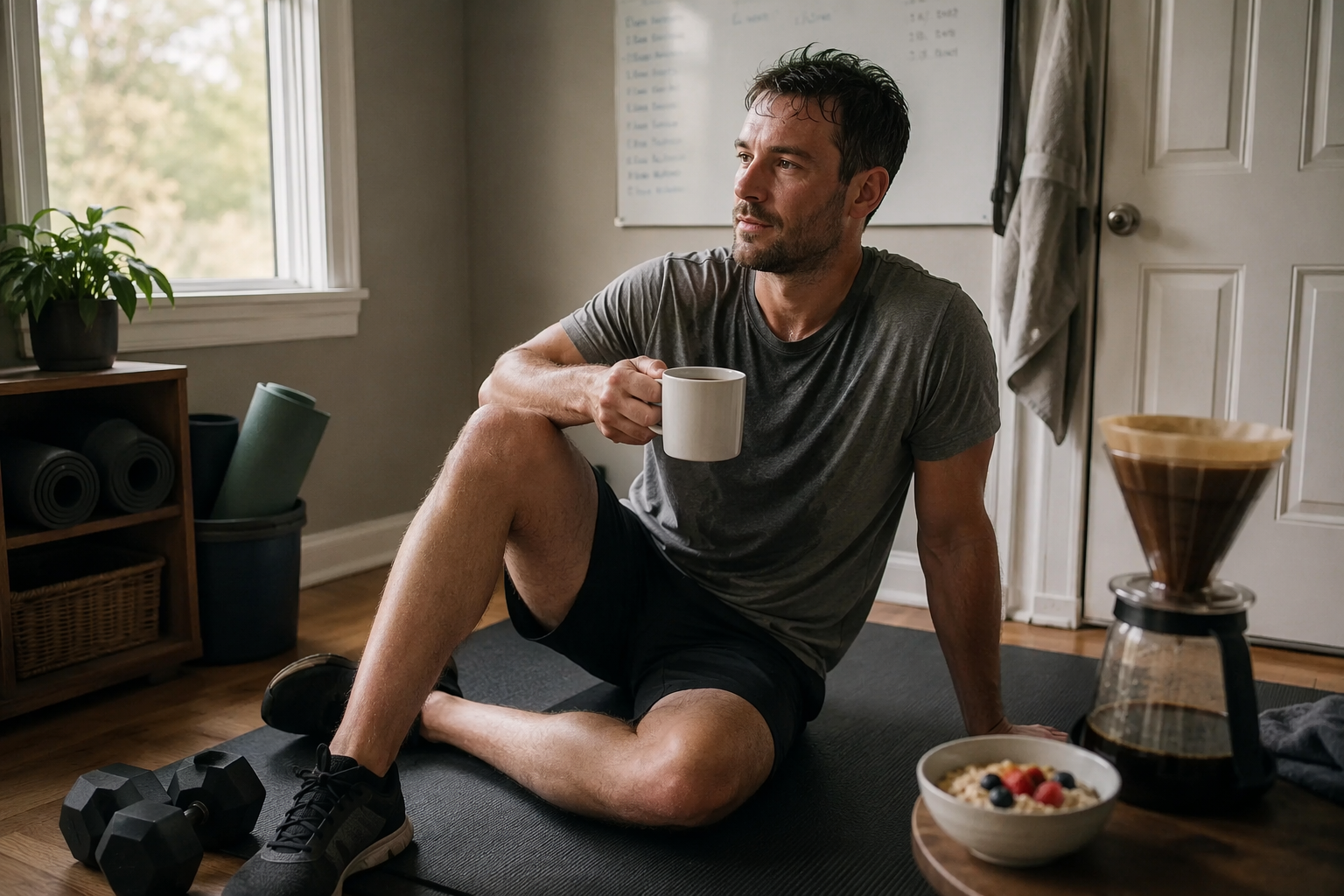
The recovery finding worth paying attention to
The most direct evidence comes from a small double-blind randomized trial by Loureiro and colleagues. Eleven endurance-trained male cyclists completed glycogen-depleting exercise, then consumed either coffee with milk or milk alone during a four-hour recovery window. The coffee-plus-milk condition produced 153% greater muscle glycogen resynthesis than milk alone, with a large effect size reported as d=0.94.[1]
That is not a vague wellness outcome. Muscle glycogen is stored carbohydrate. It is one of the fuels you rely on when a session moves beyond easy background activity: intervals on a bike trainer, a hard treadmill incline, repeated dumbbell complexes, longer circuits, or back-to-back training days. If glycogen comes back faster, the next session has a better chance of feeling like training instead of negotiation.
The trial also matters because coffee was not tested as magic bean water. It was added to a carbohydrate-containing recovery drink. The milk supplied the recovery substrate; coffee appeared to improve the handling of that substrate. The same study reported improved glycemic and insulinemic responses when coffee was added, with large effect sizes of d=0.83 and d=0.76.[1]
For a home exerciser, the practical translation is simple: coffee belongs next to the recovery food, not instead of it. A mug with oats, toast, fruit, cereal, rice, potatoes, or a milk-based smoothie makes sense. A black coffee after a draining session while postponing food for hours is a different idea, and this study does not support pretending it is the same thing.
The limits are real. This was not a large trial, not a mixed-sex sample, and not a study of beginners doing bodyweight squats between meetings. It was 11 endurance-trained male cyclists. The mechanism is plausible beyond cycling, but the confidence should stay where the evidence puts it: promising for glycogen-focused recovery, especially after harder or longer sessions, not proven for every active adult or every type of home workout.
If you already use a broader post-workout recovery routine at home, this is where coffee fits: after the session, with carbohydrates, when the next 24 hours of training and normal life still matter.
Why the heart-health part is more than a side note
Coffee’s heart-health reputation can get flattened quickly. Coffee is not a heart medication. It is also not automatically a cardiovascular villain because it contains caffeine. The better reading is that moderate coffee intake has looked consistently compatible with heart health in large population research, while individual tolerance still decides whether it is smart for a given person.
A 2019 meta-analysis by Kim and colleagues included approximately 3.8 million participants and found the lowest cardiovascular mortality risk around 2.5 cups per day, with a reported relative risk of 0.83. The same analysis reported a relative risk of 0.85 for all-cause mortality at that intake level.[2]
Harvard Health summarized a large 2022 study of about 450,000 people in which drinking two to three cups of coffee per day was associated with a 15% lower risk of cardiovascular disease. That word “associated” is doing important work. Observational findings do not prove coffee caused the lower risk, but they do make moderate intake look much less suspicious than older, one-note warnings often imply.[3]
For active people, this matters because recovery habits become daily habits. A post-workout tool that quietly worsens the bigger health picture is not much of a tool. Moderate coffee intake, especially when it does not interfere with sleep or medical conditions, sits more comfortably in the long-term cardiovascular picture than many people assume. If you want the exercise side of that cardiovascular picture, FitAtHome’s piece on how home exercise lowers stroke risk is the better place to continue that thread.
Paper-filtered coffee is the boring detail that changes the habit
Brew method deserves a little space because it changes what ends up in the cup. Filtered coffee made with paper contains far less of the cholesterol-raising diterpenes cafestol and kahweol than boiled or unfiltered coffee. One review reported about 0.02 mg of these diterpenes per cup in filtered coffee, compared with about 7.2 mg per cup in boiled or unfiltered coffee.[4]
That does not mean everyone needs a new machine. It means the plain paper-filter setup sitting on a kitchen counter is already a good fit for daily use. If coffee is going to become a recovery habit rather than an occasional pre-workout nudge, the filtered-versus-unfiltered distinction is more useful than another argument about whether coffee is “good” or “bad.”
A practical post-workout coffee setup
The protocol does not need to be complicated. After a harder workout, drink coffee with a carbohydrate-containing snack or meal. Keep water in the picture. Stop early enough that the caffeine does not steal sleep from the same recovery process you are trying to support.
| Part of the setup | What to do | Why it matters |
|---|---|---|
| Coffee | Use a normal cup you tolerate, preferably paper-filtered. | The recovery trial tested coffee added to a carb-containing drink; filtered coffee is more compatible with the heart-health evidence. |
| Carbohydrate | Pair it with food or drink that supplies carbs, such as oats, fruit, toast, cereal, rice, potatoes, or milk. | Glycogen resynthesis requires carbohydrate; coffee is the add-on, not the replacement. |
| Timing | Use it after sessions where recovery matters, especially longer or harder training days. | The strongest evidence is about a four-hour post-exercise recovery window after glycogen-depleting exercise. |
| Hydration | Treat coffee as part of fluids, not the whole plan. | Sweat loss, workout length, heat, and sodium needs still determine whether you need more than a mug and a meal. |
| Sleep protection | Move the coffee earlier or reduce the amount if it affects sleep. | Lost sleep can undercut recovery more than a recovery drink can fix. |
On hydration, coffee does not have to be treated as forbidden fluid, but it also should not crowd out the basics. If a workout is hot, long, or sweaty, use a basic hydration plan first. FitAtHome’s hydration tips for home exercise and guide to whether you need electrolytes for home workouts are better tools for that decision.
How much coffee is enough?
A cup of coffee is not a standardized dose. Caffeine content can range from about 30 to 175 mg per cup, depending on serving size, bean, roast, and preparation.[1] That range is why “one cup” can feel like a mild nudge for one person and a heart-thumping mistake for another.
Performance-oriented caffeine guidance often uses a 3–6 mg/kg bodyweight frame. For post-workout recovery, that should be treated as context, not a command. The Loureiro study supports the idea that caffeine-containing coffee can help carbohydrate recovery after demanding exercise, but it does not mean every home exerciser should chase the top of a sports-performance range.
Most active adults will do better starting with the amount of coffee they already know they tolerate. If the session ends late, if sleep is fragile, or if caffeine makes you anxious, the useful dose may be smaller than the impressive-sounding dose. The goal is to help the next session, not win a spreadsheet.
The caveats that decide whether this helps or backfires
The cleanest reason to be careful is sleep. In the CRAVE trial coverage from the American Heart Association, coffee consumption was linked with about 600 more steps per day but about 18 fewer minutes of sleep per cup.[5] More movement sounds useful, but losing sleep after an evening workout is a poor trade if recovery is the priority.
This is also where fitness trackers can be helpful without becoming the boss of the house. If late coffee reliably worsens sleep duration, resting heart rate, or heart-rate variability, the pattern matters. A single recovery score is not a diagnosis, but repeated signals are worth respecting. For the limits of those metrics, see FitAtHome’s guide to what a fitness tracker’s recovery score actually measures.
Genetics add another wrinkle. Caffeine metabolism varies partly through CYP1A2. Guest and colleagues reported that slow metabolizers may not get the same performance benefit from higher caffeine intake, and a practical ceiling for likely slow metabolizers or sensitive users is no more than 2 mg/kg.[6] Earlier JAMA research by Cornelis and colleagues connected CYP1A2 variation with different cardiovascular responses to coffee in the context of myocardial infarction risk.[7]
You do not need a genetic test before using a coffee mug after training. You do need to pay attention to your own response. If coffee gives you palpitations, anxiety, reflux, shaky hands, or a wide-awake midnight, those are not small details. They are the data you actually live with.
People with arrhythmia concerns, uncontrolled hypertension, pregnancy-related caffeine limits, significant anxiety, known caffeine sensitivity, or clinician-provided restrictions should not treat a recovery article as personal dosing advice. In those cases, the right move is to ask the clinician who knows the condition and medication list.
Where coffee earns its place
Post-workout coffee is most convincing after sessions that create a real refueling job: long trainer rides, harder treadmill work, repeated circuits, demanding dumbbell sessions, or two-a-day situations. After an easy walk, the same cup may simply be a pleasant habit. That is fine, but it is a different claim.
The evidence supports a measured practical judgment. Coffee with carbohydrates after exercise is a credible, low-cost recovery option for active people, especially when glycogen replenishment matters. Moderate daily coffee intake, particularly paper-filtered coffee, can fit a heart-healthy lifestyle. The smart version is not heroic: brew it, pair it with carbs, keep the dose tolerable, protect sleep, and let your medical context overrule any generic protocol.
References
- Coffee Increases Post-Exercise Muscle Glycogen Recovery in Endurance Athletes: A Randomized Clinical Trial, Nutrients, 2021.
- Coffee consumption and all-cause and cause-specific mortality: a meta-analysis by potential modifiers, European Journal of Epidemiology, 2019.
- Does coffee help or harm your heart?, Harvard Health Publishing.
- Coffee and its consumption: benefits and risks, PMC.
- Coffee boosts physical activity, cuts sleep, affects heartbeat, study suggests, American Heart Association, November 15, 2021.
- Caffeine, CYP1A2 Genotype, and Endurance Performance in Athletes, Medicine & Science in Sports & Exercise, 2018.
- Coffee, CYP1A2 genotype, and risk of myocardial infarction, JAMA, 2006.
Have a question about this guidance?
This is a question and correction channel, not an open discussion thread — recovery topics sit close to a medical-advice boundary, so we review submissions rather than publishing them instantly.