
Full Body Dumbbell Workout Without a Bench: A Routine for Light Weights and Small Spaces
This article provides a complete full-body dumbbell workout routine for training with only light dumbbells, no bench, and limited floor space. It covers exercise substitutions, tempo techniques, and rep strategies to build muscle effectively despite equipment constraints.
Before you start
- Equipment required
- None
- Assumes build tier
- No specific tier required
- Duration
- 40 minutes
If your setup is one pair of light adjustable dumbbells, no bench, and enough floor to lie down and step backward, you can still run a real full body dumbbell workout. It will not look like a commercial gym routine with a rack, bench, cables, and a walking-lunge runway. It also does not need to be a random list of “small-space exercises” that stop working after two weeks.
The tradeoff is simple: when the dumbbells are light, the workout has to become more deliberate. A 2022 review discussed by Garage Gym Reviews found that lower training intensities, higher frequencies, and minimal equipment can still improve strength and reduce cardiometabolic risk when the training is structured intelligently.[1] That does not make light weights magic. It means you have permission to start now, then use exercise choice, tempo, pauses, and rep targets to make the weight matter.
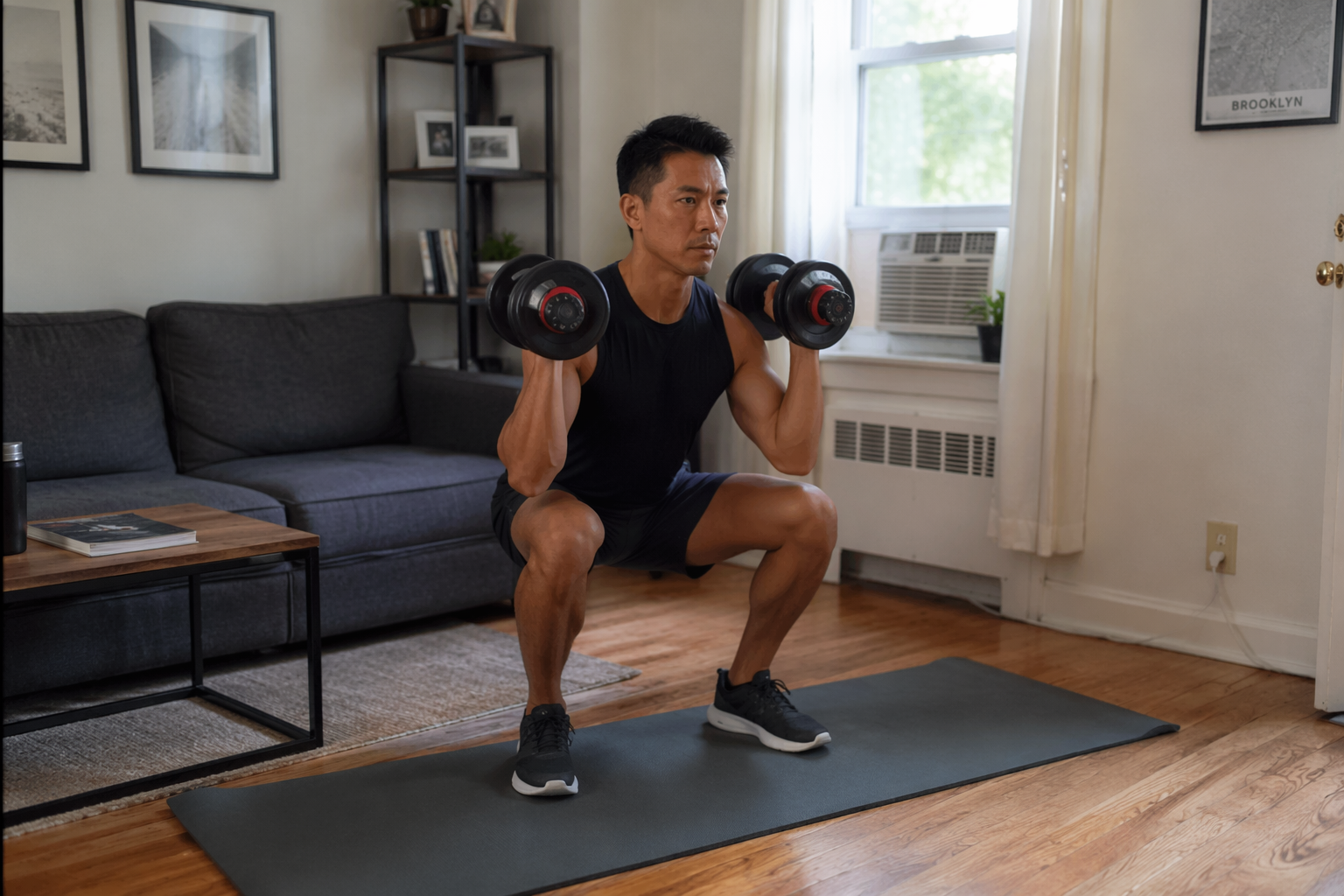
The no-bench, small-space full body dumbbell workout
Do this workout two to four times per week, leaving at least one day between hard sessions when you are new or sore. Use dumbbells that let you finish each set with about one to three good reps left. If the listed reps are too easy, do not rush to add junk volume. First slow the lowering phase, pause in the hardest position, or use the progression notes below.
| Part | Exercise | Sets | Reps | Rest | Why it is here |
|---|---|---|---|---|---|
| Warm-up | Bodyweight squat, hip hinge drill, arm circles, glute bridge, dead bug | 1–2 rounds | 6–10 each | Move continuously | Warms hips, shoulders, trunk, and pressing pattern without needing space |
| 1 | Dumbbell goblet squat or two-dumbbell front squat | 3 | 8–15 | 60–90 sec | Main knee-dominant lower-body lift |
| 2 | Dumbbell Romanian deadlift | 3 | 8–15 | 60–90 sec | Main hip-hinge lift for hamstrings, glutes, and back-side tension |
| 3 | Dumbbell floor press | 3 | 8–15 | 60–90 sec | Bench-free chest, triceps, and shoulder-friendly pressing |
| 4 | One-arm dumbbell row, supported on thigh or hip-hinge stance | 3 per side | 10–20 | 30–60 sec between sides | Upper-back pulling without a bench |
| 5 | Reverse lunge or split squat | 2–3 per side | 8–12 | 60–90 sec | Single-leg work without needing a long lane |
| 6 | Standing dumbbell overhead press | 2–3 | 8–15 | 60–90 sec | Vertical push for shoulders and triceps |
| 7 | Dumbbell curl to overhead triceps extension, or one move only if time is short | 2 | 10–20 | 30–60 sec | Optional arm work that uses light weights well |
| 8 | Suitcase march in place or dead bug with dumbbell hold | 2 | 30–45 sec | 30–45 sec | Core and bracing without planks taking over the room |
A session can take about 35–50 minutes depending on rest periods and how many optional sets you keep. If you are just starting, use the lower end of the set ranges for the lunge, overhead press, and arm work. The squat, hinge, floor press, and row are the pieces to protect.
Warm-up: keep it short and specific
- Bodyweight squat: 8 reps, controlled, feet flat.
- Hip hinge drill: 8 reps, hands on hips, push hips back without rounding.
- Glute bridge: 10 reps, pause briefly at the top.
- Arm circles or shoulder rolls: 10 each direction.
- Dead bug: 6 slow reps per side.
This is not a separate conditioning workout. It is a check-in. If your knees, hips, or shoulders feel worse after the warm-up, use the easier substitutions listed later instead of forcing the main version.
Why these exercises work when you do not have a bench
The routine starts with the lower body because light dumbbells are usually outgrown there first. Squats and hinges need the freshest effort you have. After that, the floor press and row cover the main upper-body push and pull. Reverse lunges, overhead pressing, arms, and core fill in what the big lifts do not fully handle.
That order also keeps the room manageable. You are not dragging furniture around between every set. Most of the workout happens standing in place, lying on a mat, or stepping one leg backward.
Floor press instead of bench press
The floor press is the cleanest bench-press substitute for this setup. You lie on the floor, press the dumbbells from chest level, and let your upper arms touch the floor lightly at the bottom. Garage Gym Reviews describes the dumbbell floor press as a viable alternative to a bench press, with a shorter range of motion that still trains the chest and triceps and may be easier on the shoulders.[1]
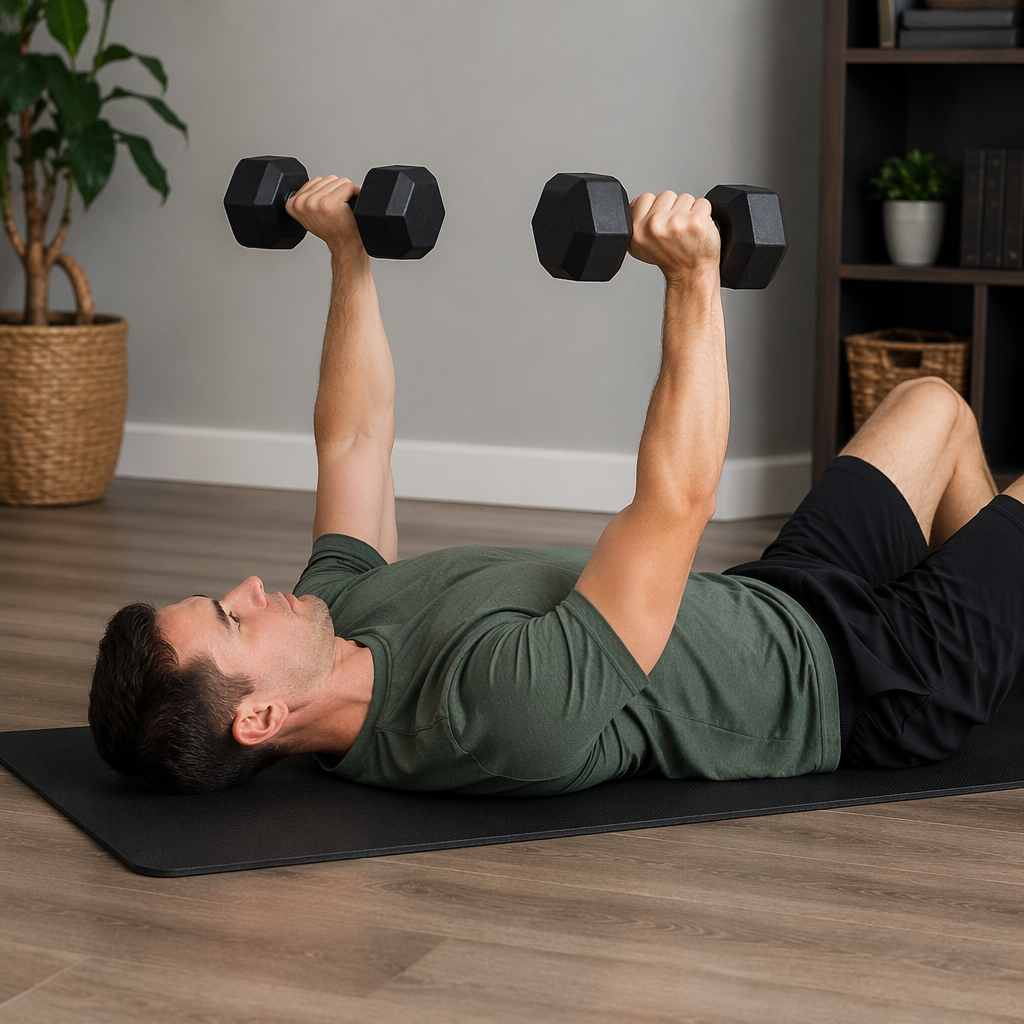
Set your elbows about 30–45 degrees from your torso rather than flaring them straight out. Start with the dumbbells over the chest, lower until the upper arms meet the floor, pause without relaxing, then press up until the elbows are straight but not slammed into lockout. If your floor is hard, use a mat or folded towel under your upper back, but do not create a wobbly platform.
What you lose is the deep stretch of a bench press. That matters, and it is one reason the floor press is not identical. What you gain is a stable, repeatable press that does not require furniture, does not ask a beginner to balance on a couch edge, and is easy to set up in an apartment.
Reverse lunge instead of walking lunge
Walking lunges are often called home-friendly until someone actually tries them between a coffee table and a wall. A reverse lunge solves the same basic single-leg problem while staying almost in place. REP Fitness notes that reverse lunges require about 3 feet of space, while walking lunges may need 10 or more feet.[2]
Step one foot backward, lower under control, lightly touch or hover the back knee, then drive through the front foot to stand. If balance is the problem, hold one dumbbell goblet-style instead of two at your sides, or keep a hand near a wall. If knee irritation is the problem, shorten the range slightly and try a split squat, where your feet stay planted for the whole set.
Rows without a bench
A one-arm dumbbell row does not require a bench if you can brace well. Put one hand on your thigh, hinge at the hips, keep the spine steady, and row the dumbbell toward the lower ribs. If that position makes your low back do more work than your upper back, use a staggered stance and rest the non-working forearm across the front thigh for support.
The point is not to make the row look hardcore. The point is to create a stable enough torso that the shoulder blade can move and the elbow can drive back. If you are twisting to finish every rep, the weight is too heavy or the set has gone too long.
How to make light dumbbells hard enough
With a barbell, progression is often obvious: add weight. With one pair of adjustable dumbbells, you may run out of load quickly, especially on squats, deadlift patterns, and lunges. The answer is not to turn every set into a 50-rep test of patience. Use the methods below before adding more exercises.
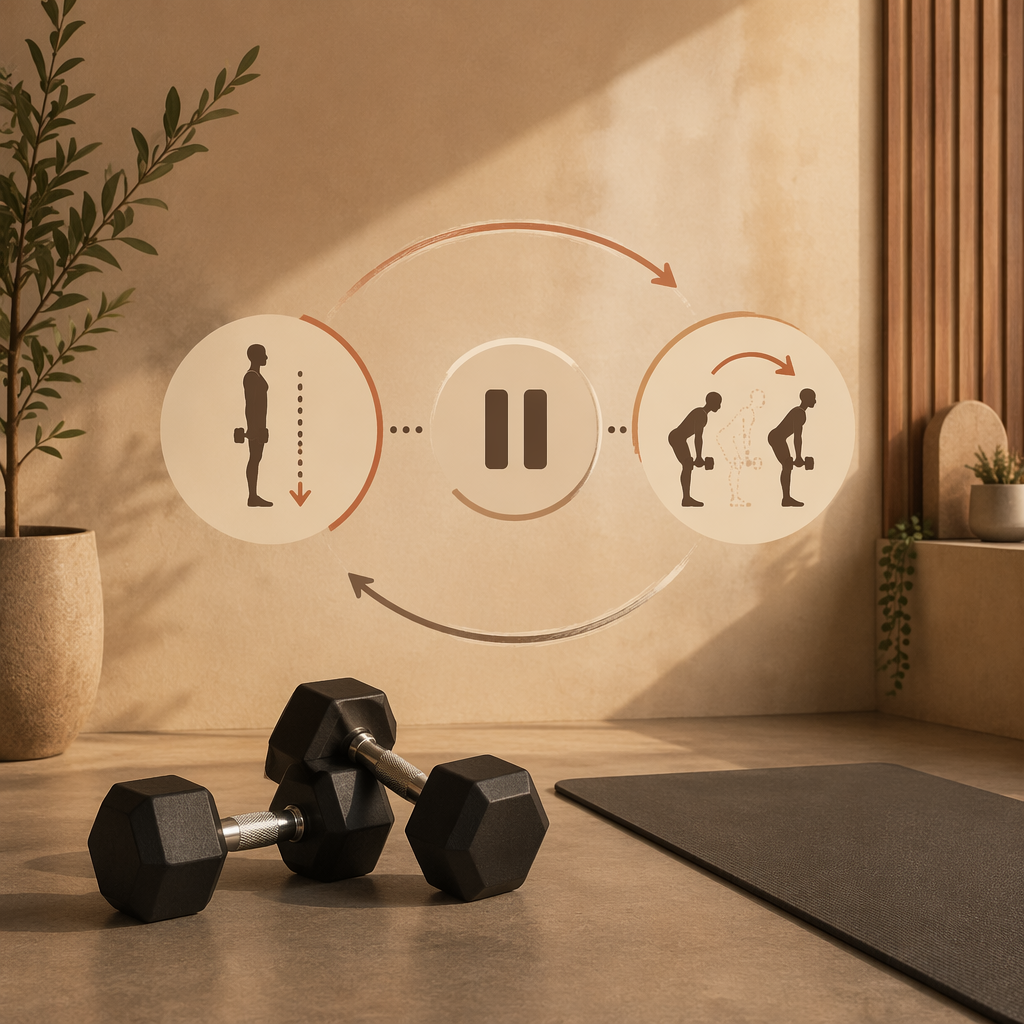
Use a 3-second lowering phase
When the dumbbells feel too light, slow the eccentric phase—the lowering part of the rep—to about 3 seconds. Garage Gym Reviews describes this as a way to increase time under tension by 200–300% without adding load.[1]
Use it on goblet squats, Romanian deadlifts, floor presses, rows, reverse lunges, and overhead presses. Count honestly: “one-one-thousand, two-one-thousand, three-one-thousand,” then lift with control. The set should feel harder because the target muscles are working longer, not because you are moving sloppily.
Pause where the movement is hardest
Pauses remove bounce. For squats, LoadMuscle recommends pausing at the bottom to increase time under tension when weights feel light.[3] A useful version here is a 2-second pause at the bottom of each goblet squat or split squat while keeping the torso braced and the feet planted.
For the floor press, pause with the upper arms resting lightly on the floor, but do not let the shoulders relax. For Romanian deadlifts, pause when the hamstrings are stretched and the dumbbells are near the shins. For rows, pause at the top with the elbow behind the body and the shoulder blade pulled back.
Use one-and-a-half reps carefully
LoadMuscle also describes one-and-a-half reps for isolation movements: perform a partial rep, return, then complete the full rep.[3] For this workout, they are best saved for curls, lateral raises if you add them, triceps extensions, and sometimes goblet squats if your joints tolerate them well.
A curl example: raise the dumbbells all the way up, lower halfway, curl back up, then lower all the way down. That entire sequence counts as one rep. Use fewer total reps than usual because one-and-a-half reps make a set longer fast.
Progression order
Use this order before changing the whole routine:
- Add reps until you reach the top of the listed range with clean form.
- Add load if your dumbbells allow it.
- Slow the lowering phase to 3 seconds.
- Add a 1–2 second pause in the hardest position.
- Add one set to the main movement, not to every exercise at once.
- Switch to a harder variation, such as split squats instead of goblet squats or single-leg Romanian deadlifts instead of two-leg Romanian deadlifts.
Do not apply every intensifier to every exercise in the same session. A 3-second eccentric, bottom pause, and one-and-a-half reps stacked together can turn a simple workout into a recovery problem. Pick one main method per lift.
Beginner modifications that still count
If the full table feels like too much, reduce the workout rather than abandoning it. Keep one squat or lunge pattern, one hinge, one press, one row, and one core drill.
| If this is the problem | Use this version | What to watch |
|---|---|---|
| Goblet squats bother the knees | Box squat to a sturdy chair or do a shorter-range goblet squat | Keep feet flat and avoid dropping into the bottom |
| Romanian deadlifts strain the low back | Reduce range and stop when the hamstrings stretch | Hips move back; spine does not round |
| Floor press feels awkward | Use one dumbbell at a time | Keep ribs down and avoid twisting |
| Rows fatigue the low back | Use a supported staggered stance with forearm on thigh | Pause the set if torso position changes |
| Reverse lunges feel unstable | Use split squats with feet planted | Hold one dumbbell goblet-style or use wall support |
| Overhead press irritates shoulders | Use a neutral-grip press or reduce range | Stop before pain, not after it |
For an absolute beginner, two sets per exercise is enough for the first couple of weeks. The early win is repeatable technique. A workout you can perform calmly three times is more useful than a heroic first session that makes stairs unpleasant for four days.
Rest, frequency, and effort
Rest long enough that the next set is still a strength or muscle-building set, not a balance test. For most people, that means 60–90 seconds after squats, Romanian deadlifts, floor presses, lunges, and overhead presses, and 30–60 seconds for curls, triceps work, and core. Built With Science emphasizes the importance of organizing full-body training around major compound movements and using rest periods that let performance stay high enough to train the target muscles.[4]
A good weekly rhythm is Monday, Wednesday, Friday. If you recover well, a fourth day can work, but keep it slightly easier: fewer sets, no one-and-a-half reps, and no need to chase failure. If you train in a hotel room or during a busy week, two sessions still keeps the routine alive.
Most working sets should end close to technical failure, not past it. Technical failure is the point where another rep would change the movement: knees cave in, back rounds, elbows flare wildly, or the dumbbells drift out of position. Stop there. Light weights only build well when the reps are controlled enough for the right muscles to keep doing the work.
When your dumbbells become the limiting factor
Adjustable dumbbells around 40–50 pounds per hand can take many beginners a long way for pressing, rows, arms, and single-leg work, but they can become limiting for lower-body compound movements.[1] That ceiling is real. A strong person will eventually find that two-dumbbell squats and Romanian deadlifts are more limited by available load than by muscle capacity.
Before buying anything, you can extend the routine by moving from two-leg to single-leg variations: split squats, rear-foot-elevated split squats if you have a stable surface, single-leg Romanian deadlifts, and slower reverse lunges. You can also add a set to the lower-body movements or use pauses more consistently.
At some point, though, tempo is no longer progression; it is just making light work slower. If you are doing controlled high-rep split squats, paused Romanian deadlifts, and clean squats at the top of the rep range without getting close to technical failure, you need a harder variation, more load, or additional equipment. That is not a failure of home training. It is what progress looks like.
A practical 3-day version
You can repeat the same workout three days per week, or rotate the emphasis slightly so your joints and attention get a break. Dumbbell-only full-body routines commonly use repeated compound patterns across the week rather than isolating each muscle on a separate day.[5]
| Day | Lower body | Push | Pull | Add-on |
|---|---|---|---|---|
| Day 1 | Goblet squat + Romanian deadlift | Floor press | One-arm row | Reverse lunge + core |
| Day 2 | Reverse lunge + Romanian deadlift | Overhead press | One-arm row | Curls + triceps |
| Day 3 | Paused goblet squat + split squat | Floor press | Row with 2-second top pause | Suitcase march |
Keep the same set and rep ranges from the main workout. The rotation is not meant to be clever. It simply gives you a way to train the whole body repeatedly without asking the same joints to experience the exact same stress every session.
Small-space setup notes
- Clear the floor before you start. Moving a table mid-workout is when consistency starts to leak.
- Put the dumbbells down under control. REP Fitness specifically notes noise considerations for home dumbbell training, and this matters if you live above someone or train early.[2]
- Keep one “home base” spot for standing lifts and one mat spot for floor work.
- For reverse lunges, step back along the same line each rep so you are not drifting into furniture.
- If grip becomes the limiting factor on lower-body sets, use a goblet hold or one dumbbell instead of letting your posture collapse.
This setup is not a full gym. It does not give you every angle, every load jump, or endless lower-body progression. But it is enough to build a consistent, muscle-building full-body routine if you use the substitutions honestly and make each rep carry tension instead of speed.
References
- Full-Body Dumbbell Workout, Garage Gym Reviews
- Full Body Dumbbell Workout for Beginners, REP Fitness
- Full Body Dumbbell Workout: Complete Plan for Home or Gym, LoadMuscle
- The #1 Full Body Workout Plan for Growth (FULLY EXPLAINED), Built With Science
- Dumbbell Only Workout: 3 Day Full Body Dumbbell Workout, Muscle & Strength
Don't have the gear this routine assumes? Find the build that covers it.
Wondering how much rest you need after this? Read our ACSM-cited recovery reference.
Questions about form, substitutions, or a correction? Leave it below.
Comments
Join the discussion with an anonymous comment.