
How to Exercise Indoors When Wildfire Smoke Fills the Air
Learn how to check your AQI, prepare indoor air with a HEPA purifier or DIY box-fan filter, and choose the right workout intensity and duration for each smoke severity level — from moderate AQI to hazardous conditions.
Before you start
- Equipment required
- None
- Assumes build tier
- No specific tier required
- Duration
- 15 minutes
Start with the number, not the mood of the sky. For an indoor workout during wildfire smoke, open AirNow.gov, enter your location, and use the current AQI as the decision gate before you lace up, unroll the mat, or start the fan bike. AirNow is the EPA’s real-time public source for smoke and air-quality guidance, and its color bands give you a repeatable way to decide whether today is an outdoor day, an indoor day, or a barely-move day.[1]
That matters because exercise changes the dose. At rest, a person breathes roughly 12 liters of air per minute; during exercise, that can rise to about 100 liters per minute. The same smoky air becomes a larger particulate load when you are breathing harder, especially outdoors where there is no filtration between you and the plume.[2]
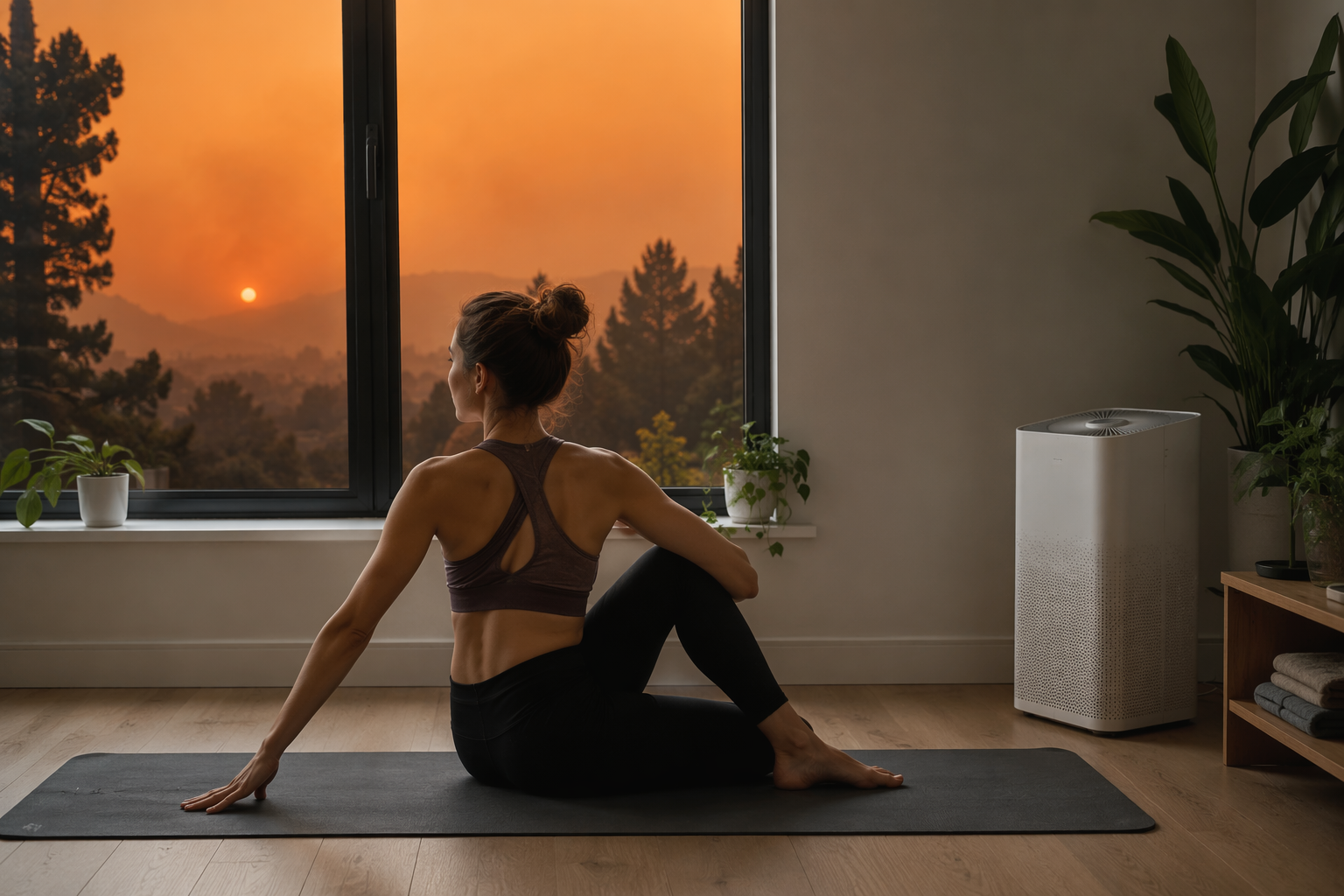
Check the AQI before choosing the workout
Do this in order: check the AQI, prepare the room, then choose the session. Reversing that order is how people end up doing a “safe indoor workout” next to an open window, in a room where nobody turned on the purifier.
| AQI | AirNow category | Outdoor training | Indoor workout choice |
|---|---|---|---|
| 0–50 | Good | Normal outdoor training is reasonable for most people. | Any normal home workout is fine if indoor air feels normal. |
| 51–100 | Moderate | Most healthy adults can train outdoors; sensitive people should be more cautious. | Normal indoor training works. Close windows if smoke is visible or smelled. |
| 101–150 | Unhealthy for sensitive groups | Sensitive groups should move indoors or cut back; healthy adults may still tolerate easier outdoor activity. | Use a filtered room. Keep sessions normal to moderately shortened, especially if symptoms appear. |
| 151–200 | Unhealthy | Move the workout indoors. This is the practical cutoff for outdoor exercise for healthy adults in the expert guidance summarized by public-health and sports-medicine sources. | Short, purposeful indoor training in a prepared room: strength circuits, short intervals, or controlled cardio. |
| 201–300 | Very unhealthy | Skip outdoor exercise. | Only low-exposure indoor movement if the room is sealed and filtered: mobility, stretching, easy strength, short walks inside. |
| 301+ | Hazardous | Do not exercise outdoors. | Rest, breathing-friendly mobility, or medical guidance if symptoms are present. Do not try to “get the workout in.” |
The red line is the one to respect. At AQI 151 and above, the useful question is no longer “Can I tough this out outside?” It is “Can I make one indoor room clean enough for a shorter session?”
Prepare one room before you train
Going indoors helps, but it is not a complete plan. Smoke gets into homes through open windows, leaky doors, bathroom fans, kitchen exhaust, and HVAC settings that pull outdoor air inside. Colorado State University notes that with windows closed and a HEPA air cleaner running, indoor PM2.5 can be less than half of outdoor concentrations.[6]
Pick the smallest practical workout room. A bedroom, office, or living room corner is easier to clean than an open-plan floor with doors opening every few minutes. Then do the unglamorous work first.
- Close windows and exterior doors before the session, not halfway through it.
- Run a HEPA purifier sized for the room, and start it before you warm up if possible.
- If you use central HVAC, check whether the system can recirculate indoor air rather than pulling in outdoor air.
- Avoid adding particles indoors: do not fry food, burn candles, smoke, or vacuum right before training.
- Keep pets, kids, and repeated door-opening traffic out of the workout room during the session if you can.
The EPA’s wildfire indoor-air guidance emphasizes the same basic controls: keep smoke out, reduce indoor particle sources, and use filtration when available.[7] None of that is glamorous fitness content. It is also the difference between an indoor workout and just exercising in a smoky box.
If you do not own a purifier
A DIY box-fan filter can be a legitimate fallback, not just internet improvisation. EPA research has found that a box fan fitted with a MERV-13 filter can reduce indoor PM2.5 at low cost.[8] Use a newer box fan when possible, follow basic electrical safety, do not leave the setup unattended, and place it where it will not tip over or overheat.
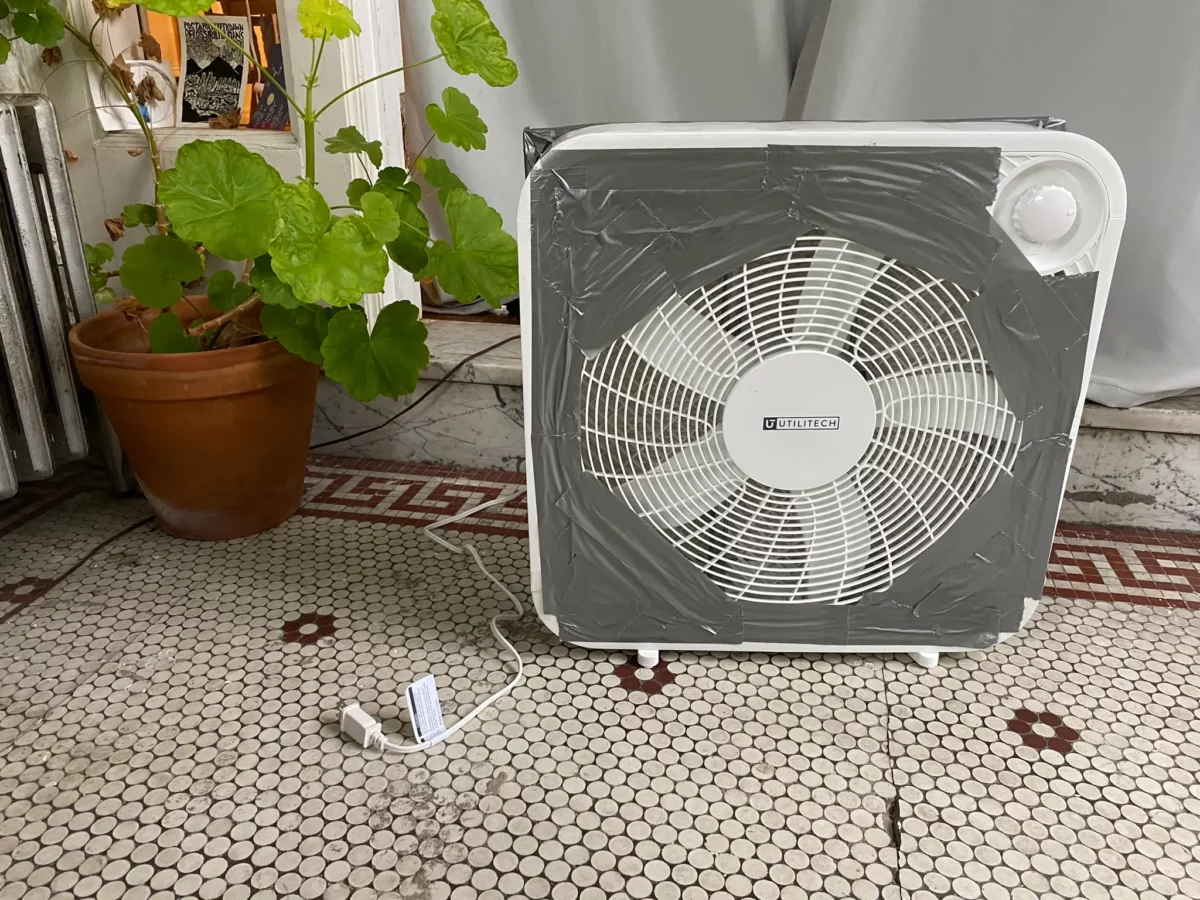
Do not treat brand names as safety guarantees. The useful specs are the filter type, clean-air delivery for the room size, whether it is actually running, and whether the room is closed enough for filtration to matter.
Choose the shortest workout that still does the job
Once the room is set, adjust the session. The most useful smoke-day training rule from Colorado State University is counterintuitive: reducing workout duration is more protective than reducing intensity during smoke events. Their guidance favors a short, intense workout over a long, moderate one because total exposure time matters.[6]
That does not mean every smoky day becomes a maximal interval day. It means that when conditions are elevated but your indoor air is controlled, a 12- to 20-minute focused session is usually a better bargain than 50 minutes of watered-down cardio. You keep the training signal and cut the time spent breathing harder.
| AQI band | Best indoor target | Good session choices | What to avoid |
|---|---|---|---|
| 51–100 | Normal training, with awareness | Regular strength workout, treadmill walk, bike, yoga, mobility, short HIIT if you planned it anyway | Ignoring symptoms just because the number is not red |
| 101–150 | Controlled indoor training | Strength training, moderate cardio, short intervals, bodyweight circuits | Long outdoor runs, hard outdoor rides, open-window workouts |
| 151–200 | Short indoor training in a filtered room | 15-minute interval circuit, 20-minute strength session, easy warmup plus main lifts | Long steady-state cardio, garage workouts with the door cracked, repeated high-volume breathing drills |
| 201–300 | Minimal dose, low irritation | Stretching, foam rolling, light mobility, short easy strength if indoor air is clearly filtered | HIIT, long cardio, “make-up” workouts, anything that causes coughing or chest tightness |
| 301+ | Rest or essential movement only | Gentle mobility, breathing-comfort positions, walking around the house as needed | Training for fitness adaptation |
A small 2025 University of Montana wildfire-smoke simulation study supports the caution around long exposure. In that study, 20 healthy exercisers had immediate declines in blood-vessel and nervous-system function after two hours of cycling in simulated smoky air, with values normalizing within one hour in clean air.[6] That is not a universal rule for every body and every smoke event. It is one study with a small healthy sample. But it fits the practical pattern: do not make smoky-air exposure longer than it needs to be.
What to do at AQI 151–200
Red AQI is the zone where many people make the worst trade: they cancel completely, then feel trapped and restless, or they go outside anyway because the streak matters. A better middle option is a short indoor session after air prep.
Keep the warmup brief and specific. If you are lifting, warm the joints and movement patterns you will use. If you are doing intervals, ramp up for a few minutes rather than turning the warmup into half the workout.
- Strength option: 3 rounds of squats or split squats, pushups or presses, rows or band pulls, and a carry or core move.
- Cardio option: 10 to 15 minutes of intervals on a bike, rower, treadmill, or step platform, with enough recovery to keep breathing controlled.
- Bodyweight option: timed rounds of lunges, incline pushups, hip hinges, dead bugs, and side planks.
- Maintenance option: one or two main lifts, a small amount of accessory work, then stop.
If you want a ready-made bodyweight structure, a busy-parent home workout plan or a no-equipment upper-body workout can be adapted by trimming total rounds rather than dragging the session out.
What changes at AQI 201 and above
Purple AQI is not just “red, but more annoying.” It is the point where the workout should shrink sharply, even indoors. If the room is sealed and filtration is running, choose mobility, stretching, foam rolling, or a very short easy strength session. If the room still smells smoky, skip training.
At AQI 301 and above, the useful move is not a modified workout. It is rest, essential movement, and keeping indoor air as clean as you can. Fitness does not disappear because you missed one hazardous-air day. Respiratory irritation can linger much longer than the satisfaction of forcing a session.
Multi-day smoke events are harder because they wear down routines. If you are stuck inside for several days, alternate very short training days with mobility or rest days. A flexible home gym plan by equipment tier is more useful here than a perfect weekly schedule that assumes clean air.
When masks, symptoms, or health history change the call
An N95 can filter fine particles when it fits well, but exercise is the hard case: the mask also increases breathing resistance. For many workouts, especially hard cardio, that makes a mask uncomfortable or impractical. A mask is not a workaround for doing intervals outside in heavy smoke.
Stop the workout if you develop coughing, wheezing, chest tightness, unusual shortness of breath, dizziness, or eye and throat irritation that worsens as you move. People with asthma, COPD, heart disease, pregnancy, recent respiratory illness, or a significant health setback should use stricter cutoffs and follow medical advice. If you are returning after illness or smoke-related symptoms, a safer return-to-home-fitness plan is a better starting point than a normal program.
Poor air is not a rare inconvenience in every city. The ACSM American Fitness Index reported in 2019 that the 100 largest U.S. cities averaged only 62% of the year with “good” air quality, though that figure may have shifted since then.[5] For people in wildfire-prone regions, smoke-day training is not an edge case. It is part of the home-fitness setup.
The smoke-day decision
If the AQI is green, train normally. If it is yellow, most healthy adults can train normally while sensitive people watch symptoms. If it is orange, sensitive people should move indoors and everyone should pay attention to symptoms. If it is red, solve the indoor-air problem first, then do a short session. If it is purple, keep movement minimal. If it is hazardous, rest.
The safest useful pattern is simple: check AirNow, close the room, run HEPA or a well-built DIY filter, shorten the workout as the AQI rises, and stop when the air or your body says the cost is no longer worth it.
References
- When Smoke is in the Air, AirNow
- Wildfire smoke can make your outdoor workout hazardous to your health, The Conversation
- Experts Offer Advice on Working Out During Wildfire Smoke Events, Public Health Institute
- Four Things to Know About Air Quality and Exercise, American Lung Association
- Air Quality and Outdoor Exercise, American College of Sports Medicine
- Is it safe to exercise outside when there is wildfire smoke in the air?, Colorado State University
- Wildfires and Indoor Air Quality (IAQ), US EPA
- Research on DIY Air Cleaners to Reduce Wildfire Smoke Indoors, US EPA
Don't have the gear this routine assumes? Find the build that covers it.
Wondering how much rest you need after this? Read our ACSM-cited recovery reference.
Questions about form, substitutions, or a correction? Leave it below.
Comments
Join the discussion with an anonymous comment.