
Routine
Tennis Conditioning Workout Inspired by Pro Matches
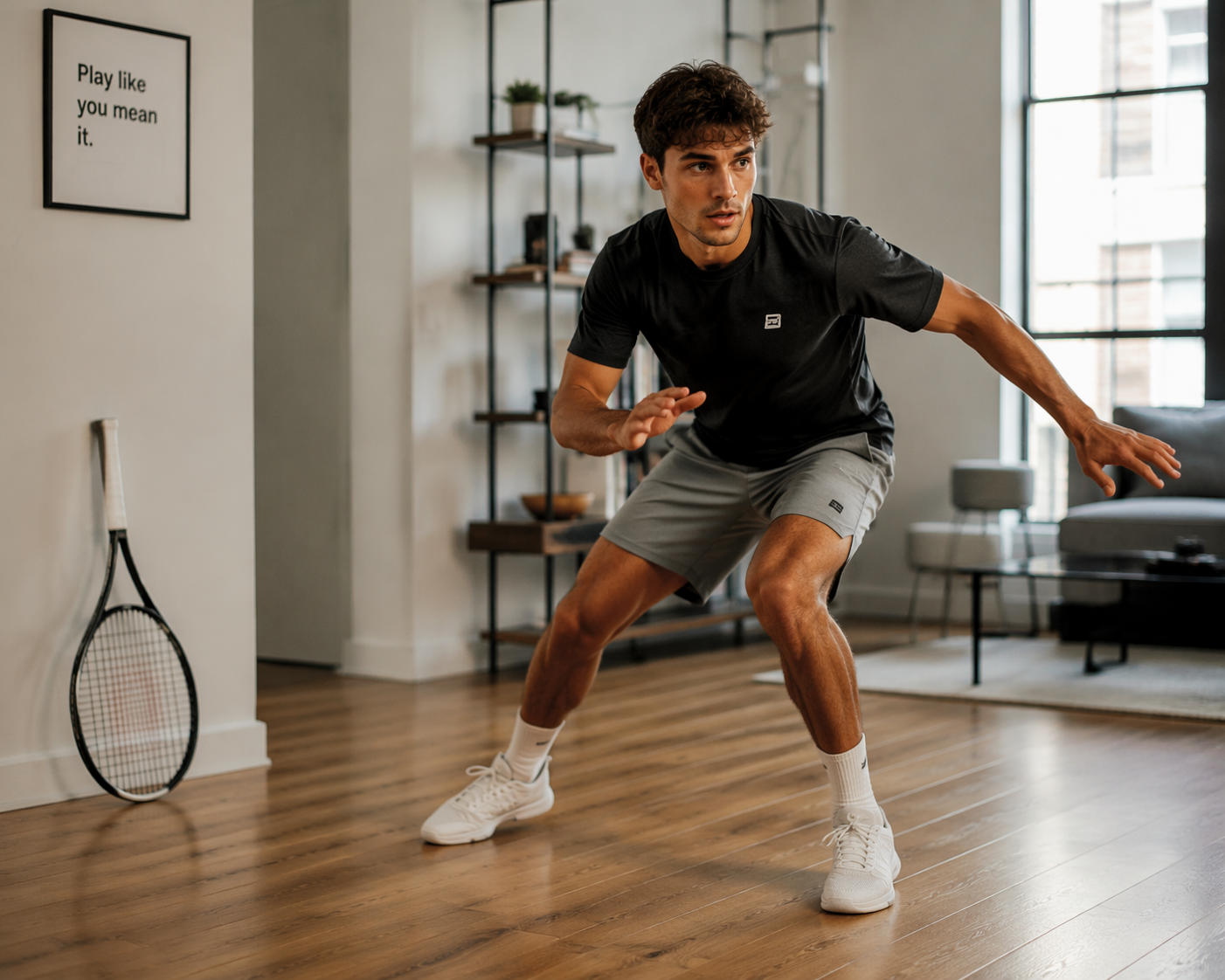
This 30-minute home conditioning workout is derived from the physical demands of professional tennis matches, using lateral shuffles, split-steps, and sprint starts in work-rest intervals that replicate the high-intensity burst pattern of real match play.
- Equipment Required
- none
- Space Needed
- small (6-8 ft wide area)
- Noise Level
- quiet
- Duration
- 30 minutes
A useful tennis conditioning workout from pro matches should not feel like a generic HIIT class with a racket leaning against the wall. Tennis is not mainly a slow run with occasional swings. Pro-match data describes something nastier and more specific: hundreds of short, hard efforts, brief recoveries, constant direction changes, and a movement pattern that lives mostly side-to-side.
Kovacs’ review of tennis physiology describes professional matches as containing roughly 300–500 high-intensity efforts, usually lasting 5–10 seconds, with about 10–20 seconds between points. The same review reports that elite players often spend much of a match at 60–90% of maximum heart rate.[1] That explains a familiar club-player problem: you can jog comfortably for miles and still feel late to the ball after a long third-set game.
The distance is not the whole story. Human Kinetics’ tennis movement summary puts typical point movement at about 8–12 meters with 3–5 changes of direction per rally.[1] The ATP’s 2023 Physicality Index makes the same point from another angle: men’s tennis had a higher workload-per-distance ratio than the other measured sports, with 2.33 meters per workload unit compared with 3.15 for the NBA and 4.40 for soccer.[2] Tennis can punish you without asking you to cover soccer-like mileage.
So the home session below is built around one idea: repeat point-like efforts often enough to stress tennis conditioning, while keeping the movements honest. No court, ladder, sled, or downstairs-neighbor-enraging jumping is required.
The 30-Minute Match-Repeat Circuit
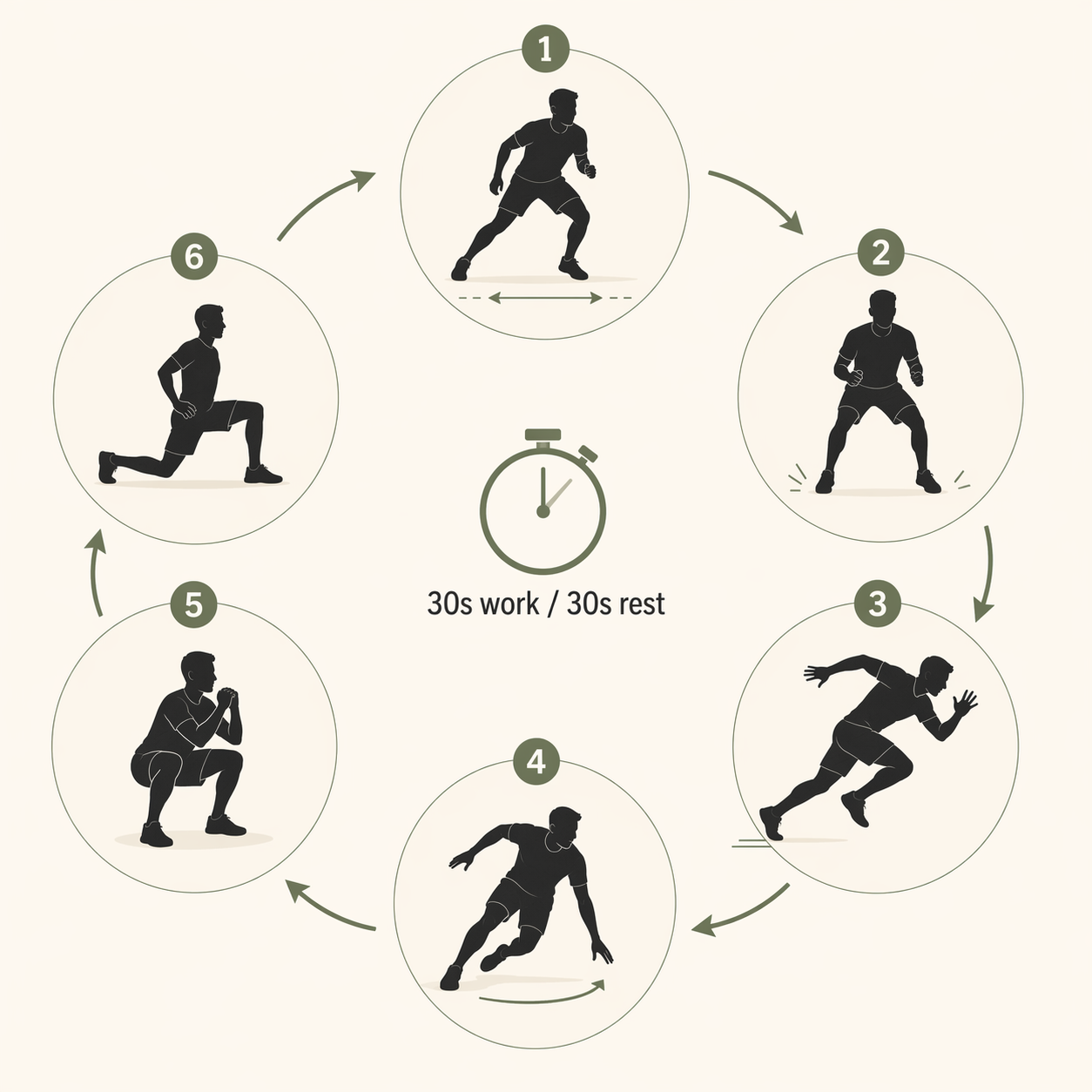
Use a timer set to 30 seconds of work and 30 seconds of rest. Complete the six movements in order, then repeat the circuit four times. With a short warm-up and a short cool-down, the whole session fits inside 30 minutes.
| Block | Time | What to do |
|---|---|---|
| Warm-up | 4 minutes | Easy bounce, hip circles, ankle rocks, bodyweight lunges, and slow lateral shuffles |
| Circuit round 1 | 6 minutes | Six drills: 30 seconds work, 30 seconds rest |
| Circuit round 2 | 6 minutes | Repeat the same six drills |
| Circuit round 3 | 6 minutes | Repeat, keeping footwork sharp rather than frantic |
| Circuit round 4 | 6 minutes | Repeat only if movement quality is still controlled |
| Cool-down | 3–4 minutes | Walk, breathe, then stretch calves, hip flexors, glutes, and adductors |
If you are new to interval conditioning, start with two or three rounds. The fourth round is not there to prove toughness. It is there to test whether your first step, split-step timing, and recovery footwork survive fatigue.
Station 1: Lateral Shuffle to Outside-Foot Brake
Mark two spots about three to four steps apart. Shuffle right, plant the outside foot, hold your torso under control for a split second, then shuffle left and repeat. Stay low enough that your hips and adductors are working, but not so low that you turn it into a squat endurance drill.
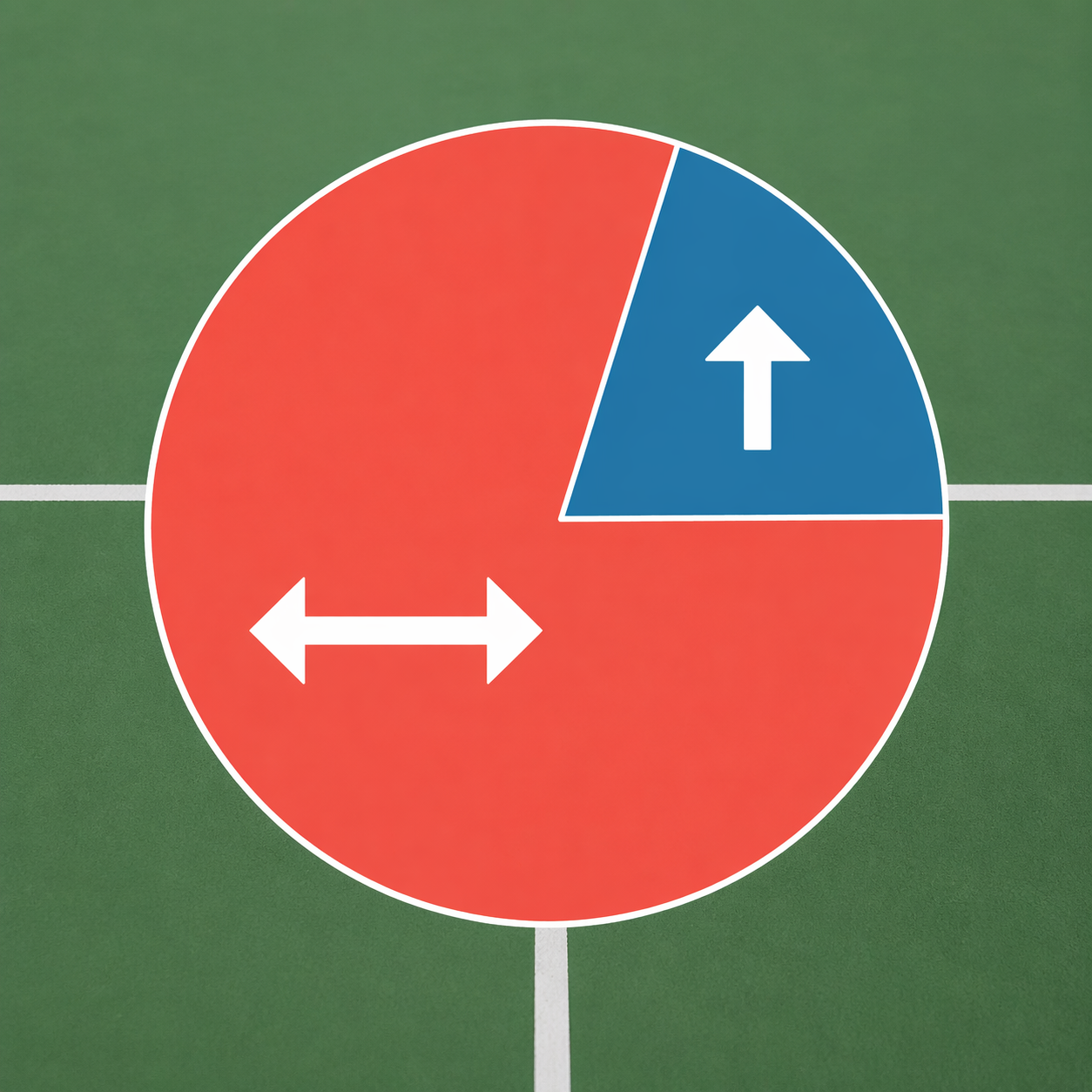
This is the backbone of the circuit because baseline tennis is heavily lateral. A study of eight professional baseline players in official ITF-sanctioned clay-court matches reported that lateral movements accounted for about 79% of on-court displacement, while forward movements accounted for about 21%.[3] That number should not be treated as a universal law for every surface and style, but it is strong enough to make side-to-side work the default, not the accessory.
Station 2: Split-Step, React, Recover
Start in an athletic stance. Perform a small split-step, then move one step to the right or left, as if reacting to a ball. Recover back to center before the next split-step. If you train alone, choose the direction yourself but avoid falling into a predictable rhythm: right, left, left, right, right, left is better than metronomic alternation.
The point is timing. Many home workouts train legs; fewer train the habit of landing, reading, pushing, and recovering. Keep the split-step quiet if you live above someone. The feet should leave the floor only enough to reset your stance.
Station 3: First-Step Sprint Starts
Set up in a ready position. On each rep, push hard for two or three steps forward, decelerate under control, then backpedal or walk back to the start. In a small apartment, make it a one-step acceleration: split-step, explosive first step, stick the landing, reset.
This drill covers the part steady cardio misses. Tennis conditioning is full of repeated starts, not just continuous movement. The distance can be tiny; the intent has to be sharp.
Station 4: Shuffle-to-Drop-Step Change of Direction
Shuffle two or three steps to one side, drop the outside foot slightly behind you, turn the hips, and push diagonally back toward center. Alternate sides. Think of recovering from a wide forehand or backhand rather than sliding around for the sake of sweating.
This station adds the messier piece of movement: you are not only going left and right, you are braking, turning, and re-accelerating. With match summaries describing 3–5 changes of direction per rally, the circuit needs more than straight-line shuttles.[1]
Station 5: Low Wide-Base Hold With Micro-Shuffles
Take a wide athletic stance, lower slightly, and make small two- to four-inch shuffles without standing up. Every few seconds, freeze as if you are loading before contact, then resume. This should burn through the hips and inner thighs without turning into knee collapse.
It is the least flashy station and one of the most useful indoors. Long baseline rallies ask you to stay low while making small corrections before the bigger move. This gives you that local fatigue without requiring a court-length run.
Station 6: Diagonal Lunge, Push Back, Split-Step
Step diagonally forward into a controlled lunge, push back to center, split-step, then repeat to the other side. Keep the front knee tracking cleanly and make the push back active. If lunges bother your knees, shorten the step and treat it as a diagonal reach.
This finishes the round by combining reach, balance, and recovery. It is not pretending to be a forehand or volley. It is training the lower-body shape that appears when you have to cover a ball outside your comfortable hitting zone and still return to neutral.
Why 30 Seconds Works for a Sport Built on 5–10 Second Bursts
A real tennis point is usually shorter than a 30-second work interval. That matters. This circuit is not a literal point simulator, and it should not be sold as one.
The reason 30 seconds is still useful is compression. Instead of performing one 5–10 second burst, resting, and repeating that pattern for an hour, the circuit stacks several point-like efforts into a controlled work block. During one 30-second station, you might split-step, push laterally, brake, recover, and repeat several times. The following 30 seconds gives enough rest to keep the next station crisp while keeping the heart rate from fully settling.
That structure lines up with repeated-effort conditioning formats used by tennis fitness coaches, including 30-second work and 30-second rest intervals.[4] It also respects the match pattern better than a continuous 20-minute jog, because quality depends on recovering just enough to accelerate again.
The rest periods are part of the workout, not wasted time. If you turn the whole thing into nonstop movement, the first step gets slower, the split-step disappears, and the session drifts back toward generic fatigue. Tennis punishes late movement more than it rewards theatrical exhaustion.
How Hard Each Round Should Feel
Round one should feel almost too controlled. You are learning the room, the floor, and the timing. Round two is where breathing starts to matter. Round three should feel like the middle of a hard service game: not destroyed, but aware that every lazy recovery step makes the next ball harder. Round four belongs only if you can still move like a tennis player.
- Good fatigue: shorter breathing, hot legs, sharper focus needed to keep your feet organized.
- Bad fatigue: knees caving in, loud landings, upright shuffling, or turning every drill into a bounce-in-place cardio move.
- Apartment rule: reduce jump height before reducing intent. A quiet split-step can still be a real split-step.
- Tennis rule: stop a round when recovery footwork disappears. The conditioning target is repeatable quality, not random suffering.
For most recreational players, two versions are enough. Use the standard version when you have normal energy: four rounds, 30 seconds on, 30 seconds off. Use the maintenance version during a busy week: three rounds with the same timing. Do not shorten the rest first. Shorter rest often makes the workout look harder while making the tennis movement worse.
What This Workout Can and Cannot Claim
The match-demand case is strong enough to shape the workout. It is not strong enough to promise better match results by itself.
The 79% lateral movement figure comes from a small study of eight professional baseline players on clay.[3] A serve-and-volley player, a doubles specialist, a grass-court match, or a very different rally profile could shift the movement mix. Even among professionals, distance covered can vary enormously by style; David Ferrer covered roughly 10,000 meters through three rounds while Novak Djokovic covered about 4,000–5,000 meters across the same span. That does not make the lateral bias useless. It just keeps it in its lane.
There is also no cited study showing that this exact match-data-derived circuit improves match performance more than generic conditioning. The logic is physiological and practical: tennis asks for repeated bursts, lateral recovery, first-step acceleration, and direction changes; this session trains those qualities in a compact format. Court time, stroke technique, serve practice, strength work, and actual point play still matter.
Where It Fits in a Tennis Week
Use this circuit one or two times per week when you do not have court access or when you need a conditioning session that still feels connected to tennis. Keep at least one easier day after the full four-round version if your hips, calves, or adductors tend to get cranky.
It pairs best with a broader plan that includes mobility, strength, and skill work. For weekly placement, use the companion guide Build a Tennis Home Training Routine as the larger schedule, then drop this session into the conditioning slot.
If you later add equipment, keep it minimal: bands for hip and shoulder work, or a compact home-gym setup that does not steal the floor space you need for shuffles. The circuit itself needs only a timer, a safe patch of floor, and enough discipline to rest before the next burst gets sloppy.
References
- Tennis Physiology: Training the Competitive Athlete, Strength and Conditioning Journal / Tennisology / Human Kinetics, 2007.
- ATP Physicality Index, ATP Tour, 2023.
- Matt's Point research review of Pereira et al. 2016, Matt's Point.
- 30-second work / 30-second rest tennis fitness protocol, Tennis Fitness.
Ready to rest?
Don't have the gear yet?
- none
Comments
Join the discussion with an anonymous comment.