
Routine
Wimbledon Tennis Training Tips You Can Do at Home with Bands
A set of resistance bands and a 6x6 foot space is all you need to train like a Wimbledon champion. This article shows recreational tennis players how to use a simple, budget-friendly band routine to improve serve velocity and court performance, based on a 4.9% serve-velocity improvement study and training methods of pros like Jannik Sinner.
- Equipment Required
- resistance bands
- Suggested Build Tier
- $0–100
- Space Needed
- 6x6 ft
- Noise Level
- low
- Duration
- 25–35 minutes
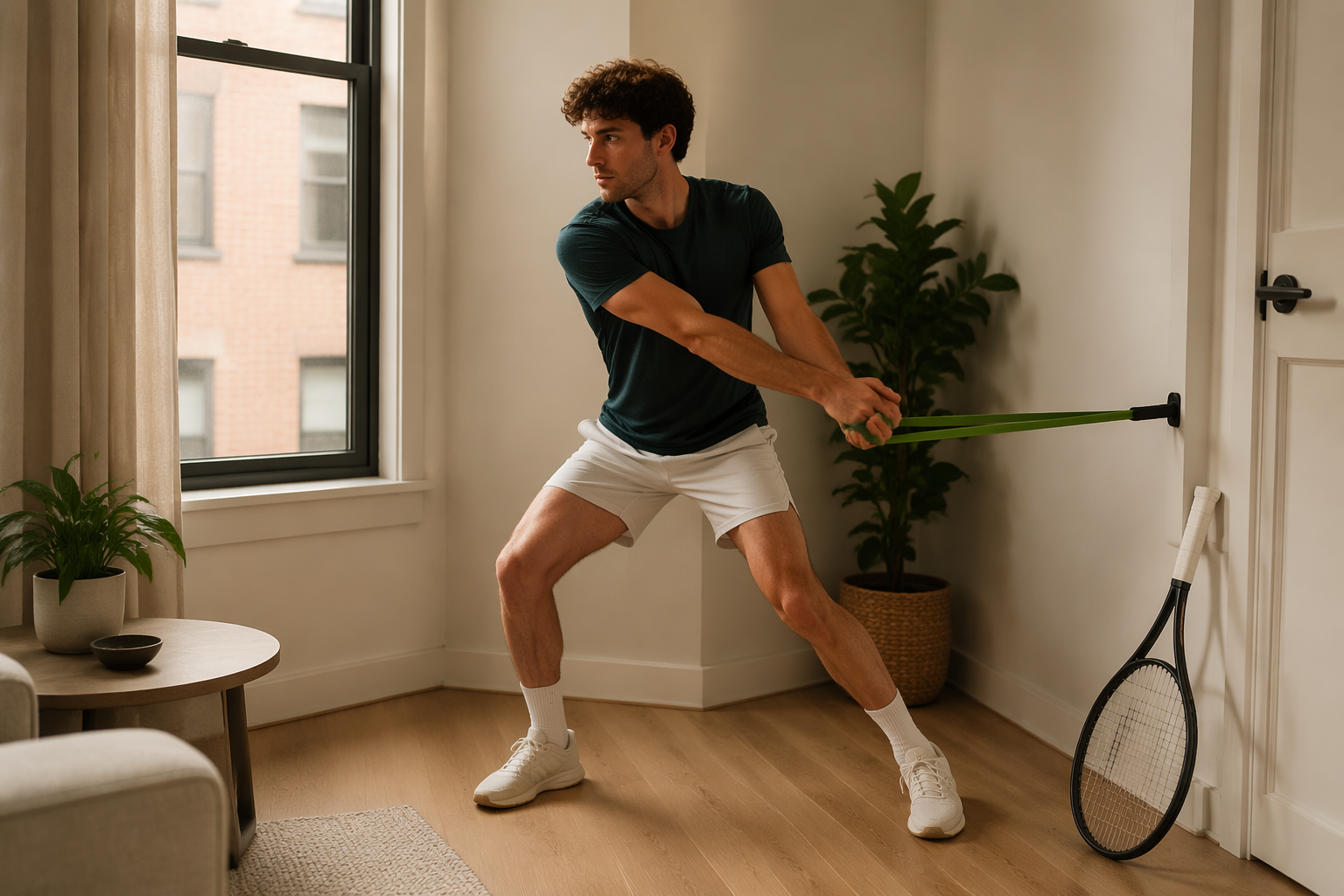
The most useful tennis training tips from a Wimbledon player are not always the glamorous ones. In a small apartment, the question is simpler: can you make tomorrow’s serve, forehand, and first step feel better with three resistance bands and a clear 6-by-6-foot corner?
For a FitAtHome-style setup, that answer starts in the $0–100 build tier. A basic set of very light, light, and medium bands usually sits around $20–$50, weighs only about 200–500g per band, and can live in a drawer, gym bag, or coat closet instead of claiming permanent floor space. Tennis Fitness, a commercial vendor that sells band equipment, gives a practical replacement window of 6–12 months when bands are used 2–3 times per week.[1]
That matters because most home tennis advice quietly assumes you have a garage, a spare room, or a gym membership. A band routine does not. It gives you enough resistance to train shoulder rotation, trunk control, racquet-side forearm endurance, and lunge stability without dumbbells hitting the baseboard or a barbell living beside the sofa.
There is a pro-level precedent, but it should be used carefully. As reported in Men’s Health UK, Jannik Sinner, the 2025 Wimbledon champion, has favored resistance bands over dumbbells and barbells because bands let him build functional strength through tennis-specific movement patterns while putting less force through the joints.[2] That does not mean a recreational player becomes Sinner by buying latex tubing. It does mean bands are not second-rate equipment reserved for rehab corners.
The Serve-Speed Evidence Is Useful, With Limits
The strongest evidence in this conversation is not a champion’s training clip. It is a controlled 6-week study by Fernandez-Fernandez and colleagues in the Journal of Sports Science & Medicine. The study involved 30 nationally ranked male junior tennis players who completed 1-hour sessions 3 times per week using a TheraBand, core, and medicine-ball protocol. The training group improved serve velocity by 4.9%.[3]
That number is worth respecting because serve speed is not a vague wellness outcome. It is a tennis outcome. A serve asks the shoulder, trunk, hips, legs, and forearm to coordinate at speed, then repeat that action under fatigue. A protocol that moves serve velocity in trained junior players deserves attention from anyone trying to make off-court work transfer back to the court.
The caveat is just as important as the improvement. The subjects were nationally ranked male juniors, not adult doubles players squeezing in a session after work. The protocol also included more than bands: medicine-ball and core work were part of the intervention.[3] So the honest takeaway is not “bands add 4.9% to your serve.” It is that tennis-specific resistance work, including band work, can plausibly improve a serve-related performance measure when trained consistently.
| What the study supports | What it does not prove |
|---|---|
| A 6-week, 3-times-per-week tennis-conditioning block can improve serve velocity in competitive junior players. | That every recreational adult will gain the same 4.9%. |
| Band work can belong inside a serious tennis-strength plan. | That bands alone replace all court practice, coaching, or full-body conditioning. |
| Tennis-specific exercises matter more than generic resistance-band circuits. | That any random band workout will transfer to serving and movement. |
The Seven Band Moves That Actually Map to Tennis
Performance Health and TheraBand publish a tennis-oriented band protocol that includes external rotation, rows, dynamic hug, wrist flexion and extension, reverse fly, supine crunch, and band lunges.[4] These vendors also sell the equipment they recommend, so their protocol should not be treated as neutral proof by itself. Still, the exercise choices make tennis sense, especially when you judge them by what the sport asks from the body.
External Rotation: The Serve-Shoulder Staple
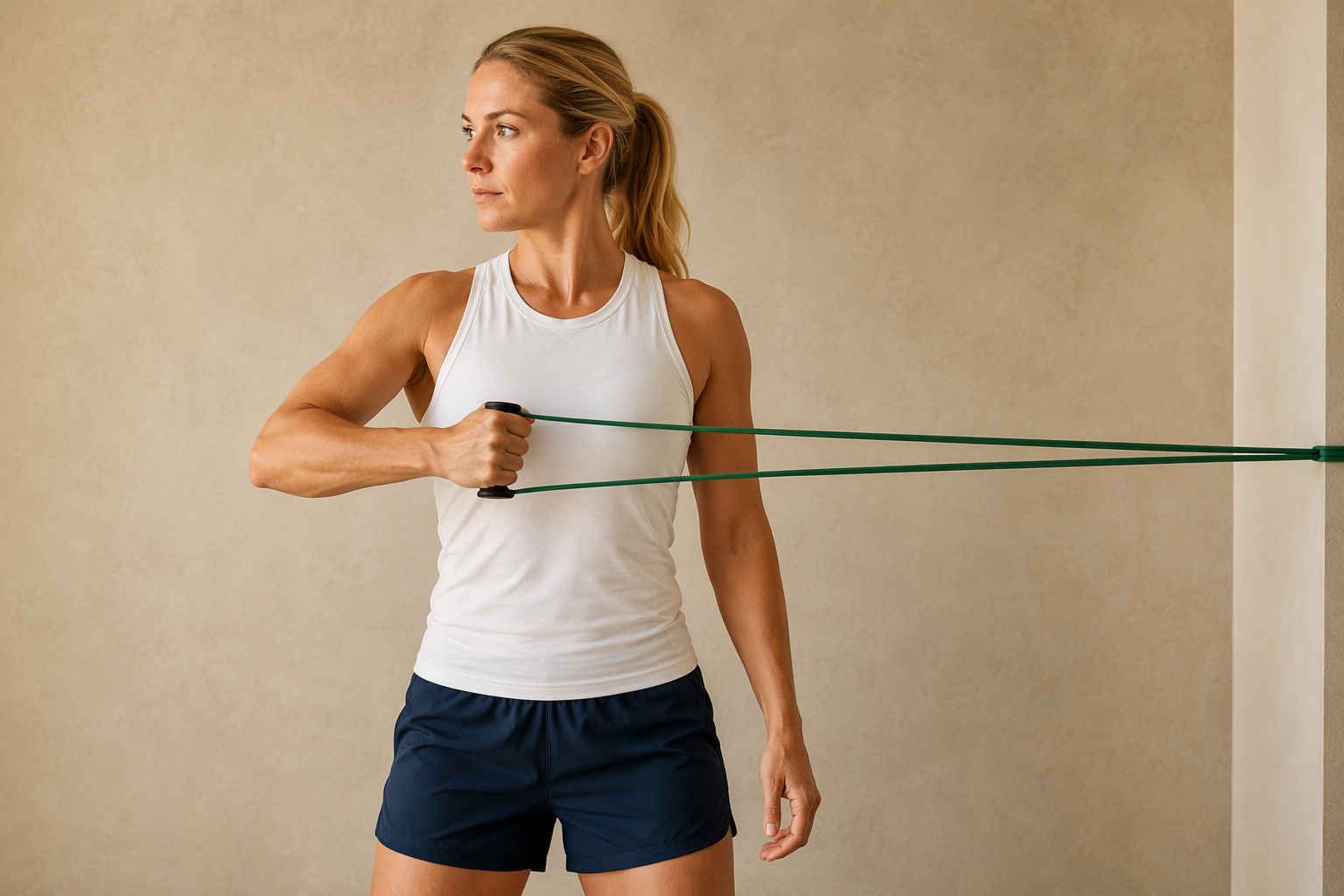
External rotation is the first exercise I would keep if the whole routine had to be cut down. Anchor the band at about elbow height, keep the working elbow bent at 90 degrees, and rotate the forearm away from the body without letting the shoulder roll forward. Use the very light band first. This is not a max-strength lift; it is shoulder control for the repeated loading that happens before and after a serve.
A recreational player usually feels the temptation to make this harder too soon. Resist that. The better progression is cleaner reps, slower return, and no shrugging. If your upper trap is doing the work, the band is too heavy or the anchor is wrong.
Rows: Posture for Groundstrokes and Serving
Rows are less glamorous than rotational drills, but they are useful because tennis constantly pulls players forward: serving, reaching for volleys, recovering after wide balls, and carrying tension through the front of the shoulder. A band row trains the upper back to pull the shoulder blades back and down instead of letting everything collapse toward the racquet hand.
Use the light or medium band depending on control. Step back until the band has tension, hinge slightly at the hips, and row toward the lower ribs. Pause briefly before returning. If you have limited court time, this is one of the better apartment exercises for preserving the posture you need late in a set.
Wrist Flexion and Extension: Racquet Control Under Fatigue
Forearm work is easy to overdo and easy to ignore. Both are mistakes. Wrist flexion and extension with a very light band train the smaller muscles that help manage racquet angle, grip endurance, and late-contact stability. They will not fix timing, but they can make the hand and forearm less likely to be the weak link when points get longer.
Keep the elbow still, move through a controlled range, and stop well before the movement becomes a tendon-irritation contest. For most recreational players, these belong near the end of the session, after shoulder and trunk work, not as a pre-court fatigue drill.
Band Lunges: Balance in the Positions Tennis Actually Uses
Tennis footwork is full of imperfect positions: a wide forehand, a rushed recovery step, a low volley, a split-step that turns into a lunge. A band lunge trains leg strength and balance while the band adds a small stability demand. That is more relevant than doing endless squats in place if your main problem is staying organized when pulled outside the singles line.
Start with bodyweight or a very light band. Step into the lunge, keep the front knee tracking cleanly, and return with control. The useful rep is the one where the hips stay level and the foot does not wobble. Add tension only after that is boring.
The Supporting Moves
Dynamic hug, reverse fly, and supine crunch round out the routine. Dynamic hug trains the chest and rotator cuff through a controlled forward pattern. Reverse fly gives the rear shoulder more work, which pairs well with rows. Supine crunch covers basic trunk strength, though it should not be mistaken for the full rotational demand of serving and groundstrokes.[4]
- External rotation: very light band, shoulder control, serve durability.
- Row: light to medium band, upper-back strength, posture under fatigue.
- Dynamic hug: very light to light band, chest and shoulder coordination.
- Wrist flexion and extension: very light band, forearm endurance and racquet control.
- Reverse fly: very light to light band, rear-shoulder stability.
- Supine crunch: bodyweight or band-assisted variation, trunk strength.
- Band lunge: bodyweight to light band, leg strength and balance.
A Small-Space Weekly Plan That Still Leaves Room for Tennis
The mistake is trying to turn bands into a second sport. They are there to support your tennis, not replace it. A practical week for a recreational player is 2 band sessions and 2 on-court sessions. Living360 reported a similar 2-and-2 structure from British player Katie Boulter’s coach Alex Ward, with 30-seconds-on and 30-seconds-off intervals used to echo the rhythm of tennis points.[5]
| Day | Session | Focus |
|---|---|---|
| Monday | Band session, 25–35 minutes | Shoulder, row, forearm, lunge, trunk |
| Tuesday | On-court session | Serve practice, rally rhythm, footwork |
| Wednesday | Rest or easy mobility | No heavy shoulder fatigue |
| Thursday | Band session, 25–35 minutes | Repeat the same pattern with cleaner reps |
| Friday | Rest | Let the arm feel fresh |
| Saturday | On-court session or match play | Apply the work under real timing |
| Sunday | Rest or light walk | Recover before the next week |
For the band sessions, 30 seconds of work followed by 30 seconds of rest keeps the workout honest without turning it into sloppy conditioning. Do 1–3 rounds depending on training age, shoulder history, and whether you are playing the next day. If you are new to bands, one careful round beats three ugly ones.
| Exercise | Work |
|---|---|
| External rotation | 30 seconds each side |
| Row | 30 seconds |
| Dynamic hug | 30 seconds |
| Wrist flexion | 30 seconds each side |
| Wrist extension | 30 seconds each side |
| Reverse fly | 30 seconds |
| Supine crunch | 30 seconds |
| Band lunge | 30 seconds each side |
The court sessions are where the adaptation has to prove itself. Put some serves in after the first band day, but do not turn the next practice into a serve-speed test. Hit targets, check whether the shoulder warms up more smoothly, and notice whether your legs stay organized on wide balls. The band work should make tennis practice more productive, not become a private contest to pull a thicker band every week.
How to Choose Bands Without Turning This Into a Gear Project
Buy three levels: very light, light, and medium. Very light covers external rotation and wrist work. Light covers dynamic hug, reverse fly, and early lunges. Medium can be useful for rows and stronger lower-body work once form is stable. That is enough for the $0–100 tier, and it stays compatible with a rental apartment.
Inspect the bands before sessions. Small tears, chalky patches, or uneven stretch are signs to replace them. The 6–12-month replacement window from Tennis Fitness is a reasonable planning range for 2–3 weekly uses, but storage changes that timeline: heat, sunlight, and sharp anchor points shorten band life.[1]
If you already use bands for general conditioning, this also fits neatly beside other small-space routines. FitAtHome’s Chris Hemsworth-inspired apartment band workout uses the same basic logic: portable resistance, low setup time, and no bulky strength station. For tennis, the difference is exercise selection. The band is only as useful as the movement you ask it to train.
What to Expect From Six Weeks
Six weeks is long enough to learn the routine, build consistency, and see whether the court feels different. It is not long enough to rebuild a serve from scratch. The Fernandez-Fernandez study gives a useful target window because its players trained 3 times per week for 6 weeks, but a recreational version with 2 band days and 2 court days is a more realistic fit for most adults.[3]
The best signs are boring ones: the shoulder feels warmer sooner, the racquet face stays steadier late in a rally, lunges feel less panicked, and the serve motion tolerates repeat practice better. If serve speed improves, good. If the bigger change is that you can practice serves without the shoulder grumbling afterward, that is still a meaningful tennis outcome.
Resistance bands are the best first tennis-strength tool for a small-space home setup, especially inside the $0–100 tier. The serve-speed evidence is real but narrower than the sales pitch: it comes from competitive juniors using a broader conditioning protocol, and it still depends on regular court practice. Use the bands to train the positions tennis keeps asking you to survive, then take that body back onto the court.
References
- Resistance Bands for Tennis Training, Tennis Fitness.
- Jannik Sinner resistance band training report, Men’s Health UK, 2026.
- Effects of a 6-week junior tennis conditioning program on service velocity, Journal of Sports Science & Medicine, 2013.
- TheraBand tennis exercise protocol, Performance Health / TheraBand.
- Katie Boulter training diary and Alex Ward coaching notes, Living360, 2025.
Ready to rest?
Don't have the gear yet?
- resistance bands
Comments
Join the discussion with an anonymous comment.