
How to Combine Yoga and Martial Arts at Home with No Equipment
Combine yoga flows and martial arts bodyweight drills in one 30-minute session using nothing but a yoga mat. This routine gives renters and apartment dwellers on a tight budget a proven way to build flexibility, balance, and strength without any additional equipment.
- Equipment required
- Yoga mat only
- Space needed
- Yoga mat plus arm reach
- Duration
- 30 min
- Difficulty
- beginner
- Noise level
- quiet
Don't have this yet? Compare options in Equipment, or see which build tier already includes it in the build matrix.
You can train yoga and martial arts at home with one yoga mat, a cleared rectangle of floor, and 30 minutes. Not pretend-sparring in the living room. Not a full grappling class. A real home-conditioning session that uses yoga for joint prep, balance, breath control, and mobility, then uses martial arts bodyweight drills for stance strength, hip control, trunk rotation, and quiet coordination.
The useful question is not whether a $20–30 mat can turn an apartment into a dojo. It cannot. The useful question is whether a beginner can start meaningful yoga martial arts home training today without buying pads, bags, bands, gloves, blocks, or a subscription. For that, the answer is yes.
| Routine Card | Details |
|---|---|
| Category | routines |
| Equipment required | Yoga mat only |
| Budget tier | $0–30 home-training build |
| Duration | 30 minutes |
| Training type | No-equipment bodyweight |
| Space needed | Small-footprint, roughly one yoga mat plus arm reach |
| Noise level | Quiet-workout friendly |
| Experience level | Beginner-friendly with modifications |
| Best for | Renters, apartment dwellers, and anyone starting with limited gear |
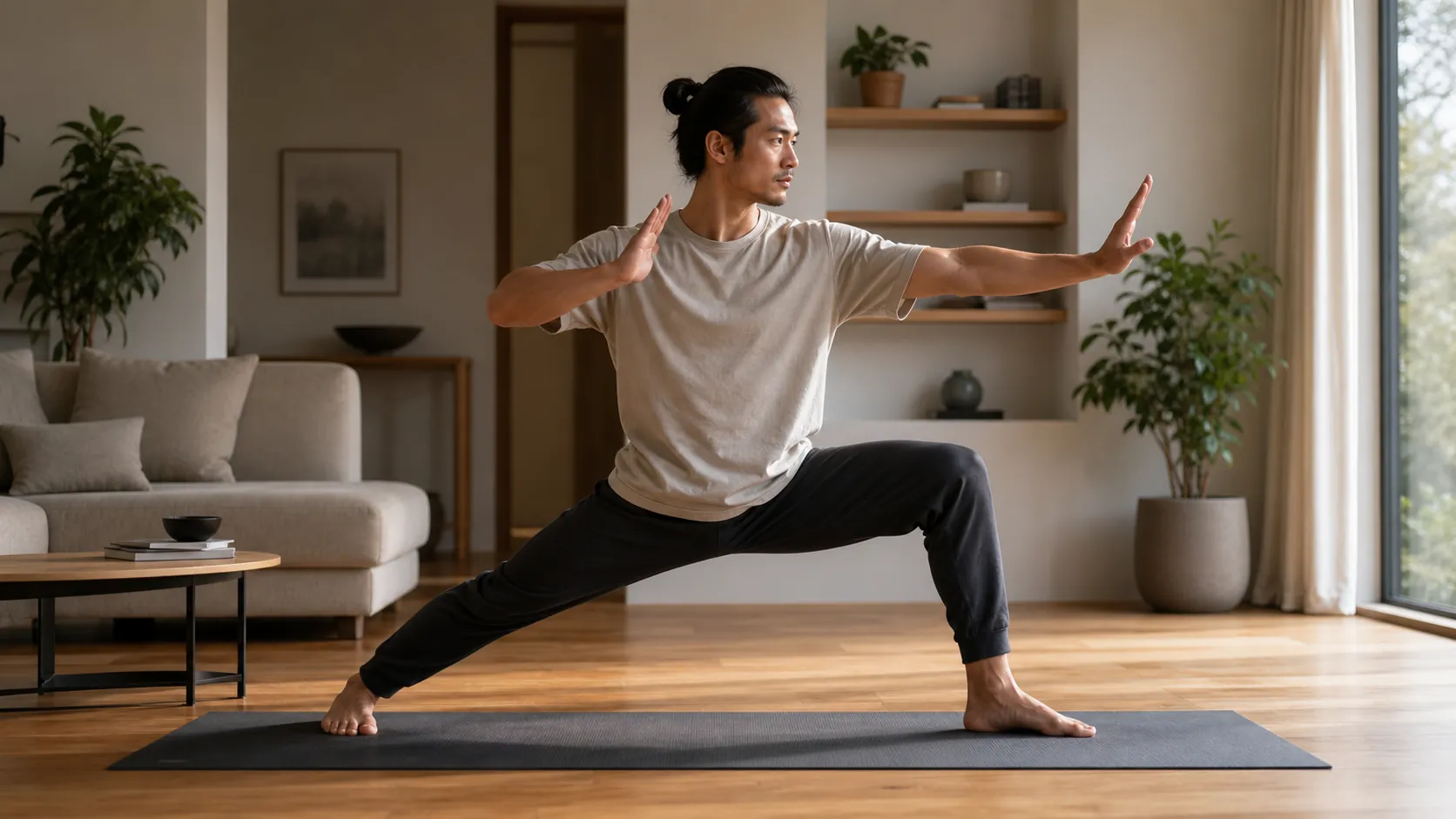
The 30-Minute Yoga + Martial Arts Mat Session
This session alternates between control, mobility, strength, and coordination. The yoga portions are not filler warmups; they prepare the hips, spine, shoulders, and balance system for the martial arts drills. The martial arts portions are not performance cosplay; they give the yoga positions a practical job.
| Time | Work | Purpose |
|---|---|---|
| 0:00–4:00 | Breathing, cat-cow, wrist circles, ankle circles, slow squat-to-stand | Prepare wrists, spine, ankles, hips, and breathing rhythm |
| 4:00–9:00 | Slow yoga flow: down dog, low lunge, crescent lunge, gentle twist, repeat both sides | Open hip flexors, warm shoulders, build balance before stance work |
| 9:00–14:00 | Horse stance intervals: 20 seconds hold, 10 seconds stand tall, repeat 10 rounds | Build leg endurance, posture control, and quiet lower-body strength |
| 14:00–19:00 | Ground movement: hip escape/shrimping, bridge, technical sit-through pattern | Practice ground movement mechanics without impact |
| 19:00–24:00 | Fighter-oriented yoga sequence: locust, revolved down dog, balancing half moon, crescent lunge | Train posterior chain, trunk rotation, balance, and hip strength |
| 24:00–28:00 | Low-impact martial arts coordination: slow knee chamber, step-back guard, stance switch, controlled front-kick chamber | Practice balance and coordination without striking furniture or shaking the floor |
| 28:00–30:00 | Child’s pose, supine twist, easy seated breathing | Bring breathing down and check hips, back, wrists, and knees |
Keep the whole session quiet. No jumping. No fast shadowboxing. No slamming hip escapes. If your floor is thin, slow repetitions are not a compromise; they are the condition that makes the workout sustainable in an apartment.
0:00–9:00: Use yoga to prepare the joints you will actually need
Start on hands and knees. Move through cat-cow slowly enough that the spine changes shape segment by segment instead of collapsing at the low back. Circle the wrists because the ground-work section will ask them to support weight. Circle the ankles because stance work punishes stiff ankles more than beginners expect.
Then move into a simple flow: down dog, step one foot forward into a low lunge, rise into crescent lunge, turn gently toward the front knee, return to down dog, and switch sides. Yoga15’s fighter-focused sequence includes crescent lunge as a useful pose for fighters, with applications around hip opening, balance, and lower-body positioning rather than vague “warrior mindset” language.[1]
For a beginner, crescent lunge has one job here: make the next stance feel less like a fight against tight hip flexors. Keep the back knee slightly bent if the low back pinches. Put hands on hips instead of overhead if balance is the limiting factor.
9:00–14:00: Horse stance without pretending it is a whole martial art
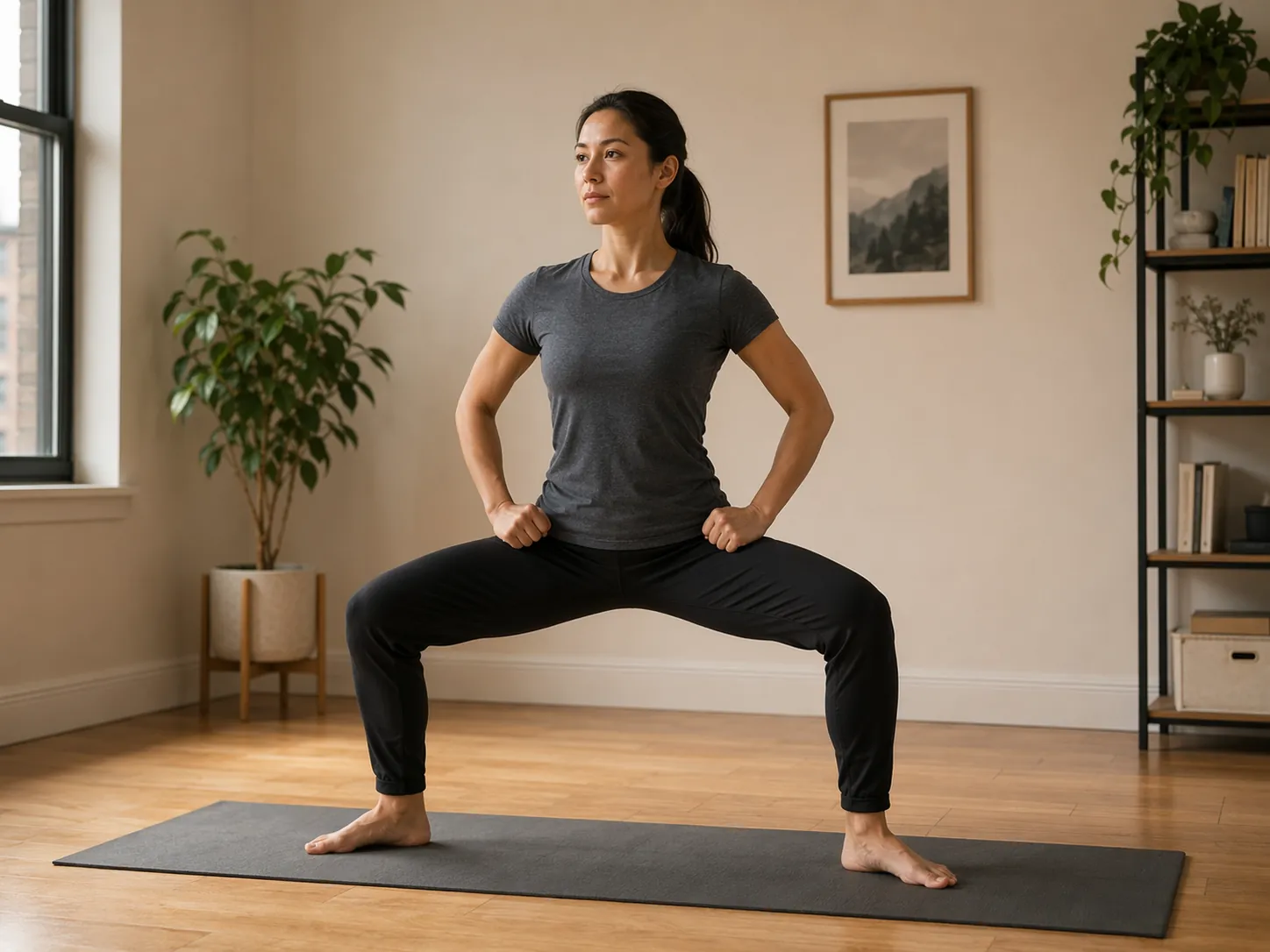
Step the feet wider than hip-width, turn the toes slightly out or keep them parallel if your knees tolerate it, bend the knees, and sit the hips down only as far as you can keep the spine tall. Hold for 20 seconds, stand up for 10 seconds, and repeat for 10 rounds.
Ooltewah Jiu-Jitsu lists horse stance among martial-arts-inspired exercises that can be done anywhere with no equipment, pointing to its role in leg power and lower-body strength.[2] In this routine, that claim gets narrowed to something a home beginner can use safely: horse stance builds leg endurance, postural control, and tolerance for holding a low position.
- If your knees cave inward, make the stance narrower.
- If your heels lift, reduce depth before you blame your mat.
- If your thighs shake, that is useful feedback, not failure.
- If you feel sharp knee pain, stop the stance and switch to a wall-supported squat hold.
Do not add punches yet. Beginners often lose their knees, ribs, and breathing the moment the arms start moving. Hold the shape first. The coordination layer can come later.
14:00–19:00: Practice hip escapes like ground movement, not floor cardio
Lie on your back with knees bent. Push through one foot, lift the hips, turn slightly onto one shoulder, and slide your hips away as if making space between your ribs and an imaginary opponent. Reset and repeat to the other side. Grant MMA includes shrimping, also called the hip escape, in a no-equipment home workout context.[3]
For home training, the hip escape is one of the best transfers between martial arts and mat work because it teaches the body to move from the hips instead of flailing from the shoulders. It is also quiet. Done well, the movement looks almost too small: bridge, angle, slide, reset.
- Beginner version: keep the hands close to the chest and move only a few inches each rep.
- More demanding version: extend the top leg as you escape, then pull the knee back in before resetting.
- Apartment rule: slide the hips; do not thump them back to the floor.
Add a simple bridge between sets: feet down, hips up, ribs controlled, lower slowly. This supports the same ground-movement pattern without needing a partner, dummy, or mat thicker than the one you already have.
19:00–24:00: Fighter-oriented yoga poses that earn their place
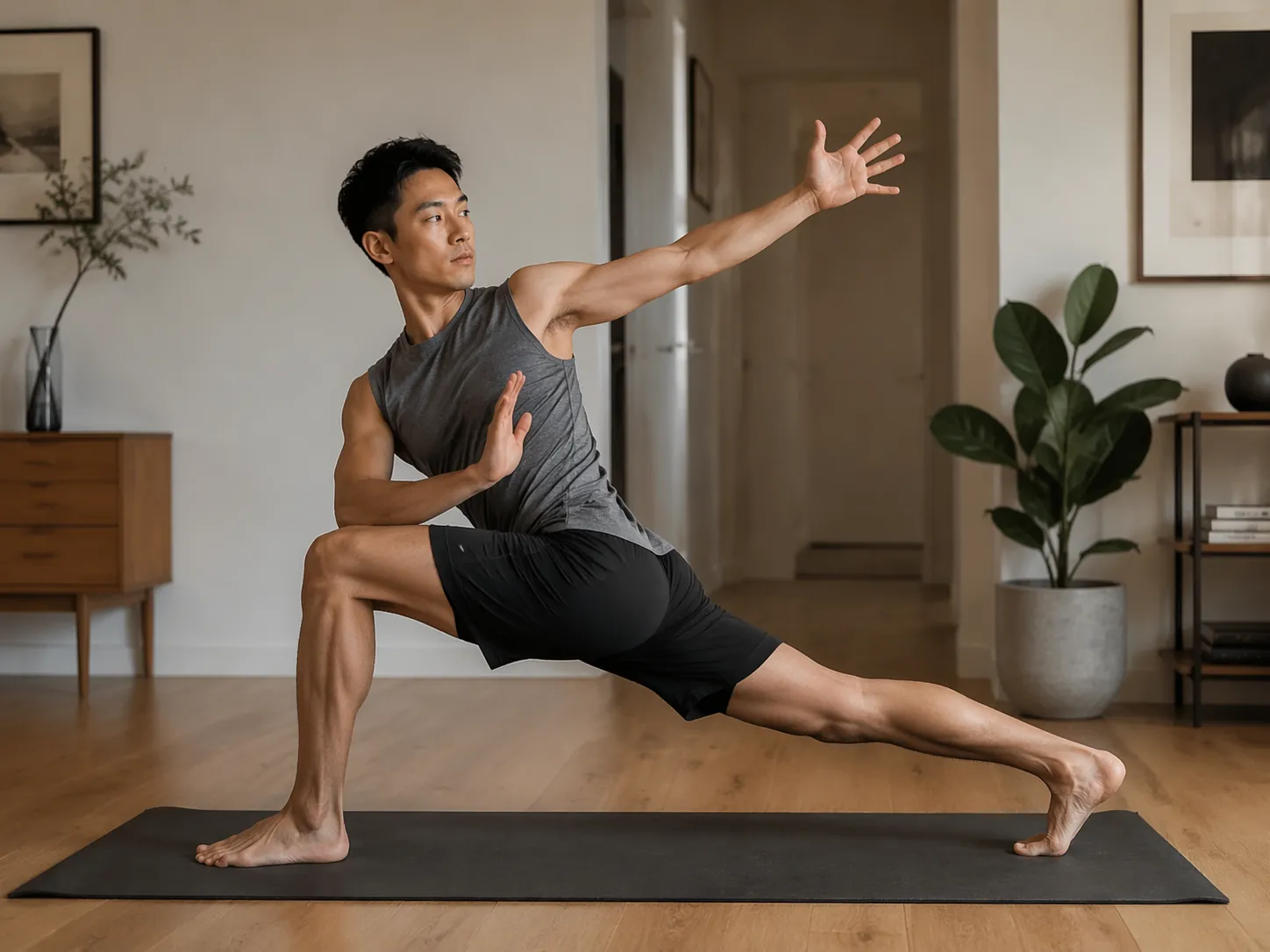
This is the part where yoga should stop being a generic stretch break. Yoga15’s yoga-for-fighters sequence names poses that map cleanly to martial arts needs, including crescent lunge, locust, revolved down dog, and balancing half moon.[1] You do not need all nine poses from the source sequence today. Four are enough for a 30-minute beginner session.
| Pose | How to use it at home | Why it fits martial arts conditioning |
|---|---|---|
| Locust | Lie face down, lift chest and legs lightly, keep the neck long, hold 3 slow breaths. | Builds posterior-chain awareness for posture and hip extension. |
| Revolved down dog | From down dog, reach one hand toward the opposite ankle or shin without forcing the twist. | Trains trunk rotation while keeping the shoulders and hips organized. |
| Balancing half moon | Use fingertips on the floor or a sofa edge if needed; lift one leg and open the chest. | Challenges balance, hip strength, and control on one standing leg. |
| Crescent lunge | Step long, bend the front knee, lengthen through the back leg, and breathe before adding rotation. | Links hip mobility, leg drive, and upright posture. |
The standing balance work matters because martial arts footwork often fails before the kick, turn, or stance even begins. If balancing half moon is too much, use a hand on the wall. The goal is not to prove you can wobble dramatically on one leg. The goal is to make the hip work while the torso stays organized.
24:00–28:00: Add coordination without adding noise
Stand near the center of the mat. Step one foot back into a comfortable guard stance, bring the rear knee forward into a slow chamber, place it down softly, then switch sides. After a few rounds, turn the chamber into a controlled front-kick shape without snapping the knee hard or aiming at furniture.
This is not striking practice in the formal sense. There is no bag, no coach, no target feedback, and no partner reading your movement. Treat it as balance and coordination practice: lift the knee, control the pelvis, place the foot down quietly, recover your stance.
- Hands stay relaxed in guard; shoulders do not climb toward the ears.
- The standing foot grips the floor without twisting the knee.
- The kicking leg moves slowly enough that you could stop at any point.
- Each foot returns to the mat silently.
28:00–30:00: Cool down before the room turns back into a room
Finish with child’s pose, a supine twist, and easy seated breathing. This does not need to become a ceremony. Let the breathing slow down, notice whether the knees or wrists feel irritated, and put the coffee table back where it belongs.
Why These Movements Work Together
Yoga and martial arts do not become one seamless system just because both can happen barefoot on a mat. The overlap is more specific than that. They share positions and capacities: hips that can open without collapsing the spine, legs that can hold low stances, shoulders that can bear weight, and a trunk that can rotate without yanking the low back around.
Crescent lunge prepares the same long split-stance relationship that appears in stepping, lunging, and recovering balance. Revolved down dog gives rotation under shoulder load. Locust teaches the back side of the body to participate instead of letting every movement become a quad-and-neck effort. Balancing half moon exposes whether one hip can hold the body steady while the torso changes position.[1]
Horse stance adds the piece yoga flows sometimes avoid: sustained leg fatigue in a symmetrical low position. Hip escapes add a different kind of intelligence: moving the pelvis on the ground, creating an angle, and coordinating a push from the foot with a turn of the torso.[2][3]
That is why the routine does not need much equipment. A bag would help striking. Bands or weights would help progressive resistance. A coach would help technique. But for this first tier, the mat is enough to give the hands, knees, spine, and hips a defined training surface while bodyweight supplies the load.
What the Flexibility Claim Can and Cannot Prove
Some sources report flexibility improvements of up to 35% after eight weeks of yoga, but the figure appears secondhand through ClassCardApp citing WebMD rather than through a directly reviewed study in the available material.[4] It is useful as a cautious signal, not as the foundation for the whole workout.
The stronger claim is simpler: consistent yoga work can be a reasonable way to train flexibility and mobility, and martial arts bodyweight drills can add stance strength and movement skill. This 30-minute session combines those jobs without pretending the exact outcome will be the same for every beginner.
Beginner Adjustments That Keep the Routine Honest
A small apartment changes the workout. That is not a flaw. It just means the routine should be built around control instead of impact, and clear positions instead of dramatic range.
| If this happens | Change this |
|---|---|
| Wrists hurt in down dog or ground drills | Use fists, forearms, or shorter holds; reduce total hand-loaded time |
| Knees hurt in horse stance | Make the stance narrower, reduce depth, or use a wall-supported squat |
| Balancing half moon feels impossible | Use fingertips on the floor, a wall, or the sofa edge |
| Hip escapes feel awkward | Make them smaller and slower; focus on bridge, angle, slide, reset |
| The routine feels too easy | Increase hold quality before adding speed |
| The routine feels too hard | Run the first 20 minutes only for two weeks |
The easiest way to ruin this session is to chase martial arts flavor before the body can control the basics. A slow knee chamber with balance is more useful than a fast kick that makes you hop across the room. A clean hip escape is more useful than a sweaty scramble that teaches nothing except how slippery your mat is.
What This Routine Is Not
This is home conditioning and movement-skill practice. It is not a replacement for formal martial arts coaching, sparring, grappling rounds, belt progression, partner drilling, or live feedback. Hip escapes make more sense when someone teaches you what you are escaping from. Stances become more meaningful when a coach connects them to footwork, structure, and pressure.
It also is not a claim that yoga-martial arts fusion is new. Branded hybrid systems such as Budokon have helped popularize the idea of combining these movement worlds. That context is interesting, but it is not necessary for this routine. A renter trying to train quietly after work needs a session that fits the room, not a lineage argument.
When to Stay in the $0–30 Tier and When to Upgrade
Stay with the yoga-mat-only version if your main goals are flexibility, balance, quiet conditioning, stance endurance, hip control, and building the habit of training at home. Those are not fake goals. They are the foundation many beginners skip because they are busy shopping for the next thing that will supposedly make training feel official.
Move toward the $100–300 tier only when the limitation is no longer starting. That next tier makes sense if you want more resistance, a striking target, thicker floor protection, or broader progression. It is an upgrade path, not an entry fee.
For now, a mat and bodyweight are enough for a meaningful combined practice. Clear the floor, keep the movements quiet, and choose drills that do more than look martial or look like yoga. The first barrier is movement selection, not cost.
References
- Yoga For Fighters — Yoga15
- 4 Martial Arts-Inspired Exercises You Can Do Anywhere with No Equipment — Ooltewah Jiu-Jitsu
- How to Workout at Home Without Equipment — Grant MMA
- Yoga and Martial Arts: The Ultimate Training Combo for Martial Arts Schools — ClassCardApp
Keep going
How often should you repeat this? See Recovery & Rest for ACSM/NSCA-cited cadence guidance.
Comments
Join the discussion with an anonymous comment.