Build a Golf Workout Routine for Home on Any Budget
A home golf workout routine matched to your budget — bodyweight only, with resistance bands, or with dumbbells. Each tier declares exact equipment cost before the first exercise so you can start where you are.
What this routine assumes
Equipment required: bodyweight, resistance bands, adjustable dumbbells
No equipment required, no purchase needed to follow this routine.
The routine
- Duration
- 30 min
- Difficulty
- beginner
- Space needed
- apartment-friendly
- Noise level
- quiet
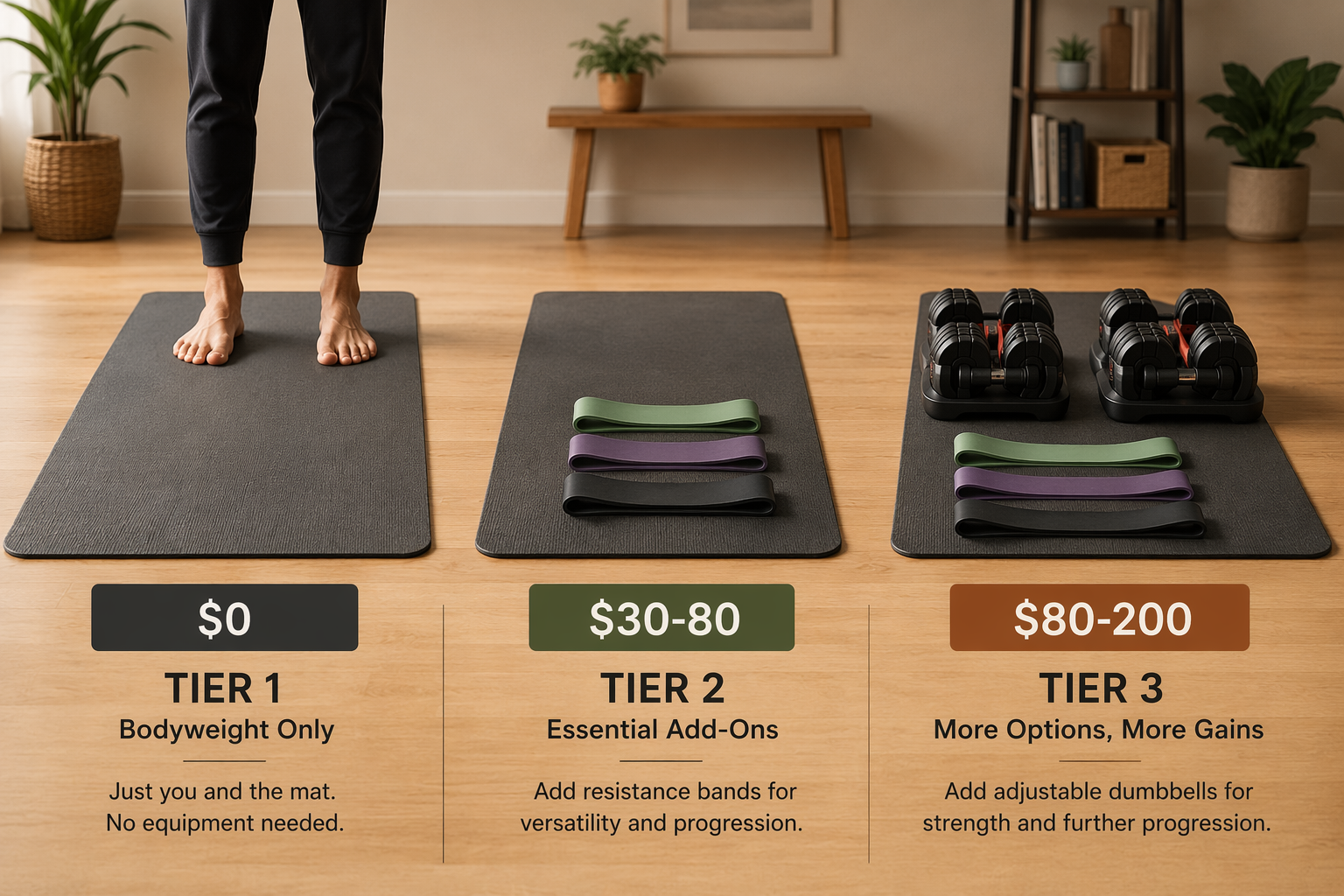
A golf workout routine for home should start with the equipment you actually have, not the equipment a video quietly assumes is sitting in your garage. So before the first squat or plank, here is the whole budget map.
| Budget tier | Equipment assumed | What this tier is best for |
|---|---|---|
| $0–30 | Bodyweight only; an exercise mat is optional | Building leg strength, trunk control, shoulder stability, and basic movement capacity without buying gear |
| $30–80 | Bodyweight plus resistance bands | Adding anti-rotation, pulling volume, lateral hip work, and more golf-like rotational resistance |
| $80–200 | Resistance bands plus one pair of adjustable dumbbells | Adding load to split squats, hinges, squats, and rows so lower-body and pulling work can progress |
These are not seriousness rankings. The $0 tier is not a waiting room for the “real” workout. MyGolfSpy’s bodyweight golf-strength protocol uses squats, push-ups, bird dogs, lunges, IYTs, and shoulder-tap planks with practical set and rep targets, which is enough to train the movements a recreational golfer keeps asking from the body: stand into the ground, control the trunk, stabilize the shoulders, and repeat posture without turning every session into a shopping list.[1]
$0–30: Bodyweight-Only Golf Workout
Equipment: none required. Optional: a mat if your knees complain before your legs do. Estimated cost: $0 if you use the floor, carpet, or a towel; up to about $30 if you buy a basic mat.
Train three days per week with at least one rest day between sessions. That rhythm matters more than finding exotic exercises, because the point is to repeat useful work often enough to adapt and leave enough space to recover. MyGolfSpy’s protocol lays out the bodyweight menu; University of Utah Health also uses a conservative three-day strength-training structure for golfers rather than daily maximal work.[1][2]
| Exercise | Sets and reps | Golf reason |
|---|---|---|
| Bodyweight squat | 3 sets of 10–15 reps | Leg strength and the ability to use the ground without needing external load |
| Push-up | 3 sets of 5–12 reps; elevate hands on a couch or counter if needed | Upper-body strength and shoulder control without turning the shoulder into the whole swing |
| Bird dog | 3 sets of 8–10 reps per side | Trunk control while the arms and legs move, which is closer to golf than a loose sit-up contest |
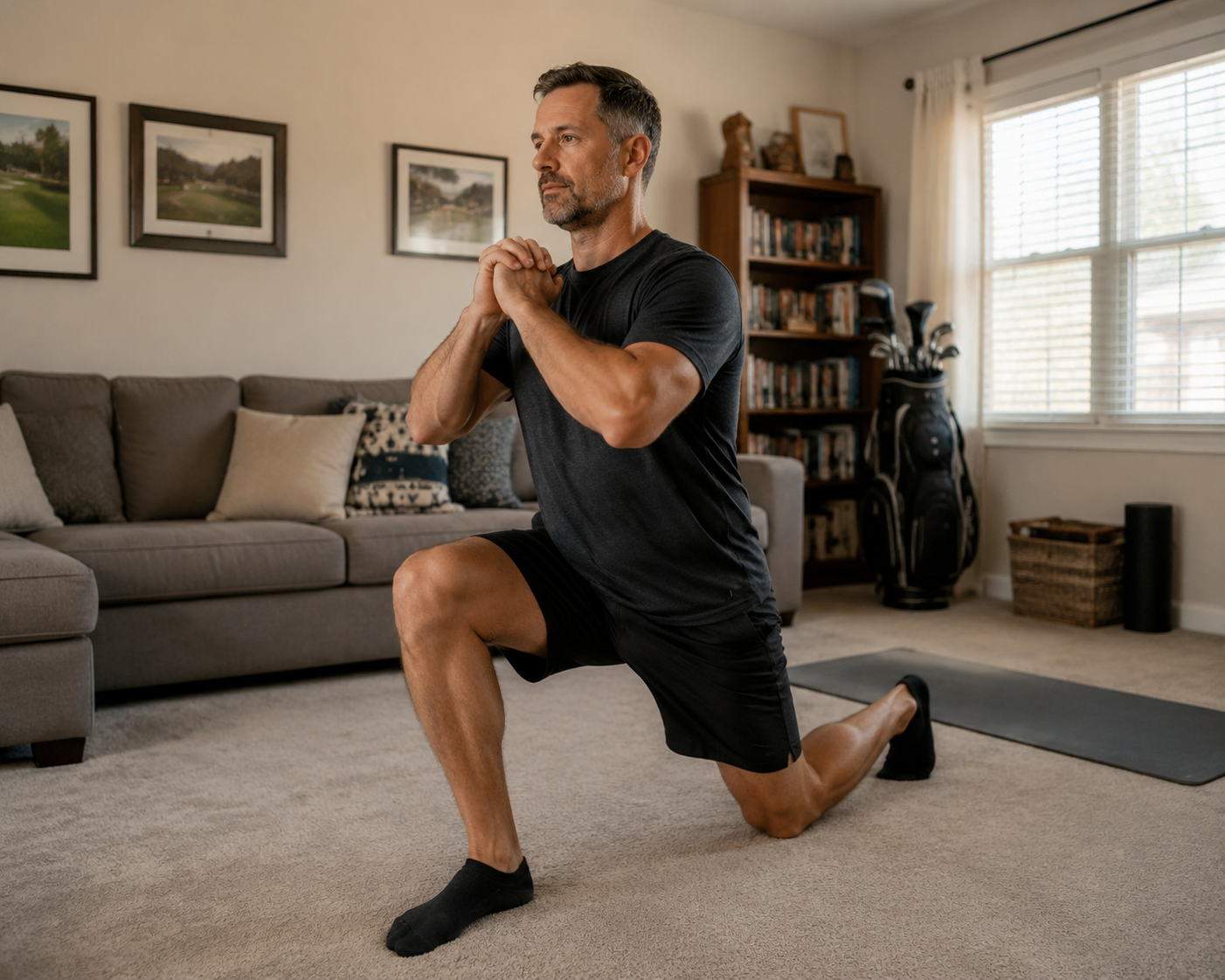
| Reverse lunge or split squat | 3 sets of 8–10 reps per side | Single-leg strength for a stance that constantly shifts pressure |
| Prone IYT | 2–3 sets of 6–10 reps in each position | Shoulder-blade control and posture endurance |
| Shoulder-tap plank | 3 sets of 10–20 total taps | Anti-rotation: keeping the trunk quiet while an arm moves |
A simple week can look like Monday, Wednesday, and Friday, or Tuesday, Thursday, and Saturday. Keep the same six exercises for the first few weeks instead of changing the workout every session. The progression is boring in the useful way: add reps until you hit the top of the range with clean control, then slow the lowering phase, add a pause, or choose a harder variation.
How to Make the Bodyweight Tier Harder Without Buying Anything
- Squat: pause for two seconds at the bottom, then stand without bouncing.
- Push-up: move from counter height to couch height to floor height before adding more reps.
- Bird dog: hold each rep for three seconds and keep the hips from rolling open.
- Lunge: use a slow three-count descent or switch to a split-squat hold at the bottom.
- IYT: lift lower, not higher, if your neck starts doing the work your shoulder blades should be doing.
- Shoulder-tap plank: widen the feet at first; narrow them only when the hips stay level.
That is a complete routine. It will not prove you gained a specific number of miles per hour in clubhead speed, because the sources here do not support that kind of home-workout promise. What it can do is give you repeatable strength and control work that fits the space between the sofa and the coffee table.
$30–80: Add Resistance Bands
Equipment: a small resistance-band set, ideally including a light mini band, a medium loop band, and a handled or long band you can anchor safely. Estimated cost: about $30–80 depending on brand, attachments, and H2 2026 pricing.
Bands do not replace the bodyweight tier. They fill gaps the bodyweight tier leaves open: horizontal pulling, lateral hip work, standing anti-rotation, and resisted rotation. DRVN Golf describes bands as a useful golf tool partly because their resistance increases as they stretch, an “accommodating resistance” pattern the site connects to the accelerating nature of the golf swing.[3] That is a source-specific claim, not a license to turn every movement into a simulated swing. The safer takeaway is narrower: bands give you resistance in directions that are hard to create with bodyweight alone.
| Keep from the bodyweight tier | Add with bands | Why it changes the workout |
|---|---|---|
| Squat | Band squat | Adds resistance through the hips and legs without needing dumbbells |
| Bird dog or shoulder-tap plank | Pallof press | Trains the trunk to resist rotation while standing |
| Prone IYT | Band pull-apart | Adds more upper-back and shoulder-blade volume |
| Reverse lunge | Lateral band walk | Targets the hips in a side-to-side pattern missing from the bodyweight routine |
| Bodyweight control work | Band rotational swing or controlled band rotation | Introduces resisted rotation without treating it as a full-speed golf swing |
A three-day band week can still use the same schedule. Do the bodyweight routine first, then add two or three band movements rather than bolting on a second workout. For most home golfers, the best first additions are Pallof presses, pull-aparts, and lateral walks. PureGym’s golf-workout guidance also includes banded work among home-friendly options, which supports using bands as a practical supplement rather than a novelty item.[4]
| Band exercise | Sets and reps | Setup note |
|---|---|---|
| Pallof press | 2–3 sets of 8–12 reps per side | Anchor the band at chest height; press straight out without letting the torso turn |
| Band pull-apart | 2–3 sets of 12–20 reps | Use a light band and stop before the shoulders shrug |
| Lateral band walk | 2–3 sets of 8–12 steps each direction | Keep the band light enough that the knees do not collapse inward |
| Band squat | 3 sets of 10–15 reps | Stand on the band or use a loop setup only if it feels secure |
| Controlled band rotation | 2–3 sets of 8–10 reps per side | Move under control; this is strength practice, not a full-speed swing rehearsal |
The band tier is worth the money when the bodyweight routine starts to feel limited in one of two ways: you cannot load pulling work well, or you want standing trunk work that teaches you not to get dragged around by your arms. If neither problem is bothering you yet, keep your money in your pocket and keep training.
$80–200: Add Adjustable Dumbbells
Equipment: resistance bands plus one pair of adjustable dumbbells, or one adjustable dumbbell if that is what the budget allows first. Estimated cost: about $80–200 for entry-level adjustable options in H2 2026 pricing.
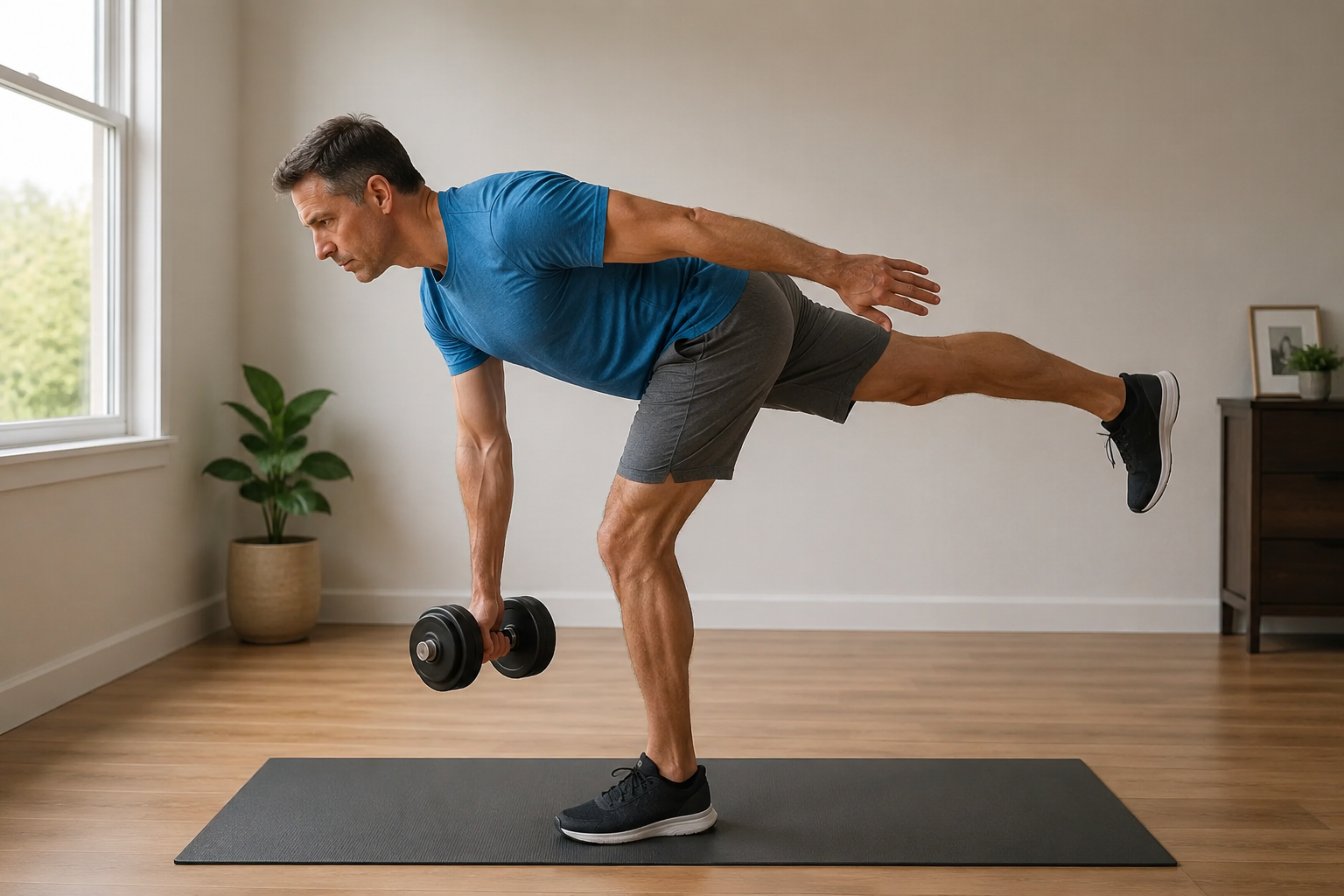
Dumbbells earn their floor space because they make the lower-body and hinge patterns honest. University of Utah Health’s golfer strength guide uses staple lifts including split squats, single-leg Romanian deadlifts, bent-over rows, and goblet squats inside a three-day training structure.[2] Those are not cute “golf-specific” tricks. They are the kind of loaded movements that help a golfer build legs, hips, back, and posture capacity without needing a cable stack.
| Dumbbell exercise | Sets and reps | Golf reason |
|---|---|---|
| Goblet squat | 3 sets of 8–12 reps | Loads the squat pattern while encouraging an upright torso |
| Dumbbell split squat | 3 sets of 8–10 reps per side | Builds single-leg strength for pressure shift and stance control |
| Single-leg Romanian deadlift | 3 sets of 6–10 reps per side | Trains hip hinge control, balance, and posterior-chain strength |
| Bent-over dumbbell row | 3 sets of 8–12 reps per side | Adds loaded pulling for the upper back and posture endurance |
| Farmer carry or suitcase carry | 3 carries of 20–40 steps | Trains grip, trunk stiffness, and staying tall under load |
This tier is also where load management matters. If a dumbbell makes the split squat so heavy that you shorten the range, wobble through the bottom, or turn the set into a balance rescue, it is too heavy for that day. The upgrade is not the purchase itself; it is the ability to add small amounts of load while keeping the movement clean.
A Practical Three-Day Dumbbell Week
| Day | Main work | Support work |
|---|---|---|
| Day 1 | Goblet squat, push-up, Pallof press | Band pull-apart, bird dog |
| Day 2 | Split squat, bent-over row, shoulder-tap plank | Lateral band walk, prone IYT |
| Day 3 | Single-leg Romanian deadlift, goblet squat, controlled band rotation | Farmer or suitcase carry, bird dog |
The dumbbell tier does not need a dozen exercises. It needs enough load to make squatting, hinging, lunging, and rowing progress over time. TPI’s home-workout framing is useful here because it treats home training as something that can be built without expensive machines, not as a watered-down version of a commercial gym.[5]
When to Move Up a Tier
Move from bodyweight to bands when you want anti-rotation and pulling work that bodyweight cannot provide cleanly. Move from bands to dumbbells when your legs and hips need more load than tempo, pauses, and higher reps can reasonably supply. Do not move up because a routine looks more golf-like on camera.
| If your current limitation is… | The next useful purchase is probably… | Because… |
|---|---|---|
| You cannot train pulling without improvising awkward furniture rows | Resistance bands | Pull-aparts and anchored rows are easy to set up and pack away |
| Your trunk work is all floor-based | Resistance bands | Pallof presses let you train anti-rotation while standing |
| Squats and lunges feel too easy even with pauses | Adjustable dumbbells | External load makes lower-body work progress without inventing harder circus variations |
| Your posture fades late in rounds or long range sessions | Bands or dumbbells | Rows, pull-aparts, carries, and hinges give the upper back more work capacity |
| You want power work after a strength base is in place | A later medicine-ball option | P4S includes medicine-ball rotational slams in its golf exercise list, but that is outside the core bodyweight, band, and dumbbell budget promise here.[6] |
One statistic sometimes passed around in golf-fitness articles is a second-hand claim about lower-handicap golfers having greater rotational strength. It is not needed here. The practical case for this routine is already strong enough without leaning on a study that was not verified against the original article.
The Routine to Start This Week
If your budget is $0, run the bodyweight routine three days per week. If you already own bands, add Pallof presses, pull-aparts, and lateral walks. If you already own dumbbells, build the week around goblet squats, split squats, single-leg Romanian deadlifts, and rows. Keep at least one rest day between sessions, and upgrade only when the next tier solves a real limitation in the current one.
References
- Bodyweight Strength Training for Golf, MyGolfSpy.
- Your Strength Training Guide for a Better Golf Game, University of Utah Health, July 2025.
- Resistance Band Exercises for Golf, DRVN Golf, March 2026.
- Best Golf Workouts for the Gym & Home, PureGym.
- Home Workout for Golf Strength, Mobility & Conditioning, Titleist Performance Institute.
- 20 Golf Workouts & Exercises, P4S Golf.
Missing the equipment, or need to rest?
- Luis de la Fuente's Bicep Workout You Can Do at Home
- Replicate Chris Hemsworth's Extraction 3 Workout at Home
- Wildfire Smoke Exercise Safety Tips for Every AQI Level
Sore or unsure how much rest you need? Read Recovery & Rest— this routine doesn’t cover injury-specific advice.
Comments
Join the discussion with an anonymous comment.