
12-Week At-Home Bodyweight Workout Plan (No Equipment Needed)
This 12-week bodyweight workout plan provides a progressive structure for beginners to build strength at home without any equipment. Each phase includes clear level-up gates so you know exactly when to advance to harder exercises.
For the next 12 weeks, your job is not to guess whether a home workout is “working.” Your job is to follow three full-body sessions per week, leave at least 48 hours between them, and move to harder exercises only when your reps prove you are ready.
That matters because beginners are often handed a list of bodyweight exercises with no operating system. “Do more when it gets easy” sounds harmless until you are alone on a living room floor wondering whether your shaky eighth push-up means you should stop, push harder, or switch exercises. This plan removes as much of that guessing as possible.
| Weeks | Main goal | Training days | How you progress |
|---|---|---|---|
| 1–4 | Learn the movements and find the right difficulty | 3 full-body sessions per week | Add clean reps until you can pass the gate |
| 5–8 | Build strength with harder variations and more work | 3 full-body sessions per week | Use harder exercises, extra sets, and controlled tempo |
| 9–12 | Push advanced beginner strength and identify your next limit | 3 full-body sessions per week | Advance to tougher bodyweight variations or repeat the phase |
The main level-up rule is simple: when you can complete 20 controlled reps of an exercise with good form, you are usually ready to try the next harder variation. That 20-rep gate appears in several bodyweight training templates and progression guides, and it works well because it gives beginners a visible standard instead of a mood-based decision.[1][2][3]
The other rule is less comfortable but just as important: light-load bodyweight sets need to be taken close to failure. Built With Science cites research showing that loads as low as roughly 30–40% of one-rep max can still stimulate muscle growth when sets are pushed close enough to failure; stopping far short makes bodyweight training much easier to recover from, but also much less productive.[2]
The weekly schedule
Train three days per week. Monday, Wednesday, and Friday works. Tuesday, Thursday, and Saturday works. What you do not need is six random hard days followed by two weeks of soreness and avoidance.
| Day | Plan |
|---|---|
| Monday | Full-body workout |
| Tuesday | Rest, walking, light mobility, or normal daily activity |
| Wednesday | Full-body workout |
| Thursday | Rest, walking, light mobility, or normal daily activity |
| Friday | Full-body workout |
| Saturday | Optional easy movement; do not turn it into a fourth hard session |
| Sunday | Rest |
Most beginner bodyweight programs settle around full-body training three times per week because it gives each movement enough practice without asking sore joints and tendons to repeat the same stress every day. The broader public-health floor for strengthening work is at least two days per week, but this plan uses three because beginners usually need repetition as much as intensity.[3][4][7]
Before each workout, spend a few minutes getting warm: easy marching in place, arm circles, hip hinges, bodyweight good mornings, ankle rocks, and a few slow practice reps of the first exercise. Warm-ups do not need to become a second workout. They need to make the first working set feel less abrupt.[6]
How hard each set should feel
Near failure does not mean collapsing onto the carpet. It means you stop when you could do about one to three more clean reps if you absolutely had to. A clean rep is controlled, uses the same range of motion as the earlier reps, and does not require twisting, bouncing, or holding your breath like you are trying to move furniture.
- Too easy: you finish the set and know you had five or more clean reps left.
- Useful: the last two or three reps slow down, but your form still looks like the first rep.
- Too hard: your joints hurt, your range of motion disappears, or you have to cheat to finish the rep.
Most of your working sets in this plan sit between 8 and 20 reps. Systematic-review discussions cited by Bony to Beastly support the 6–20 rep range as a practical hypertrophy zone when sets are hard enough; higher-rep work can still be useful, but the evidence becomes less tidy as the reps climb much beyond that range.[1]
The no-equipment exercise menu
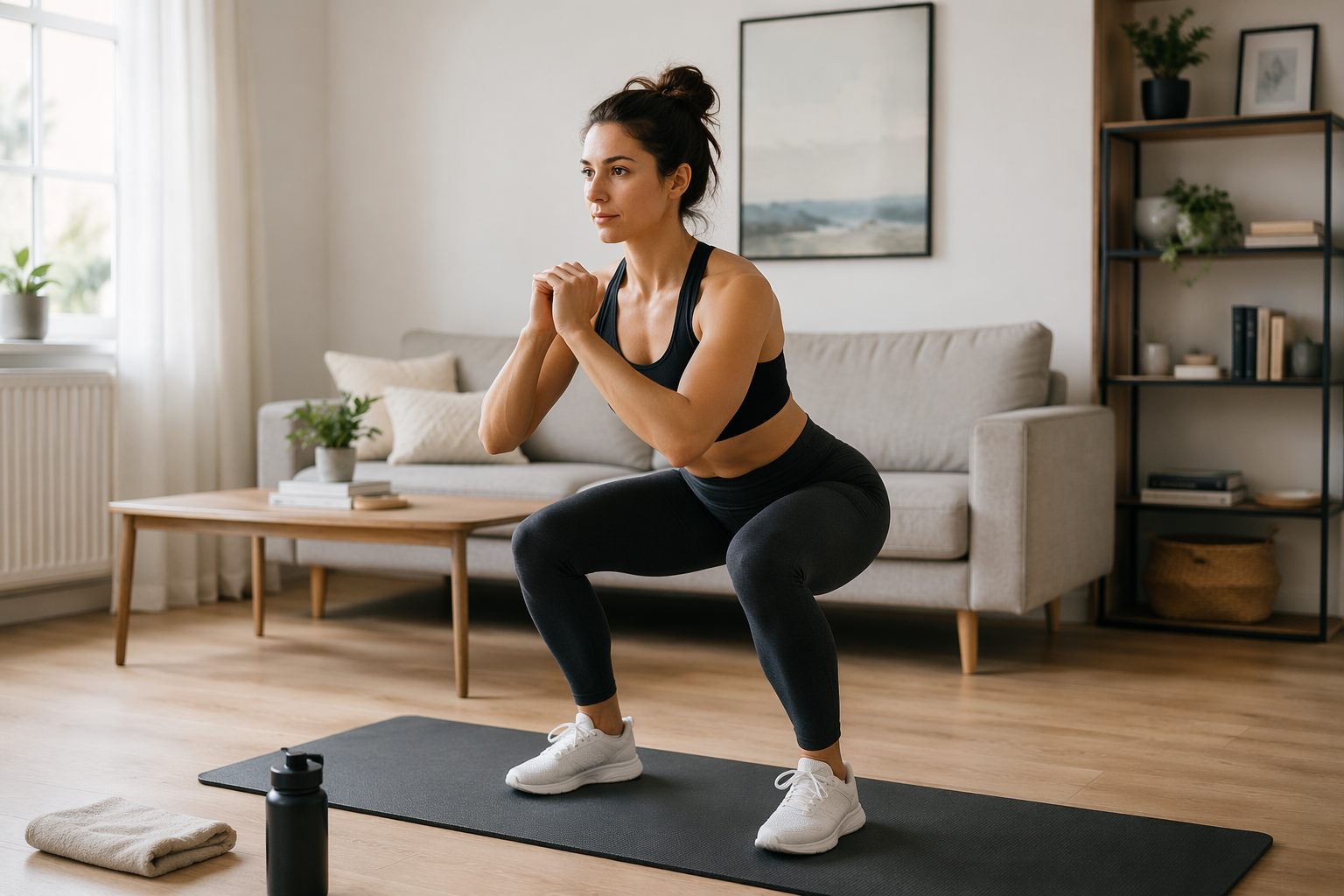
You will use the same basic movement patterns throughout the 12 weeks: squat, hinge or bridge, push, single-leg work, trunk stability, and a small amount of shoulder-focused pushing later. The exercises change when your current version stops being challenging enough.
| Pattern | Easier | Standard | Harder |
|---|---|---|---|
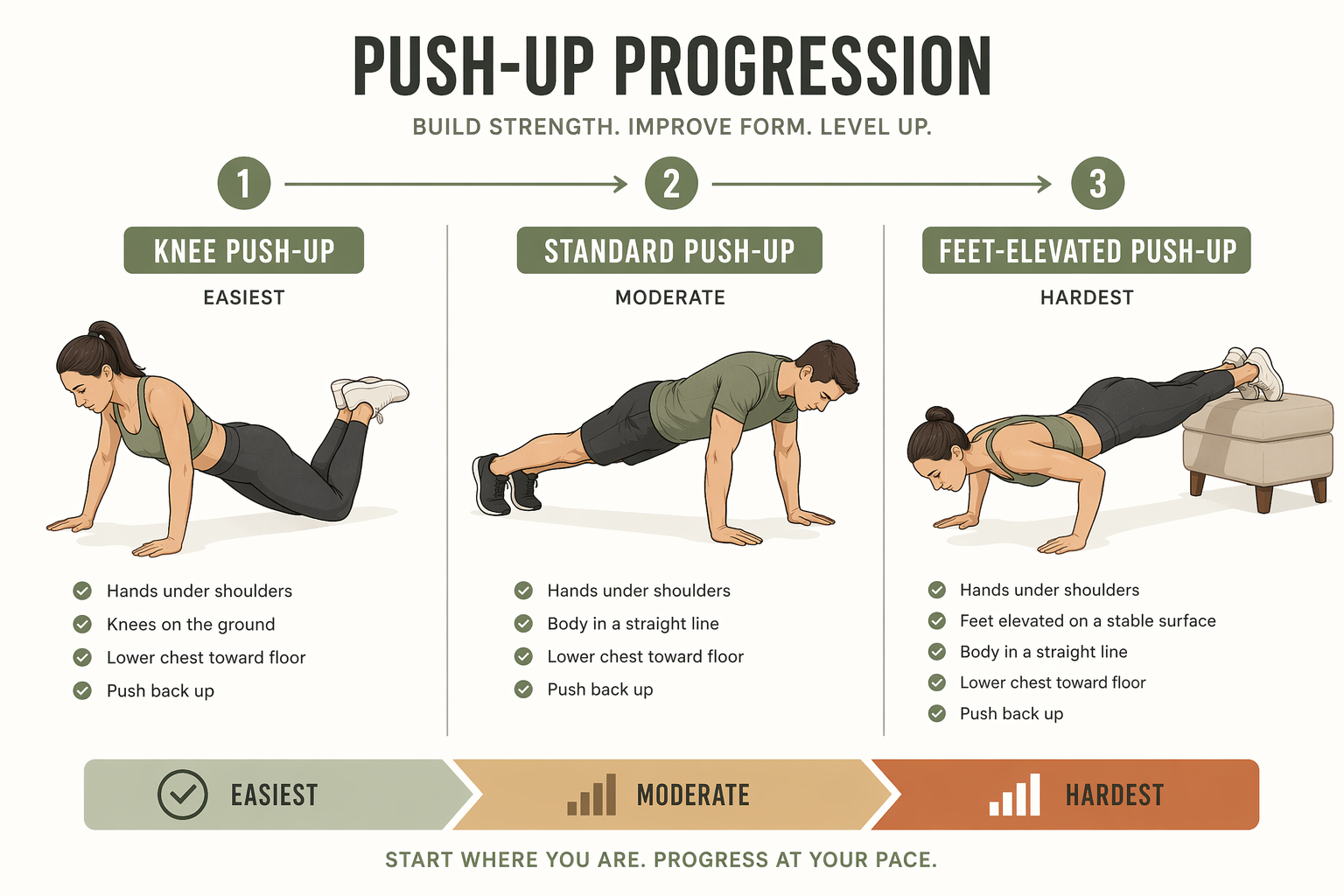
| Push | Wall push-up or knee push-up | Floor push-up | Feet-elevated push-up |
| Squat | Box squat to a chair | Air squat | Tempo squat or jump-free squat pulses |
| Single-leg | Supported split squat | Reverse lunge | Bulgarian split squat |
| Glutes/hinge | Glute bridge | Single-leg glute bridge | Long-lever single-leg bridge |
| Core | Dead bug or bird-dog | Forearm plank | Longer plank or slow mountain climber |
| Shoulders | Incline pike hold | Pike push-up | Feet-elevated pike push-up |
Push-ups deserve special attention because they are one of the few bodyweight movements where the load jumps are easy to underestimate. Bony to Beastly cites EMG-based estimates that a knee push-up loads roughly 49% of bodyweight, a standard floor push-up about 65%, and a feet-elevated push-up about 70–75%, depending on body proportions and setup.[1] Those are approximate reference points, not laboratory labels for your body, but they explain why moving from knees to the floor can feel like more than a small promotion.
Weeks 1–4: learn the standard before chasing difficulty
The first month is where most beginners either build confidence or collect bad reps. Choose versions that let you train hard without turning every set into a negotiation with your joints. Easier variations are not a confession. They are how you keep the target muscle doing the work long enough to adapt.
| Exercise | Sets | Reps or time | Use this version first |
|---|---|---|---|
| Box squat or air squat | 2–3 | 8–15 reps | Use a chair target if depth or balance is uncertain |
| Knee push-up or wall push-up | 2–3 | 8–15 reps | Choose the version that lets you keep a straight line from shoulders to hips to knees or feet |
| Glute bridge | 2–3 | 10–15 reps | Pause briefly at the top instead of rushing |
| Reverse lunge or supported split squat | 2 | 8–12 reps per side | Hold a wall lightly if balance is stealing the set |
| Bird-dog | 2 | 6–10 reps per side | Move slowly enough that your hips do not rock |
| Forearm plank | 2 | 15–30 seconds | Stop before your lower back sags |
Rest 60–90 seconds between sets. If you are breathing hard after squats or lunges, take the longer rest. The plan does not get better because you rush.
Your Phase 1 level-up gates
- Squat gate: 20 controlled air squats to consistent depth, without knee pain or collapsing posture.
- Push-up gate: 20 controlled reps on your current variation. If that is wall push-ups, move to a lower incline or knee push-ups. If that is knee push-ups, test floor push-ups.
- Glute bridge gate: 20 controlled reps with a clear pause at the top.
- Lunge gate: 15 controlled reps per side without using your hands to push off your thigh.
- Plank gate: 30 seconds with ribs down, glutes lightly squeezed, and no sagging.
If you do not pass a gate by the end of Week 4, repeat Weeks 3–4. Do not graduate because the calendar is bored. A beginner who repeats two weeks and then advances cleanly is in a better position than one who drags poor reps into a harder phase.
Weeks 5–8: add work without making the plan random
This is the month where vague advice usually fails people. You are stronger than you were in Week 1, but not every exercise should jump to the hardest version at once. Progression comes from four levers: more reps, harder variations, slower tempo, and more sets. Use one or two at a time, not all four because you had a good Monday.
Those four levers show up repeatedly across bodyweight training guides because they solve the main no-equipment problem: you cannot simply add five pounds to the bar. You have to make the same bodyweight demand more force, more control, more time, or more total work.[1][3][4]
| Exercise | Sets | Reps or time | Progression note |
|---|---|---|---|
| Air squat or tempo squat | 3–4 | 10–20 reps | Use a 3-second lowering phase if 20 regular squats are easy |
| Floor push-up or knee push-up | 3–4 | 8–20 reps | Use the hardest version that keeps clean reps in range |
| Reverse lunge | 3 | 10–15 reps per side | Step back under control; do not drop into the bottom |
| Single-leg glute bridge | 3 | 8–15 reps per side | If this is too hard, keep standard bridges and pause longer |
| Slow mountain climber or dead bug | 2–3 | 8–15 reps per side | Choose control over speed |
| Forearm plank | 2–3 | 25–45 seconds | Stop when position changes, not when the timer flatters you |
How to choose your push-up variation in Phase 2
If you passed 20 knee push-ups, start each workout with floor push-ups. You might only get 5–8 clean reps at first, and that is fine. The load estimate jumps from roughly half your bodyweight on knee push-ups to about two-thirds on standard push-ups, so expecting the same rep count immediately is not realistic.[1]
- If floor push-ups fall below 5 clean reps: do one set of floor push-ups, then finish the remaining sets with knee push-ups.
- If floor push-ups land between 6 and 15 reps: keep them as your main push movement.
- If floor push-ups reach 20 clean reps: you are ready to test feet-elevated push-ups in Phase 3.
For squats, the problem is often the opposite. Many beginners can reach 20 bodyweight squats before their legs are truly challenged. Slow the lowering phase, pause near the bottom, or add a fourth set before you jump to more complicated leg work. Harder is useful only when it is still measurable.
Your Phase 2 level-up gates
- Push-up gate: 20 controlled floor push-ups before testing feet-elevated push-ups.
- Squat gate: 20 tempo squats with a 3-second lower and consistent depth before shifting emphasis to harder single-leg work.
- Lunge gate: 15 reverse lunges per side with balance and control before testing Bulgarian split squats.
- Glute gate: 15 single-leg glute bridges per side with hips level.
- Core gate: 45-second plank without sagging or piking.
If one exercise passes its gate and another does not, progress only the exercise that passed. Your legs and push-ups do not have to graduate on the same day. This is one of the advantages of a gate-based plan: it lets your actual abilities set the pace.
Weeks 9–12: harder variations, clearer limits
By the third month, the plan becomes less about learning what a workout feels like and more about finding which bodyweight progressions still challenge you. You are still training three days per week. You are still stopping near failure. The difference is that the exercises now ask more from one side of the body, from your shoulders, or from your ability to control tempo.
| Exercise | Sets | Reps or time | Regression if needed |
|---|---|---|---|
| Tempo squat or squat pulse | 3–4 | 12–20 reps | Use regular air squats if tempo breaks form |
| Feet-elevated push-up or floor push-up | 3–4 | 6–15 reps | Use floor push-ups until you can keep a straight body line |
| Bulgarian split squat or reverse lunge | 3 | 8–12 reps per side | Use reverse lunges if balance ruins the set |
| Single-leg glute bridge | 3 | 10–20 reps per side | Use two-leg bridges with a pause if hips twist |
| Pike push-up | 2–3 | 6–12 reps | Use a pike hold or partial range |
| Plank variation or slow mountain climber | 2–3 | 30–60 seconds or 10–20 reps per side | Return to standard plank when position breaks |
Feet-elevated push-ups are not a decorative upgrade. With the feet raised, the estimated load rises to roughly 70–75% of bodyweight, again with individual variation.[1] Start conservatively. If your hips sag, your shoulders shrug up to your ears, or every rep turns into a partial, the floor push-up is still your working exercise.
Pike push-ups are included because a no-equipment plan otherwise leaves vertical pushing almost untouched. Keep the reps modest and controlled. This is not the place to fling your head at the floor and call it shoulder training.
Your Phase 3 level-up gates
- Feet-elevated push-up gate: 15 controlled reps before raising the feet higher or adding a slower tempo.
- Bulgarian split squat gate: 12 controlled reps per side before adding pauses or longer range of motion.
- Pike push-up gate: 12 controlled reps before trying a harder angle.
- Single-leg bridge gate: 20 controlled reps per side before switching to longer-lever bridge variations.
- Core gate: 60 seconds of honest plank position or 20 slow mountain climbers per side without hip bouncing.
A secondary source, Daily Burn, reports on a 2019 PeerJ comparison in which calisthenics and weight training produced comparable improvements in strength and body composition over 8 weeks.[5] That is useful reassurance, not permission to pretend all tools are identical. Bodyweight training can be highly effective when it is progressive and hard enough; it also has obvious weak spots.
The honest limitation: pulling is the missing piece
A true no-equipment plan struggles to train the upper back. Push-ups, squats, lunges, bridges, planks, and pike push-ups can carry a beginner a long way, but they do not replace rows, pull-ups, or pulldowns. Calling a plank a “back exercise” does not solve that.
If you have a safe setup, a sturdy table row, towel row, or doorway-row variation can begin to fill the gap. If you do not have a safe setup, do not improvise with furniture that slides, doors that cannot hold load, or towels that may tear. At that point, the smallest useful equipment upgrade is not a full home gym; it is something that lets you pull safely, such as a pull-up bar, suspension trainer, resistance band, or access to a rowing station.
What to do after Week 12
Do not treat Week 12 as a finish line. Treat it as a placement test.
- If you missed several gates: repeat the phase where your form started breaking down.
- If you passed most gates but not all: keep the harder exercises you earned and repeat the weaker movements at their current level.
- If you passed the Phase 3 gates: move to harder bodyweight variations, add slower tempo, or increase sets carefully.
- If leg training or upper-back work is clearly limited: consider minimal equipment instead of pretending no-equipment training covers everything equally.
The useful outcome of this 12-week plan is not that you will never need another routine. It is that you now know how progression works: choose a version you can control, train it close to failure, pass a visible gate, and then make the exercise harder for a reason.
References
- Beginner Bodyweight Workout Plan for Building Muscle—Full Guide — Bony to Beastly
- Build Muscle At Home: The BEST Full Body Home Workout For Growth — Built With Science
- 9 Week Bodyweight Workout For Strength & Muscle Gains — Muscle & Strength
- Bodyweight Workout for Beginners (20-Minute at Home Routine) — Nerd Fitness
- Best No-Equipment Home Workouts That Actually Build Strength — Daily Burn
- 7-Day Bodyweight Training Plan for Beginners — EatingWell
- Physical Activity Guidelines for Americans — U.S. Department of Health and Human Services
This is general fitness education, not medical advice. For diagnosis or treatment of pain or injury, consult a qualified clinician.
Pick your next session
Browse all routines to find an appropriately-spaced next session.
Spot something off?
This content sits adjacent to health guidance — tell us if a citation or figure needs a correction.