
The Hidden Costs of Home Gym Equipment: A 5-Year Total Cost of Ownership Guide
Thinking of building a home gym? The sticker price is just the beginning. This guide breaks down the hidden costs — flooring, assembly, subscriptions, and resale value — so you can compare the true 5-year cost of budget, mid-range, and premium setups versus a gym membership.
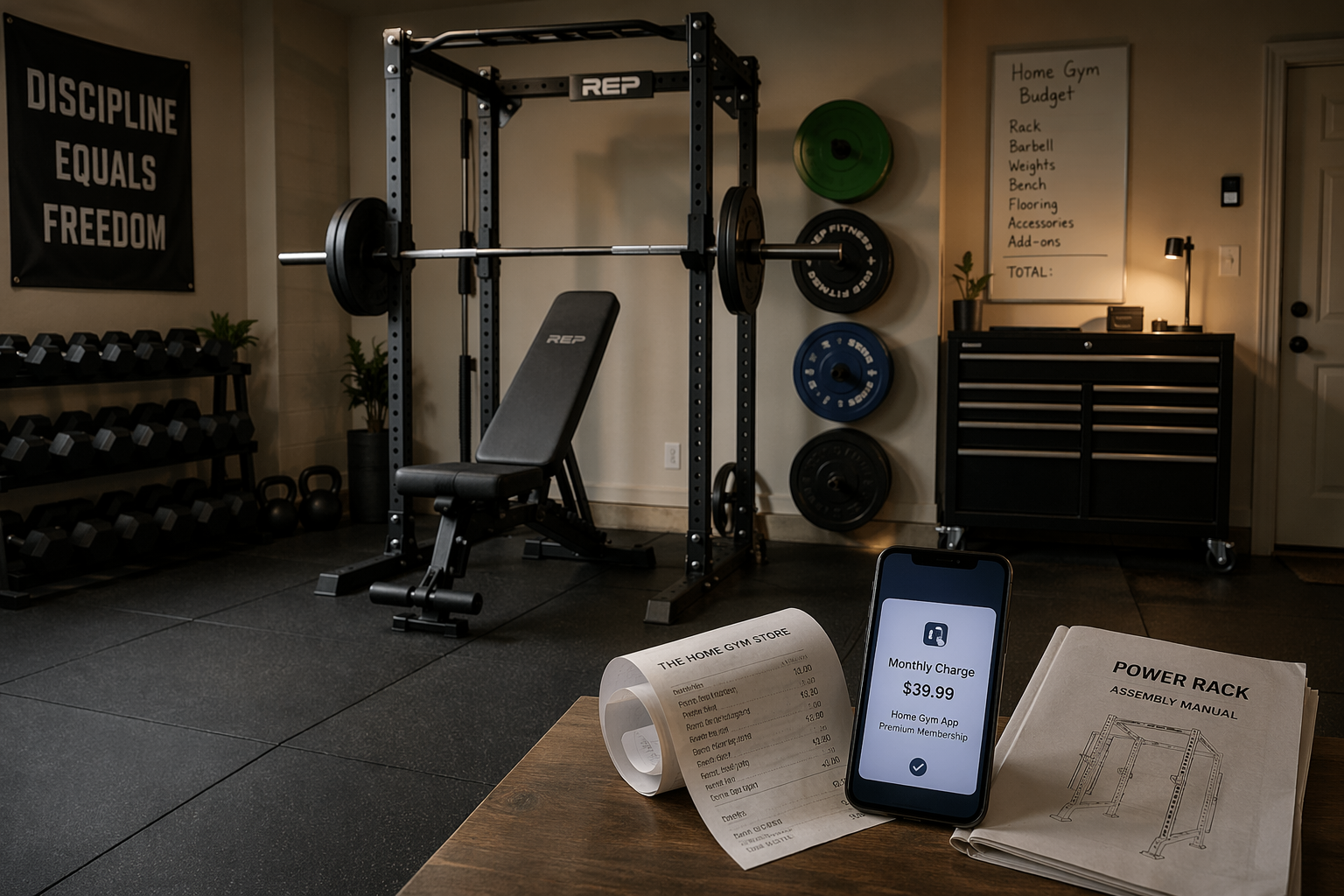
Introduction: Why the Sticker Price Is Only Half the Story
When you start shopping for home gym equipment, the first number you see is the price tag on the machine. A power rack for $380. A smart gym for $4,295. A set of adjustable dumbbells for $300. Those figures are easy to compare, and most buyer guides — including our own Best Home Exercise Equipment for Every Budget — organize recommendations around them. But the upfront cost is only the beginning.
The true cost of a home gym includes flooring, assembly fees, essential accessories you didn't budget for, ongoing maintenance, and — in the case of smart gyms — monthly subscription charges that can quietly double your total investment over five years. Resale value also matters: a well-chosen rack from a brand like Rogue can recoup 80–90% of its cost when you sell it, while a budget brand might return only 40–50%.
This guide breaks down every cost layer — visible and hidden — so you can compare the 5-year total cost of ownership (TCO) across budget, mid-range, and premium home gym builds, and weigh them against a commercial gym membership. If you are making a high-consideration purchase, this is the framework you need before you swipe your card.
Section 1: Upfront Equipment Costs — A Quick Primer by Tier
Before we layer on the hidden costs, it helps to establish a baseline. Home gym setups generally fall into three tiers based on the core strength equipment. These are the starting points we will use for the 5-year TCO comparison later.
| Tier | Upfront Cost Range | Typical Core Equipment |
|---|---|---|
| Budget | $300 – $1,000 | Adjustable dumbbells, resistance bands, a folding bench, a budget barbell, and a simple squat stand or power rack like the REP PR-1100 at $380 |
| Mid-Range | $1,000 – $3,000 | A dedicated power rack, Olympic barbell, 255–500 lbs of bumper or iron plates, an adjustable bench, and a basic cardio machine |
| Premium | $3,000 – $6,000+ | A commercial-grade rack or all-in-one smart gym (e.g., Tonal 2 at $4,295), premium barbell, calibrated plates, dedicated cardio, and high-end flooring |
These ranges come from industry averages. According to Garage Gym Reviews, the average home gym investment lands between $1,500 and $2,500. But that figure typically excludes the costs we are about to cover. If you are looking for a detailed breakdown of what to buy at each tier, our budget-tier equipment guide covers the specific products. Here, we are focused on what happens after the purchase.
Section 2: The Hidden Costs Breakdown — What They Don't Tell You at Checkout
The equipment itself is the headline, but four supporting cost categories can add $500 to $1,500 or more to your total before you lift your first weight. Here is what to expect.
Flooring
Protecting your floor (and your equipment) is non-negotiable. Dropping a barbell on concrete can damage both the bar and the slab. The most cost-effective solution is a 3/4-inch rubber stall mat from a farm supply store. Tractor Supply sells these for about $50 per 4x6 sheet, which covers 24 square feet. For a typical 8x8 foot lifting area, you need roughly three mats — about $150 total.
On the other end, premium interlocking gym flooring runs $3 to $5 per square foot. Covering the same 64-square-foot area costs $192 to $320. The difference is appearance and thickness options, not function for most home users.
Assembly and Delivery
A power rack or functional trainer arrives in a box that weighs 200 to 400 pounds. If you assemble it yourself, the cost is your time — typically two to four hours with basic tools. If you opt for white-glove delivery and assembly, expect to pay $150 to $400 depending on the equipment's complexity and your location.
Some retailers include assembly in the delivery fee; others charge separately. Always check the fine print before checkout. A $380 power rack can become a $580 power rack if you add delivery and assembly.
Essential Accessories
The equipment list on a product page rarely includes everything you actually need. Most home gyms require at least these additions:
- A barbell (budget options start around $180, premium bars run $300+)
- Weight plates (255 lbs of budget iron: $250–$400; bumper plates: $400–$700)
- An adjustable bench (a solid model like the Major Fitness bench at $220 supports up to 1,300 lbs)
- Storage solutions (a weight tree or plate holder: $50–$150)
- Collars, chalk, a lifting belt, and possibly a pull-up bar if your rack does not include one
These accessories typically add $100 to $500 to your total, depending on quality. A budget build that skimps on the barbell may save money upfront but could need a replacement within a year.
Ongoing Maintenance
Home gym equipment requires periodic maintenance. Barbell bushings need lubrication, cables on functional trainers stretch and fray, and bolts on power racks can loosen over time. Budget for $50 to $100 per year in lubricants, replacement parts, and tools. Commercial-grade remanufactured equipment, which some sources say can last 15–20 years with proper care, may have lower annual maintenance costs than budget gear.
Section 3: The Subscription Trap — How Monthly Fees Can Double Your Cost
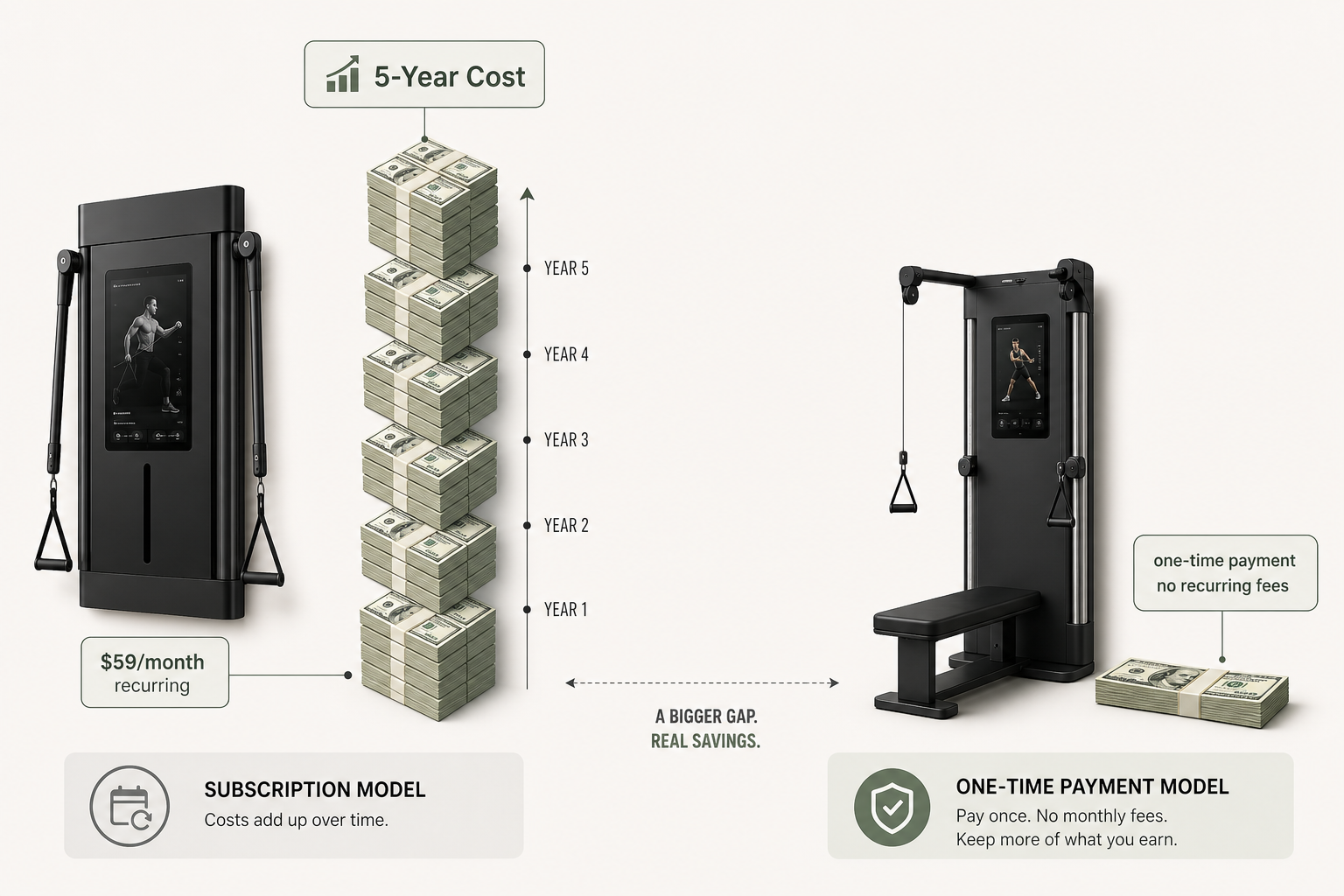
Of all the hidden costs, recurring subscriptions are the most insidious because they are easy to ignore at purchase time. A $59 monthly fee does not feel significant when you are already spending $4,000 on a machine. But over five years, that fee adds up to $3,540 — nearly the cost of the equipment itself.
Consider two popular smart gyms:
| Smart Gym | Upfront Price | Monthly Subscription | 5-Year Total Cost |
|---|---|---|---|
| Tonal 2 | $4,295 | $59/month | $4,295 + ($59 × 60) = $7,835 |
| Speediance Gym Monster | $3,199 | None | $3,199 |
The difference is $4,636 over five years. The Speediance Gym Monster costs less upfront and has no subscription, making it $2,655 cheaper than the Tonal 2 even before factoring in the subscription. For buyers who want guided programming without a recurring fee, a no-subscription smart gym or a traditional rack-and-barbell setup paired with a free or low-cost app is the more economical path.
If you are considering a smart gym primarily for the guided programming, compare the subscription cost against a standalone strength training app. Many high-quality apps cost $10 to $20 per month and work with any equipment. Our guide on choosing a strength training app walks through the questions to ask before committing to a subscription.
Section 4: Resale Value — Why Your Equipment Choice Matters Years Later
Not all equipment holds its value equally. When you eventually upgrade or downsize, the amount you recoup from selling your gear directly affects your net cost of ownership.
Rogue Fitness equipment consistently commands high resale prices on the used market. Multiple sources report that Rogue racks, barbells, and plates retain 80–90% of their original value, especially if they are well-maintained. A Rogue Ohio Power Bar purchased for $300 might sell for $250–$270 after two years of use.
Budget brands like CAP or lower-tier models from major retailers do not fare as well. Their resale value typically falls to 40–50% of the original purchase price. A $200 CAP barbell might fetch $80–$100 on the used market. The coating can flake, and the steel may not hold up as well, which reduces buyer confidence.
Smart gyms and all-in-one machines have a different resale dynamic. Because they rely on proprietary software and subscriptions, their value drops significantly once the warranty expires or a newer model is released. A five-year-old Tonal unit with an active subscription may sell for 30–40% of its original price; a unit with a lapsed subscription is nearly worthless to a buyer who would have to pay the $59/month fee to use it.
Section 5: The 5-Year TCO Showdown — Home Gym vs. Gym Membership
Now we bring all the costs together. The table below compares the 5-year total cost of ownership for three home gym builds — budget, mid-range, and premium — against a commercial gym membership. The gym membership figure uses the 2024 Health & Fitness Association average of $65 per month, or $780 per year.
| Cost Category | Budget Build | Mid-Range Build | Premium Build (No Subscription) | Premium Build (With Subscription) | Gym Membership (5 Years) |
|---|---|---|---|---|---|
| Upfront Equipment | $500 | $2,000 | $5,000 | $5,000 (e.g., Tonal 2 at $4,295 + accessories) | $0 |
| Flooring | $150 (stall mats) | $200 (stall mats + extra) | $400 (premium flooring) | $400 | $0 |
| Assembly | $0 (DIY) | $0 (DIY) | $200 (white-glove) | $200 | $0 |
| Accessories | $200 | $350 | $500 | $500 | $0 |
| Maintenance (5 years) | $250 | $250 | $250 | $250 | $0 |
| Subscriptions (5 years) | $0 | $0 | $0 | $3,540 ($59/mo × 60) | $3,900 ($65/mo × 60) |
| Estimated Resale Value | -$200 (40% of $500) | -$1,200 (60% of $2,000) | -$4,000 (80% of $5,000) | -$1,500 (30% of $5,000) | $0 |
| 5-Year Net Cost | $900 | $1,600 | $2,350 | $8,390 | $3,900 |
The results are revealing. A budget home gym costs $900 over five years — $3,000 less than a gym membership. A mid-range build costs $1,600, still less than half the membership cost. A premium build without a subscription costs $2,350, saving $1,550 compared to the gym.
But a premium build with a mandatory subscription — like the Tonal 2 — costs $8,390 over five years, more than double the gym membership. The subscription alone adds $3,540, and the poor resale value of subscription-dependent equipment adds another layer of cost.
The verdict: For most buyers, a mid-range home gym without a mandatory subscription is the most economical choice over five years. It costs roughly 60% less than a gym membership and provides equipment you own outright. If you prefer guided programming, pair a traditional setup with a $10–$20/month app instead of buying a subscription-locked smart gym.
Section 6: Smart Buying Calendar — When to Get the Best Deals
Timing your purchase can reduce your upfront costs by 15–30%, which directly improves your TCO. Home gym equipment follows a predictable sales calendar.
- Black Friday / Cyber Monday (late November): The single best time to buy. Major brands like Rogue, REP Fitness, and PRx Performance offer site-wide discounts of 10–20%. Flooring and accessories also see deep discounts.
- Labor Day (early September): The second-best sales event. Many retailers offer 10–15% off with free shipping. Good for mid-range and premium builds.
- Memorial Day (late May): Solid discounts on cardio equipment and flooring. Less consistent for strength gear, but worth watching.
- New Year / January: Brands often run "resolution" promotions, but inventory can be tight. Prices are generally higher than Black Friday.
- End-of-season clearance (February, August): Retailers clear out previous-year models. Good for budget buyers willing to accept last year's color or minor cosmetic differences.
If you are not in a rush, the smartest strategy is to build your equipment list now, track prices through the summer, and pull the trigger on Black Friday. A 15% discount on a $2,000 mid-range build saves $300 — enough to cover your flooring and accessories.
Frequently Asked Questions
Is a home gym really cheaper than a gym membership?
Yes, for most people. A mid-range home gym costs roughly $1,600 over five years, while a commercial gym membership at $65/month costs $3,900 over the same period. The home gym breaks even in about two years, according to multiple cost analyses. The savings increase if you factor in commute time and gas.
For a basic 8x8 foot lifting area, horse stall mats cost about $150 total. Premium interlocking flooring for the same area runs $192 to $320. If you are covering an entire garage (roughly 20x20 feet), stall mats cost roughly $500, while premium flooring could exceed $2,000.
Are smart gym subscriptions worth it?
It depends on your budget and preferences. A subscription-based smart gym like the Tonal 2 costs $7,835 over five years — more than double the cost of a no-subscription smart gym or a traditional rack setup. If you value guided programming and have the budget, the convenience may justify the cost. But for most buyers, a traditional setup with a $10–$20/month app provides similar programming at a fraction of the total cost.
What is the best time of year to buy home gym equipment?
Black Friday and Cyber Monday offer the deepest discounts, typically 10–20% off. Labor Day and Memorial Day are the next best opportunities. If you can wait, plan your purchase around late November for maximum savings.
How much resale value does home gym equipment retain?
Premium brands like Rogue retain 80–90% of their value on the used market. Budget brands like CAP retain 40–50%. Subscription-dependent smart gyms retain significantly less — roughly 30–40% — because the buyer must also take over the subscription.
This is general fitness education, not medical advice. For diagnosis or treatment of pain or injury, consult a qualified clinician.
Pick your next session
Browse all routines to find an appropriately-spaced next session.
Spot something off?
This content sits adjacent to health guidance — tell us if a citation or figure needs a correction.