
7 Beginner Home Gym Mistakes (and How to Fix Them)
Starting a home gym is exciting, but common planning, purchasing, setup, and training mistakes can cost you time, money, and motivation. This guide walks through the four phases of building a home gym and shows you how to avoid the errors that derail most beginners.
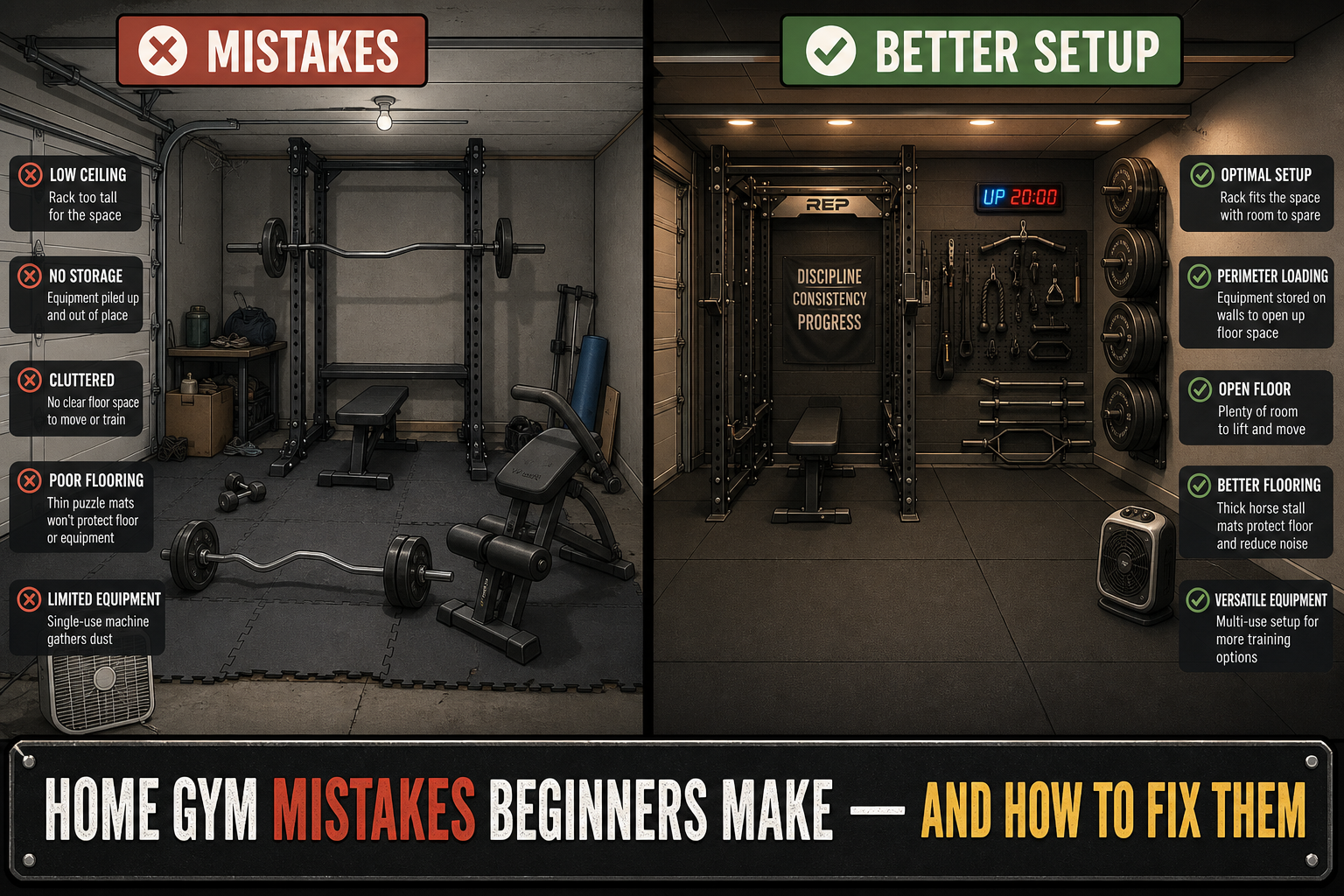
Why Most Home Gym Beginners Make the Same Mistakes
Building a home gym is a sequence of decisions, not a single shopping trip. The problem is that most beginners treat it like the latter. They see a photo of a finished garage gym on social media, buy a rack and a barbell, throw down some puzzle mats, and start lifting. A few months later, the barbell is rusting, the mats are crumbling, the cheap bench wobbles, and motivation has evaporated.
The mistakes that derail new home gym owners fall into four predictable phases: planning, purchasing, setup, and training. Each phase builds on the one before it. A planning error — like not measuring your ceiling height — leads to a purchasing error — buying a power rack that doesn't fit — which leads to a setup error — cramming it into a corner — which leads to a training error — skipping overhead presses because you can't do them safely. This is the cascade of regret, and it is almost entirely preventable.
This guide walks through each phase in order, not as a random list of tips but as a decision pathway. If you address planning before buying, buying before setting up, and setup before training, you skip the cascade entirely. The data backs this up: poor space planning alone can cost between $500 and $2,000 in return shipping, restocking fees, and replacement purchases, according to an analysis by CTX Home Gyms. That is money spent fixing a mistake that a roll of painter's tape could have prevented.
Phase 1: Planning Mistakes — The Foundation You Can't Skip
Planning mistakes are the most expensive because they compound into every later phase. Fixing a bad purchase is annoying. Fixing a bad purchase that doesn't fit your space is demoralizing. Fixing a bad purchase that doesn't fit your space and doesn't match your training goals is how people end up with a $2,000 clothes rack in the corner of their garage.
Not Measuring Your Space (Especially Ceiling Height)
Floor space is the obvious measurement, but ceiling height is the one that trips up beginners. A power rack with a pull-up bar typically needs 8 to 9 feet of clearance. If you plan to do overhead presses while standing, you need even more. Basements are notorious for this: a 7-foot ceiling eliminates most overhead movements and many pull-up bars entirely.
The fix is simple and costs nothing. Use painter's tape to outline the footprint of every piece of equipment you are considering directly on your floor. Stand inside the tape. Walk around it. Can you load a barbell? Can you do a burpee next to it? Can you open the door? This single step, recommended by both REP Fitness and Garage Gym Experiment, prevents the most common space-related regret.
Skipping the Budget Conversation
A home gym budget is not a spending limit — it is a decision-making tool. Without one, you either underspend on junk that breaks or overspend on features you will never use. According to Garage Gym Reviews' 2026 cost analysis, the average beginner home gym costs between $1,500 and $2,500. That figure includes a power rack, barbell, weight plates, adjustable bench, and basic flooring. It does not include a commercial treadmill or a full set of kettlebells.
The same analysis notes that the average gym membership costs $65 per month, based on 2024 data from the Health & Fitness Association. At that rate, a $2,000 home gym pays for itself in roughly 26 months — and that is before factoring in gas, time, or the fact that you own the equipment afterward.
| Budget Tier | Typical Cost | What It Covers |
|---|---|---|
| Budget | $300–$1,000 | Adjustable dumbbells, kettlebells, resistance bands, budget cardio machine |
| Mid-range | $1,000–$3,000 | Power rack, Olympic barbell, weight plates, adjustable bench, flooring |
| Full gym | $3,000–$6,000 | Above plus cardio machine, rack accessories, dedicated flooring, storage |
| Commercial-grade | $6,000+ | Commercial-quality machines, multiple stations, premium accessories |
This is general fitness education, not medical advice. For diagnosis or treatment of pain or injury, consult a qualified clinician.
Pick your next session
Browse all routines to find an appropriately-spaced next session.
Spot something off?
This content sits adjacent to health guidance — tell us if a citation or figure needs a correction.