
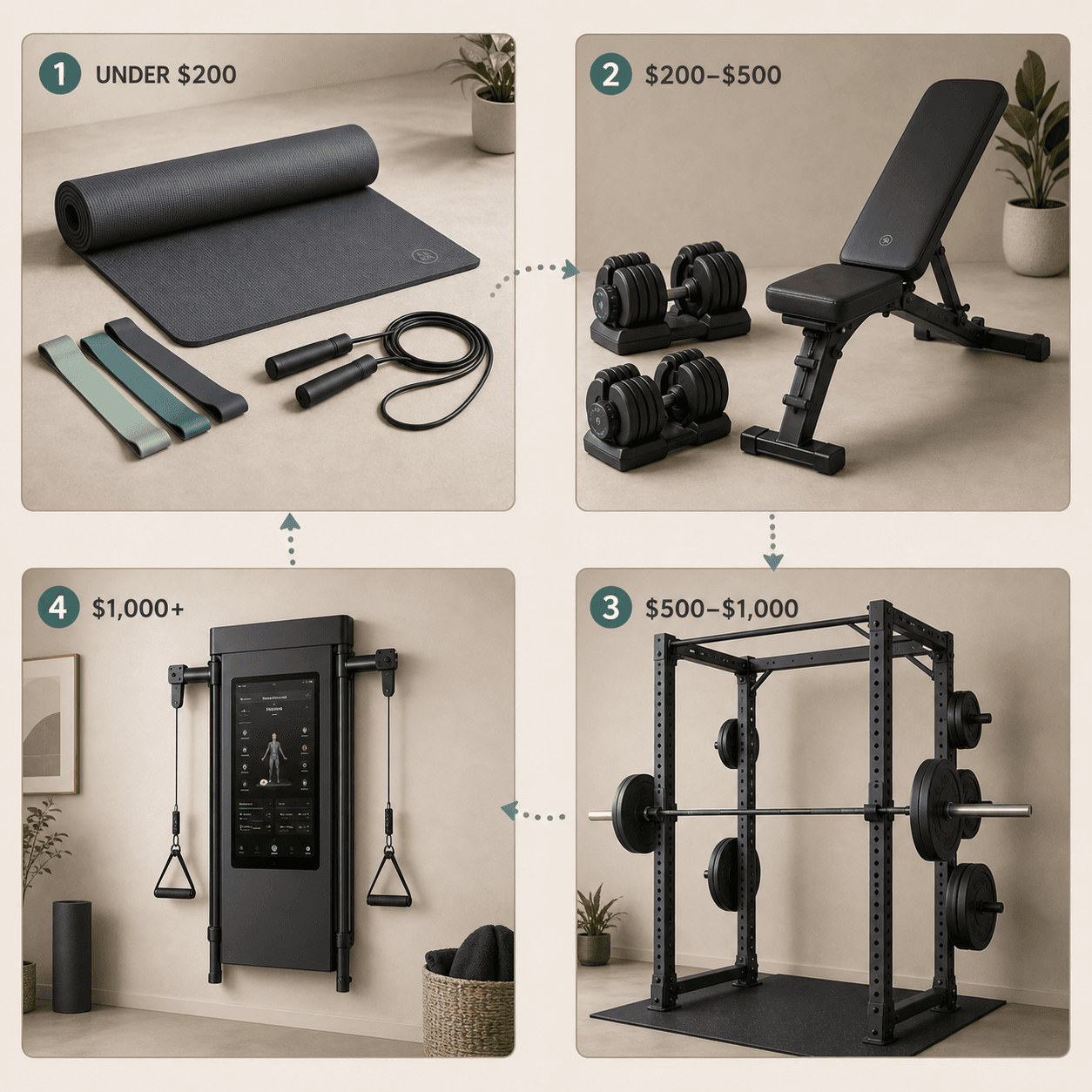
Start with your real budget, not your dream budget
Search for “best home exercise equipment” and you get a $4,295 Tonal next to a $12.99 resistance band set. They aren’t competing. One is a furniture-grade machine with a subscription; the other fits in a desk drawer. A single “best” list is useless.
The only sensible starting point is your budget ceiling — not what you wish you could spend, but what you actually will. The average home gym costs $1,500–$2,500, according to a Garage Gym Reviews cost analysis, and pays for itself in roughly two years compared with the average $65-per-month gym membership (2024 Health & Fitness Association data). That breakeven only matters once you know your tier.
This guide is organized by five real spending tiers, from under $200 to $2,000+. Each has a clear strategy, buy‑vs‑skip picks, and the hidden costs most roundups ignore.
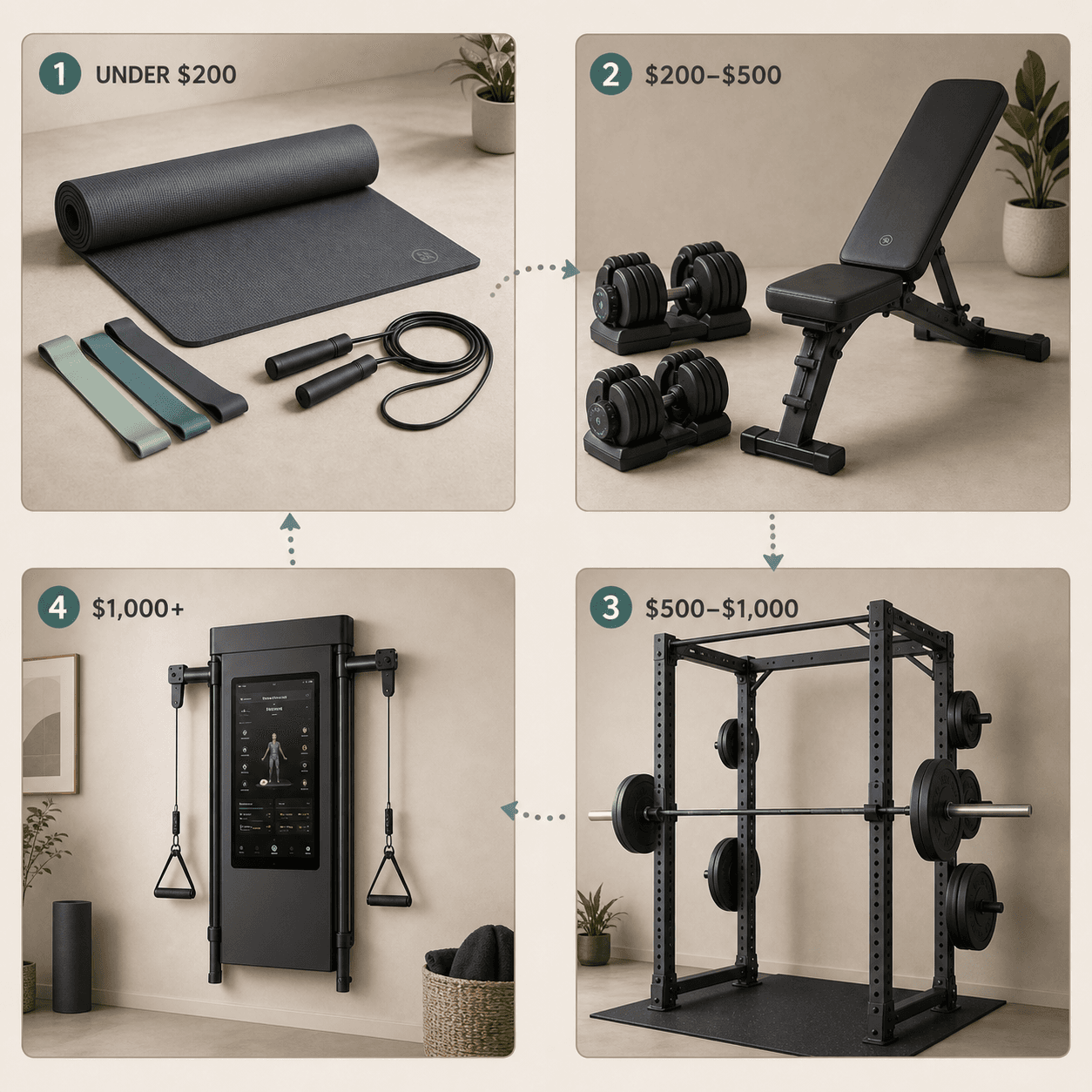
Under $200: What $150–$200 actually gets you
A mat, resistance bands, and a single pair of dumbbells cover “about 90 percent of effective home training” — that’s personal trainer Sam Siwicki’s opinion, not a peer‑reviewed study. For general fitness it’s a reasonable starting point. For heavy compound lifts, it won’t cut it.
Here’s what to buy and what to skip:
- Buy a thick yoga mat that won’t wear out in six months. The Manduka PRO ($144) is built for lifetime use; the Lululemon The Mat ($98) is cheaper and still excellent. Skip the $15 foam mats — they compress after a few weeks.
- Buy resistance bands. SPRI Flat Bands 3‑pack ($12.99) or the Living.Fit set ($128.94) with up to 250 lbs resistance. Bands get dismissed as toys, but they shine for warm‑ups, glute activation, and isolation work. Where they genuinely fail: heavy compound lifts (bench press, squats over 185 lbs). For those you need free weights.
- Skip cheap fixed dumbbells. A pair of plastic‑coated concrete dumbbells will wobble and chip. If your budget stretches another $50–$100, invest in a single pair of medium‑weight cast‑iron dumbbells (15–25 lbs) instead.
- Add an ab wheel ($7.99) — it is the best $8 you will spend on core work.
Total: about $150–$200. No subscription, no assembly required. If space is a concern, our Compact Home Gym by Space Tier guide shows how to store all of it in a closet.
$200–$500: The adjustable dumbbell sweet spot — if you actually use them
Once you have $200–$500, the highest‑ROI purchase is a pair of adjustable dumbbells. One set replaces 15+ pairs of fixed dumbbells, saves floor space, and retains resale value. But only if you train consistently enough to justify the cost. If you’re on the fence, start with the lower tier.
Options at this price point:
| Model | Price | Weight range | Key note |
|---|---|---|---|
| Feierdun Adjustable Dumbbells | $109.99 | Configures into kettlebells, barbell | Budget pick but lower build quality |
| TYZDMY 52.5‑lb pair | $269.99 | 5–52.5 lbs in 15 increments | Good value; smooth adjustment |
| REP Fitness QuickDraw | $335.99 | 5–60 lbs | Lifetime warranty, drop‑proof |
Add a basic weight bench (under $100) and you have a setup that handles squats, presses, rows, and curls. This combination — adjustable dumbbells + bench — is my default recommendation for anyone in this tier with at least 20 square feet of floor space.
For a deeper look at what $500 can buy in a complete machine, read Marcy 150lb Stack vs. Bowflex vs. Budget Rack: Which $500 Home Gym Setup Wins?.
$500–$1,000: Power rack or space‑saver?
At this level you face a genuine choice: build around a power rack or go premium on adjustable resistance.
Path A — power rack starter: A budget rack like the Fitness Reality 810XLT (~$300) plus a barbell and 255 lbs of plates runs about $400–$500 total. This gives you barbell squats, bench press, deadlifts, and overhead press — the core compound lifts — but demands roughly 6’×6’ of floor space.
Path B — premium compact alternative: The X3 Bar ($549) generates up to 300 lbs of resistance from a 10″×19″×1″ footprint — about the size of a shoebox. No subscription, no assembly, and it stores behind a door. If you live in an apartment or share a room, this is the strongest space‑saving option. Or upgrade the REP QuickDraw at $335.99 and add a flat bench.
The recommendation depends on your long‑term goal: if you want to progress toward powerlifting numbers, invest in the rack. If you need maximum strength in minimum space, the X3 Bar wins. There is no universal “best” — only the trade‑off between scalability and compactness.
$1,000–$2,000: Convenience today vs. flexibility later
Spending more does not automatically buy better gear — it often buys convenience that comes with a future cost. Compare the two popular all‑in‑ones:
| Model | Price | Resistance | Footprint | Upgrade path |
|---|---|---|---|---|
| Bowflex Xtreme 2 SE | $1,499 | 210 lbs (upgradable to 410 lbs) | Larger | Add weight stacks |
| Bells of Steel All‑in‑One | $1,299.99 | 300 lbs cable capacity | Compact | Modular attachments |
| Traditional rack + barbell + plates | ~$1,500–$2,000 | Unlimited with plate additions | 6’×6’ | Fully scalable, no proprietary parts |
The Bowflex and Bells of Steel require little assembly and offer dozens of exercise positions with a single machine. But both use proprietary cables and pulleys — if a part breaks years down the line, you are beholden to the manufacturer. A traditional rack setup has zero proprietary parts; a standard barbell and plates can be replaced from any fitness store. Convenience today can mean less flexibility tomorrow.
$2,000+: The smart gym math trap
Here is where the real cost‑of‑ownership gap opens. A $4,295 Tonal 2 looks like the ultimate home gym — until you run the five‑year numbers.
Tonal 2: $4,295 + $59.95/month × 60 months = $7,487 over five years. A Speediance Gym Monster ($3,199, no subscription) costs $3,199 total — saving $4,288. A traditional commercial‑grade rack with plates, barbell, and bench runs about $2,500 and costs exactly $2,500 over five years because there is no monthly fee. Even the X3 Bar ($549) is in this conversation if you do not need guided workouts.
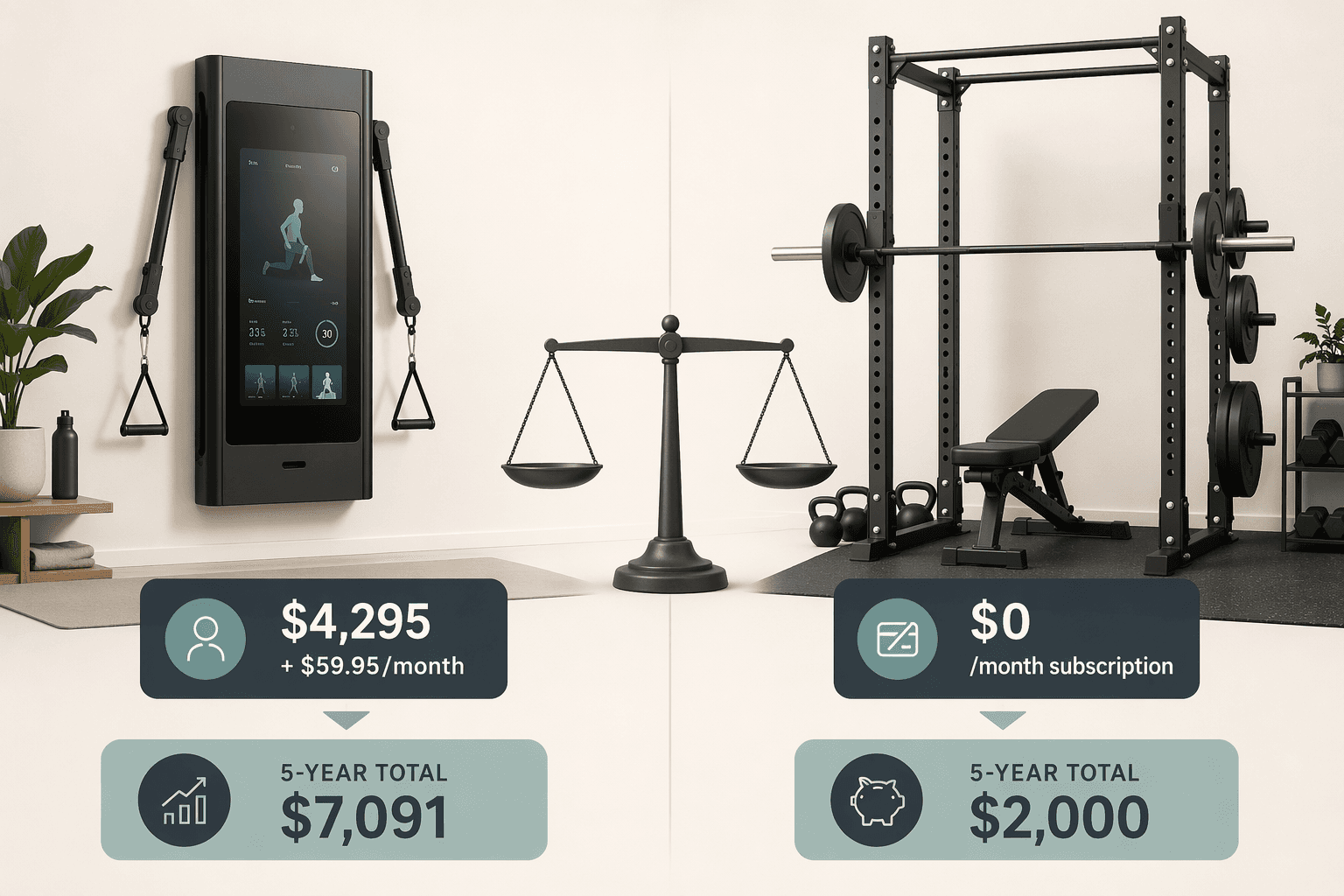
The smart gym argument is compelling if you value interactive coaching and space‑saving design. But if your budget is $2,000–$3,000, do not assume “more expensive = better value.” Add up the monthly drain before you decide.
The only cost table that matters — 5‑year totals
Here is the table that accounts for subscriptions, shipping, and the real price of ownership.
| Setup | Initial price | Monthly subscription | Shipping | Warranty | 5‑year total | Skip if… |
|---|---|---|---|---|---|---|
| Resistance bands + mat + ab wheel | ~$200 | $0 | Free | Varies | $200 | You need heavy compound lifts |
| Adjustable dumbbells + bench | ~$400–$500 | $0 | Often free | 1–5 years | $400–$500 | You want barbell training |
| X3 Bar | $549 | $0 | Free | Lifetime on bar | $549 | You need guided coaching |
| Bells of Steel All‑in‑One | $1,299.99 | $0 | Doesn't specify | Manufacturer | $1,299.99 | You want modular upgrade path |
| Bowflex Xtreme 2 SE | $1,499 | $0 | Not shown | Manufacturer | $1,499 | You want non‑proprietary parts |
| Traditional rack + plates + barbell | ~$2,500 | $0 | Varies | Lifetime on rack | $2,500 | You have under 6’×6’ floor space |
| Speediance Gym Monster | $3,199 | $0 | Not shown | Manufacturer | $3,199 | You want free‑weight feel |
| Tonal 2 | $4,295 | $59.95/mo | $250 | 2 years | $7,487 | You want to avoid monthly fees |
Bottom line: the cheapest upfront option is often the cheapest overall — unless you genuinely need heavy progressive overload (400+ lbs on a barbell) or guided smart‑gym coaching. If your training fits a resistance band or adjustable dumbbell program, you can save thousands.
Define your total budget — initial price plus five years of possible subscriptions — and then pick the tier that fits. No single piece of equipment is the “best” until you know the real number you are willing to spend.
Comments
Join the discussion with an anonymous comment.