
Home Gym vs. Gym Membership: The Complete 2026 Cost-Benefit Breakdown
A transparent cost-benefit analysis comparing home gym and gym membership expenses across multiple tiers, including hidden fees and time costs. Shows break-even points and helps budget-conscious readers decide based on their space, motivation, and training preferences.
The usual comparison starts with a monthly fee. Planet Fitness: $15 a month. Gold's Gym: $25. Quick math says $180–600 a year. That number is not just a little off — it is missing half the story. The average US gym member actually spends $60–65 a month in 2026, once you add annual fees, gas, parking, and the random locker rental. That comes to $1,000–$1,500 per year. That is the real baseline for comparing a home gym.
What Your Gym Membership Actually Costs
The advertised monthly fee is a teaser. Planet Fitness runs $15–24.99 a month, but the annual fee of $49 is quietly added after the first month. Mid-tier chains like LA Fitness or 24 Hour Fitness charge $30–60 a month, plus initiation fees that can hit $99. High-end studios like Equinox go to $205–395 a month. The average across all tiers, weighted by actual membership numbers, is $60–65 a month.
Then there is the commute. A 10-mile round trip costs about $1.40 in gas per visit, according to AAA estimates. If you go 200 times a year (roughly four times a week), that is $280 a year just to get there. Add the time: 15–20 minutes each way averages 69 hours a year behind the wheel. That time is not a direct dollar cost, but it matters when you consider what else you could do with it.
Home Gym Tiers: What $350, $1,200, and $3,000 Really Buy
The counterargument is that home gym equipment costs a lot upfront. True for some setups, but the range is wider than most people realize. The Home Gym Foundry breaks it into three practical tiers:
| Tier | Upfront Cost | Yearly Upkeep | What It Typically Includes |
|---|---|---|---|
| Budget | $350 | $30 | Resistance bands, yoga mat, adjustable dumbbells (up to 50 lbs), a pull-up bar, maybe a cheap bench |
| Mid-tier | $1,200 | $75 | A rack-compatible barbell set, bumper plates, adjustable bench, cable attachment, and a sturdy rack or squat stand |
| Premium | $3,000 | $150 | Commercial-grade barbell, full power rack, plate tree, rower or assault bike, high-quality bench, and flooring |
I will be honest: the $350 tier is suspiciously low. It buys essentially bodyweight gear and light resistance. That works for a beginner or someone focused on mobility and light strength, but it will not satisfy someone who wants serious progressive overload within six months. A more realistic start for most people is closer to the mid-tier, which aligns with CNET’s calculated average setup cost of $1,098. Still, 38.6% of home fitness equipment buyers in the US spent under $500 on a single piece, according to a 2022–2023 Statista survey — so a full budget setup can be done, but only if you keep your expectations modest. For a deeper look at what each tier actually includes, see our home gym system cost breakdown.
Why One Source Says 4 Months and Another Says 4 Years
Here is where things get interesting. The Home Gym Foundry claims a budget home gym breaks even in 4–5 months when compared to a $50/month gym membership. CNET says the break-even for a $1,098 home gym vs. Gold's Gym at $25/month is about four years. Both are cited, both are defensible, and both are incomplete if you do not adjust for your own assumptions.
The difference comes down to three variables: the cost of the gym membership you are comparing against, the upfront cost of the home gym, and whether you include hidden costs like commute gas and annual fees. The Home Gym Foundry comparison pits a $350 home gym against a $50/month membership with an extra $250/year in hidden costs — commute, annual fees, and the like. That arithmetic is aggressive but not dishonest: if your gym really costs $50 a month and you drive 10 miles each way, the all-in monthly cost is around $73. A $350 home gym then breaks even by month 5. CNET, on the other hand, compares a $1,098 home gym against a $25/month Gold's Gym membership with no commute or annual fees baked in. Their break-even is ~4 years because they are comparing a higher home gym cost against a lower, cleaner gym membership number.
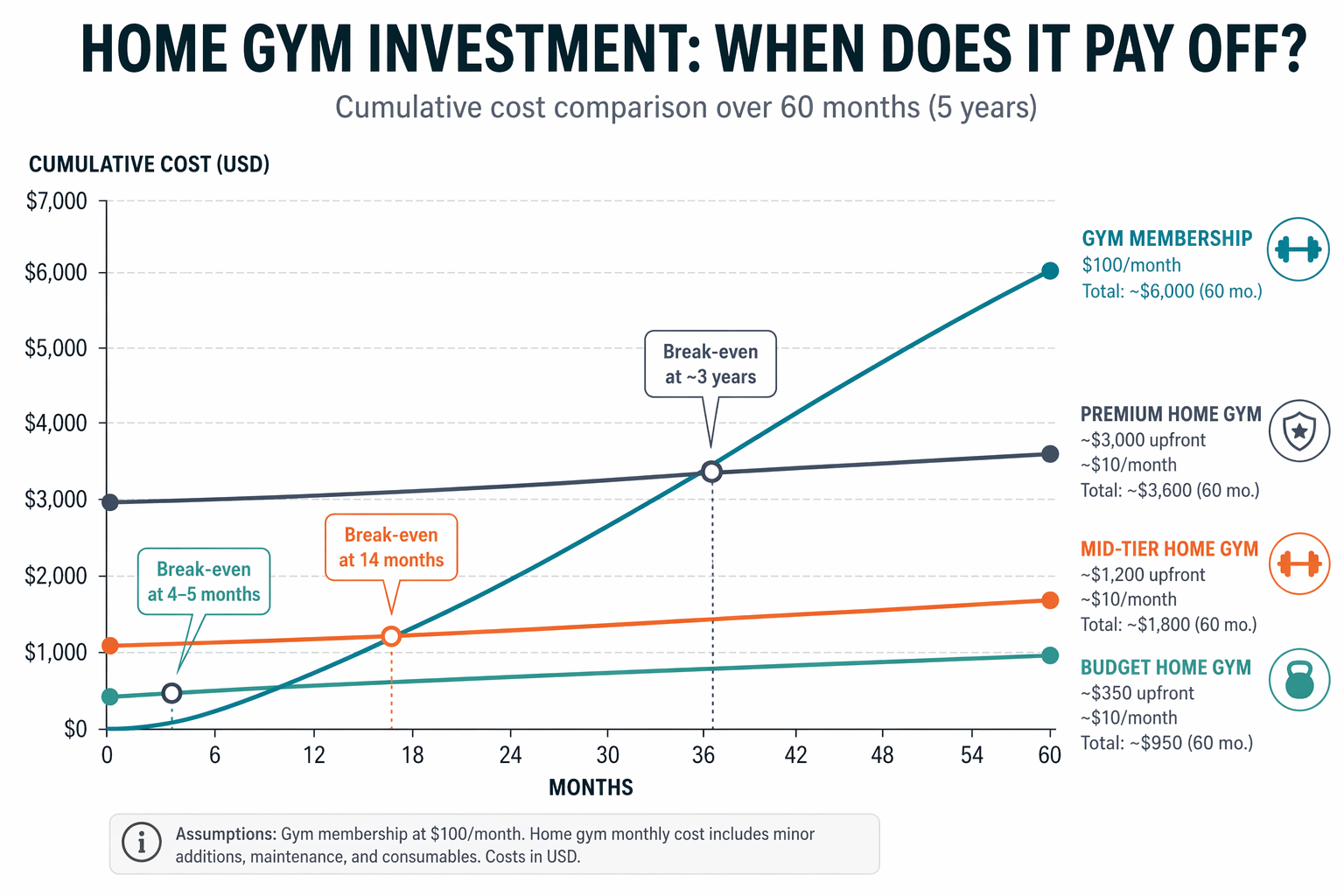
I do not think either source is wrong. They are answering different questions. The real question is: what does your specific situation look like? The table below shows cumulative costs over five years for three home gym tiers and a typical mid-tier gym membership (using the all-in cost of $1,200/year).
| Option | Year 1 | Year 3 | Year 5 |
|---|---|---|---|
| Mid-tier gym (all-in) | $1,200 | $3,600 | $6,000 |
| Budget home gym ($350) | $380 | $440 | $500 |
| Mid-tier home gym ($1,200) | $1,275 | $1,425 | $1,575 |
| Premium home gym ($3,000) | $3,150 | $3,450 | $3,750 |
Over five years, a mid-tier gym costs about $6,000. A budget home gym costs roughly $500 — a 92% saving. Even the premium home gym, at $3,375, is 44% cheaper than the gym membership. The break-even on the mid-tier home gym, compared to the gym scenario, is around month 14. For the premium tier, it takes about 30 months.
The Non-Financial Factors That Can Break the Math
The numbers look good for home gyms — so why does the decision still feel complicated? Because money is not the only variable. A home gym only saves you money if you actually use it. The equipment becomes a cost, not an investment, if it collects dust.
Consider this: 50% of new gym members quit within six months, and 46% of those who drop out cite cost as a reason. A home gym eliminates the sunk-cost feeling of a monthly membership you are not using — but it replaces it with a different risk: buying gear that ends up as a clothes rack.
On the other side, 51% of US exercisers prefer home workouts for convenience, and 20% prefer them for privacy. The time savings are real: 100–200 hours a year when you cut the commute and the wait for the squat rack. That is a weekend a month regained.
76% of people want to be fit, but only 48% exercise regularly. The gap is not about knowing what to do — it is about removing friction.
So Which Should You Choose?
After running the numbers and weighing the intangibles, here is the honest verdict: the right choice depends on your motivation style, your space, and your tolerance for commitment.
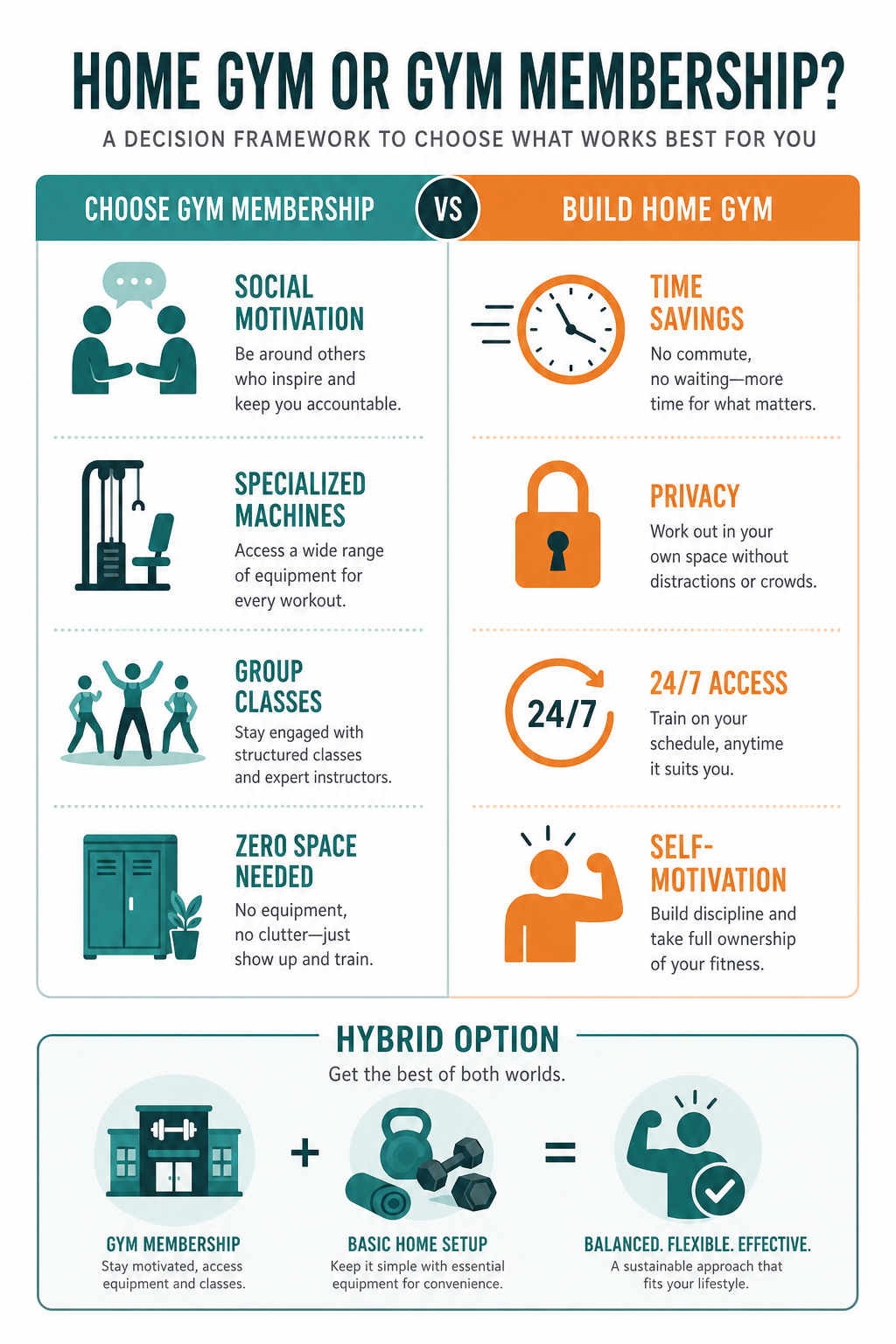
- Choose a gym membership if you thrive on social energy, need access to specialized machines (cable crossovers, plate-loaded leg press), have absolutely no space at home, or value group classes over training consistency.
- Build a home gym if you value time over equipment variety, have a spare corner (about 6x6 feet for a basic setup), are self-motivated enough to train without external pressure, and plan to work out consistently for at least three years.
- Consider the hybrid option: a budget home gym for daily convenience plus a cheap gym membership for occasional specialized sessions. The data shows that active adults with a hybrid approach lean 60:40 toward home workouts. That ratio feels about right to me — enough home training to save time and money, enough gym visits to get the machine work and the social fix.
The financial case for a home gym is strong, especially if you choose the mid-tier or budget route and stick with it for a few years. But the math is incomplete if it ignores your own habits. The best financial choice is the one you will actually follow through on. If that is a hybrid setup — a $10-a-month Planet Fitness membership and a set of adjustable dumbbells at home — then that is the right answer.
If you decide to go the home gym route, our best home exercise equipment buying guide can help you pick the right gear. And if budget is your primary constraint, the home fitness on a budget guide breaks down smart choices under $300.
This is general fitness education, not medical advice. For diagnosis or treatment of pain or injury, consult a qualified clinician.
Pick your next session
Browse all routines to find an appropriately-spaced next session.
Spot something off?
This content sits adjacent to health guidance — tell us if a citation or figure needs a correction.