
Home Fitness on a Budget: Smart Equipment and App Choices for Every Price Point
A practical, tiered guide for building an effective home gym without overspending. Covers smart equipment picks and free or low-cost apps across three budget ranges ($0–100, $100–500, $500–1,500), with a decision matrix and subscription cost analysis to help you choose what fits your space, goals, and wallet.
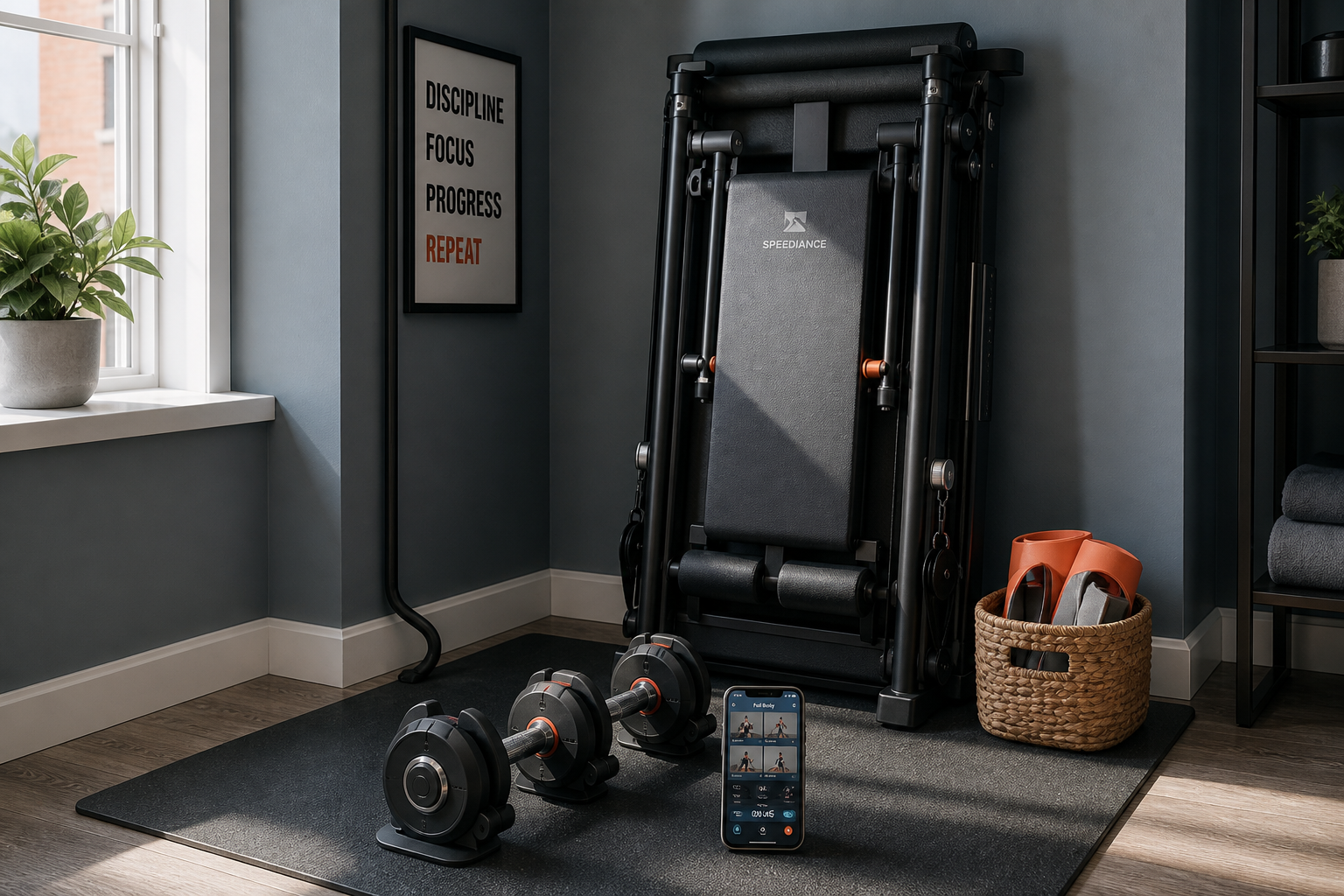
Why Cost Is the #1 Barrier — and Why 2026 Changes the Equation
If you have held off building a home gym because you assume it requires a dedicated room and a four-figure budget, you are not alone. According to Statista data aggregated by PTPioneer, 35.6% of US exercisers cite cost as the main factor preventing them from purchasing home fitness equipment, and the largest share of buyers (38.6%) spend under $500 on a single piece of equipment. Those figures, current as of 2022, reflect a persistent reality: price, not motivation, is the primary gatekeeper.
What has changed by mid-2026 is the quality of options available at those lower price points. The market has responded to demand. Compact multi-function machines that fold to the size of a suitcase, adjustable dumbbells that replace an entire rack, and genuinely free workout apps with professional programming have matured to the point where effective home fitness no longer requires a large upfront investment. The global home fitness equipment market is projected to grow from $13.57 billion in 2026 to $22.99 billion by 2034 (Fortune Business Insights), and a significant portion of that growth is in the sub-$500 segment and online sales channels, which are expanding at a 3.02% CAGR.
Tier 1: $0–100 — Bodyweight, Bands, and Free Apps
This tier is for anyone who wants to start training today with minimal financial commitment. It is also the most space-efficient option — ideal for apartment dwellers and those testing whether a home fitness routine will stick before investing in larger gear.
Core Hardware (Under $100)
- Resistance bands (set of 3–5 bands): $15–30. Provide progressive resistance for strength work, take up no space, and travel easily.
- Yoga or exercise mat: $15–25. Essential for floor work, stretching, and protecting your floor surface.
- Foam roller: $15–30. Supports recovery and mobility work, which is often overlooked by beginners.
- Pull-up bar (doorway-mounted): $20–40. Adds upper-body pulling movements that bodyweight squats and push-ups cannot replace.
With these four items — totaling roughly $65–125 depending on choices — you can perform a full-body strength, cardio, and mobility routine. The remaining budget goes toward the most important piece of equipment in this tier: your smartphone.
Free Apps That Deliver Real Programming
The app landscape has shifted dramatically. Several platforms now offer genuinely free versions that are not limited trials or stripped-down demos. According to expert testing by Garage Gym Reviews (updated June 2026), three apps stand out for their no-cost offerings:
- Nike Training Club: Completely free since 2020 with no premium tier. Offers on-demand and live classes from certified instructors across strength, HIIT, yoga, and Pilates. This is the closest you will get to a premium app experience at zero cost.
- Caliber: A robust free-forever version with a library of over 500 exercises, custom workout programs based on an initial assessment, and progress tracking. Particularly strong for strength training.
- FitOn: The free version provides access to a large library of guided workout videos with modifications shown on screen. Recommended for beginners who benefit from visual coaching.
For a deeper look at strength-focused free options, see our guide to best free exercise apps for home gym owners, which covers strength logging, programming, and progressive overload tools that work well with bodyweight and band training.
Tier 2: $100–500 — Adjustable Dumbbells, Multi-Function Machines, and Smart Free Apps
This is the sweet spot for budget-conscious buyers who want more resistance than bands can provide and are ready for equipment that supports progressive overload over months or years. The $100–500 range covers the majority of US home fitness buyers (38.6% spend under $500), and the options here have improved significantly in terms of build quality and space efficiency.
Key Equipment Options
- Adjustable dumbbells ($150–350): Replace 10–15 individual dumbbell pairs. Look for models with a quick-change mechanism and a weight range of 5–50 lbs per hand. Brands like Bowflex, PowerBlock, and Nuobell dominate this space.
- Folding weight bench ($80–150): Pairs with adjustable dumbbells for pressing, rowing, and seated exercises. A folding bench stores vertically and takes up less than 3 sq ft when not in use.
- Wonder Core Pro Max 4-in-1 ($149): A compact multi-function machine that folds to 47" x 22.5" x 10" — roughly the footprint of a large rolling suitcase. It includes four training modes: rowing machine, ab glider, leg press, and Roman chair. The manufacturer claims the rowing mode activates 85% of full-body muscles, and a free companion app with coached workouts is available. At under 7 sq ft folded, this is one of the most space-efficient strength options on the market.
- Budget magnetic rowing machine ($200–400): Provides low-impact cardio and full-body pulling work. Magnetic resistance is quieter and requires less maintenance than air or water rowers at this price point.
App Recommendations for This Tier
With adjustable dumbbells or a multi-function machine, you need programming that supports progressive overload — not just random workouts. Boostcamp is a standout option here. Its free version provides access to over 1,000 strength-training programs, including more than 100 created by certified expert coaches. This is not a trial — the free tier is functional and well-maintained.
For a broader comparison of app pricing and features across free and paid tiers, our guide to free vs paid iPhone fitness apps breaks down what you actually get at each price point.
| Equipment | Approximate Price | Space Footprint | Best For |
|---|---|---|---|
| Adjustable dumbbells | $150–350 | 2 sq ft (stored) | Strength training, progressive overload |
| Folding weight bench | $80–150 | 3 sq ft (stored) | Pressing, rowing, seated exercises |
| Wonder Core Pro Max 4-in-1 | $149 | Under 7 sq ft (folded) | Full-body strength, rowing, compact spaces |
| Budget magnetic rower | $200–400 | 8–10 sq ft | Low-impact cardio, endurance |
Tier 3: $500–1,500 — Smart Trainers, Cable Machines, and App-Only Subscriptions
This tier is for readers ready to invest in equipment that offers guided programming, real-time feedback, or a more traditional gym experience at home. The key difference from lower tiers is the introduction of subscription costs — you are not just buying hardware; you are buying into a platform.
Smart Equipment Worth Considering
- Tempo Move Starter Bundle ($504, $39/mo subscription): Uses your TV and a 3D sensor to track your movement and provide real-time form feedback. The starter bundle includes weights, a barbell, and a mat. The subscription unlocks the full class library and personalized programming. At $504, it is one of the most affordable smart gym entries, but the $39/month fee adds $468 per year.
- MaxPRO SmartConnect Portable Cable Machine ($749, optional $19.99/mo subscription): A portable cable machine that fits in a carry bag and provides up to 150 lbs of magnetic resistance. The subscription is optional and unlocks guided workouts and programming. This is a strong option for apartment dwellers who want cable-based training without a wall-mounted system.
- Quality folding treadmill ($600–1,200): Folding treadmills in this range (e.g., NordicTrack, Sole, Horizon) offer incline, Bluetooth connectivity, and decent cushioning. Many come with a 30-day to 1-year iFIT or Peloton app trial, after which you pay $12.99–$39/month for guided runs.
The App-Only Alternative: Premium Programming Without Premium Hardware
If you already own basic equipment (dumbbells, a bench, a mat) and want structured programming without buying new hardware, the Peloton App-only membership ($12.99/month) is a compelling option. It provides access to strength, yoga, HIIT, outdoor running, and meditation classes — no Peloton bike or treadmill required. Over three years, that is $467.64 — less than the upfront cost of most smart gyms, and you can cancel anytime.
The Subscription Math: Free vs. Paid App Models Compared
Subscription costs are the hidden variable in home fitness budgeting. A $12.99/month app may seem trivial, but over 3–5 years it can exceed the cost of the equipment itself. The table below compares the key apps mentioned across all three tiers, showing what you get at each price point.
| App | Pricing Model | Monthly Cost | Key Features | Best For |
|---|---|---|---|---|
| Nike Training Club | Free (no premium tier) | $0 | On-demand & live classes, certified instructors, strength/HIIT/yoga/Pilates | Beginners, anyone wanting zero-cost guided workouts |
| Caliber | Free forever | $0 | 500+ exercises, custom programs, progress tracking | Strength-focused training, progressive overload |
| FitOn | Free version | $0 | Guided videos with modifications, large library | Visual learners, beginners |
| Boostcamp | Free version | $0 | 1,000+ strength programs, 100+ from certified coaches | Intermediate lifters, program followers |
| Peloton App | Subscription only | $12.99/mo | Strength, yoga, HIIT, outdoor runs, meditation | Those who want premium programming without premium hardware |
| Tempo | Hardware + subscription | $39/mo | 3D form tracking, personalized classes, live coaching | Form-conscious buyers, guided workout fans |
For a deeper dive into how subscription costs accumulate for specific equipment categories, see our analysis of exercise bike subscription costs over 1, 3, and 5 years. The same math applies to most smart gyms and connected fitness platforms.
Decision Matrix: Match Your Budget and Goal to the Right Setup
The following matrix maps common reader profiles to specific equipment and app recommendations from the three tiers. Use it as a shortcut to your ideal setup without re-reading the full article.
| Your Profile | Budget | Primary Goal | Space Constraint | Recommended Gear | Recommended App |
|---|---|---|---|---|---|
| Complete beginner, testing the waters | $0–100 | Build consistency, learn basic movements | Very limited (apartment, shared space) | Resistance bands, yoga mat, foam roller | Nike Training Club or FitOn (free) |
| Apartment dweller, wants strength training | $100–500 | Build muscle, progressive overload | Under 10 sq ft | Adjustable dumbbells, folding bench, or Wonder Core Pro Max | Caliber or Boostcamp (free) |
| Budget-conscious cardio seeker | $100–500 | Improve endurance, low-impact cardio | Under 12 sq ft | Budget magnetic rowing machine | FitOn or Peloton App ($12.99/mo) |
| Form-focused lifter, ready to invest | $500–1,500 | Guided strength training with feedback | Moderate (spare room, corner) | Tempo Move Starter Bundle | Tempo subscription ($39/mo) |
| Cable training enthusiast, small space | $500–1,500 | Versatile cable-based strength | Very limited (portable) | MaxPRO SmartConnect | MaxPRO subscription (optional, $19.99/mo) |
| Runner who wants guided programming | $500–1,500 | Running + cross-training | Moderate | Quality folding treadmill | Peloton App ($12.99/mo) or treadmill's native app |
If you are still deciding between an all-in-one machine and a modular setup, our long-term cost comparison of all-in-one fitness machines vs. modular home gyms over 5 years provides the data you need to make that call.
Final Take: Start Where You Are, Upgrade When You Need To
The most important takeaway from this guide is that effective home fitness is accessible at every budget level. The $149 Wonder Core Pro Max and a free app like Nike Training Club can deliver a full-body workout that rivals what many commercial gyms offer. The $504 Tempo Move with guided form feedback can accelerate your learning curve if you have the budget and want the coaching layer.
The common thread across all three tiers is that consistency matters more than equipment. The best piece of equipment is the one you will actually use three to four times per week. Start with the tier that fits your current budget and space. Upgrade only when your goals, strength level, or available space change — not because a marketing campaign tells you that you need more.
This result comes from one real apartment under the stated conditions — it is a strong signal, not a guarantee your space will measure identically.
Builds this evidence supports
Cable Machine Alternatives That Save Space and Money
Compare the best cable machine alternatives for home gyms – from resistance bands and pulley systems to suspension trainers and compact digital units – and find the right option for your space and budget.
How to Choose a Compact Home Gym That Works for Your Space, Budget, and Noise Tolerance
This article provides a structured decision framework for apartment dwellers and small-space residents to match their specific floor footprint, noise sensitivity, and budget to the most suitable compact home gym strategy — whether that's an all-in-one machine, modular build, smart digital system, or band/bodyweight setup.
The Garage Gym Reality Check: What Equipment Actually Fits in a Single-Car Garage
Most garage gym guides assume a two-car space. This article uses real dimensions, real equipment footprints, and three layout templates to show what fits—and what doesn't—in a single-car garage (10x20 to 12x20 ft).
Spot something off?
If this result didn't match your own space, let us know — floor-damage and noise claims carry real deposit-risk consequences if we get them wrong.