
Best Home Workout Machine for Beginners: Which Type to Buy First, and What to Skip Until You Know Your Routine
Most beginners buy the wrong machine first. This guide uses a start-small, upgrade-later framework to help you choose the best first machine based on your intended path — strength, cardio, or unsure — and avoid costly mistakes.
The Beginner's Paradox: You Don't Know What You'll Use Until You Start
Walk into any home fitness forum and you'll find the same story repeated in dozens of variations: a beginner buys a $3,000 all-in-one smart gym or a commercial-grade treadmill, uses it enthusiastically for three weeks, then watches it collect laundry for the next three years. The machine wasn't bad. The problem was that the buyer had no way of knowing whether they would actually enjoy that type of training before committing to it.
This is the beginner's paradox in home fitness: you need equipment to build a routine, but you don't know what equipment suits you until you have a routine. The conventional approach — pick a category, read reviews, buy the "best" model in your budget — skips over this fundamental uncertainty. It assumes you already know whether you're a strength person, a cardio person, or something in between. Most beginners don't.
The data backs up the risk. According to industry research, 67% of gym members rarely or never use their membership, and 50% of new members quit within the first six months. At-home equipment faces the same abandonment pattern — only the financial loss is larger because you can't cancel a piece of equipment the way you can cancel a monthly membership.
Why 'Start Small' Is the Smartest Strategy for Beginners
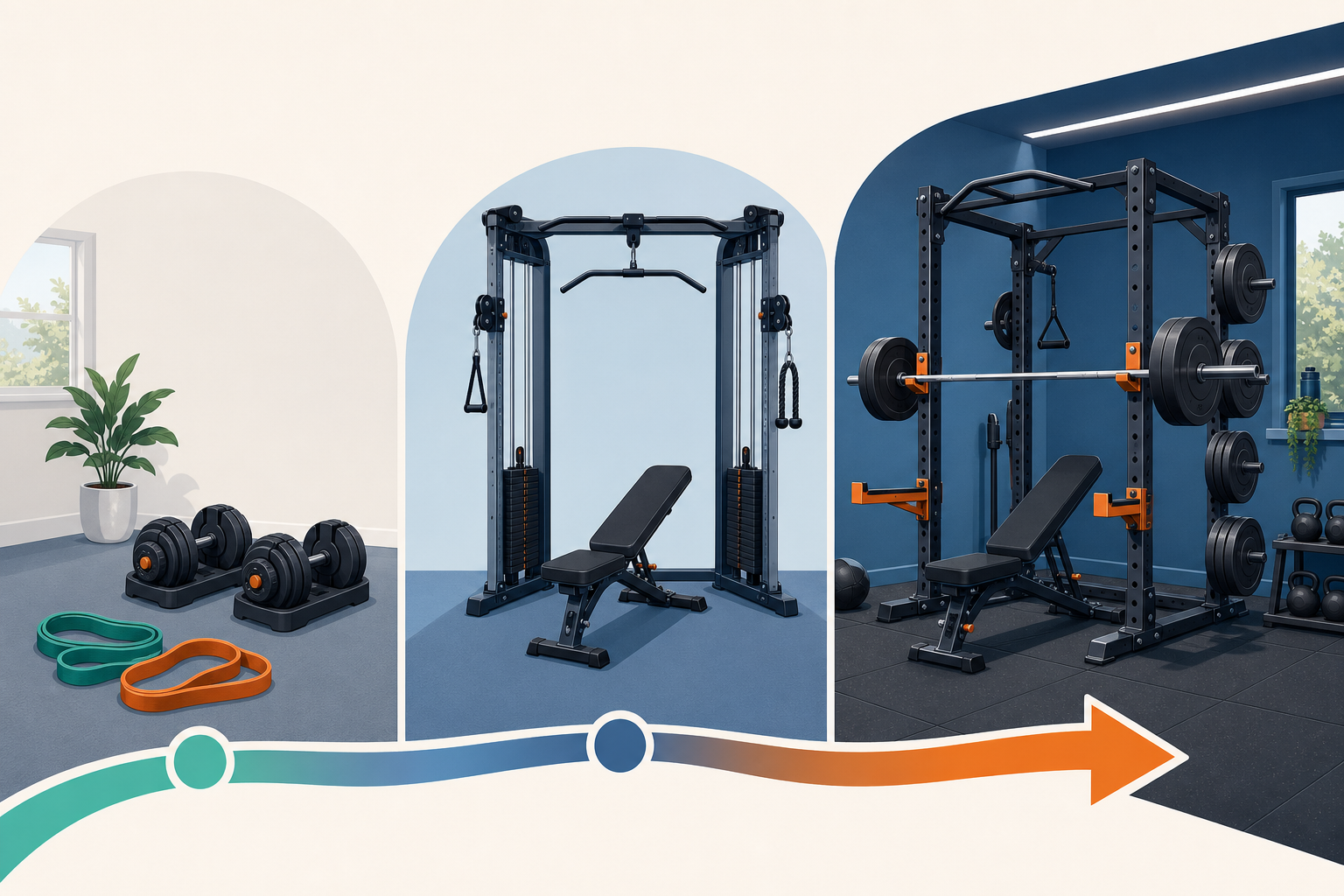
The "start small" approach isn't just frugal advice — it is grounded in exercise science and behavioral psychology. Exercise physiologists at the Cleveland Clinic explicitly recommend building slowly, noting that it is often better to add equipment a little at a time, especially when you are still figuring out how often you will use your gym. Their reasoning is straightforward: a small, manageable setup reduces the psychological pressure to "get your money's worth" and lets you discover your actual preferences without the sunk-cost guilt.
The financial case is equally compelling. A Statista survey from April 2022 found that 38.6% of US home fitness equipment buyers spent under $500 on a single piece of equipment. That $500 threshold is significant: it represents the price point where a beginner can buy genuinely useful equipment without over-committing. Compare that to the average price of tested home gym machines, which sits at $1,855, and the gap becomes clear. The industry's "best of" lists are built around products that serve intermediate and advanced users, not the uncertain beginner.
Starting small also protects against the most common reason for equipment abandonment: discovering you dislike the activity. A walking pad costs roughly $300. A budget exercise bike runs about $340. Resistance bands are $25 to $40. If you buy a walking pad and realize after a month that you dread walking, you are out $300 — not $3,000. That difference matters because it determines whether you try a different activity or give up on home fitness entirely.
- 38.6% of US home fitness equipment buyers spend under $500 per item (Statista, April 2022)
- 30.4% of US exercisers own weightlifting equipment at home — the most popular category
- 35.6% cite cost as the main barrier to purchasing home fitness equipment
- 51% of US exercisers prefer at-home workouts for convenience (2023)
Best First Buys by Intended Path
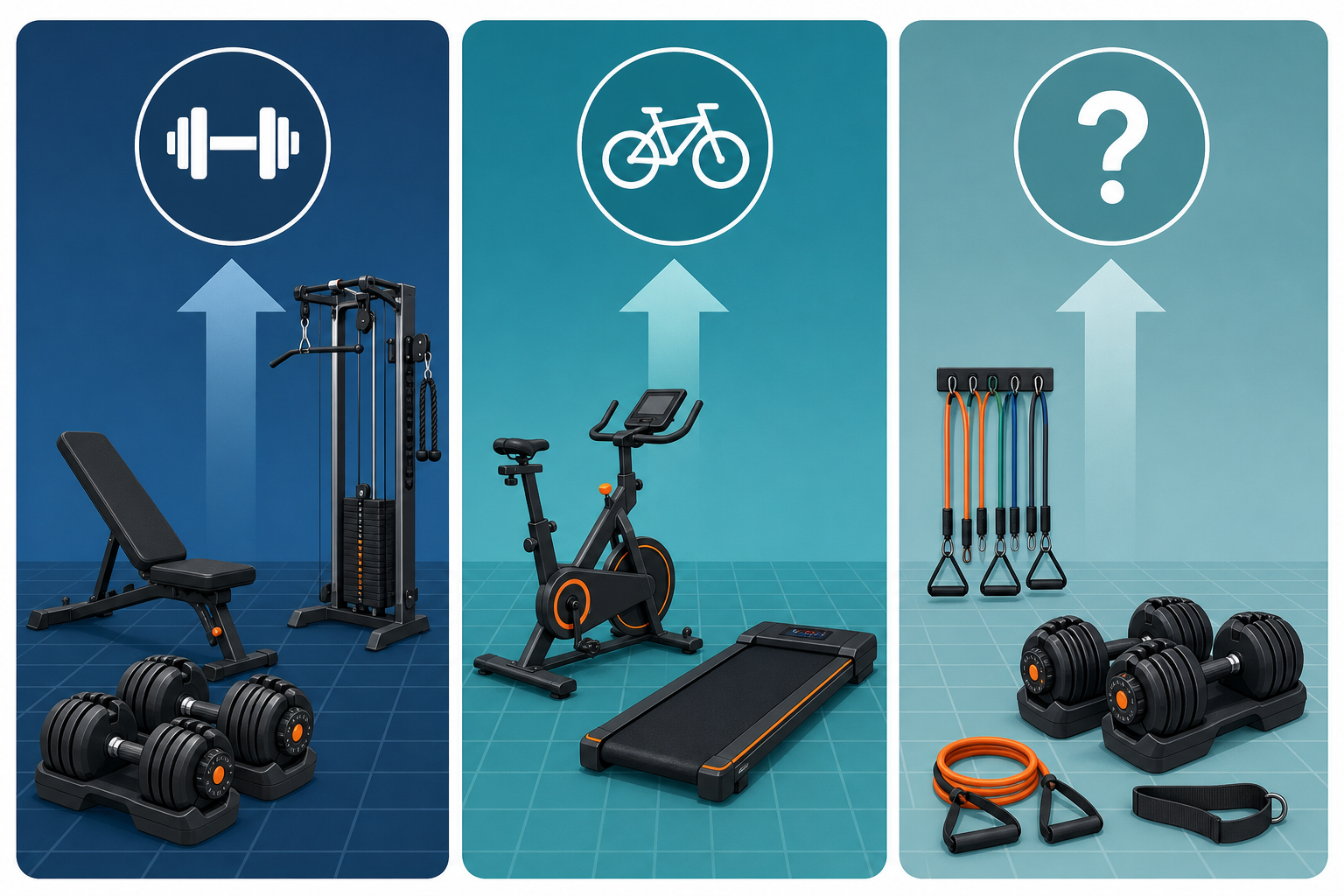
Most beginners have a vague sense of what they might enjoy — they lean toward strength, toward cardio, or they genuinely have no idea. The following three paths match each scenario with a specific first purchase that minimizes risk while providing a real training experience.
Strength Path: Adjustable Dumbbells + Bench, or a Cable Tower
If you suspect you are a strength-training person, the smartest first purchase is a set of adjustable dumbbells and a flat-to-incline bench. This combination covers the majority of fundamental movements — presses, rows, curls, extensions, lunges — and can be expanded later with additional plates or a second dumbbell set. A quality adjustable dumbbell pair runs $200 to $400, and a solid bench costs $100 to $200. Total investment: $300 to $600.
For beginners who want a more structured strength experience with built-in progression, the Bells of Steel Cable Tower with Weight Stack is an unusually strong option at its price point. Starting at $434.99, it offers a 210-lb weight stack, 33 height adjustments, and a compact footprint of 31 inches deep by 28.5 inches wide. Garage Gym Reviews, which extensively tested the unit, calls it a "home gym owner's dream product" and names it the best home gym for beginners. The cable tower provides constant tension through the full range of motion — something dumbbells cannot replicate — and the weight stack eliminates the need to buy, store, and change plates.
Cardio Path: Budget Bike or Walking Pad
If cardio is your inclination, the lowest-risk entry point is a budget-friendly stationary bike or a walking pad. The Yosuda indoor cycling bike, frequently cited around $340, is a popular entry-level option that provides a legitimate cycling workout without the premium price tag of a Peloton or NordicTrack. It is magnetic resistance, belt-driven, and requires no subscription. A walking pad — essentially a compact, foldable treadmill without a console — runs $250 to $400 and fits under a bed or couch.
Both options share a critical advantage: they let you test your tolerance for the activity at a low cost. If you discover that stationary cycling bores you after two weeks, you are out $340, not $2,695 (the price of a Peloton Bike+). If you love it, you can upgrade to a higher-end model later with the confidence that the investment will actually be used.
The 'No Idea' Path: Resistance Bands + Adjustable Dumbbells
If you genuinely have no idea whether you prefer strength or cardio — and many beginners don't — the safest first purchase is a set of resistance bands paired with a single set of adjustable dumbbells. Total cost: $50 to $150. This combination covers strength work (dumbbell presses, rows, squats), resistance training (band pull-aparts, banded squats, banded push-ups), and even cardio-style circuits (banded jumping jacks, dumbbell complexes).
The evidence for resistance bands is stronger than most beginners realize. A 2019 systematic review published in SAGE Open Medicine found that training with resistance bands can provide comparable strength gains to free weights. The Cleveland Clinic cites this same review in their home gym recommendations, noting that bands minimize startup cost while delivering real results. For a beginner who doesn't know what they want, $30 worth of bands and a $70 set of adjustable dumbbells is the lowest possible financial commitment that still provides a legitimate full-body workout.
| Path | Recommended First Purchase | Price Range | Why It Works |
|---|---|---|---|
| Strength | Adjustable dumbbells + bench | $300–$600 | Covers all fundamental movements; expandable later |
| Strength (structured) | Bells of Steel Cable Tower | $435 | 210-lb weight stack, constant tension, compact footprint |
| Cardio | Yosuda indoor cycling bike | $340 | Legitimate cycling workout, no subscription required |
| Cardio | Walking pad | $250–$400 | Compact, foldable, tests walking/running tolerance |
| Unsure | Resistance bands + adjustable dumbbells | $50–$150 | Covers strength and cardio; minimal financial risk |
What Beginners Should Skip (and Why)
Equally important to knowing what to buy is knowing what to avoid. The following categories are poor first purchases for beginners, regardless of how highly they rank in general roundups.
- Smart gym subscriptions ($480–$720/year). Tonal 2 costs $4,295 and requires a $59.95/month membership with a 12-month commitment. Peloton's All-Access membership is $49.99/month. NordicTrack's iFit is $39/month after the first year. These subscriptions create ongoing financial pressure to use the machine — pressure that often backfires when the beginner misses a week and feels guilty about the wasted money. The Cleveland Clinic's advice applies directly here: start with a lower-priced device to see if you like the activity before committing to a subscription.
- Large all-in-one machines. Multi-station gyms that combine a lat pulldown, leg press, chest press, and cable crossover in a single unit are tempting because they promise full-body training in one purchase. In practice, they are bulky, expensive ($1,500–$3,000), and often have compromised range of motion on key exercises. They also occupy 30–50 square feet of floor space — a significant commitment for someone who hasn't established a routine.
- Smith machines. The fixed vertical bar path of a Smith machine restricts natural movement patterns and can reinforce poor squat and press mechanics. Beginners who learn on a Smith machine often struggle to transition to free-weight barbell training later. A simple barbell and squat stand is a better long-term investment.
For a deeper look at the most common purchasing errors, see our guide on 7 Beginner Home Gym Mistakes (and How to Fix Them). It covers the full range of pitfalls, from underestimating floor space to ignoring resale value.
The Upgrade Path: How to Build Your Gym Over Time
The "upgrade path" is the core differentiator of this approach. Instead of buying everything at once, you layer equipment incrementally as your habits and needs evolve. This isn't the same as buying cheap equipment and replacing it — it is a deliberate progression where each addition unlocks new training capabilities.
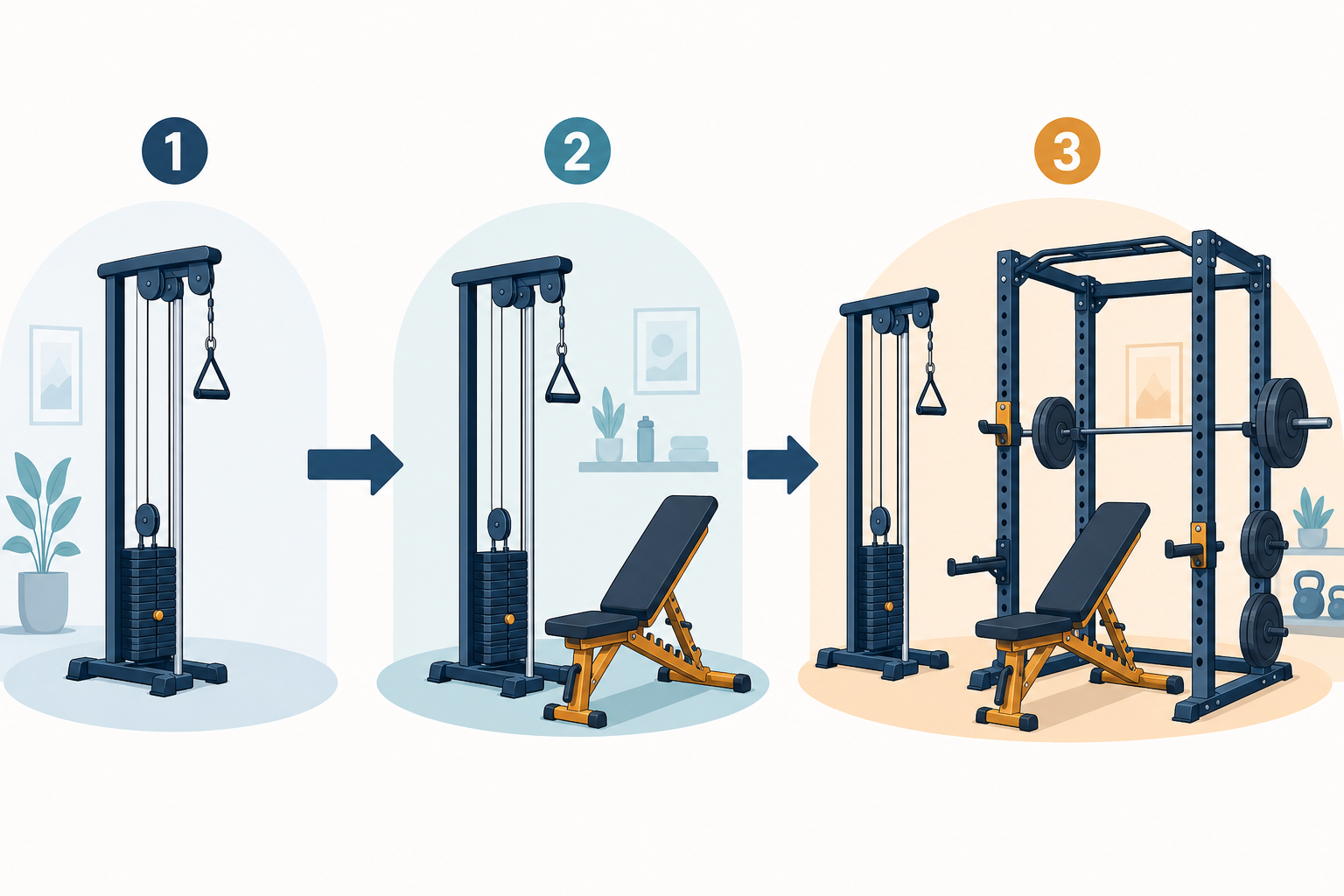
Here is a concrete example of an upgrade path for a strength-oriented beginner:
- Start with the Bells of Steel Cable Tower ($435). This single piece gives you a 210-lb weight stack, 33 cable positions, and the ability to perform rows, pulldowns, presses, tricep extensions, bicep curls, and core work. It is a complete upper-body and core training station on its own.
- Add an adjustable bench ($100–$200). With the bench, you can perform seated cable rows, incline and decline presses, and dumbbell work. The bench also enables floor-based exercises like hip thrusts and glute bridges.
- Add a power rack ($400–$800). Once your strength progresses beyond what the cable tower's 210-lb stack can provide, a power rack with a barbell and plates unlocks squats, deadlifts, bench presses, and overhead presses. The cable tower remains useful for accessory work and isolation exercises.
This progression works because each piece retains its value as you add more equipment. The cable tower doesn't become obsolete when you buy a rack — it becomes a dedicated accessory station. The bench doesn't become redundant — it moves from primary to supplementary use. And because strength equipment holds its value well (used gear typically resells at 50–70% of retail), you can sell pieces that no longer fit your routine without taking a major loss.
For a more detailed progression model that covers different budget tiers and space scenarios, see our Garage Gym Equipment Priority Tier List: What to Buy First, What to Skip, and When to Upgrade. It maps out the full hierarchy from essential to optional, with upgrade timing guidance.
Guided Programming as a Retention Tool
Equipment is only half the equation. The other half is having a clear, followable plan for what to do with it. Beginners who buy equipment without a programming strategy are significantly more likely to abandon their setup within the first three months.
Guided programming — whether through a fitness app, a structured training plan, or a coach — provides the decision-making layer that beginners lack. It answers the questions that derail consistency: "What do I do today?" "How many sets?" "When do I increase weight?" "When do I rest?" Without this structure, even the best equipment sits unused.
The cost of guided programming is remarkably low compared to smart gym subscriptions. A quality strength-training app like Strong, Hevy, or Caliber costs $10 to $20 per month. A structured training plan from a reputable source runs $20 to $50 one-time. Compare that to the $39 to $59 per month that smart gym memberships charge, and the value proposition becomes clear: a $15/month app paired with a $435 cable tower provides more programming flexibility than a $4,295 smart gym with a mandatory $60/month subscription.
| Option | Monthly Cost | Annual Cost | Equipment Required | Commitment |
|---|---|---|---|---|
| Strength app (Strong, Hevy, Caliber) | $10–$20 | $120–$240 | Dumbbells, bench, or cable tower | Cancel anytime |
| Structured training plan | $0–$50 one-time | $0–$50 | Varies by plan | One-time purchase |
| Peloton All-Access | $49.99 | $599.88 | Peloton bike or tread | Ongoing subscription |
| Tonal membership | $59.95 | $719.40 | Tonal 2 ($4,295) | 12-month commitment |
| iFit (NordicTrack) | $39 | $468 | NordicTrack machine | Ongoing after first year |
The financial logic is straightforward: a beginner who spends $500 on a cable tower and $15/month on a programming app has a total first-year cost of $680. A beginner who buys a Tonal 2 has a first-year cost of $5,014.95 ($4,295 + $719.40). Both can achieve meaningful strength gains. The difference is that the first beginner can walk away from their setup with a $300 loss if they decide strength training isn't for them. The second beginner is locked in.
Decision Summary: Your First Machine by Budget and Goal
The following table consolidates the recommendations from this guide into a single, scannable reference. Use it to make your first purchase decision, then revisit it when you are ready to upgrade.
| Your Situation | Recommended First Purchase | Price Range | Why This Works |
|---|---|---|---|
| I want to build strength | Adjustable dumbbells + bench | $300–$600 | Covers all fundamental lifts; expandable later |
| I want structured strength training | Bells of Steel Cable Tower | $435 | 210-lb weight stack, constant tension, compact |
| I want to do cardio | Yosuda indoor cycling bike | $340 | Legitimate cycling workout, no subscription |
| I want to walk or jog at home | Walking pad | $250–$400 | Compact, foldable, low commitment |
| I have no idea what I want | Resistance bands + adjustable dumbbells | $50–$150 | Covers strength and cardio; minimal risk |
| I have $100 or less | Resistance bands only | $25–$40 | Comparable strength gains to free weights (2019 SAGE review) |
| I have a routine and want to upgrade | Power rack + barbell + plates | $400–$800 | Unlocks squats, deadlifts, bench press |
For a more comprehensive overview of the entire buying process — including space planning, budget allocation, and long-term cost comparisons — read The First-Time Home Gym Buyer's Decision Framework. It covers the full picture, while this guide fills the specific "what to buy first as a beginner" gap.
This result comes from one real apartment under the stated conditions — it is a strong signal, not a guarantee your space will measure identically.
Builds this evidence supports
Small Treadmill Buying Guide: 7 Critical Specs to Check Before You Buy
A cross-category spec primer for apartment and small-space dwellers comparing walking pads, ultra-compact folding treadmills, and full-size folding treadmills. Learn the concrete thresholds for motor HP, deck length, noise, warranty, and subscription lock-in so you can compare apples to apples.
Where to Spend vs. Save on Affordable Home Gym Equipment: A Quality Tradeoff Guide
A practical guide for budget-conscious buyers (under $1,000) that reveals which equipment categories demand a higher investment for safety and durability, and where cutting costs is a smart move.
Garage Gym Equipment Tier System: What to Buy First, Second, and Third Based on Your Training Goals
A practical guide for beginners and intermediate home gym builders that uses a community-backed tier system (must-have, should-have, nice-to-have, avoid) to help you buy equipment in the right order—so every purchase serves a real training need and nothing is wasted.
Spot something off?
If this result didn't match your own space, let us know — floor-damage and noise claims carry real deposit-risk consequences if we get them wrong.