
All-in-One Home Gym Types Compared: Weight Stack vs. Plate-Loaded vs. Digital Resistance vs. Power Rod
Choosing an all-in-one home gym starts with the resistance type. This guide compares weight stack, plate-loaded, digital, and power rod systems across cost, feel, maintenance, and training fit to help intermediate buyers make the right call.
Why Resistance Type Matters More Than Brand
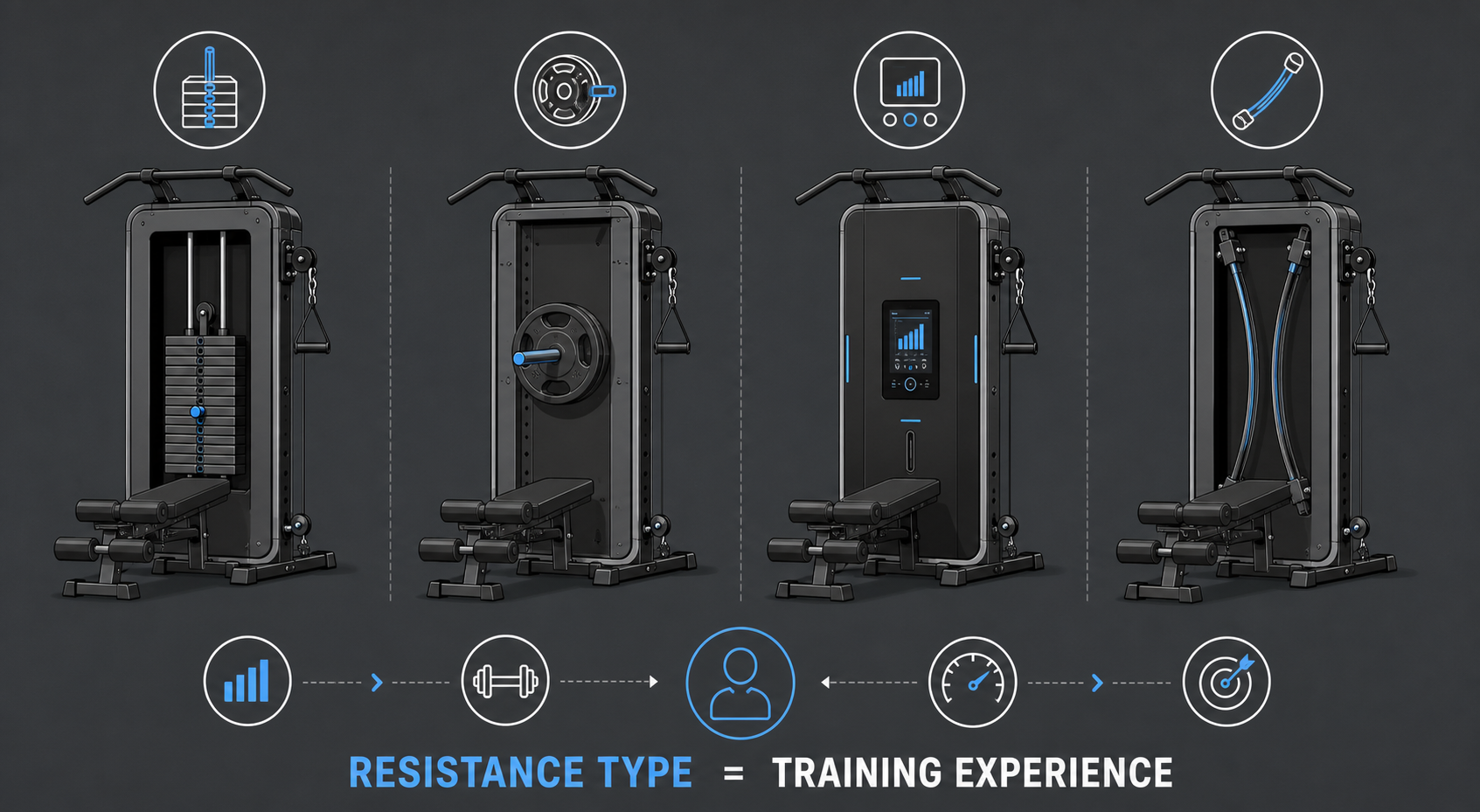
When you start shopping for an all-in-one home gym, the first thing you notice is the brand names. Tonal, Bowflex, Speediance, Major Fitness, Force USA — each one has a marketing story, a signature look, and a price point. But the brand is a distraction. The single most important decision you will make is not which logo sits on the frame, but which resistance technology moves the handles.
Resistance type determines how the machine feels during a rep, how much weight you can load, whether you need a subscription to use it, how much maintenance it requires, and how easy it is to upgrade down the road. A weight stack machine and a digital resistance machine might both be called "all-in-one" home gyms, but they deliver fundamentally different training experiences. Choosing the wrong resistance type means living with a machine that fights your goals rather than supporting them.
This guide breaks down the four resistance systems found in full-sized all-in-one machines — weight stack, plate-loaded, digital resistance, and power rod — across the dimensions that actually matter for an intermediate buyer. By the end, you will have a clear framework for matching a resistance type to your training style, budget, space, and tolerance for ongoing costs.
The Four Resistance Systems: How Each Works
Before comparing trade-offs, it helps to understand what is actually happening inside each machine when you pull a cable or press a lever arm. The mechanism shapes the feel, the durability, and the long-term ownership experience.
Weight Stack
A weight stack machine uses a vertical stack of rectangular steel plates connected to a cable-and-pulley system. You select the load by inserting a pin into the stack at the desired weight. The resistance is gravitational — you lift a fixed mass through a range of motion, and the weight returns to the stack when you release tension. The Major Fitness B17 Flying Fortress, for example, uses this system, offering 130 to 260 lbs of resistance per side depending on the configuration.
Weight stacks are the closest thing to a commercial gym experience in a home setting. The resistance curve is consistent, the cable path is smooth, and there is no electronic component to fail. The trade-off is weight: a full stack machine can weigh several hundred pounds, making shipping expensive and floor placement a permanent decision.
Plate-Loaded
Plate-loaded systems use the same cable-and-pulley architecture as weight stacks, but instead of a built-in stack, they have weight horns where you load your own Olympic or standard plates. You provide the plates, which means the total resistance is limited only by how many plates you own and how many the horns can hold.
This design keeps the upfront machine cost lower because you are not paying for a stack of precision-machined plates. It also means you can add weight incrementally without buying a new machine. The downside is convenience: changing weight requires walking to a plate tree, loading or unloading plates, and re-racking. Exercise transitions are slower than a weight stack, where a pin pull takes two seconds.
Digital Resistance
Digital resistance systems use electromagnetic or motor-driven mechanisms to create resistance electronically. There are no physical plates. The machine applies resistance through a motor or electromagnet that the control software adjusts in real time. The Tonal 2 uses this approach, with a maximum resistance of 250 lbs total, while the Speediance Gym Monster offers 220 lbs total.
Digital resistance enables features that physical systems cannot match: automatic weight adjustments between sets, eccentric overload modes, real-time form feedback, and integration with training apps. The machines are also the most compact of the four types, often wall-mounted or freestanding with a small footprint. The catch is that digital systems require power and, in most cases, an active subscription. The Tonal 2 and Speediance Gym Monster both require ongoing subscriptions to access their full feature sets.
Power Rod
Power rod systems, most commonly associated with Bowflex machines, use a set of composite rods that flex when you pull against them. The resistance increases as the rods bend further, creating a variable resistance curve that differs from the constant gravitational load of a weight stack. The Bowflex Xtreme 2 SE, for example, comes with a base resistance of 210 lbs that can be upgraded to 410 lbs by adding more rod sets.
Power rods are lightweight — the entire machine is significantly easier to move and assemble than a weight stack unit. They are also quiet and require no electricity. The feel, however, is polarizing. The resistance is heaviest at the midpoint of the movement and lightest at the start and end, which can feel unnatural for exercises like squats and deadlifts where you want consistent tension through the full range of motion.
Head-to-Head Comparison: Key Dimensions at a Glance
The table below maps each resistance type across the dimensions that matter most for an intermediate buyer. The data draws on real product examples tested and reviewed by sources like Garage Gym Reviews, with pricing current as of June 2026.
| Dimension | Weight Stack | Plate-Loaded | Digital Resistance | Power Rod |
|---|---|---|---|---|
| Resistance curve feel | Constant — most like free weights | Constant — depends on cable path | Programmable — can mimic multiple curves | Variable — heaviest at midpoint |
| Max resistance (example) | 130–260 lbs per side (Major Fitness B17) | Unlimited (depends on plates owned) | 220–250 lbs total (Speediance Gym Monster / Tonal 2) | 210–410 lbs total (Bowflex Xtreme 2 SE) |
| Maintenance | Low — lubricate cables, replace if frayed | Low — lubricate cables, replace if frayed | Moderate — electronics, motor, software updates | Low — rods may degrade over years |
| Upgradeability | Limited — add-on kits or new machine | High — buy more plates | None — max resistance is fixed | Moderate — add rod sets |
| Subscription required | No | No | Yes — $40–$60/month | No |
| Typical footprint | Standard (20–40 sq ft) | Standard to large (25–50 sq ft) | Compact (under 20 sq ft) | Compact to standard (15–30 sq ft) |
| Resale value | High | Moderate to high | Low — tech becomes dated | Moderate |
Price Breakdown by Resistance Type
Upfront cost is only part of the equation. The total cost of ownership includes the machine price, shipping, required accessories (plates for plate-loaded systems), and any ongoing subscription fees. The table below lays out typical price ranges for each resistance type, using real product examples.
| Resistance Type | Example Machine | Machine Price | Required Add-Ons | Monthly Subscription | Estimated 3-Year Total |
|---|---|---|---|---|---|
| Weight Stack | Major Fitness B17 | $4,199.99 | None | $0 | $4,199.99 |
| Plate-Loaded | Varies by brand | $1,500–$3,000 | Plates ($300–$800) | $0 | $1,800–$3,800 |
| Digital Resistance | Tonal 2 / Speediance Gym Monster | $3,199–$4,295 | None | $40–$60/month | $4,639–$6,455 |
| Power Rod | Bowflex Xtreme 2 SE | $1,499 | None | $0 | $1,499 |
To put these numbers in context, the average home gym cost for most buyers falls between $1,500 and $2,500, according to observational data from Garage Gym Reviews. The average gym membership runs roughly $65 per month, or $780 per year. A $1,500 home gym breaks even against that membership cost in about two years. However, that breakeven calculation changes dramatically if the machine carries a $40–$60 monthly subscription — a digital resistance system with a subscription adds $480–$720 per year to the cost, pushing the breakeven point further out.
Which Training Styles Does Each Type Support?
Not every resistance type is equally suited to every training goal. The matrix below shows how each system performs across common training styles, from strength and hypertrophy to power, endurance, and rehabilitation work.
| Training Style | Weight Stack | Plate-Loaded | Digital Resistance | Power Rod |
|---|---|---|---|---|
| Strength (low reps, heavy load) | Good — up to stack max | Excellent — load as heavy as you want | Limited — max 220–250 lbs total | Good — up to 410 lbs with upgrade |
| Hypertrophy (moderate reps, moderate load) | Excellent — smooth, consistent tension | Excellent — easy to progress | Good — automatic weight adjustment helps | Moderate — variable curve may feel off |
| Power / Explosive work | Moderate — cable path limits speed | Moderate — cable path limits speed | Good — eccentric modes, accommodating resistance | Poor — variable curve not suited for explosive reps |
| Endurance (high reps, low load) | Good — quick pin changes | Poor — slow plate changes between sets | Excellent — instant weight changes, pacing features | Good — lightweight machine, easy to rep out |
| Rehabilitation / Low-impact | Good — controlled, smooth motion | Good — controlled, smooth motion | Excellent — accommodating resistance, form feedback | Moderate — variable curve may be unpredictable |
Weight stacks and plate-loaded systems dominate for strength and hypertrophy because they provide consistent, progressive overload without electronic limits. Digital resistance excels for endurance and rehabilitation work where quick weight changes and accommodating resistance curves add real value. Power rods are a compromise: they work for general fitness and moderate strength work, but the variable resistance curve makes them a poor fit for explosive training and a questionable fit for serious lower-body strength work.
Decision Flowchart: Finding Your Resistance Type
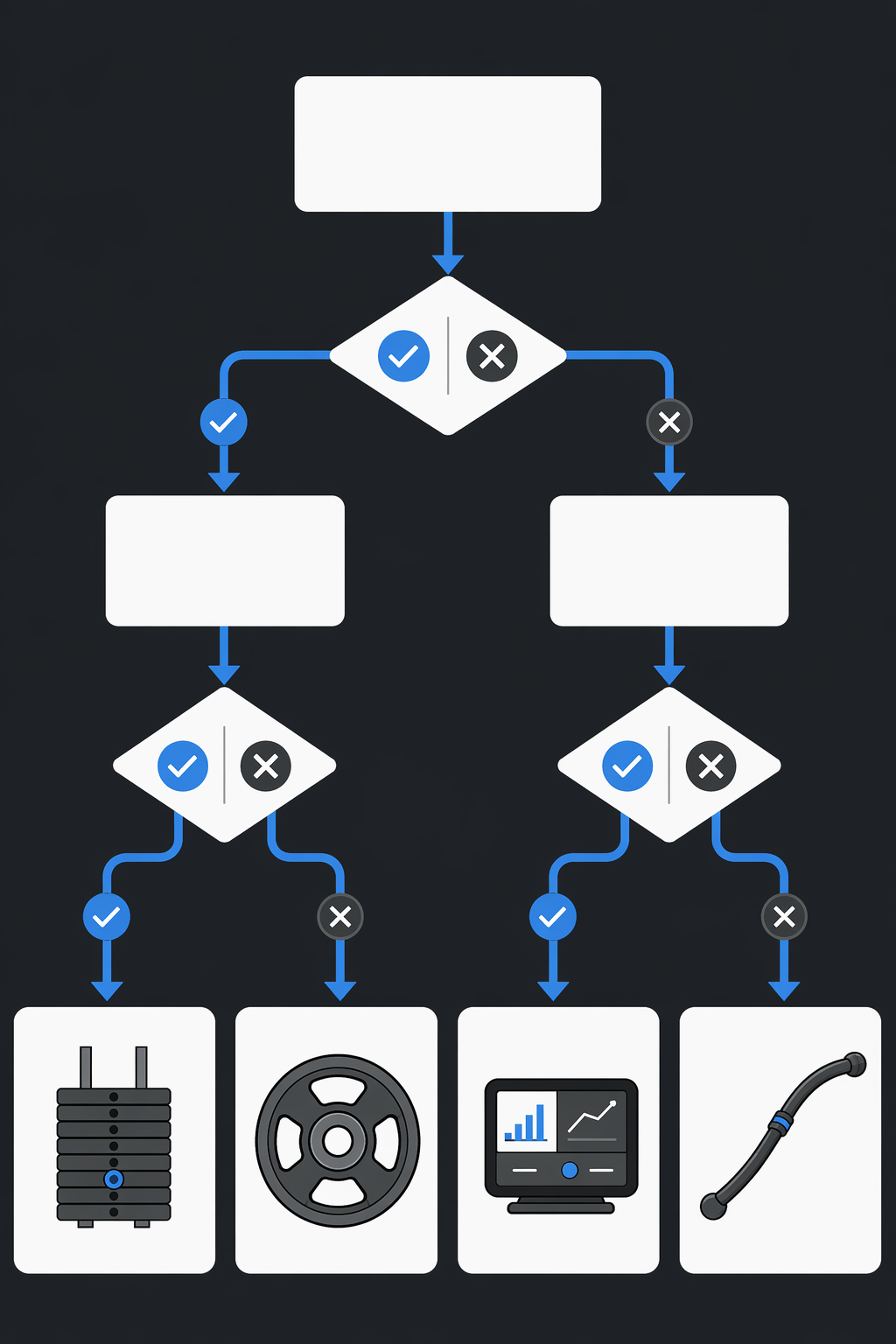
If you prefer a text-based walkthrough, here is the same decision logic in a step-by-step format. Answer each question honestly — the goal is fit, not aspiration.
- What is your primary training goal? If you are focused on strength or hypertrophy and want to lift heavy, skip digital resistance — the 220–250 lb max will become a ceiling within a year. If you are focused on general fitness, endurance, or rehabilitation, digital resistance or power rods may be sufficient.
- What is your budget? If you want to spend under $2,000 total, power rod systems (Bowflex Xtreme 2 SE at $1,499) are the most affordable complete package. Plate-loaded systems can also fit this range if you already own plates. Weight stacks and digital systems start above $3,000.
- Can you tolerate a subscription? If the answer is no, eliminate digital resistance. The subscription cost adds $480–$720 per year, and without it, most digital machines lose their core functionality.
- How much space do you have? If you have under 20 square feet, digital resistance is the most compact option. Power rods also fit in smaller spaces. Weight stacks and plate-loaded systems generally need 20–50 square feet.
- Do you plan to upgrade resistance over time? If yes, plate-loaded is the clear winner — you can add plates indefinitely. Power rods can be upgraded with add-on kits. Weight stacks and digital systems are essentially fixed at their max resistance.
- How important is resale value? If you might sell the machine in a few years, weight stacks hold value best. Digital systems depreciate quickly as technology advances. Power rods and plate-loaded systems fall in the middle.
If you are still unsure after working through these questions, consider your tolerance for compromise. No resistance type is perfect. The best choice is the one whose weaknesses you can live with and whose strengths match your priorities.
Recommendations by User Profile
The decision framework above works well if you have clear priorities. But many buyers fall into recognizable profiles. Here is how the four resistance types map to common buyer types.
The Budget-Conscious Lifter
You want a capable machine without spending over $2,000, and you are willing to trade some convenience for value. A power rod system like the Bowflex Xtreme 2 SE at $1,499 gives you a complete all-in-one with no subscription and no need to buy plates. The trade-off is the variable resistance feel, which may not satisfy you if you are used to free weights. If you already own a set of plates, a plate-loaded system in the $1,500–$2,000 range offers a more traditional feel and unlimited upgrade potential.
The Data-Driven Tech Enthusiast
You want smart features, automatic weight adjustments, and training analytics. You are comfortable with a subscription because you see it as a software cost, not a hidden fee. Digital resistance is your category. The Tonal 2 and Speediance Gym Monster both offer polished experiences, but be aware of the 220–250 lb max resistance ceiling. If you are an intermediate or advanced lifter, that ceiling will limit your lower-body and compound lifts. The subscription cost ($40–$60/month) adds $480–$720 per year to the total cost of ownership.
The Traditionalist Who Wants a Gym-Like Feel
You want the machine to feel as close to a commercial gym cable crossover as possible. You do not want a subscription, and you are willing to pay more upfront for a durable, heavy-duty system. A weight stack machine is your match. The Major Fitness B17 at $4,199.99 is a premium example, but there are also options in the $2,500–$3,500 range from brands like Body-Solid and Titan Fitness. The weight stack delivers the smoothest, most consistent resistance curve and holds its resale value better than any other type.
The Small-Space Dweller
You have limited floor space — under 20 square feet — and you need a machine that fits without dominating the room. Digital resistance systems are the most compact, with wall-mounted or slim freestanding designs. Power rod machines like the Bowflex Xtreme 2 SE are also relatively compact and can be folded or moved more easily than a weight stack. If you have a bit more room, a compact plate-loaded system can work, but you will need storage space for the plates.
The Beginner Who Wants Simplicity
You are new to strength training and want a machine that is easy to use, does not require a lot of setup, and will not overwhelm you with options. A power rod system is the simplest entry point — no plates to load, no pins to pull, no subscription to manage. The resistance is built in, and the machine is ready to use out of the box. As you progress, you may find the variable resistance curve limiting, but for the first year or two of training, it is a capable and affordable starting point.
Frequently Asked Questions
Can I upgrade the resistance on my machine later?
It depends on the type. Plate-loaded systems are the most upgradeable — you simply buy more plates. Power rod systems like the Bowflex Xtreme 2 SE can be upgraded with add-on rod kits, increasing max resistance from 210 lbs to 410 lbs. Weight stack machines typically cannot be upgraded beyond their built-in stack; you would need to buy a new machine or an aftermarket add-on kit. Digital resistance systems have a fixed max resistance (220–250 lbs) that cannot be increased.
Are digital resistance subscriptions worth the cost?
The value depends on how much you use the smart features. If you follow guided workouts, rely on automatic weight adjustments, and use the training analytics, the $40–$60 per month can be a reasonable cost — comparable to a streaming service or a budget gym membership. If you prefer to design your own workouts and do not need digital coaching, the subscription adds $480–$720 per year with no tangible benefit. Over three years, a digital resistance system with subscription can cost $1,500–$2,500 more than an equivalent non-subscription machine.
Which resistance type feels most like free weights?
Weight stack systems provide the most natural feel because the resistance is constant throughout the range of motion, just like a barbell or dumbbell. Plate-loaded systems are a close second, though the cable path can introduce some friction. Digital resistance can be programmed to mimic a constant load, but the motor-driven feel is not identical to gravitational weight. Power rods have the least natural feel because the resistance peaks at the midpoint of the movement, which is the opposite of how free weights behave.
How much space do I really need for each type?
Digital resistance systems are the most space-efficient, typically requiring under 20 square feet. Power rod machines like the Bowflex Xtreme 2 SE need about 15–30 square feet. Weight stack machines generally require 20–40 square feet, and plate-loaded systems can need 25–50 square feet depending on the frame size and how many plates you store. These figures assume you have enough clearance to perform exercises without hitting walls or ceilings. Always measure your actual space and add at least 2 feet of clearance on each side for arm movement.
Do power rods wear out over time?
Yes, power rods can lose elasticity over years of use, especially if they are stored in extreme temperatures or exposed to direct sunlight. Bowflex offers a 5-year warranty on rods for the Xtreme 2 SE, which suggests the manufacturer expects them to last at least that long under normal use. If a rod breaks or loses tension, replacement rod sets are available. This is a longer-term maintenance consideration that weight stack and plate-loaded systems do not have.
Which type is best for lower-body exercises like squats and deadlifts?
Plate-loaded systems are the best choice for heavy lower-body work because you can load as much weight as you need. Weight stack machines are also effective, but you are limited by the stack max. Digital resistance systems are generally not suitable for heavy lower-body work because their 220–250 lb total max is too low for most intermediate and advanced lifters. Power rods are a poor fit for squats and deadlifts because the variable resistance curve provides the least tension at the bottom of the movement — exactly where you need it most.
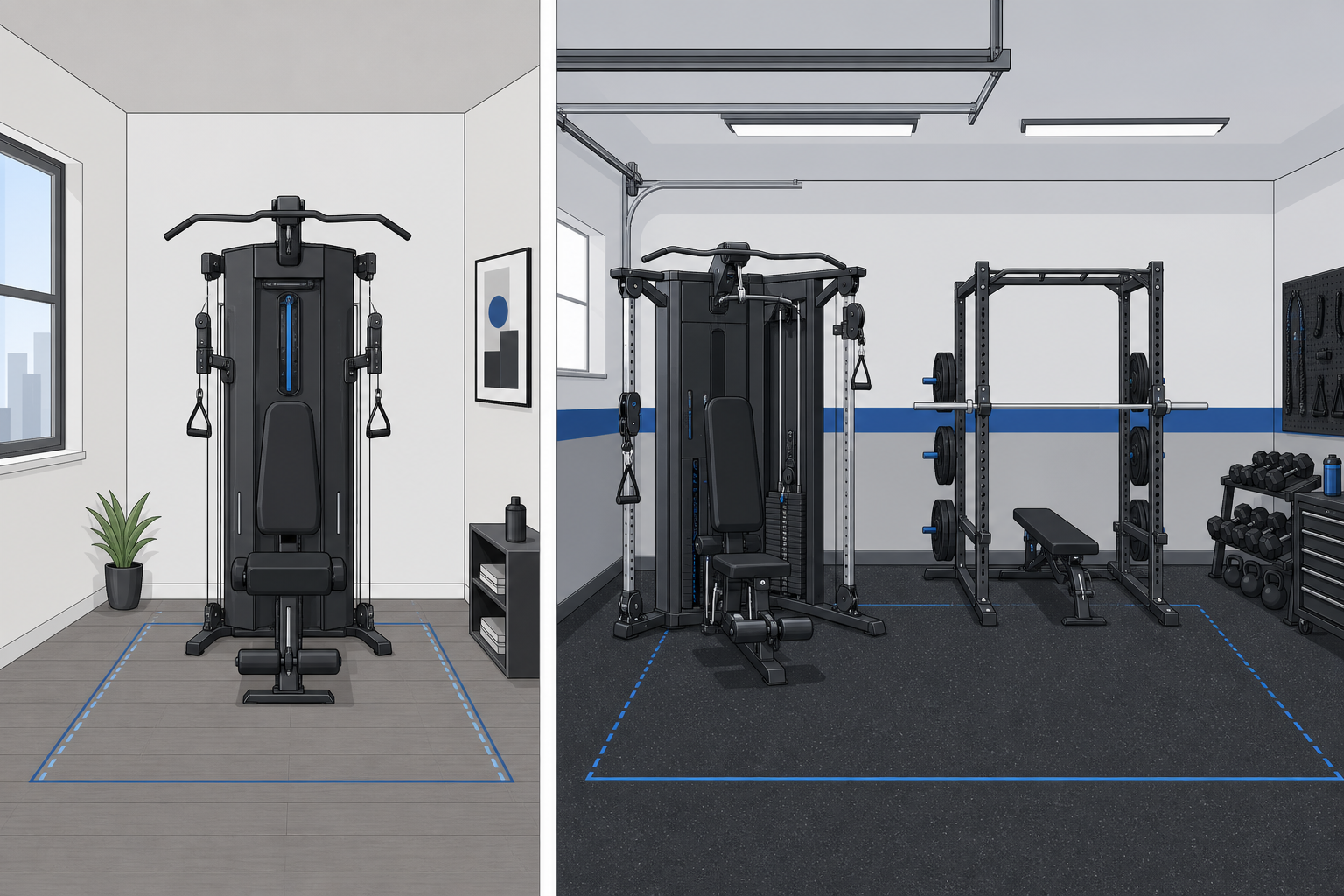
This result comes from one real apartment under the stated conditions — it is a strong signal, not a guarantee your space will measure identically.
Builds this evidence supports
No build currently links to this specific test. Browse all builds with a matching tag.
Spot something off?
If this result didn't match your own space, let us know — floor-damage and noise claims carry real deposit-risk consequences if we get them wrong.