
Home Gym Equipment Types Explained: Which System Actually Fits Your Training Style, Space, and Budget?
A decision-first guide to the five main home gym equipment archetypes — power racks, all-in-one machines, functional trainers, smart gyms, and compact setups — helping beginners and intermediate buyers match the right system to their training goals, available space, budget, and subscription tolerance before comparing specific models.
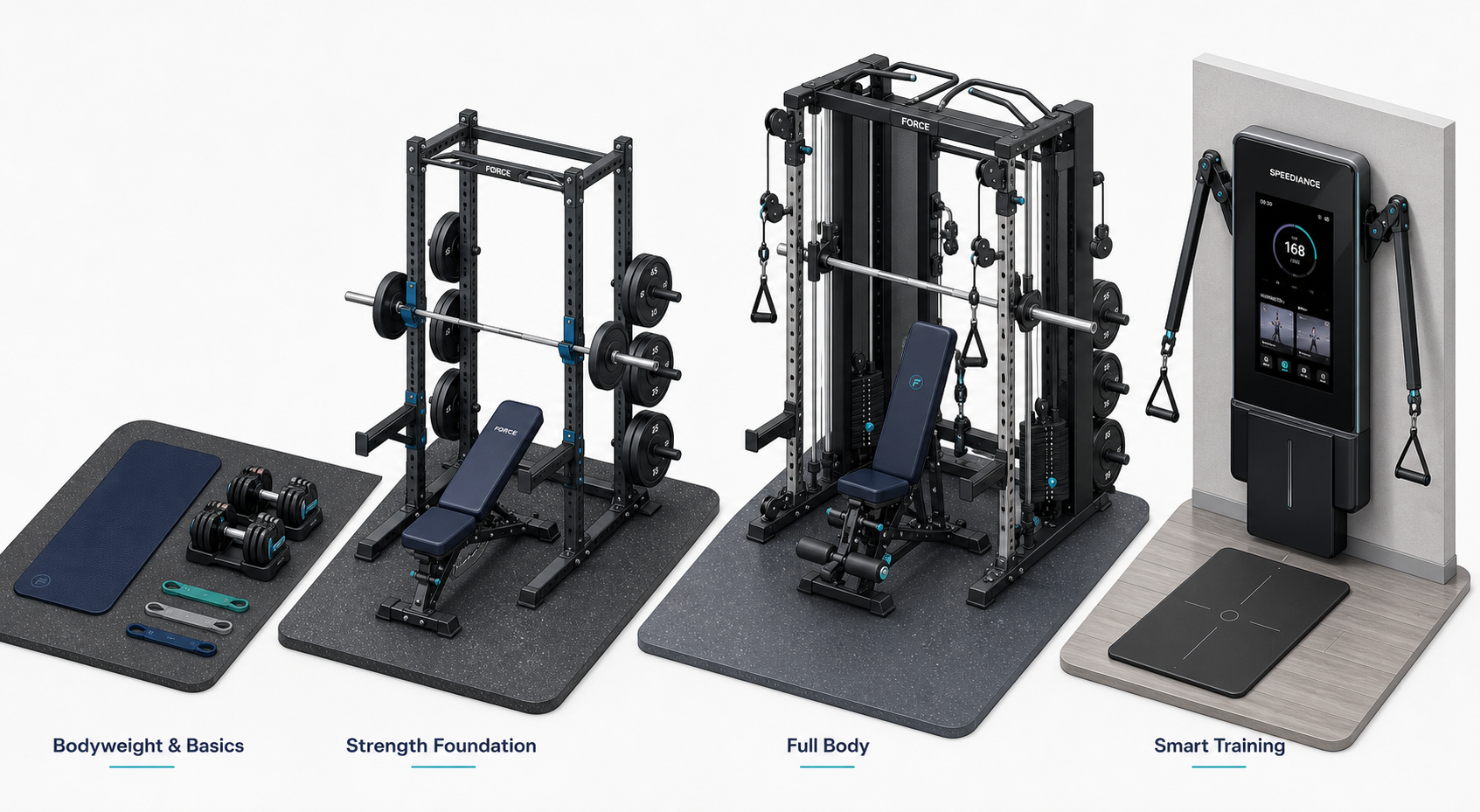
Why Comparing Home Gym Equipment Is Like Comparing Vehicles Without Distinguishing Trucks from Sedans
If you searched for "best home gym equipment" and landed on a listicle that jumbles a power rack, a smart gym, and a set of resistance bands into the same ranking, you've already experienced the problem. The home gym market has fragmented into distinct equipment archetypes — each built around a fundamentally different training philosophy, space requirement, resistance ceiling, and cost structure. Comparing a Tonal 2 directly against a REP PR-1100 power rack is like comparing a sedan to a flatbed truck: both move things, but they serve completely different jobs.
This guide exists to help you pick the right archetype before you compare specific models. The average home gym costs around $1,855 according to Garage Gym Reviews' 2026 testing data, but that average masks a wide spread: a budget band-and-dumbbell setup can start under $500, while a fully equipped power rack gym or a subscription-based smart gym can push past $4,000. The wrong archetype choice — buying a smart gym when you want to deadlift 400 lbs, or a power rack when you have a 6x8 ft spare room — wastes money and floor space regardless of which specific model you pick.
We'll walk through five archetypes, each with its own trade-off profile across space, resistance, price, subscription risk, and training style. By the end, you'll know which category fits your situation, and you'll have clear next-step links to deeper comparison guides for the specific models within that category.
The Five Home Gym Equipment Archetypes at a Glance
The table below summarizes the five archetypes across the decision axes that matter most: the floor space you'll need to dedicate, the maximum resistance available, the typical price range for a functional setup, whether an ongoing subscription is required, and the training style each archetype best supports. Use this as your reference point as you read the detailed sections that follow.
| Archetype | Space Required | Max Resistance | Typical Price Range | Subscription Risk | Best Training Style |
|---|---|---|---|---|---|
| Power Rack + Barbell | 80–150 sq ft (8x8 ft minimum) | 1,000+ lbs | $1,000–$3,000 | None | Strength / Powerlifting |
| All-in-One Machine | 37–50 sq ft | 300–600 lbs (Smith machine) | $1,300–$4,200 | Low (some models) | General Fitness / Bodybuilding |
| Functional Trainer / Cable Machine | 44–64 sq ft | 200–400 lbs per side | $1,300–$3,000 | None | Functional / General Fitness |
| Smart Home Gym (Digital Resistance) | 10–50 sq ft | 220–250 lbs total | $3,000–$4,300 | High (most require subscription) | General Fitness / Guided Training |
| Compact / Portable Setup | <10 sq ft (stored); 20–50 sq ft (in use) | 60–250 lbs (dumbbells/bands) | $200–$2,200 | None | All levels, space-constrained |
Archetype 1: Power Rack + Barbell — The Strength-Training Foundation
If your primary goal is building raw strength — squatting, bench pressing, deadlifting, overhead pressing — a power rack and barbell setup is the gold standard. No other archetype offers a higher resistance ceiling. A quality power rack like the REP PR-1100 costs around $380, supports up to 700 lbs, and uses 14-gauge steel. Add a barbell, weight plates, and a bench, and you're in the $1,000–$1,500 range for a setup that will last decades and retain strong resale value.
The trade-offs are real. A power rack setup requires 80–150 sq ft of dedicated floor space and at least an 8-ft ceiling. It's self-directed training — there's no AI coach, no guided workout library, no screen telling you what to do. You need to know (or learn) the basic compound lifts and manage your own progressive overload. For many buyers, that's exactly the point: no subscription, no platform dependency, and equipment that will outlast any smart device on the market.
| Factor | Power Rack + Barbell |
|---|---|
| Entry price (rack only) | $380 (REP PR-1100) |
| Full setup price | $1,000–$3,000 |
| Resistance ceiling | Unlimited (1,000+ lbs with quality rack) |
| Space needed | 80–150 sq ft (8x8 ft minimum) |
| Ceiling requirement | 8 ft minimum |
| Subscription required | No |
| Best resale value | High — iron and steel hold value |
| Best for | Strength athletes, powerlifters, serious lifters |
If you're building out a traditional strength-training gym and want to know what to buy first, second, and third, our Garage Gym Equipment Tier System guide walks through the purchase order based on your training goals.
Archetype 2: All-in-One Machines — Smith Machine, Cables, and Pull-Up Bar in One Footprint
All-in-one machines combine a Smith machine, dual cable pulleys, a pull-up bar, and often a leg press or preacher curl station into a single welded frame. The Major Fitness B17 is a representative example: it costs about $4,200, occupies roughly 37 sq ft (68.1" D x 78.7" W x 88.1" H), and weighs 879.8 lbs. It comes with a 1-year warranty.
The appeal is obvious: one machine, one footprint, dozens of exercises. You can do squats, bench presses, rows, lat pulldowns, cable flyes, and pull-ups without moving between stations. For someone with a single-car garage or a spare bedroom who wants full-body variety without buying a rack, barbell, plates, and a separate cable tower, an all-in-one machine is a space-efficient solution.
The trade-offs are equally clear. The Smith machine's fixed vertical bar path is less natural for compound lifts than a free barbell, which can limit strength development and doesn't engage stabilizer muscles the same way. The resistance ceiling is lower — typically 300–600 lbs on the Smith, and 200–300 lbs on the cables. The 1-year warranty on the B17 is notably shorter than the lifetime warranties common on power racks. And at 879.8 lbs, this is not a machine you move once it's assembled.
| Factor | All-in-One Machine (Major Fitness B17) |
|---|---|
| Price | $4,200 |
| Footprint | 37 sq ft (68.1" D x 78.7" W x 88.1" H) |
| Weight | 879.8 lbs |
| Warranty | 1 year |
| Resistance type | Smith machine + dual cables |
| Subscription required | No |
| Best for | General fitness, bodybuilding, space-conscious buyers |
For a deeper look at specific all-in-one models evaluated side by side, see our All-in-One Home Gym Machines: A Complete 2026 Comparison Guide.
Archetype 3: Functional Trainers and Cable Machines — Cable-Based Full-Body Training
Functional trainers — also called cable machines or crossover machines — use dual adjustable pulleys to deliver smooth, constant-tension resistance through a wide range of motion. They typically require 44–64 sq ft of floor space and cost between $1,300 and $3,000. Unlike Smith machines, functional trainers allow free, three-dimensional movement patterns: cable flyes, woodchoppers, face pulls, triceps pushdowns, and rotational exercises that are difficult to replicate with a barbell or dumbbells.
This archetype is a strong fit for general fitness enthusiasts, athletes doing sport-specific conditioning, and people recovering from injuries who need controlled, variable-angle resistance. The constant cable tension keeps muscles under load through the entire range of motion — something free weights don't provide at the top and bottom of most lifts.
The limitation is resistance ceiling. Most functional trainers max out at 200–400 lbs per side, which is sufficient for hypertrophy and muscular endurance but insufficient for heavy strength training. If your primary goal is a 400-lb squat or a 300-lb bench press, a functional trainer won't get you there on its own. It works best as a complement to a power rack or as the centerpiece of a general fitness gym.
| Factor | Functional Trainer / Cable Machine |
|---|---|
| Price range | $1,300–$3,000 |
| Footprint | 44–64 sq ft |
| Max resistance per side | 200–400 lbs |
| Resistance type | Cable (constant tension) |
| Subscription required | No |
| Best for | General fitness, rehab, functional training |
Archetype 4: Smart Home Gyms (Digital Resistance) — Compact but Subscription-Dependent
Smart home gyms use electromagnetic or motorized digital resistance to replace weight plates and cables. The Tonal 2 is the best-known example: $4,295 for the hardware, plus a $59.95/month subscription, delivering up to 250 lbs of digital resistance in a wall-mounted unit that measures just 5.25" D x 21.5" W x 50.9" H. It requires 7 feet of clearance to use safely. The Speediance Gym Monster is a competing option at $3,199 with no subscription fee, offering up to 220 lbs of digital resistance in a slightly larger footprint (49.21" D x 28.34" W x 72.83" H when unfolded).
The value proposition is space efficiency plus guided training. Smart gyms occupy 10–50 sq ft — dramatically less than a power rack or all-in-one machine — and their software platforms provide AI coaching, auto-adjusting resistance, workout libraries, and form feedback. For someone who values guided programming and lives in an apartment where a power rack is physically impossible, a smart gym may be the only viable path to a comprehensive home strength setup.
The critical trade-off is the resistance ceiling. At 220–250 lbs total, digital resistance is sufficient for most general fitness users but will be outgrown by anyone who can squat or deadlift more than that. The subscription dependency is another major consideration: a subscription-required smart gym can cost $6,100–$9,600 over five years when you add hardware and monthly fees together, according to the AEKE buying guide. A subscription-free system like the Speediance Gym Monster costs $3,200–$5,500 over the same period.
| Factor | Tonal 2 | Speediance Gym Monster |
|---|---|---|
| Price | $4,295 | $3,199 |
| Subscription | $59.95/month | None |
| Max resistance | 250 lbs | 220 lbs |
| Footprint (wall-mounted) | 5.25" D x 21.5" W x 50.9" H | 49.21" D x 28.34" W x 72.83" H (unfolded) |
| Clearance required | 7 ft | Not specified |
| Best for | Guided training, small spaces | Subscription-averse buyers |
If you're considering a smart gym and want to understand what level of AI coaching you actually get for your money, our Smart Home Gym AI Coaching: What Each Tier Actually Does for Your Training guide breaks down the features across different platforms.
Archetype 5: Compact and Portable Setups — Foldable Racks, Adjustable Dumbbells, and Bands
For buyers who can't dedicate a full room to fitness, compact and portable setups offer a path to a functional home gym in under 50 sq ft — and often under 10 sq ft when stored. This archetype includes three sub-categories: adjustable dumbbells, foldable racks, and resistance bands.
The REP QuickDraw Adjustable Dumbbells start at $335.99 for the 40-lb pair and go up to $576 for the 60-lb pair, with a lifetime warranty. They're 18.5 inches long at max weight and replace an entire rack of individual dumbbells. The PRx Profile PRO Squat Rack costs $1,099.99, folds to just 4 inches off the wall when not in use, and still supports up to 1,000 lbs — enough for serious squatting and benching. The Living.Fit Resistance Bands set costs $128.94, provides up to 250 lbs of resistance, and has a lifetime warranty.
The strength of this archetype is its flexibility. You can start with adjustable dumbbells and a bench for under $500, add a foldable rack when you're ready to squat and bench heavy, and supplement with bands for pull-ups, rows, and accessory work. The trade-off is that no single compact component matches the exercise variety or resistance ceiling of a full power rack or all-in-one machine. Heavy compound lifters will eventually hit the 60-lb ceiling on adjustable dumbbells, and band resistance doesn't provide the same linear loading as free weights.
| Component | Price | Max Resistance | Storage Footprint | Warranty |
|---|---|---|---|---|
| REP QuickDraw Dumbbells (60-lb pair) | $576 | 60 lbs per dumbbell | 18.5" length | Lifetime |
| PRx Profile PRO Foldable Rack | $1,099.99 | 1,000 lbs | 4" off wall when folded | Not specified |
| Living.Fit Resistance Bands Set | $128.94 | 250 lbs total | Drawer or small bag | Lifetime |
| Fringe Sport Black Bumper Plates | ~$2.20/lb | Varies | Stackable | Lifetime |
If you're working with a small space and need a step-by-step decision process before buying anything, our Compact Home Gym Buyer's Guide: 8 Questions to Answer Before Buying a Single Piece of Gear walks through the key questions to ask yourself first.
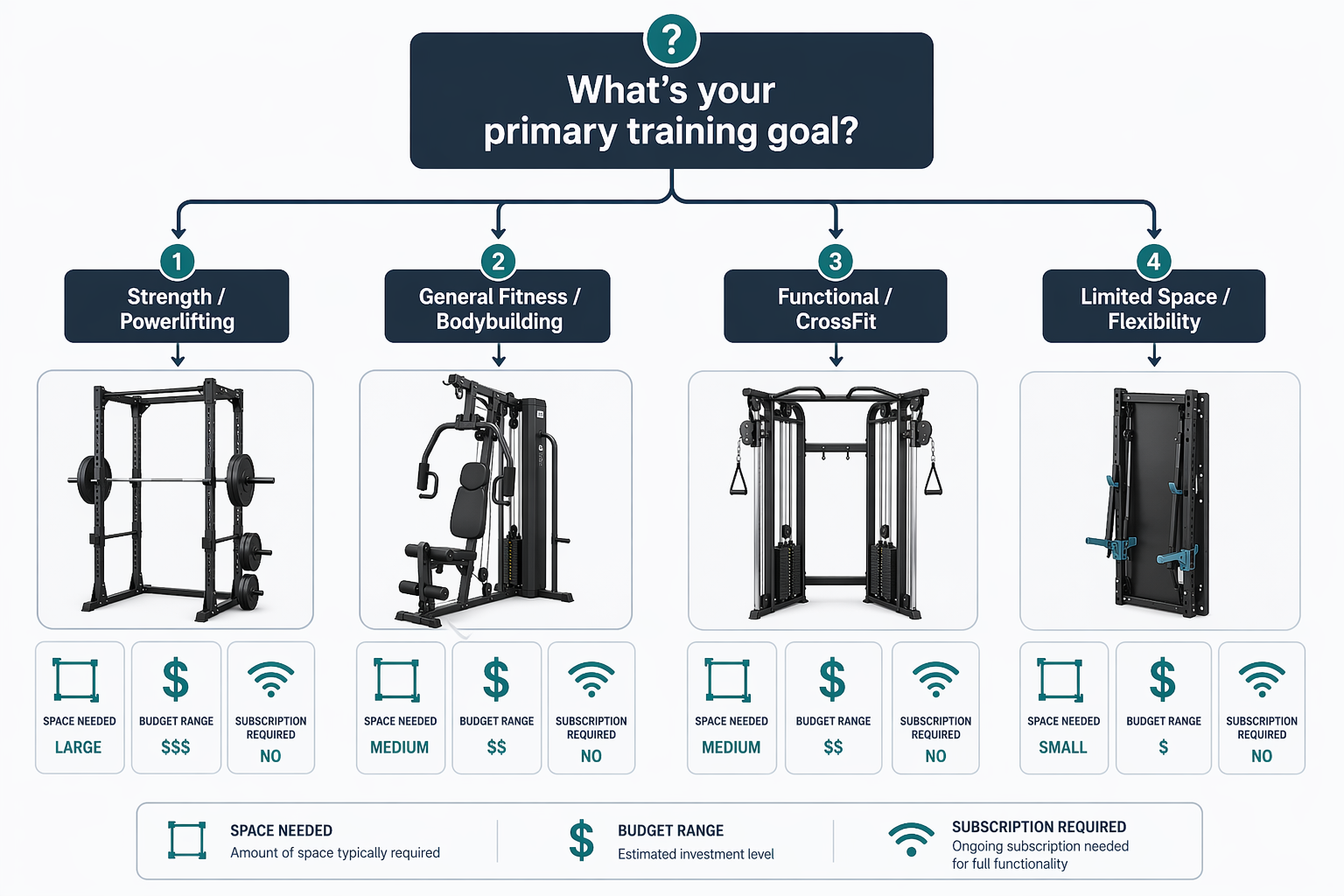
Decision Flowchart: Match Your Training Style, Space, Budget, and Subscription Preference to the Right Archetype
The following decision framework routes you to the right archetype based on four questions. Answer them in order, and you'll narrow the field before you ever compare specific models.
- What is your primary training goal? If it's strength and powerlifting — squat, bench, deadlift, overhead press — you need a power rack. If it's general fitness, bodybuilding, or variety, consider an all-in-one machine or functional trainer. If it's guided training with minimal space, a smart gym may fit. If you're unsure or just starting out, a compact setup with adjustable dumbbells and a bench gives you the most flexibility to change direction later.
- How much dedicated floor space do you have? If you have 80+ sq ft and an 8-ft ceiling, a power rack is viable. If you have 37–64 sq ft, an all-in-one machine or functional trainer works. If you have less than 50 sq ft or need to store equipment between sessions, look at compact setups or smart gyms.
- What is your budget? Under $500: compact setup (adjustable dumbbells, bands, mat). $1,000–$3,000: power rack with barbell and plates, or a mid-range functional trainer. $3,000–$4,500: all-in-one machine or smart gym. Above $4,500: you can combine archetypes — a power rack plus a functional trainer, or a premium all-in-one.
- Are you willing to pay a monthly subscription? If the answer is no, eliminate most smart gyms (unless you choose a subscription-free model like the Speediance Gym Monster). Power racks, all-in-one machines, functional trainers, and compact setups have no ongoing fees.
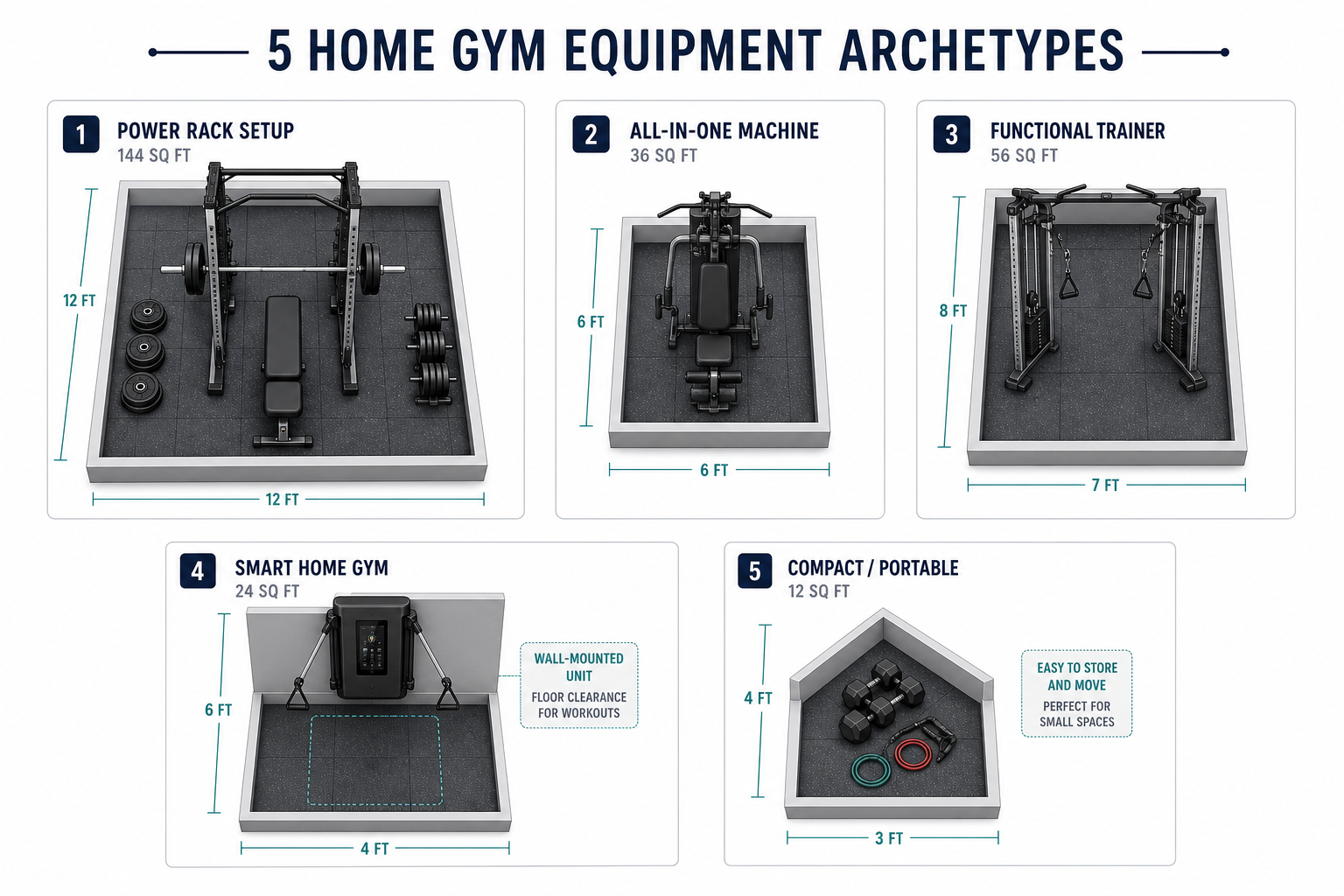
How to Upgrade Over Time: Pairing Archetypes for a Complete Home Gym
The archetype framework isn't just for a single purchase — it's a roadmap for building out your home gym over months or years. Most people don't buy a complete gym in one transaction. They start with one archetype and add complementary pieces as their training evolves and their budget allows.
Here are the most common upgrade paths:
- Start with compact (adjustable dumbbells + bench + bands) → add a foldable rack → add a barbell and plates → eventually replace the foldable rack with a full power rack. This path works for beginners who aren't sure how serious they'll get and want to avoid wasting money on equipment they outgrow.
- Start with a power rack + barbell + plates → add a functional trainer or cable attachment for isolation and accessory work. This is the classic strength athlete's progression: build the foundation first, then add variety.
- Start with an all-in-one machine → add adjustable dumbbells and a dedicated bench for free-weight work that the Smith machine can't replicate. This path suits buyers who want the convenience of a single machine but eventually want to incorporate free-weight movements.
- Start with a smart gym → add resistance bands or adjustable dumbbells for exercises that exceed the smart gym's resistance ceiling. This is the most space-efficient path but requires accepting the subscription cost as a permanent line item.
The key insight is that the archetype you choose first determines your upgrade options. A power rack setup is the most expandable — you can add cables, a functional trainer, cardio equipment, or specialty bars without replacing the core. A smart gym is the least expandable — you're locked into its resistance ceiling and ecosystem. An all-in-one machine sits in the middle: you can add free weights around it, but the machine itself is a fixed, non-modular platform.
Whichever archetype you choose, the most important step is matching it to your training style, space, and budget before you compare specific models. The right archetype makes the product decision straightforward. The wrong one makes every subsequent purchase a workaround.
This result comes from one real apartment under the stated conditions — it is a strong signal, not a guarantee your space will measure identically.
Builds this evidence supports
Cable Machine Alternatives That Save Space and Money
Compare the best cable machine alternatives for home gyms – from resistance bands and pulley systems to suspension trainers and compact digital units – and find the right option for your space and budget.
How to Choose a Compact Home Gym That Works for Your Space, Budget, and Noise Tolerance
This article provides a structured decision framework for apartment dwellers and small-space residents to match their specific floor footprint, noise sensitivity, and budget to the most suitable compact home gym strategy — whether that's an all-in-one machine, modular build, smart digital system, or band/bodyweight setup.
The Garage Gym Reality Check: What Equipment Actually Fits in a Single-Car Garage
Most garage gym guides assume a two-car space. This article uses real dimensions, real equipment footprints, and three layout templates to show what fits—and what doesn't—in a single-car garage (10x20 to 12x20 ft).
Spot something off?
If this result didn't match your own space, let us know — floor-damage and noise claims carry real deposit-risk consequences if we get them wrong.