
Smart Home Gym AI Coaching: What Each Tier Actually Does for Your Training
Not all 'AI coaching' is the same. This guide breaks down the three distinct tiers of smart home gym intelligence — from basic video playback to real-time skeletal tracking — so you can match the right level of coaching to your training needs and budget.
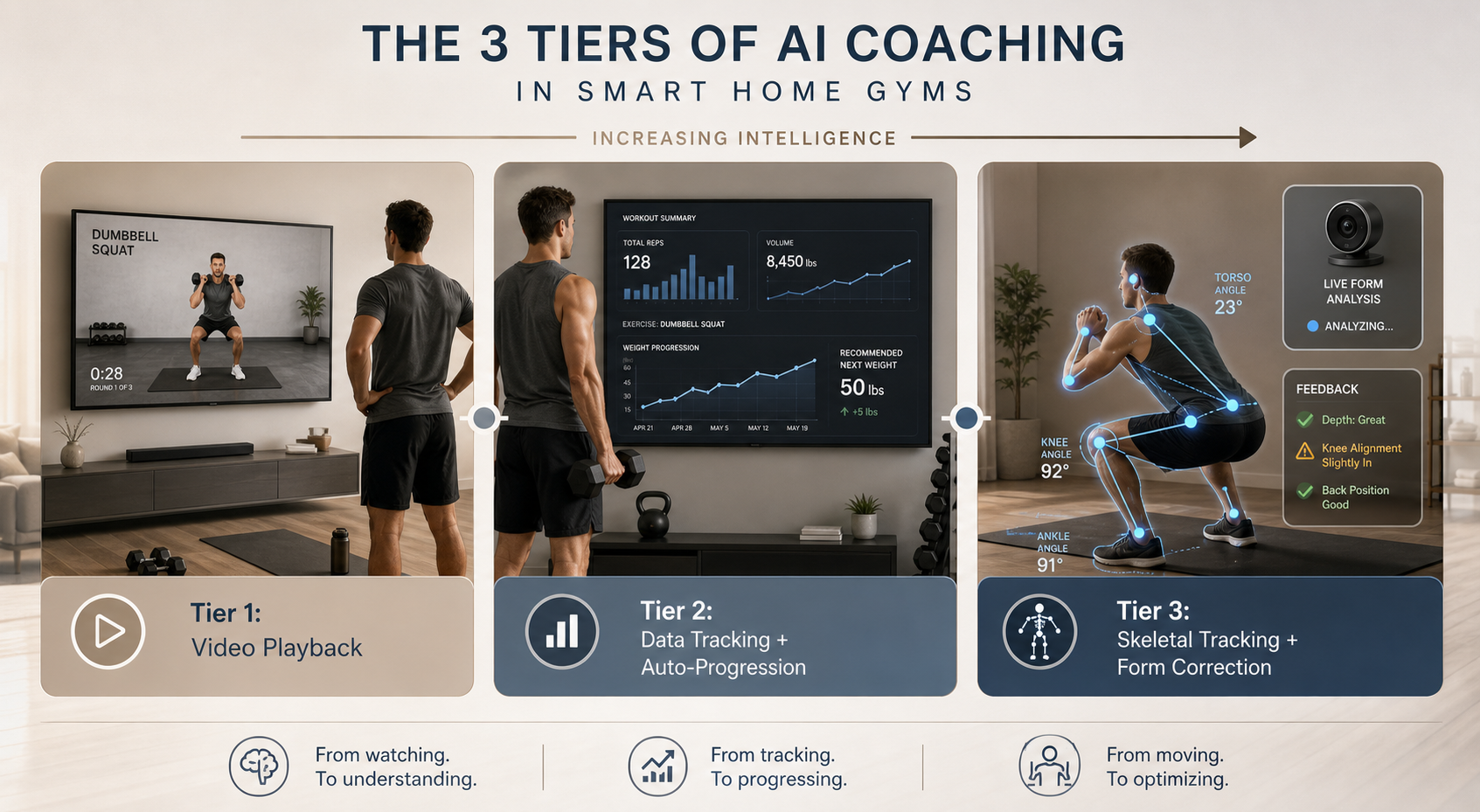
Why 'AI Coaching' Means Three Very Different Things
Walk into the smart home gym aisle — or more accurately, scroll through it — and every manufacturer claims their system offers "AI-powered coaching." The problem is that this single phrase covers three fundamentally different technologies. One system might simply play a pre-recorded video on a screen. Another logs your reps and automatically increases the weight next week. A third uses a camera and skeletal tracking to tell you, in real time, that your hips are rising too fast on that deadlift.
These are not incremental differences. They represent three distinct tiers of machine intelligence, and the gap between them determines what a system can actually do for your training. The AEKE buying guide defines these tiers as: screen-only (no performance data), data-tracking (logs reps/sets/load and auto-adjusts recommendations), and full AI coaching (skeletal tracking or sensors for real-time form correction). This framework is useful because it cuts through the marketing noise and lets you match a system to your actual needs — rather than overpaying for features you will never use or, just as commonly, under-buying and wondering why your "smart" gym doesn't feel smart at all.
Tier 1: Screen-Only Systems — Video Playback Without Intelligence
Tier 1 is the baseline. These systems consist of a screen — often a tablet or a smart mirror — that streams workout videos. The machine has no awareness of who is using it, how many reps they have completed, what weight they are lifting, or whether their form is correct. It is, functionally, a television with a fitness library attached.
Examples include basic Echelon models and older-generation smart mirrors that lack integrated cameras or sensors. You follow along with the instructor on screen, but if you pause mid-set or skip a rep, the system does not know and does not adjust.
- What it can do: Provide guided workout content, music, and class-style motivation. Useful for beginners who just need structure and visual demonstration.
- What it cannot do: Track your performance over time, adjust resistance automatically, correct your form, or provide any data-driven feedback on your progress.
For a user whose primary goal is simply showing up and following a class, Tier 1 may be sufficient. But it is a stretch to call this "AI coaching" — the intelligence resides entirely in the human instructor on the screen, not in the machine.
Tier 2: Data-Tracking Systems — Auto-Progression Without Form Feedback
Tier 2 represents a meaningful step up. These systems log your reps, sets, and load, and use that data to auto-adjust weight recommendations based on a strength assessment or your past performance. The machine knows who you are and how you performed last session — and it uses that information to push progressive overload.
The Speediance Gym Monster is the clearest example. According to Garage Gym Reviews, Speediance offers auto-weight recommendations based on a strength assessment — similar to Tonal — but has no camera or real-time form feedback. Men's Health confirms that Speediance provides real-time feedback and imbalance correction with a post-training summary, but this is based on sensor data from the cables and handles — not camera-based movement analysis. Tonal 2's basic mode also operates at this tier when used without its Smart View camera feature.
- What it does well: Progressive overload tracking. The system remembers your last workout and adjusts weight recommendations accordingly. This removes the mental load of deciding how much to lift each session.
- Where it falls short: No real-time movement analysis. If your form degrades on the last rep of a set, the system does not know. It tracks what you did, not how well you did it.
Tier 2 is ideal for intermediate lifters who understand good form and simply want a system that handles the math of progressive overload. If you already know how to squat, press, and pull with proper technique, the lack of form correction may not matter to you.
Tier 3: Skeletal Tracking and Real-Time Form Correction
Tier 3 is where the term "AI coaching" finally earns its weight. These systems use cameras, multiple sensors, or skeletal tracking to analyze your movement in real time and provide live form corrections. The machine does not just know what you did — it watches how you did it and intervenes when your technique breaks down.
Several products currently operate at this tier, each using a different technical approach:
| System | Tracking Technology | Key AI Feature | Max Resistance | Subscription |
|---|---|---|---|---|
| Tonal 2 | 13 sensors + camera + gyroscope motion sensors in handles/bar | Smart View: real-time form tracking and technique analysis | 250 lbs | $59.95/month |
| Peloton Cross Training Bike+ | Peloton IQ AI-powered camera | Rep counting, weight identification, form correction during strength workouts | N/A (bike + floor) | $50/month |
| Tempo Move | iPhone camera + 3D Tempo Vision | Movement capture and form feedback via phone camera | User's own weights | $39/month |
| AEKE K1 | Skeletal tracking (proprietary) | Real-time form correction and movement analysis | Not specified | Not specified |
Tonal 2 is the most sensor-dense system on the market. Garage Gym Reviews reports it uses 13 sensors, a camera, and gyroscope motion sensors in the handles and bar for form tracking and rep counting. CNET confirms the smart handles contain gyroscope motion sensors for rep tracking, and PCMag adds that Smart View uses an integrated camera, sensor data from cables, and machine learning to monitor form and provide corrections. The system can identify when you are struggling and offer form suggestions.
Peloton's Cross Training Bike+ takes a different approach with Peloton IQ, an AI-powered camera that counts reps, identifies the weights being lifted, and checks exercise form during strength workouts, according to both CNET and PCMag. The 23.8-inch HD touchscreen swivels 360 degrees for floor-based workouts, making it a hybrid cardio-and-strength system.
Tempo Move uses a different approach entirely: it relies on your iPhone's camera and 3D Tempo Vision to capture movement. Garage Gym Reviews notes it requires a 6x6 ft clear space and an iPhone camera for movement capture. This makes it the most affordable entry point to Tier 3, but it also means the quality of tracking depends on your phone's camera and your room's lighting conditions.
What Each Tier Can and Cannot Do for Your Training
The differences between tiers become clearer when mapped against specific training dimensions. The table below shows what each tier delivers across five key areas that matter for long-term progress.
| Training Dimension | Tier 1: Screen-Only | Tier 2: Data-Tracking | Tier 3: Skeletal Tracking |
|---|---|---|---|
| Progressive Overload | Manual — you track your own weights | Automatic — system adjusts based on past performance | Automatic + form-aware — adjusts based on performance and technique |
| Form Correction | None | None (post-workout summary only) | Real-time — camera or sensors analyze movement and provide corrections |
| Motivation / Engagement | Instructor-led classes | Classes + personal progress data | Classes + data + real-time feedback |
| Data Tracking | None | Reps, sets, load, estimated 1RM | Reps, sets, load, movement quality, technique metrics |
| Long-Term Adaptability | Static — same content regardless of progress | Adaptive — weight recommendations evolve | Highly adaptive — weight and technique guidance evolve together |
Subscription Dependency: Which Features Are Gated Behind a Paywall
The relationship between AI coaching features and subscription cost is not straightforward. In general, Tier 3's most valuable features — real-time form correction, detailed analytics, and adaptive programming — are almost always subscription-gated. Tier 2 systems may offer basic functionality without a subscription, but the AI-driven features that make them "smart" often require a monthly fee.
| System | Tier | Monthly Subscription | Features Without Subscription | Features Gated Behind Subscription |
|---|---|---|---|---|
| Speediance Gym Monster | 2 | $0 (lifetime free) or $24.90–$29/month | Core workout functions, manual mode | AI coaching, auto-weight adjustment, post-training summary |
| Tonal 2 | 2 (basic) / 3 (with Smart View) | $59.95/month (12-month min) | Manual resistance adjustment only | Smart View form tracking, Aero workouts, adaptive weight, spotter mode |
| Peloton Cross Training Bike+ | 3 | $50/month | Basic bike functions, limited strength content | Peloton IQ form correction, full class library, rep counting |
| Tempo Move | 3 | $39/month | Basic workout videos | 3D Tempo Vision form tracking, movement analysis, class library |
Speediance is the outlier here. Innerbody reports that the Gym Monster 2 (Works Plus) costs $3,689 all-in with no membership required, making its 5-year total cost $3,689 compared to Tonal 2's $8,685. However, Men's Health notes that AI coaching and tracking costs $24.90/month (or $249/year), suggesting the "free" tier may be more limited than advertised. This inconsistency makes it essential to verify current terms before purchasing.
Decision Guide: Which AI Coaching Tier Do You Actually Need?
The right tier depends on your training experience, goals, and budget. Here are three common reader profiles and the tier that fits each.
- The Beginner Who Just Needs Guided Workouts and Motivation: Tier 1 or 2 is sufficient. If you are new to strength training and your primary goal is consistency, a screen-only system or a basic data-tracking system will provide the structure you need without the subscription overhead. You can always upgrade later.
- The Intermediate Lifter Who Wants Data-Driven Progression: Tier 2 is the sweet spot. If you already have solid form and understand how to train with proper technique, Speediance's auto-weight adjustment and post-training summary give you progressive overload without the monthly fee of a Tier 3 system. You get the data without paying for form correction you do not need.
- The Serious Athlete or Technique-Focused Lifter: Tier 3 is worth the investment. If you are training for a specific strength goal, recovering from an injury, or want to ensure every rep is technically sound, Tonal 2's Smart View or Peloton IQ's form correction can provide feedback that a human coach would charge significantly more for.
For a broader comparison of all features across smart home gym systems — not just AI coaching — see our All-in-One Home Gym Machines: A Complete 2026 Comparison Guide. For a curated list of top picks across all categories, check our Best Home Gym Equipment guide.
The Bottom Line on Smart Home Gym AI Coaching
The term "AI coaching" currently spans three distinct technology tiers, and the gap between them is wide. A Tier 1 system is a video player. A Tier 2 system is a data logger with auto-progression. A Tier 3 system is a movement analyst that can correct your form in real time. None of these is inherently better than the others — the right choice depends entirely on your training experience, goals, and budget.
What matters most is matching the tier to your actual needs. If you are a beginner, start with Tier 1 or 2 and invest the savings in a few sessions with a human coach. If you are an intermediate lifter, Tier 2 gives you the data you need without the subscription overhead. If you are a serious athlete, Tier 3's real-time feedback can be a genuine training tool — but only if you are willing to pay the recurring subscription cost.
Remember: subscription costs are a recurring decision, not a one-time purchase. A $59.95/month fee adds up to over $3,500 in five years. Before committing to any system, calculate the total cost of ownership and verify which features are available without a subscription. For a deep dive on Tonal 2's specific capabilities, read our Tonal 2 Home Gym Review.
This result comes from one real apartment under the stated conditions — it is a strong signal, not a guarantee your space will measure identically.
Builds this evidence supports
No build currently links to this specific test. Browse all builds with a matching tag.
Spot something off?
If this result didn't match your own space, let us know — floor-damage and noise claims carry real deposit-risk consequences if we get them wrong.