
All-in-One Home Gym Machines: A Complete 2026 Comparison Guide by Space, Budget, and Training Level
This guide helps you choose the right all-in-one home gym by first understanding the five machine types—single-stack, dual-stack, multi-station, smart/digital, and power rod—then matching them to your space, budget, and training goals. It includes a comparison table of top models and a decision flowchart.
- Budget tier
- $1,500–$3,000
- Space type
- compact, medium, full
Items included: —
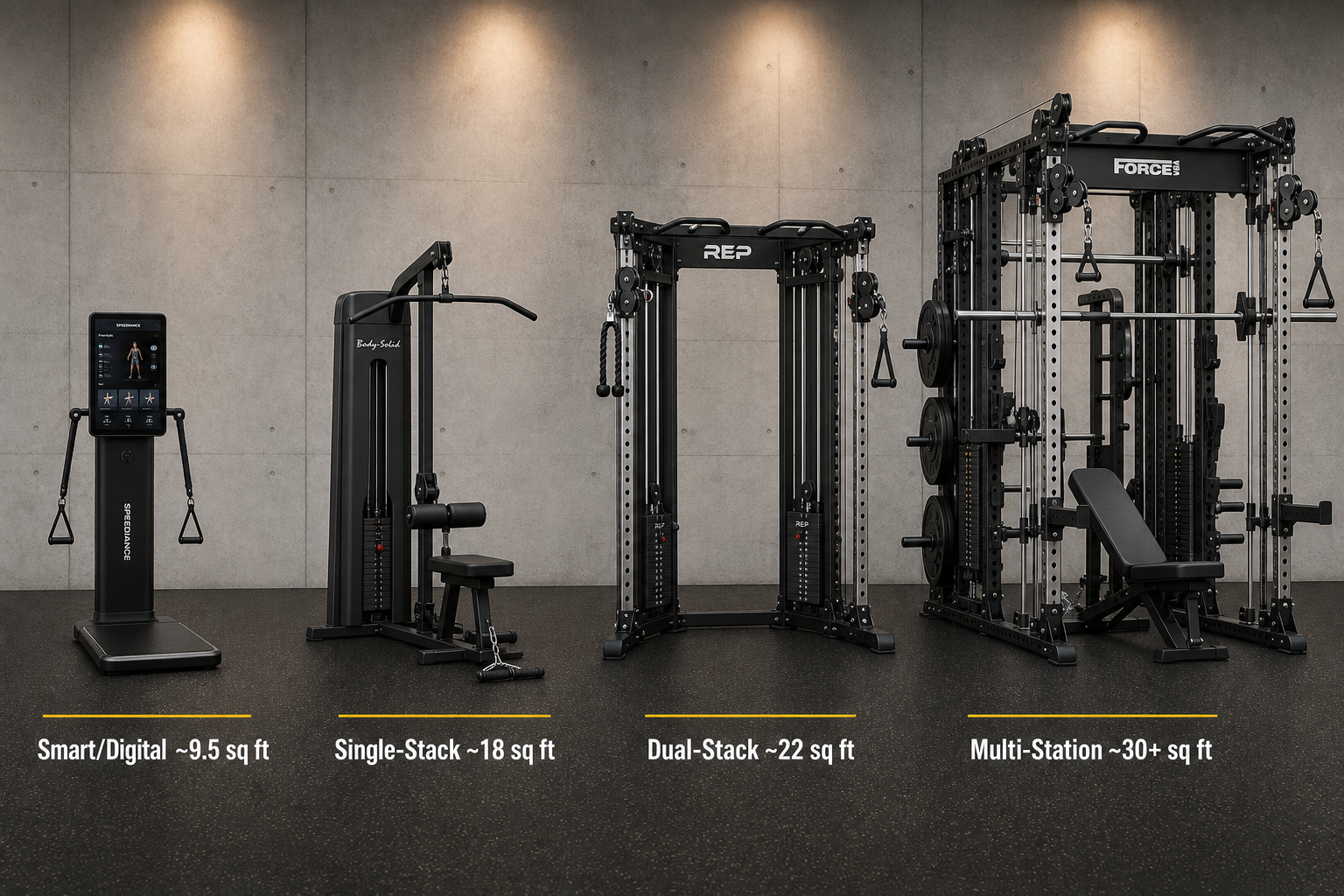
The all-in-one home gym market has never been more crowded. In 2026, you can buy a machine that folds into a closet, one that replaces an entire commercial gym, and everything in between. The problem isn't finding options — it's understanding which type of machine actually fits your situation. Most comparison guides rank products by price or rating without explaining the structural tradeoffs between machine categories. A smart gym with 220 lbs of digital resistance and a dual-stack functional trainer with 400 lbs of cable weight serve completely different buyers, even if their price tags overlap.
This guide takes a different approach. Instead of a flat list of picks, it organizes all-in-one machines by their fundamental type — single-stack, dual-stack functional trainer, multi-station, smart/digital resistance, and power rod/band systems — then helps you match each type to your available space, training level, and budget. By the end, you'll know not just which model to buy, but why that machine type is the right fit for your home gym.
The 5 Types of All-in-One Home Gym Machines Explained
Before comparing specific models, it's essential to understand the five machine categories. Each type uses a different resistance mechanism and structural design, which determines its footprint, exercise variety, and long-term durability. Choosing the right category first narrows your options dramatically.
1. Single-Stack Machines (Guided Cable Systems)
A single-stack machine uses one weight stack with a single cable column. You perform exercises by attaching handles, bars, or straps to the cable. These machines are compact, typically requiring under 20 square feet, and provide guided, controlled movement paths. They excel at compound exercises like lat pulldowns, rows, and chest presses, and are ideal for solo lifters who want a full-body workout without needing a spotter.
The Body-Solid EXM2500 ($1,795) is a strong example: it features a 210 lb selectorized weight stack, a heavy-duty 2" x 4" 12-gauge steel frame, and a footprint that fits most spare rooms. Single-stack machines typically use a 1:1 pulley ratio, meaning the weight you select is the weight you feel — a critical advantage for heavy pulling exercises.
2. Dual-Stack Functional Trainers
Dual-stack functional trainers have two independent weight stacks, each with its own cable column. This design allows for unilateral training (working one arm or leg at a time), cable crossovers, and a much wider range of isolation exercises. The tradeoff is that most dual-stack trainers use a 2:1 pulley ratio, meaning the effective resistance is half the weight selected. As REP Fitness explains, a 2:1 ratio provides twice the cable travel, which is excellent for flyes and crossovers but makes heavy lat pulldowns and rows feel lighter than the stack weight suggests.
Models like the REP FT-5000 ($2,000–$2,500) have dual 200 lb stacks (effective 100 lbs each at 2:1) and a 14.5 sq ft footprint. The Titan Fitness Functional Trainer is another popular option in this category. These machines offer the most exercise variety for their footprint but are not the best choice if heavy back work is your primary goal.
3. Multi-Station Gyms
Multi-station gyms combine multiple exercise stations — a cable column, a Smith machine, a leg press, a lat pulldown, and often a dip/chin station — into a single frame. These are the largest all-in-one machines, typically requiring a space of about 7' x 10' (70 sq ft). They are designed for families or serious lifters who want a complete gym in one unit.
The Force USA G20 ($3,000–$4,000) is the current top-rated multi-station machine, with an 11-gauge steel frame, dual 289 lb selectorized weight stacks, 11 stations, and a 2:1 cable ratio. Its footprint is 29.2 sq ft. The Major Fitness B17 Flying Fortress ($4,200) is another heavy hitter, with a footprint of 68.1" D x 78.7" W x 88.1" H and dual weight stacks expandable to 260 lbs each. Both machines require significant assembly time — estimated at 35 hours by Strong Home Gym.
4. Smart / Digital Resistance Machines
Smart gyms use electromagnetic or motorized resistance instead of weight stacks or plates. They are the most compact all-in-one option, with footprints as small as 9.5 sq ft. The Speediance Gym Monster ($3,199) measures 49.21" D x 28.34" W x 72.83" H and folds to just 14.96" D when not in use. It offers 220 lbs of total digital resistance with no required subscription. The Tonal 2 ($4,295) is wall-mounted, requires 7 feet of wall and floor space, and offers up to 250 lbs of digital resistance — but requires a monthly membership for full features.
Smart gyms excel at space efficiency and guided programming, but their resistance ceilings (typically 200–250 lbs) make them less suitable for advanced strength training. They are best for beginners to intermediate lifters who prioritize a small footprint and digital coaching over raw weight capacity.
5. Power Rod / Band Resistance Systems
Power rod machines use flexible composite rods or heavy-duty bands to create resistance. They are quieter than weight stacks, require less structural support, and are often the most affordable all-in-one option. The Bowflex Xtreme 2 SE ($1,499) is the most well-known example, with 210 lbs of power rod resistance (upgradable to 410 lbs) and a footprint of 63" D x 49" W x 83.25" H. It offers over 40 exercises and is frequently recommended for beginners.
The tradeoff is that power rod resistance feels different from weight stacks — it increases throughout the range of motion rather than providing constant tension — and the rods can lose elasticity over years of heavy use. These machines are best for budget-conscious buyers or those who prioritize quiet operation.
How to Choose by Space: Compact, Medium, and Full-Size Setups
Space is the single most limiting factor for most home gym buyers. Before considering price or resistance, measure your available floor area and ceiling height. As RitFit's 2026 home gym size guide emphasizes, "clearance matters as much as square footage" — bar loading, bench movement, and safe access all require working space beyond the equipment footprint.
The table below maps machine types to three footprint categories. Use it as your first filter.
| Footprint Category | Floor Space | Machine Types That Fit | Example Models | Clearance Notes |
|---|---|---|---|---|
| Compact | Under 10 sq ft | Smart/digital, power rod | Speediance Gym Monster (9.5 sq ft), Bowflex Xtreme 2 SE | Allow 2–3 ft behind and to the sides for cable movements |
| Medium | 10–20 sq ft | Single-stack, dual-stack functional trainer | Body-Solid EXM2500, REP FT-5000 (14.5 sq ft), Bells of Steel All-in-One | Requires 6–7 ft ceiling height for lat pulldowns; allow 3 ft in front for bench |
| Full | 20+ sq ft | Multi-station, hybrid (rack + cables) | Force USA G20 (29.2 sq ft), Major Fitness B17, REP Ares 2.0 on PR-5000 rack | Minimum 7.5 ft ceiling; allow 4 ft clearance on all sides for Smith machine and cable movements |
If you're working with a 6' x 8' space — which RitFit identifies as the minimum for a compact strength setup — a smart gym or a compact single-stack machine is your realistic option. A 10' x 10' room, described as the "best overall size for most home gym owners," can accommodate a medium-footprint dual-stack trainer or a compact multi-station unit. For a full-size multi-station gym like the Force USA G20, you'll need at least a 12' x 12' space.
For readers still planning their space, the Complete Small-Space Home Gym Buyer's Decision Guide provides detailed room-by-room recommendations for compact and medium footprints.
How to Choose by Resistance Needs: Beginner, Intermediate, and Advanced
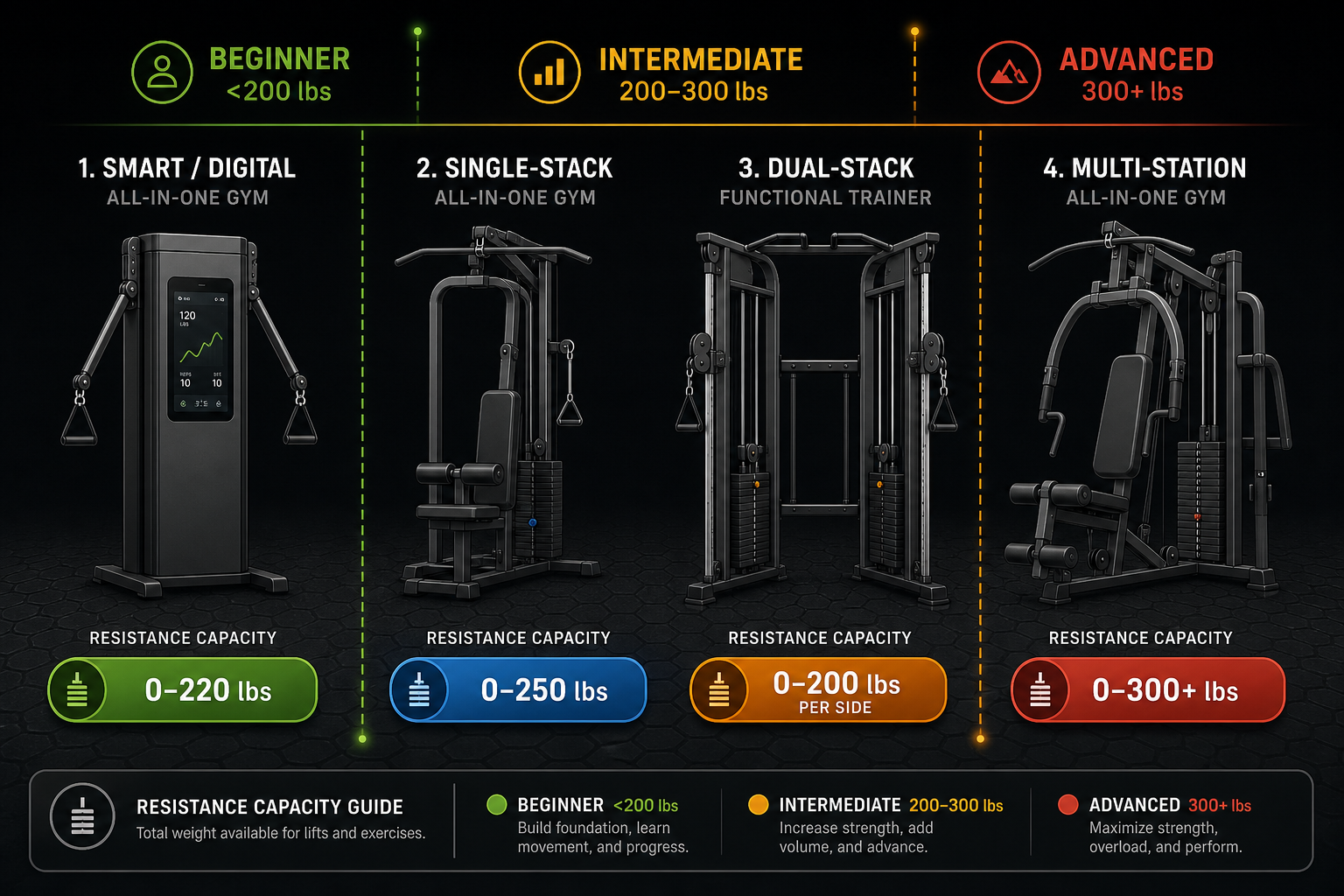
Resistance capacity is the second critical filter. A machine that maxes out at 200 lbs may serve a beginner well for years, but an intermediate lifter will hit that ceiling in months. Understanding how machine types deliver resistance — and how pulley ratios affect the feel — prevents an expensive upgrade later.
| Training Level | Resistance Needed | Suitable Machine Types | Example Models | Pulley Ratio Impact |
|---|---|---|---|---|
| Beginner | Under 200 lbs | Power rod, smart/digital, single-stack (210 lb stack) | Bowflex Xtreme 2 SE (210 lbs), Speediance (220 lbs), Body-Solid EXM2500 (210 lbs) | 1:1 ratio on single-stack means 100 lbs feels like 100 lbs; 2:1 on dual-stack means 200 lbs feels like 100 lbs |
| Intermediate | 200–300 lbs | Single-stack with upgrade, dual-stack (effective 200+ lbs), hybrid | REP Ares 2.0 (260 lbs per stack, 2:1), Force USA G20 (289 lbs per stack, 2:1) | Hybrid systems like REP Ares 2.0 use a 2-to-1 connector bar to combine stacks for 1:1 ratio on heavy pulls |
| Advanced | 300+ lbs | Multi-station with heavy stacks, plate-loaded hybrid, separate rack + cable | Major Fitness B17 (expandable to 260 lbs per stack), Force USA G20 (289 lbs per stack) | Advanced lifters often prefer plate-loaded or separate equipment to exceed 300 lbs without 2:1 ratio limitations |
The pulley ratio is the most misunderstood spec in all-in-one machines. A 1:1 ratio means the resistance you feel matches the weight on the stack — select 100 lbs, you lift 100 lbs. A 2:1 ratio means the effective resistance is half the stack weight — select 200 lbs, you feel 100 lbs. As REP Fitness explains, the 2:1 design provides twice the cable travel, which is beneficial for exercises like chest flyes and cable crossovers that require a wide range of motion. But for heavy lat pulldowns and rows, a 2:1 machine requires double the stack weight to achieve the same resistance as a 1:1 machine.
Price Tiers: Budget, Mid-Range, and Premium
The average all-in-one home gym costs $1,855, according to Garage Gym Reviews, but the range is wide — from under $1,000 for basic power rod systems to over $5,000 for commercial-grade multi-station units. Your budget determines not just which models you can afford, but which machine types are available to you.
| Price Tier | Price Range | Machine Types Available | What You Get | Example Models |
|---|---|---|---|---|
| Budget | Under $1,500 | Power rod, basic single-stack, plate-loaded | 210–250 lbs resistance, compact footprint, limited exercise variety, basic warranty | Bowflex Xtreme 2 SE ($1,499), Bells of Steel All-in-One (starting at $1,300), Powerline BSG10X |
| Mid-Range | $1,500–$3,000 | Single-stack, dual-stack functional trainer, entry-level multi-station | 200–300 lbs per stack, better build quality (12–14 gauge steel), more exercises, 1–5 year warranty | Body-Solid EXM2500 ($1,795), REP FT-5000 ($2,000–$2,500), REP Ares 2.0 ($3,000) |
| Premium | $3,000–$5,000+ | Multi-station, hybrid (rack + cables), smart/digital | Dual 260–300 lb stacks, 11-gauge steel, 10+ stations, digital programming, 10+ year warranty on frame | Force USA G20 ($3,000–$4,000), Major Fitness B17 ($4,200), Speediance Gym Monster ($3,199), Tonal 2 ($4,295) |
Assembly time is a hidden cost that varies dramatically by machine type. Strong Home Gym reports that the Speediance Gym Monster takes about 90 minutes to set up, while the Force USA G20 and Major Fitness B17 can take up to 35 hours. If you're not comfortable with DIY assembly, factor in professional installation costs ($200–$500) or choose a machine like the Powerline BSG10X, which ships 90% pre-assembled.
For a deeper look at long-term costs — including subscription fees, maintenance, and resale value — see the Smart Home Gym Total Cost of Ownership: 5-Year Breakdown. If your budget is below the typical all-in-one range, the Best Home Exercise Equipment for Every Budget guide covers options from $200 to $2,500+.
Top All-in-One Home Gym Machines Compared
The following table compares 10 top-rated all-in-one machines across the dimensions that matter most: machine type, footprint, resistance type and max weight, pulley ratio, price, best-for audience, and assembly time. Use this as your final shortlist reference after narrowing by space, resistance needs, and budget.
| Model | Machine Type | Footprint (D x W x H) | Resistance Type & Max | Pulley Ratio | Price | Best For | Assembly Time |
|---|---|---|---|---|---|---|---|
| Body-Solid EXM2500 | Single-stack | ~15 sq ft | 210 lb weight stack | 1:1 | $1,795 | Solo lifters, guided full-body workouts | 2–4 hours |
| REP FT-5000 | Dual-stack functional trainer | 14.5 sq ft | Dual 200 lb stacks (effective 100 lbs each) | 2:1 | $2,000–$2,500 | Isolation work, unilateral training, cable crossovers | 3–5 hours |
| REP Ares 2.0 | Hybrid (rack + dual cables) | Varies (attaches to PR-4000/5000 rack) | Dual 260 lb stacks (upgradable to 310 lbs) | 2:1 (1:1 with connector bar) | $3,000 | Heavy pulls + functional trainer versatility | 4–6 hours |
| Force USA G20 | Multi-station | 29.2 sq ft | Dual 289 lb selectorized stacks | 2:1 | $3,000–$4,000 | Serious lifters, families, 11 stations | ~35 hours |
| Major Fitness B17 | Multi-station | 68.1" x 78.7" x 88.1" | Dual stacks expandable to 260 lbs each | 2:1 | $4,200 | Heavy training, multiple users | ~35 hours |
| Speediance Gym Monster | Smart/digital | 9.5 sq ft (folds to 15" D) | 220 lbs digital resistance | Digital (no pulley) | $3,199 | Small spaces, beginners to intermediate, no subscription needed | ~90 minutes |
| Tonal 2 | Smart/digital | Wall-mounted, 7 ft wall space | 250 lbs digital resistance | Digital (no pulley) | $4,295 | Serious weightlifters, guided programming (membership required) | Professional installation |
| Bowflex Xtreme 2 SE | Power rod | 63" x 49" x 83.25" | 210 lbs (upgradable to 410 lbs) | 1:1 (rod system) | $1,499 | Beginners, quiet operation, budget buyers | 2–3 hours |
| Bells of Steel All-in-One | Single-stack / plate-loaded hybrid | 54.6" x 59" x 81" | 210 lb weight stack (plate-loaded optional) | 1:1 | $1,300 (starting) | Budget buyers, compact spaces | 2–4 hours |
| Powerline BSG10X | Single-stack | ~12 sq ft | 160 lb weight stack | 1:1 | Under $1,000 | Absolute budget, no-assembly-needed buyers | Minimal (90% pre-assembled) |
Decision Flowchart: Which All-in-One Machine Is Right for You?
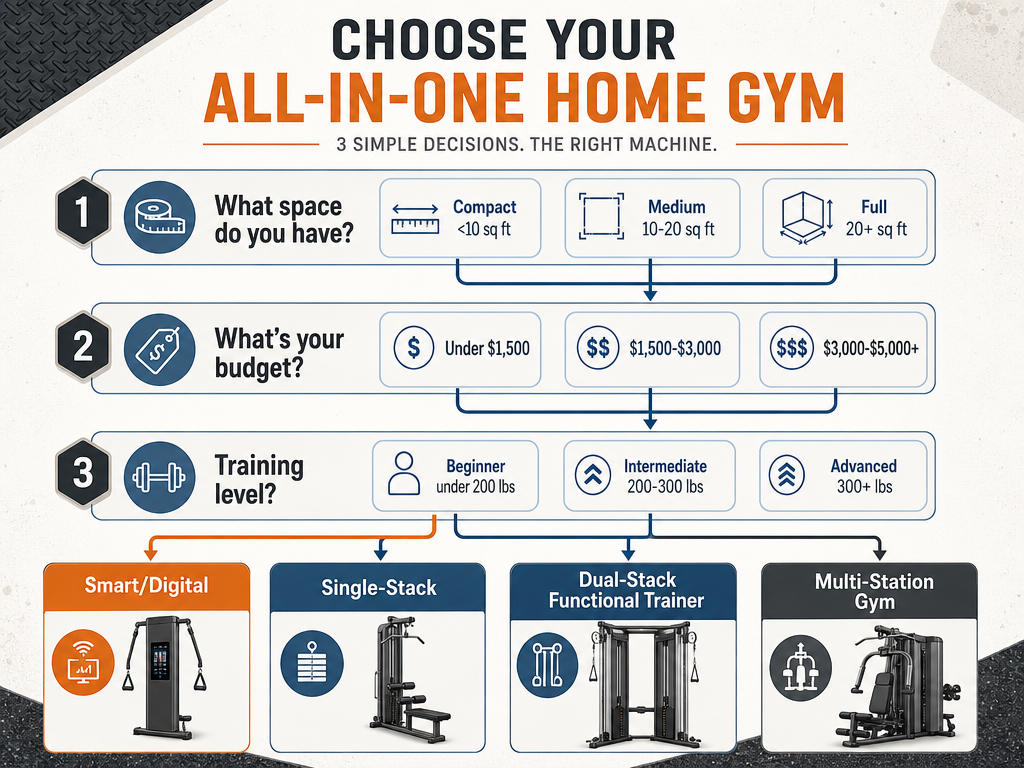
Use the three sequential questions below to route yourself to the right machine type and specific model recommendations. Each path synthesizes the space, resistance, and budget dimensions covered in the previous sections.
Question 1: How much space do you have?
- Compact (under 10 sq ft): Go to Question 2 with smart/digital and power rod machines as your primary options. Consider Speediance Gym Monster (no subscription) or Bowflex Xtreme 2 SE (budget-friendly).
- Medium (10–20 sq ft): Go to Question 2 with single-stack and dual-stack functional trainers as your primary options. Consider Body-Solid EXM2500 (best value) or REP FT-5000 (most variety).
- Full (20+ sq ft): Go to Question 2 with multi-station and hybrid machines as your primary options. Consider Force USA G20 (best overall) or Major Fitness B17 (heavy training).
Question 2: What is your budget?
- Under $1,500: Focus on power rod (Bowflex Xtreme 2 SE) or entry-level single-stack (Bells of Steel All-in-One, Powerline BSG10X). Expect 160–210 lbs resistance and limited exercise variety.
- $1,500–$3,000: You can access quality single-stack (Body-Solid EXM2500), dual-stack functional trainers (REP FT-5000), and the REP Ares 2.0 hybrid. This is the sweet spot for most buyers.
- $3,000–$5,000+: Premium multi-station (Force USA G20, Major Fitness B17) and smart gyms (Speediance, Tonal 2) are within reach. Consider long-term subscription costs for smart gyms.
Question 3: What is your training level?
- Beginner (under 200 lbs needed): Any machine type will work. Prioritize ease of use and guided movement. Bowflex Xtreme 2 SE (power rod) or Speediance (smart) are excellent starting points.
- Intermediate (200–300 lbs needed): Choose a machine with upgradable stacks or a 1:1 ratio for heavy pulls. Body-Solid EXM2500 (1:1, 210 lbs) or REP Ares 2.0 (connector bar for 1:1) are strong options.
- Advanced (300+ lbs needed): Multi-station machines with heavy stacks (Force USA G20, Major Fitness B17) or a separate rack + cable setup are your realistic options. Smart gyms and most dual-stack trainers will hit their ceiling too quickly.
For readers who are still deciding between an all-in-one and separate equipment, the Home Gym System vs. Building Your Own: A Total Cost of Ownership Comparison provides a detailed financial breakdown. If you're still exploring broader equipment options, the Best Home Gym Equipment: Tiered Picks by Budget, Space, and Training Goal guide covers standalone pieces as well.
Frequently Asked Questions About All-in-One Home Gyms
What is a 1:1 vs. 2:1 pulley ratio and why does it matter?
A 1:1 pulley ratio means the resistance you feel matches the weight on the stack. A 2:1 ratio halves the effective resistance — a 200 lb stack feels like 100 lbs — but doubles the cable travel. As REP Fitness explains, 1:1 is ideal for heavy lat pulldowns and rows, while 2:1 is better for flyes, crossovers, and exercises requiring a wide range of motion. Some hybrid systems like the REP Ares 2.0 use a connector bar to combine both stacks for a 1:1 ratio on heavy pulls, offering the best of both worlds.
How long does assembly take?
Assembly time varies dramatically by machine type. Smart gyms like the Speediance Gym Monster take about 90 minutes. Single-stack and dual-stack machines typically require 2–5 hours. Large multi-station machines like the Force USA G20 and Major Fitness B17 can take up to 35 hours, according to Strong Home Gym. If you're not comfortable with DIY assembly, factor in professional installation costs ($200–$500) or choose a machine like the Powerline BSG10X, which ships 90% pre-assembled.
What warranty should I look for?
Look for a minimum of 10 years on the frame, 2–5 years on parts, and 1 year on labor. Premium machines like the Force USA G20 and Major Fitness B17 typically offer lifetime frame warranties. Budget machines may offer only 1–2 years on parts. Avoid machines with less than a 1-year parts warranty, as cable replacements and pulley repairs can cost $100–$300.
How much clearance do I need around the machine?
As RitFit's guide emphasizes, clearance matters as much as the equipment footprint. Allow at least 2–3 feet behind and to the sides of the machine for cable movements, and 3–4 feet in front for bench placement and bar loading. For machines with a Smith machine or lat pulldown, ensure at least 7.5 ft of ceiling height. A machine that technically fits your floor plan may be unusable if you can't safely perform the exercises.
Can I upgrade resistance later?
It depends on the machine type. Some single-stack machines allow adding weight stack extensions (e.g., Bowflex Xtreme 2 SE upgrades from 210 lbs to 410 lbs). The Major Fitness B17's dual stacks are expandable to 260 lbs each. Smart gyms like Speediance and Tonal 2 have fixed resistance ceilings (220 lbs and 250 lbs respectively) that cannot be upgraded. If you plan to progress beyond intermediate level, choose a machine with upgradable stacks or a plate-loaded option.
Some links on this page are affiliate links — they may earn us a commission at no extra cost to you. Our tier and tests are decided before we ever check which links pay; see our full affiliate disclosure.
Spot something off?
Noise and floor-damage claims carry real deposit-risk consequences if we get them wrong — tell us if your experience with this build didn't match what's above.