
Home Gym System vs. Building Your Own: A Total Cost of Ownership Comparison for 2026
Deciding between an all-in-one home gym system and a modular, build-your-own setup? This guide breaks down the total cost of ownership over 1, 3, and 5 years, comparing space requirements, resistance ceilings, and hidden costs like subscriptions to help you choose the right path for your budget and space.
- Budget tier
- $1,000–$3,000
- Space type
- apartment
Items included: —
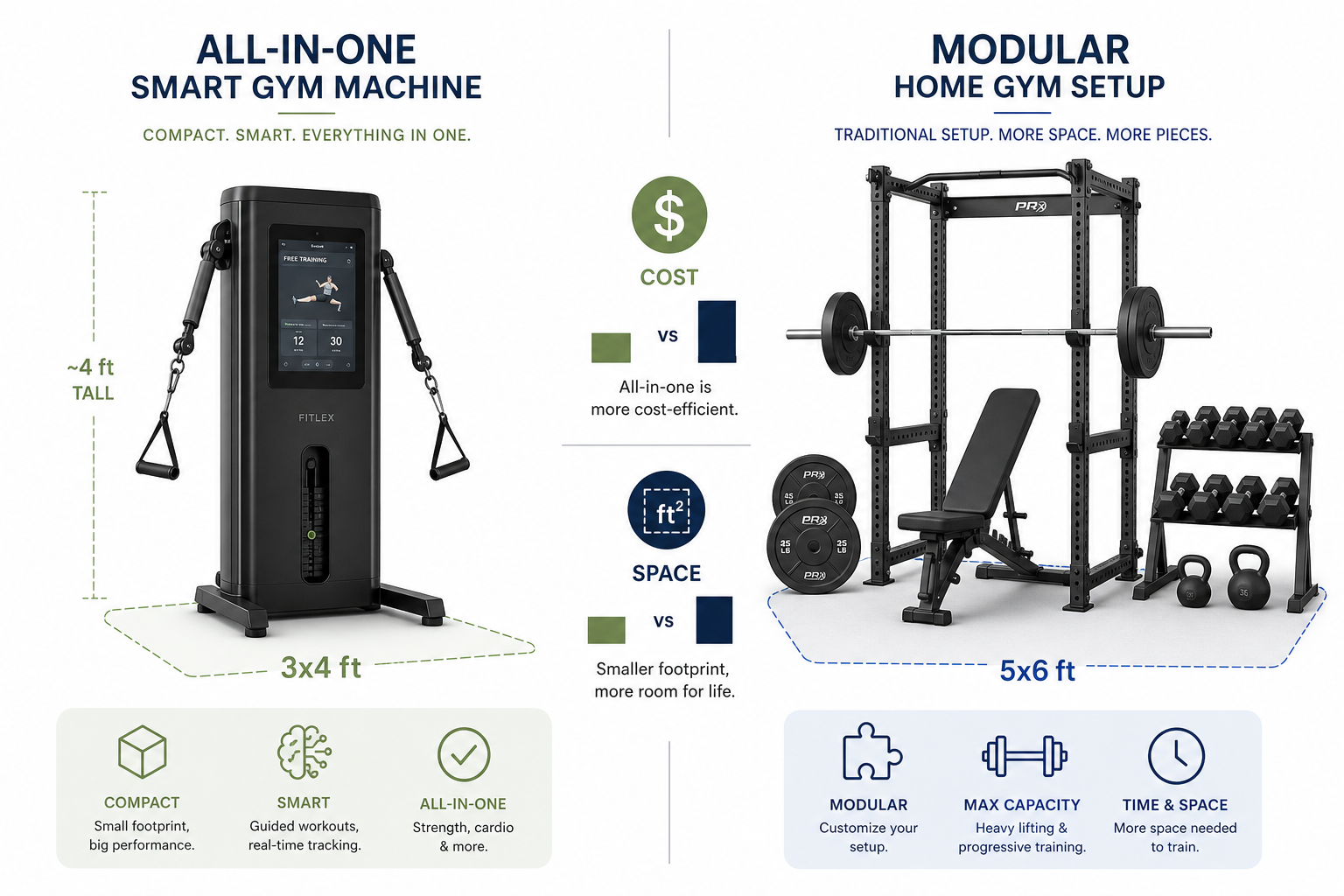
The Build-vs-Buy Conflict: Which Home Gym Setup Saves You More?
Every budget-conscious buyer faces the same fork in the road: do you buy a single all-in-one home gym system that promises a full-body workout in a compact footprint, or do you assemble a modular setup piece by piece — rack, barbell, plates, bench — betting that the long-term savings and higher resistance ceiling are worth the extra floor space?
The answer is not straightforward. The home fitness equipment market is projected to grow from roughly $12.4 billion in 2025 to $19.6 billion by 2035, and with 63% of users now preferring smart connected equipment, the industry is pushing hard on the all-in-one narrative. But a well-chosen modular setup can match or exceed the training potential of a machine that costs two to three times as much — and it never asks for a monthly subscription fee.
This guide breaks down the total cost of ownership for both paths over 1, 3, and 5 years. We compare actual floor dimensions, resistance ceilings, subscription traps, and resale value so you can decide which trade-offs align with your budget, space, and training goals. The goal is not to declare a single winner — it is to give you the numbers you need to make an informed decision.
What We Compared: Two Paths to a Home Gym
To make this comparison concrete, we selected representative products for each approach at three budget tiers. These are not the only options, but they are well-documented, widely available, and illustrate the structural differences between the two paths.
Path 1: All-in-One Home Gym Systems
These machines consolidate multiple exercise stations into a single frame. Resistance comes from selectorized weight stacks, digital electromagnetic systems, or tension rods. We used three examples that span the budget range:
- Bowflex Xtreme 2 SE Home Gym ($1,499) — 210 lbs of resistance (upgradable to 410 lbs), 63"L x 49"W footprint, over 70 exercise combinations, 7-year machine warranty.
- Speediance Gym Monster ($3,199) — 220 lbs max digital resistance (110 lbs per arm), 49"L x 28"W footprint (folds to 15" deep), no subscription required.
- Tonal 2 ($4,295) — 250 lbs digital resistance, 21.5"L x 5.25"W wall-mounted footprint, requires a $59/month subscription.
Path 2: Modular Build-Your-Own Setup
A modular setup starts with a power rack and adds a barbell, weight plates, and a bench. You can buy everything at once or phase in pieces over time. Our representative builds:
- Budget build (~$1,105): REP PR-1100 Power Rack ($380), Synergee Games Cerakote Barbell ($180), Fringe Sport Black Bumper Plates (~$300 for a 255-lb set), REP FB-5000 Competition Flat Bench ($245).
- Mid-range build (~$1,800): Upgrade to a REP PR-4000 rack ($500), add an adjustable bench like the Major Fitness Adjustable Bench ($220), and expand plate selection to 400+ lbs.
- Premium build (~$3,000+): PRx Profile PRO Squat Rack ($1,100, folds to wall), premium barbell, competition-grade plates, and a full set of adjustable dumbbells.
Total Cost of Ownership: 1-Year, 3-Year, and 5-Year Comparison
The upfront purchase price tells only part of the story. Subscription fees, assembly costs, and maintenance add up over time. The table below calculates total cost for each setup at three budget tiers, including the break-even point against the average $65/month gym membership.
| Setup | Upfront Cost | Annual Subscription | 1-Year Total | 3-Year Total | 5-Year Total | Break-Even vs. $65/mo Gym |
|---|---|---|---|---|---|---|
| Bowflex Xtreme 2 SE | $1,499 | $0 | $1,499 | $1,499 | $1,499 | ~23 months |
| Speediance Gym Monster | $3,199 | $0 | $3,199 | $3,199 | $3,199 | ~49 months |
| Tonal 2 | $4,295 | $708 ($59/mo) | $5,003 | $6,419 | $7,835 | Never vs. gym alone |
| Budget Modular Build | $1,105 | $0 | $1,105 | $1,105 | $1,105 | ~17 months |
| Mid-Range Modular Build | $1,800 | $0 | $1,800 | $1,800 | $1,800 | ~28 months |
| Premium Modular Build | $3,000 | $0 | $3,000 | $3,000 | $3,000 | ~46 months |
The budget modular build breaks even against a gym membership in roughly 17 months — faster than any all-in-one system except the Bowflex Xtreme 2 SE, which breaks even at about 23 months. The Tonal 2, with its $59/month subscription, never breaks even against a standard gym membership when you factor in the upfront hardware cost.
However, break-even analysis alone misses the point. An all-in-one system like the Speediance Gym Monster costs more upfront but requires no subscription and occupies roughly 40% less floor space than a modular rack setup. For someone paying premium rent per square foot in a city apartment, that space savings has real dollar value.
Space Comparison: Footprint, Ceiling Height, and Room Fit
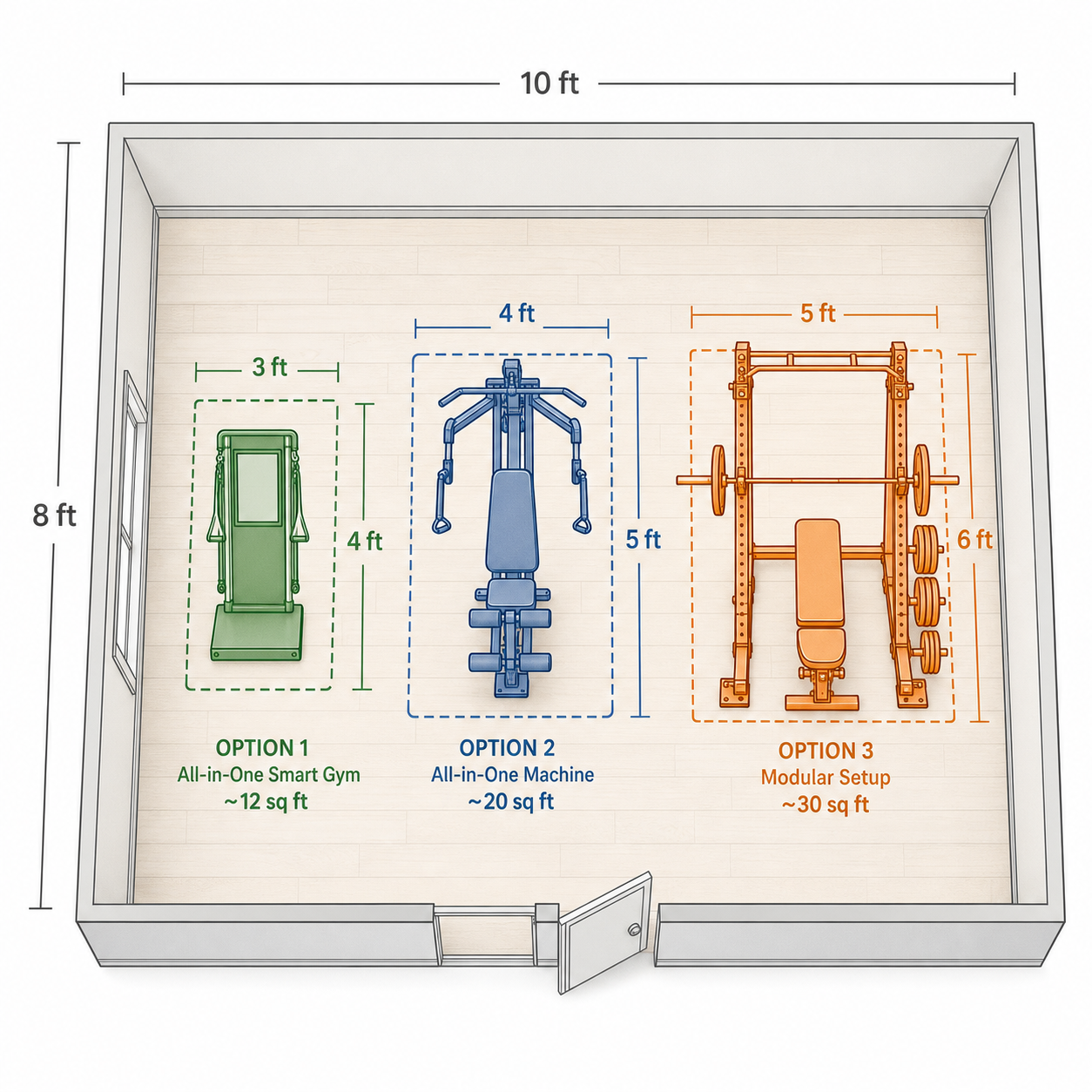
With 39 million Americans living in apartments, floor space is often the deciding factor. The table below shows the actual dimensions and square footage required for each setup, including the clearance needed for safe use.
| Setup | Equipment Footprint | Recommended Clearance | Total Space Needed | Ceiling Height Required | Folding/Storage Option |
|---|---|---|---|---|---|
| Speediance Gym Monster | 49"L x 28"W (~9.5 sq ft) | 2 ft on each side | ~15 sq ft | 73" (unfolded) | Folds to 15"D x 28"W |
| Bowflex Xtreme 2 SE | 63"L x 49"W (~21.5 sq ft) | 2 ft on each side | ~30 sq ft | 84" | No |
| Tonal 2 (wall-mounted) | 21.5"L x 5.25"W (~0.8 sq ft) | 3 ft in front, 2 ft sides | ~12 sq ft | 51" (unit height) | Wall-mounted, no floor footprint |
| Budget Modular (4-post rack) | 48"L x 48"W (~16 sq ft) | 3 ft in front, 2 ft sides | ~35 sq ft | 84"+ | Some racks fold (e.g., PRx PRO) |
| Premium Modular (folding rack) | 39.5"D x 53"W (~14.5 sq ft unfolded) | 3 ft in front | ~25 sq ft | 81"-95" | Folds flat to wall |
The Speediance Gym Monster and Tonal 2 are the clear winners for tight spaces. The Speediance folds to just 15 inches deep, and the Tonal mounts entirely on the wall with only a 5.25-inch depth. A modular rack setup, even a compact 4-post model, requires roughly 35 square feet of total space when you account for the area needed to load plates and perform lifts safely.
If you are working with a spare room or garage, the modular setup's space requirement is manageable. If you are in a studio apartment where every square foot counts, an all-in-one system — particularly a wall-mounted or folding model — may be the only realistic option.
Resistance Ceiling and Exercise Versatility: What Can You Actually Lift?
The maximum resistance a system can deliver determines whether you can continue making strength gains over time. This is where modular setups pull decisively ahead.
| Setup | Max Resistance | Resistance Type | Upgradable? | Exercise Variety |
|---|---|---|---|---|
| Bowflex Xtreme 2 SE | 210 lbs (stock), 410 lbs (upgraded) | Power rod | Yes (add rod kit) | 70+ exercises |
| Speediance Gym Monster | 220 lbs (110 lbs per arm) | Digital electromagnetic | No | Full-body (cable + accessory-based) |
| Tonal 2 | 250 lbs | Digital electromagnetic | No | Full-body (cable + accessory-based) |
| Budget Modular Build | 400+ lbs (limited by plate set) | Iron/bumper plates | Yes (add more plates) | Unlimited (any barbell or dumbbell exercise) |
| Premium Modular Build | 1,000+ lbs (limited by rack capacity) | Iron/bumper plates | Yes | Unlimited |
For a beginner focused on general fitness, 210–250 lbs of resistance is more than enough for the first year or two. But if your goal is strength training with progressive overload — adding weight to the bar every session — a modular setup is the only path that does not force you to buy a new machine when you outgrow the old one.
The Bowflex Xtreme 2 SE is a partial exception: its resistance can be upgraded from 210 lbs to 410 lbs with an add-on rod kit. That extends its useful life considerably, though the power rod resistance curve differs from free weights in ways that some lifters find less satisfying for heavy compound movements.
Exercise variety is a different story. The Bowflex Xtreme 2 SE claims over 70 exercise combinations from a single station. A modular rack setup technically offers unlimited exercises — but you need to know what to do with a barbell, plates, and a bench. For beginners who value guided variety over raw strength potential, the all-in-one path may be more practical.
The Subscription Trap: Hidden Costs of Smart Gym Systems
The most insidious cost difference between the two paths is the subscription fee. Smart all-in-one systems increasingly require monthly payments to unlock their full feature set — guided workouts, AI tracking, progress analytics, and even basic functionality in some cases.
| System | Monthly Subscription | Annual Cost | 5-Year Subscription Total | 5-Year Total (Hardware + Subscription) | Can You Use It Without Subscription? |
|---|---|---|---|---|---|
| Tonal 2 | $59 | $708 | $3,540 | $7,835 | Limited (no guided workouts, no tracking) |
| Tempo | $39 | $468 | $2,340 | Varies by hardware | Limited |
| Speediance Gym Monster | $0 | $0 | $0 | $3,199 | Full functionality |
| Bowflex Xtreme 2 SE | $0 | $0 | $0 | $1,499 | Full functionality |
| Any Modular Setup | $0 | $0 | $0 | $1,105 - $3,000 | Full functionality |
The Speediance Gym Monster is a notable exception in the smart gym category: it offers full functionality with no subscription fee. That makes its $3,199 price tag more palatable over the long term, though it still costs nearly three times as much as a budget modular build that also has no subscription.
If you are considering a subscription-based system, calculate the 5-year total before you buy. A Tonal 2 costs $7,835 over 5 years — more than seven times the cost of a budget modular build. The guided workouts and AI tracking may be worth it to some users, but the value proposition changes dramatically when you look beyond the upfront price.
Resale Value and Upgrade Paths: Which Setup Holds Its Value?
Equipment that holds its value reduces your effective cost of ownership. Modular setups have a clear advantage here for two reasons: individual components can be sold separately, and the market for used barbells, plates, and racks is deep and liquid.
Modular Setup Resale and Upgrades
- Iron plates and barbells typically retain 60–80% of their original value on the used market if kept in reasonable condition.
- Power racks from reputable brands (REP, Rogue, Titan) hold value well and can be disassembled for transport.
- You can upgrade incrementally: start with a budget rack and basic plates, then upgrade the barbell, add a better bench, or expand your plate collection over years.
- If your goals change, you can sell individual pieces and reconfigure — you are not locked into a single system.
All-in-One System Resale and Limitations
- All-in-one machines are harder to sell because they are large, heavy, and must be moved as a single unit.
- Depreciation is steeper: a used all-in-one machine typically sells for 40–60% of its original price, and finding a local buyer who wants that specific model is harder.
- You cannot upgrade individual components. If you outgrow the resistance, you must replace the entire machine.
- Subscription-based systems (Tonal, Tempo) have additional risk: if the company changes its pricing model or goes out of business, the hardware may lose most of its value.
For buyers who plan to keep their equipment for 5+ years, the modular path offers better long-term value retention and flexibility. For buyers who expect to move frequently or may sell their equipment within 2–3 years, the all-in-one path's higher depreciation is a real cost to factor into the decision.
Decision Flowchart: Which Home Gym Path Is Right for You?
Use the questions below to map your priorities to the right path. There is no universal best choice — only the best choice for your specific constraints.
- Do you have less than 20 sq ft of dedicated floor space? → All-in-one system (wall-mounted or folding model like Tonal or Speediance). If you have 35+ sq ft available, modular is viable.
- Is your primary goal strength training with progressive overload beyond 250 lbs? → Modular setup. No all-in-one system under $5,000 can match the resistance ceiling of a barbell and plates.
- Do you want guided workouts, AI tracking, and a polished app experience? → All-in-one smart system (Tonal, Speediance, or Tempo). Modular setups require you to plan your own programming.
- Is your total budget under $1,500? → Modular build. A budget modular setup at ~$1,105 outperforms any all-in-one system at that price point in terms of resistance ceiling and long-term value.
- Do you hate the idea of a monthly subscription? → Modular setup or a subscription-free all-in-one like Speediance or Bowflex. Avoid Tonal and Tempo unless you are comfortable with ongoing payments.
- Do you plan to upgrade equipment over time? → Modular setup. You can swap individual components without replacing the entire system.
- Are you a complete beginner who wants a simple, all-in-one solution with minimal setup complexity? → All-in-one system. The Bowflex Xtreme 2 SE at $1,499 is a strong entry point with no subscription and a proven track record.
For a deeper dive into specific all-in-one systems, see our Best Home Gym Systems Compared guide. If you decide on the modular route, our Garage Gym Setup on a Budget guide walks through a phased build from $300 to $1,500. And if you are new to home fitness entirely, read about 7 Beginner Home Gym Mistakes before making your first purchase.
Some links on this page are affiliate links — they may earn us a commission at no extra cost to you. Our tier and tests are decided before we ever check which links pay; see our full affiliate disclosure.
Spot something off?
Noise and floor-damage claims carry real deposit-risk consequences if we get them wrong — tell us if your experience with this build didn't match what's above.