
Best Home Gym Systems Compared: Resistance, Footprint, Warranty, and Total Cost
A structured comparison of the top home gym systems available in 2026, evaluated across the axes that matter most for high-consideration buyers: resistance ceiling, floor footprint, warranty length, subscription cost, and total 5-year ownership cost — with category winner picks and a buyer profile decision guide.
Quick Comparison: Top Home Gym Systems at a Glance
The table below covers the seven systems featured in this comparison. Prices reflect Q2 2026 retail; verify current pricing before purchasing as these figures are subject to change.
| System | Price (2026) | Resistance Ceiling | Footprint (frame) | Subscription | Warranty | Standalone? |
|---|---|---|---|---|---|---|
| REP Fitness Ares 2.0 | ~$2,999 | 200 lb per stack | Attaches to PR-4000/5000 rack | None required | Lifetime (frame) | No — rack required |
| Bells of Steel All-in-One | ~$1,900 | 200 lb (cable) | ~48" × 48" | None required | Lifetime (frame) | Yes |
| Major Fitness Heritage B17 | ~$4,200 | 200 lb per stack | ~82" × 55" | None required | 1 year | Yes |
| Titan Fitness Functional Trainer | ~$1,600 | 200 lb per stack | ~51" × 26" | None required | 1 year | Yes |
| Tonal 2 | ~$4,295 | 200 lb (digital) | ~21.5" × 5" (wall-mounted) | $59.95/month | 2 years | Yes (wall-mounted) |
| Speediance Gym Monster | ~$2,999 | 220 lb (digital) | ~47" × 24" | Optional (enhanced features) | 2 years | Yes |
| Major Fitness Spirit B52 | ~$2,199 | 160 lb per stack | ~61" × 48" | None required | 1 year | Yes |
How We Compared These Systems
No single home gym system is the best buy for every buyer. Each machine in this comparison wins on a different axis, and the right choice only becomes clear when you identify which axis matters most for your actual training situation. The comparison below is structured around six axes rather than a single ranked list.
- Resistance ceiling: The maximum load per cable stack or per digital weight system. Matters most for intermediate-to-advanced lifters performing heavy rows, lat pulldowns, and cable squats.
- Footprint including active clearance zone: The machine's frame dimensions plus the floor area required for full cable movement. Listed dimensions routinely understate the actual space required.
- Warranty length: An underweighted spec at this price tier. A 1-year warranty on a $3,000–$4,200 machine represents meaningful financial risk if a cable, pulley, or weld fails in year two.
- Subscription independence: Whether the machine functions fully without an ongoing monthly fee. Subscription-dependent systems have significantly higher 5- and 10-year total costs.
- Versatility per dollar: The range of compound and isolation movements supported relative to purchase price, including whether the machine replaces or supplements existing equipment.
- Total cost of ownership: Purchase price plus subscription costs, estimated accessory costs, and delivery or installation fees over a 5- and 10-year horizon.
Individual System Profiles
REP Fitness Ares 2.0 Functional Trainer
| Spec | Detail |
|---|---|
| Price (2026) | ~$2,999 |
| Resistance | 200 lb per stack (400 lb combined) |
| Pulley ratio | 2:1 |
| Frame footprint | Attaches to REP PR-4000 or PR-5000 rack |
| Standalone? | No — requires compatible rack |
| Subscription | None |
| Warranty | Lifetime frame, 2 years parts |
| Weight stack material | Selectorized steel |
The Ares 2.0 is the strongest rack-integrated functional trainer currently available for home use. Dual 200 lb stacks with a 2:1 pulley ratio give you effective resistance up to 100 lb per side at the handle — sufficient for virtually all cable movements including heavy lat pulldowns, cable rows, and standing cable squats.
The critical constraint: this is not a standalone purchase. It requires a REP PR-4000 or PR-5000 power rack, which adds $600–$1,200 to the total cost depending on configuration. If you already own a compatible REP rack, the Ares 2.0 is an efficient upgrade. If you are starting from scratch, you are looking at a combined investment of $3,600–$4,200 before accessories.
- Lifetime frame warranty is the strongest in this comparison.
- No subscription required, ever.
- Integrates rack and cable into a single footprint — efficient if you need both.
- Not a standalone option — buyers without a compatible REP rack must budget for both.
- Setup complexity is higher than standalone cable towers.
Who it's for: Serious compound lifters with a garage or dedicated room who already own or plan to buy a REP PR-4000/5000 rack and want to add full cable functionality without a second machine footprint.
Bells of Steel All-in-One Home Gym
| Spec | Detail |
|---|---|
| Price (2026) | ~$1,900 |
| Resistance | 200 lb cable stack |
| Frame footprint | ~48" × 48" |
| Standalone? | Yes |
| Subscription | None |
| Warranty | Lifetime (frame and shrouds) |
| Includes | Squat rack, cable system, pull-up bar, J-hooks, safety arms |
At approximately $1,900, the Bells of Steel All-in-One is the strongest value proposition in this comparison for buyers who want both a squat rack and a cable system in a single purchase under $2,000. The lifetime frame warranty at this price point is genuinely unusual — most competitors at this tier offer 1 year.
The cable stack tops out at 200 lb, which is sufficient for most training programs. The 48" × 48" frame footprint is compact for a rack-cable combination, though you will still need 15–20 sq ft of clearance beyond the frame for cable pull movements.
- Best price-to-feature ratio under $2,000 for a rack-plus-cable combination.
- Lifetime warranty is a meaningful differentiator at this price tier.
- No subscription, no ongoing cost beyond the purchase.
- Single cable stack limits simultaneous dual-cable exercises without repositioning.
- Ceiling height requirement (~90") rules it out for some basement or garage spaces.
Who it's for: Budget-conscious buyers who want a complete strength training setup — rack and cable — in a single purchase under $2,000, with long-term warranty coverage.
Major Fitness Heritage B17 Flying Fortress
| Spec | Detail |
|---|---|
| Price (2026) | ~$4,200 |
| Resistance | 200 lb per stack (dual stacks, 400 lb combined) |
| Frame footprint | ~82" × 55" |
| Standalone? | Yes |
| Subscription | None |
| Warranty | 1 year |
| Includes | Power rack, dual cable stacks, functional trainer arms, lat pulldown, low row, Smith machine attachment on select configs |
The B17 is the most feature-dense all-in-one system in this comparison. Dual 200 lb stacks, a full power rack, functional trainer arms, and a lat pulldown/low row station in a single frame make it the closest thing to a commercial multi-station in a residential package.
The 82" × 55" frame footprint is the largest in this comparison. Factor in active clearance zones on all sides and you are realistically looking at 150–180 sq ft of dedicated floor space. This machine belongs in a garage or large dedicated room, not a spare bedroom.
- Most versatile feature set of any system in this comparison — dual stacks, rack, and functional trainer in one frame.
- No subscription required.
- 1-year warranty is disproportionately short for a $4,200 machine.
- Largest footprint in the comparison — requires a large dedicated space.
- Assembly complexity is high; professional installation is worth considering.
Who it's for: Serious lifters with a large garage who want maximum training versatility in a single machine and are comfortable accepting short warranty coverage in exchange for feature density.
Titan Fitness Functional Trainer
| Spec | Detail |
|---|---|
| Price (2026) | ~$1,600 |
| Resistance | 200 lb per stack (dual stacks) |
| Pulley material | Aluminum (commercial-grade) |
| Frame footprint | ~51" × 26" |
| Standalone? | Yes |
| Subscription | None |
| Warranty | 1 year |
The Titan Fitness Functional Trainer delivers commercial-grade aluminum pulleys and dual 200 lb weight stacks at the lowest price point in this comparison. For buyers whose primary goal is cable training — not rack-based barbell work — it offers a strong resistance-to-price ratio.
The 51" × 26" frame footprint is among the most compact of the cable-only systems here, though the narrow depth means the active clearance zone extends significantly in front of the machine. The 1-year warranty is the same limitation seen on the B17, but at $1,600 the financial exposure is proportionally lower.
- Lowest price point for dual 200 lb stacks with aluminum pulleys.
- No subscription required.
- Compact frame footprint for a dual-stack cable system.
- 1-year warranty — same limitation as more expensive competitors.
- Cable-only: does not replace a rack or barbell setup for compound lifters.
Who it's for: Buyers who want a standalone cable system without rack functionality, prioritize commercial-quality pulleys at a competitive price, and already have or do not need barbell training capability.
Tonal 2
| Spec | Detail |
|---|---|
| Price (2026) | ~$4,295 (hardware) |
| Resistance | Up to 200 lb (digital electromagnetic) |
| Frame footprint | ~21.5" × 5" (wall-mounted) |
| Standalone? | Yes (wall-mounted) |
| Subscription | $59.95/month (required for full functionality) |
| Warranty | 2 years |
| AI coaching | Yes — adaptive programs, form feedback |
Tonal 2 has the smallest static footprint of any system in this comparison — it mounts to a wall and occupies virtually no floor space when not in use. The digital electromagnetic resistance system and AI coaching platform are genuinely differentiated features with no direct equivalent among the mechanical systems here.
The subscription cost is the defining financial consideration. At $59.95/month, Tonal 2 accumulates approximately $720 per year in ongoing costs beyond the hardware purchase. Over five years, that adds $3,597 to the $4,295 hardware cost for a total of roughly $7,892. Over ten years, total cost reaches approximately $12,489. No other system in this comparison comes close to that 10-year figure.
- Smallest static footprint by a significant margin — wall-mounted with near-zero floor space when folded.
- AI coaching and adaptive programming are unique in this comparison.
- 2-year warranty is better than the 1-year coverage on Titan and Major Fitness.
- $59.95/month subscription is mandatory for full functionality — the highest ongoing cost of any system here.
- 10-year total cost exceeds $12,000 — roughly 3× the 10-year cost of subscription-free alternatives at similar purchase prices.
- Digital resistance has a different feel than mechanical weight stacks — some lifters prefer the latter for heavy compound movements.
Who it's for: Buyers in apartments or small spaces where floor footprint is the binding constraint, who value AI-guided programming and are comfortable with the long-term subscription cost as part of their fitness budget.
Speediance Gym Monster
| Spec | Detail |
|---|---|
| Price (2026) | ~$2,999 |
| Resistance | Up to 220 lb (digital) |
| Frame footprint | ~47" × 24" |
| Standalone? | Yes |
| Subscription | Optional (enhanced AI features) |
| Warranty | 2 years |
| Smart features | Touchscreen, guided workouts, form tracking (camera-optional) |
The Speediance Gym Monster is the most direct comparison point for Tonal 2 buyers who want smart gym features without mandatory subscription lock-in. At $2,999 with a 220 lb digital resistance ceiling and an optional (not required) subscription for enhanced AI features, it offers a lower-cost entry into the smart gym category.
The 47" × 24" footprint is compact for a freestanding system with this resistance range. The 2-year warranty matches Tonal 2 at a lower hardware price. The key tradeoff versus Tonal is that the AI coaching platform is less mature, and the wall-mount option that makes Tonal nearly invisible when not in use is not available.
- Highest digital resistance ceiling in the comparison at 220 lb.
- Subscription is optional, not required — full mechanical functionality without ongoing fees.
- Lower hardware price than Tonal 2 for comparable smart gym features.
- Freestanding, not wall-mounted — larger floor footprint than Tonal 2 when in use.
- AI coaching platform is less developed than Tonal's at this stage.
Who it's for: Buyers comparing Tonal 2 who want smart gym technology and digital resistance but are unwilling to commit to a mandatory monthly subscription.
Major Fitness Spirit B52
| Spec | Detail |
|---|---|
| Price (2026) | ~$2,199 |
| Resistance | 160 lb per stack (dual stacks) |
| Frame footprint | ~61" × 48" |
| Standalone? | Yes |
| Subscription | None |
| Warranty | 1 year |
| Includes | Power rack, dual cable stacks, pull-up bar, J-hooks, safety bars |
The Spirit B52 occupies the mid-range between the Bells of Steel at ~$1,900 and the B17 at ~$4,200. It combines a power rack and dual cable stacks in a single frame at a price point accessible to buyers who need more than a single-stack setup but cannot justify the B17's cost.
The 160 lb per stack resistance ceiling is lower than the dual 200 lb stacks on the B17, Titan, and REP Ares 2.0. For most training programs this is sufficient, but advanced lifters performing heavy lat pulldowns or cable squats may find themselves approaching the ceiling. The 1-year warranty is the same limitation as the B17 at a lower price.
- Rack-plus-dual-cable combination at a mid-range price.
- No subscription required.
- 160 lb per stack is sufficient for most programs but lower than competitors at similar or higher prices.
- 1-year warranty at $2,199 is the same short coverage as the $4,200 B17.
Who it's for: Buyers who want a combined rack-and-cable system in the $2,000–$2,500 range and do not require the maximum 200 lb per stack resistance ceiling.
Category Winner Picks
Each pick below names the specific axis it wins on and the tradeoff that makes it the right choice for that buyer profile — not a universal recommendation.
- Best overall: REP Fitness Ares 2.0 (with PR-4000/5000 rack). Wins on resistance ceiling, warranty, and long-term value for serious lifters — but only for buyers who already own or plan to buy a compatible REP rack. If you need a standalone system, this pick does not apply.
- Best under $2,000: Bells of Steel All-in-One. Lifetime warranty, 200 lb cable stack, and a combined rack-cable system at ~$1,900 is the strongest value in this comparison at any price tier.
- Best for small spaces: Tonal 2. The wall-mounted form factor with near-zero floor footprint when not in use is unmatched. The mandatory subscription is the cost of that space efficiency.
- Best for heavy compound lifters: Major Fitness Heritage B17. Dual 200 lb stacks, full power rack, and functional trainer arms in a single frame. Accept the 1-year warranty limitation in exchange for maximum feature density.
- Best smart gym: Tonal 2 for AI coaching depth; Speediance Gym Monster for buyers who want smart features without a mandatory subscription. Evaluate both before committing at the $3,000 tier.
- Best subscription-free option: Speediance Gym Monster. Offers digital resistance and optional smart features at $2,999 with no required monthly fee — the most direct subscription-free alternative to Tonal 2.
Total Cost of Ownership: 5-Year and 10-Year Breakdown
Purchase price is only part of the financial picture for home gym systems. Subscription costs, delivery and installation fees, and accessory purchases can add substantially to the total. The table below models 5-year and 10-year costs using current pricing as of June 2026.
| System | Hardware Price | Annual Subscription Cost | 5-Year Total | 10-Year Total |
|---|---|---|---|---|
| REP Ares 2.0 (cable attachment only) | ~$2,999 | $0 | ~$2,999 | ~$2,999 |
| REP Ares 2.0 + PR-4000 rack (est.) | ~$3,700–$4,200 | $0 | ~$3,700–$4,200 | ~$3,700–$4,200 |
| Bells of Steel All-in-One | ~$1,900 | $0 | ~$1,900 | ~$1,900 |
| Major Fitness Heritage B17 | ~$4,200 | $0 | ~$4,200 | ~$4,200 |
| Titan Fitness Functional Trainer | ~$1,600 | $0 | ~$1,600 | ~$1,600 |
| Tonal 2 | ~$4,295 | ~$720 ($59.95/mo) | ~$7,895 | ~$12,495 |
| Speediance Gym Monster | ~$2,999 | $0 (subscription optional) | ~$2,999 | ~$2,999 |
| Major Fitness Spirit B52 | ~$2,199 | $0 | ~$2,199 | ~$2,199 |
Delivery and installation add costs that are easy to overlook. Most functional trainers and all-in-one rack systems weigh 400–800 lb assembled and require freight delivery with liftgate service, typically adding $150–$400 to the purchase cost. Tonal 2 requires professional wall installation, which the company typically includes in the purchase price but should be confirmed at time of order. The REP Ares 2.0 installation into an existing rack is a DIY process but adds significant time.
Footprint Reality Check: Listed Dimensions vs. Active Clearance Zone
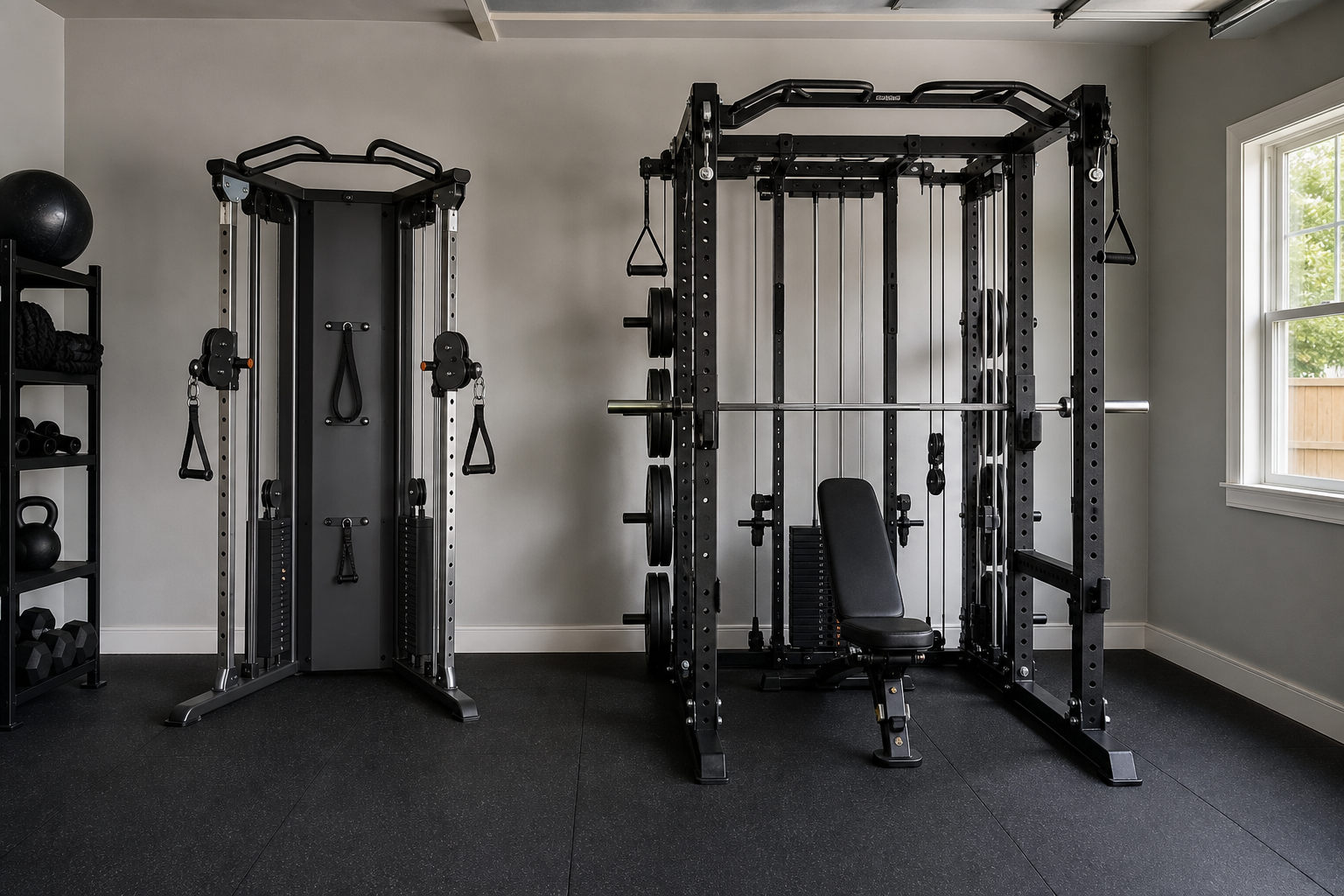
The frame dimensions listed in product specs describe the machine's physical footprint — the area the machine itself occupies. They do not describe the floor area you need to actually use the machine. For cable-based systems, the active clearance zone — the space required to perform full cable movements in front of, behind, and beside the machine — is consistently larger than the frame, often by a factor of 3 to 5.
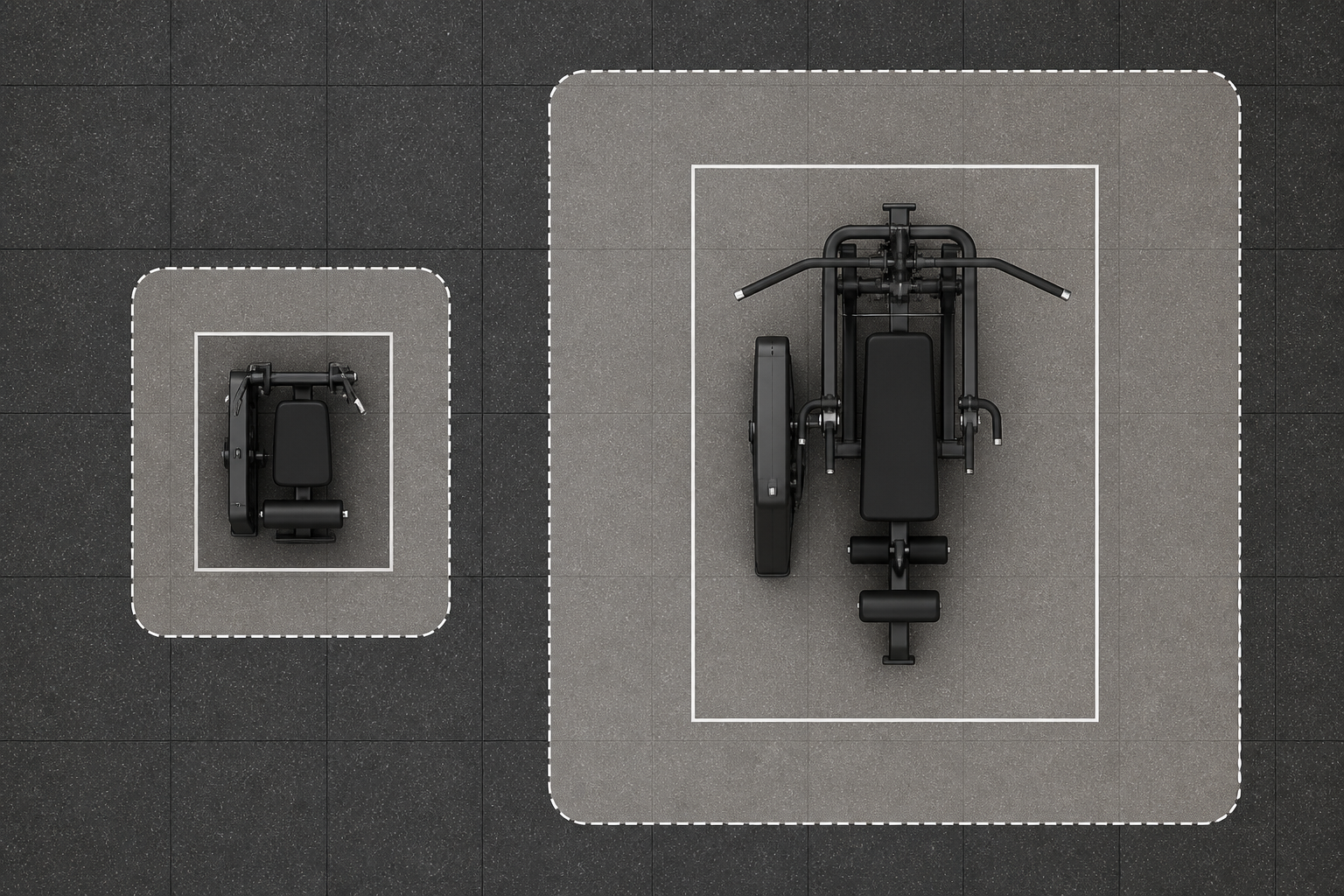
A practical rule of thumb: plan for a minimum of 6 feet of clear floor space in front of any cable station for low-cable and standing cable movements. For functional trainer systems used for full-range cable flyes or cable squats, 8 feet of clearance in front is more realistic. Behind the machine, allow at least 3 feet for loading and access.
| System | Frame Footprint | Estimated Active Clearance Zone | Realistic Total Floor Area |
|---|---|---|---|
| Tonal 2 | ~21.5" × 5" (wall-mounted) | ~6 ft in front | ~50–60 sq ft |
| Titan Fitness Functional Trainer | ~51" × 26" | ~6–8 ft in front, 3 ft sides | ~80–100 sq ft |
| Bells of Steel All-in-One | ~48" × 48" | ~6 ft front, 3 ft sides and rear | ~90–110 sq ft |
| Speediance Gym Monster | ~47" × 24" | ~6–8 ft in front | ~80–100 sq ft |
| Major Fitness Spirit B52 | ~61" × 48" | ~6–8 ft front, 3 ft sides and rear | ~120–140 sq ft |
| Major Fitness Heritage B17 | ~82" × 55" | ~8 ft front, 4 ft sides and rear | ~150–180 sq ft |
| REP Ares 2.0 + PR-4000 rack | ~48" × 48" (rack) | ~8 ft front, 4 ft sides and rear | ~130–160 sq ft |
Buyer Profile Decision Guide
The right system depends on which constraint is binding for your situation. Use the profiles below to find the closest match.
| Buyer Profile | Primary Constraint | Recommended System | Key Reason |
|---|---|---|---|
| Serious compound lifter with a garage and existing REP rack | Resistance ceiling + long-term value | REP Fitness Ares 2.0 | Lifetime warranty, dual 200 lb stacks, no subscription — but requires compatible rack |
| Serious compound lifter building from scratch in a garage | Feature density + versatility | Major Fitness Heritage B17 | Dual 200 lb stacks + full rack in one frame — accept the 1-year warranty limitation |
| Buyer under $2,000 who needs both rack and cable | Budget | Bells of Steel All-in-One | Best warranty (lifetime) and value combination under $2,000 |
| Apartment dweller with limited floor space | Floor footprint | Tonal 2 | Wall-mounted with near-zero floor footprint; subscription cost is the tradeoff |
| Buyer wanting smart features without subscription lock-in | Subscription independence | Speediance Gym Monster | Optional subscription, 220 lb digital resistance, $2,999 hardware |
| Buyer prioritizing warranty and long-term ownership value | Warranty length | Bells of Steel All-in-One or REP Ares 2.0 | Lifetime frame warranties — the only systems in this comparison with that coverage |
| Budget-constrained buyer who needs cable-only (no rack) | Price + cable resistance | Titan Fitness Functional Trainer | Dual 200 lb stacks with aluminum pulleys at the lowest price in this comparison |
Frequently Asked Questions
How much space do I actually need for a home gym system?
Plan for the total floor area including active clearance zones, not just the machine's frame dimensions. For most standalone cable systems and all-in-one rack machines, a realistic minimum is 80–110 sq ft of dedicated floor space. Larger all-in-one systems like the Major Fitness B17 require 150–180 sq ft. The only system in this comparison that works in genuinely tight spaces is the wall-mounted Tonal 2, which requires approximately 50–60 sq ft of active floor space.
Is a subscription worth it for a home gym system?
It depends on how much you will actually use the guided programming. Tonal 2's $59.95/month subscription adds $720 per year and over $7,000 over 10 years. If the AI coaching and adaptive programming significantly improve your training consistency and results, that cost may be justified. If you already follow a structured program independently, subscription-free systems like the Bells of Steel, Titan, or Speediance Gym Monster deliver equivalent or greater mechanical performance at a fraction of the 10-year cost.
One practical test before committing: use Tonal's or Speediance's app-based free trial period to assess whether you actually follow the guided workouts consistently. Subscription value is zero if the platform goes unused after the first month.
Can I build muscle effectively on a cable-only system?
Yes, for most training goals. Cable systems provide continuous tension through the full range of motion, which research supports as effective for hypertrophy. The primary limitation is that cable-only systems do not allow barbell-based compound movements — heavy barbell squats, deadlifts, and bench press require a rack and barbell setup. Buyers whose programs center on these movements should choose a system that includes rack functionality (Bells of Steel All-in-One, Major Fitness B17, Spirit B52, or REP Ares 2.0 with rack) rather than a standalone cable tower.
What warranty length is acceptable at this price tier?
For machines priced $1,500 and above, a 1-year warranty is below the standard you should expect. Frame welds, cable systems, and pulley assemblies on heavy-use equipment can and do fail after the first year. At $3,000–$4,200, a 1-year warranty represents meaningful financial risk.
The benchmark in this comparison: Bells of Steel and REP Fitness both offer lifetime frame warranties. Tonal 2 and Speediance offer 2-year coverage. Titan Fitness and both Major Fitness systems offer only 1 year. If warranty length is a priority — and it should be at this price tier — the Bells of Steel and REP Ares 2.0 are the only systems that provide genuinely long-term coverage.
How do these systems compare to building a traditional rack-and-free-weight setup?
A traditional setup — power rack ($600–$1,000), barbell ($200–$400), weight plates ($400–$800), and a bench ($200–$500) — can deliver equivalent or superior strength training capability for $1,400–$2,700, with no subscription cost and no single point of failure. The tradeoff is that cable-specific movements (cable flyes, lat pulldowns, cable rows, tricep pushdowns) require either a separate cable attachment or a standalone cable machine.
All-in-one systems in this comparison justify their cost when the combined rack-plus-cable functionality is genuinely needed and when floor space is limited enough that two separate machines are not viable. For buyers who primarily train with barbells and only occasionally use cables, a traditional rack setup with a separate cable attachment (like the REP Ares 2.0) may be more cost-effective than a fully integrated all-in-one.
This result comes from one real apartment under the stated conditions — it is a strong signal, not a guarantee your space will measure identically.
Builds this evidence supports
Cable Machine Alternatives That Save Space and Money
Compare the best cable machine alternatives for home gyms – from resistance bands and pulley systems to suspension trainers and compact digital units – and find the right option for your space and budget.
How to Choose a Compact Home Gym That Works for Your Space, Budget, and Noise Tolerance
This article provides a structured decision framework for apartment dwellers and small-space residents to match their specific floor footprint, noise sensitivity, and budget to the most suitable compact home gym strategy — whether that's an all-in-one machine, modular build, smart digital system, or band/bodyweight setup.
The Garage Gym Reality Check: What Equipment Actually Fits in a Single-Car Garage
Most garage gym guides assume a two-car space. This article uses real dimensions, real equipment footprints, and three layout templates to show what fits—and what doesn't—in a single-car garage (10x20 to 12x20 ft).
Spot something off?
If this result didn't match your own space, let us know — floor-damage and noise claims carry real deposit-risk consequences if we get them wrong.