
Smith Machine vs. Power Rack: Which Should You Build Your Home Gym Around?
Choosing between a Smith machine and a power rack for your home gym isn't a simple binary. This guide breaks down the key differences in safety, exercise variety, strength carryover, space, and budget, and shows how hybrid all-in-one machines are making this an 'and' decision rather than an 'or'.
The Core Question: Guided Path vs. Free Bar
If you are building a home gym and trying to decide between a Smith machine and a power rack, you have likely encountered a wall of conflicting advice. One camp says Smith machines are for beginners and lack real strength transfer. The other argues that power racks are dangerous without a spotter and take up too much room. Both sides have a point, but neither tells the full story.
The real question is not which piece of equipment is objectively better. It is which one fits your specific training context: Do you train alone or with a partner? Are you focused on hypertrophy, or are you chasing a bigger squat? How much space and budget do you actually have?
This article breaks down the decision across the dimensions that matter for a home gym owner — safety, exercise variety, strength carryover, space, and cost — and introduces a third path that is making the old binary obsolete: the hybrid all-in-one machine.
Smith Machine Explained: Guided Path, Safety Hooks, and Counterbalance
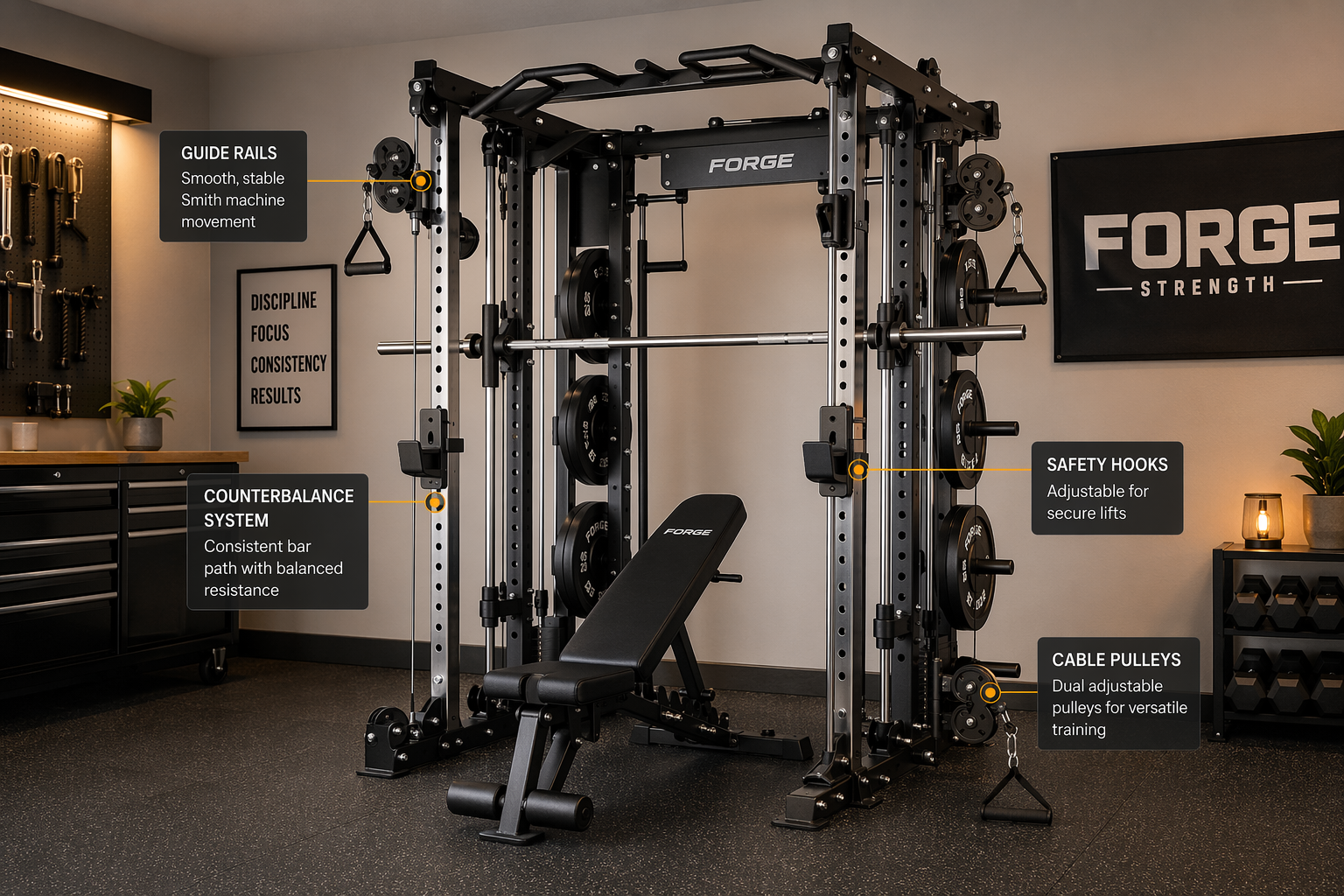
A Smith machine fixes the barbell to a vertical or slightly angled set of guide rails. The bar moves along a predetermined path, and built-in safety hooks allow you to rack the bar at any point in the range of motion by simply rotating your wrists. Most models also include a counterbalance system that reduces the effective starting weight of the bar.
Key characteristics of a typical Smith machine:
- Guided bar path: The bar travels in a fixed plane, usually with a slight rearward angle (around 7 degrees) to mimic a natural squat or press path.
- Built-in safety hooks: Unlike a power rack where you must set spotter arms at the correct height, a Smith machine lets you rack the bar at any point by turning the bar. This is a significant safety advantage for solo training.
- Counterbalance: The bar itself may weigh 45 lbs, but the counterbalance system can reduce the felt weight to around 15 lbs. This makes the machine more accessible for warm-ups, high-rep sets, or lifters working around an injury.
- Weight capacity: Most home-grade Smith machines support between 400 and 800 lbs of loaded weight. The Titan Smith Machine, for example, has a 600-lb capacity, while the RitFit PSR05 2.0 is rated for 440 lbs.
The guided path and safety hooks make the Smith machine the safer choice for a lifter who trains alone and wants to push sets close to failure without worrying about getting pinned under the bar.
Power Rack Explained: Free Bar, Safety Arms, and Attachment Ecosystem
A power rack (also called a squat rack or cage) is an open steel frame that holds a free barbell on adjustable J-hooks. You lift the bar off the hooks, perform your exercise, and return it. Safety arms or spotter arms catch the bar if you fail a rep, but they must be set at the correct height before you start.
The defining advantage of a power rack is its attachment ecosystem:
- Free bar path: The barbell moves naturally, requiring your stabilizer muscles to control the weight in three dimensions. This is the foundation of strength sport training.
- Adjustable safety arms: You set the arms at a height just below your bottom position for squats or bench press. If you fail, the bar drops a few inches onto the arms. This is safe, but it requires proper setup and is less forgiving than a Smith machine's instant racking.
- Attachment ecosystem: A power rack can accept a pull-up bar, dip station, landmine, cable pulley system, monolifts, and specialty bars. This versatility allows you to perform hundreds of exercises from a single piece of equipment.
- Standard Olympic bar: You use a 45-lb barbell with standard diameter, which means you can use the same bar for deadlifts, rows, and overhead presses outside the rack.
For lifters who prioritize strength sport performance, want maximum exercise variety, or train with a partner who can spot, a power rack is the more versatile long-term investment.
Head-to-Head Comparison: Smith Machine vs. Power Rack
The table below summarizes the key differences across the dimensions that matter most for a home gym decision.
| Dimension | Smith Machine | Power Rack |
|---|---|---|
| Bar path / feel | Guided (vertical or angled); predictable and stable | Free; requires stabilizer muscle control |
| Safety for solo training | Excellent — built-in hooks catch bar at any point | Good — requires correctly set spotter arms |
| Learning curve | Low — easy to learn proper form | Moderate — requires technique practice |
| Exercise variety | Good — squats, presses, rows, shrugs, calf raises | Excellent — hundreds of exercises with attachments |
| Stabilizer activation | Lower — bar path is fixed | Higher — free bar requires full-body stabilization |
| Effective bar weight | Variable — counterbalance reduces felt weight | Standard — 45-lb Olympic bar |
| Space footprint | Compact — average 69" W x 52" D | Varies — 48"–72" W x 48"–60" D typical |
| Budget | $500–$2,000+ | $300–$2,000+ (without attachments) |
| Best use case | Solo trainers, hypertrophy focus, beginners | Strength athletes, maximum versatility, partner training |
Safe Solo Training: Which Is Better When You Lift Alone?
If you train alone — and most home gym owners do — safety is the single most important factor in your equipment decision. A failed rep on bench press or squat can be dangerous without a spotter.
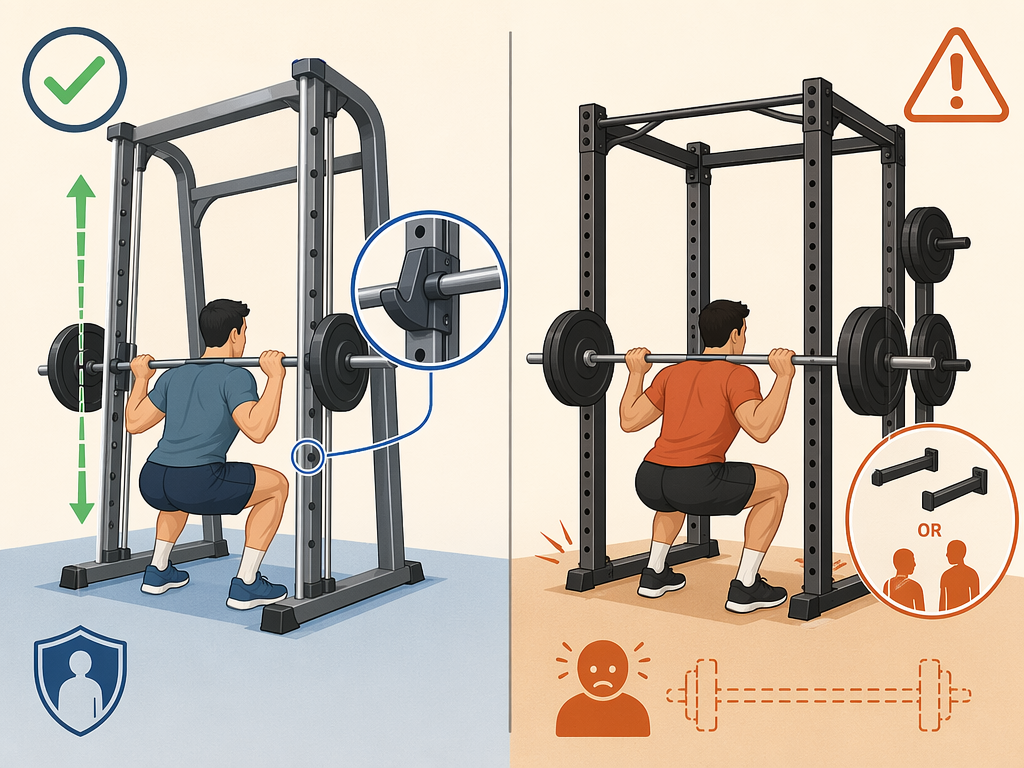
The Smith machine has a clear advantage here. Its built-in safety hooks allow you to rack the bar at any point in the range of motion by simply rotating your wrists. You do not need to set spotter arms at a precise height, and you do not need to worry about the bar falling if you lose control. The guided bar path also means the bar cannot tip or sway, which is a real risk with a free barbell during heavy squats or presses.
A power rack is still safe for solo training, but it requires more discipline. You must set the spotter arms at the correct height before each exercise. If you set them too low, the bar can still pin you. If you set them too high, you lose range of motion. For bench press, you also need to ensure the arms are positioned so the bar does not roll off them after you rack it.
Exercise Variety: What Can You Actually Do?
The range of exercises you can perform is one of the biggest differentiators between these two options.
A power rack, with its attachment ecosystem, is the clear winner for variety. With a pull-up bar, dip station, landmine, and cable pulley system, you can perform hundreds of exercises targeting every muscle group. A cable attachment alone adds lat pulldowns, cable rows, face pulls, tricep pushdowns, and cable crossovers — exercises that are impossible on a standalone Smith machine.
A Smith machine is more limited but still versatile. You can perform squats (front, back, and split), bench press (flat, incline, and decline), overhead press, rows, shrugs, calf raises, and hip thrusts. Some lifters also use Smith machines for lunges and single-leg work. The limitation is that the fixed bar path does not accommodate every body type or exercise variation perfectly.
Strength Carryover and Muscle Growth: What the Research Says
The debate over whether Smith machines build strength and muscle as effectively as free weights is one of the most persistent in fitness. The research provides a nuanced answer.
A 2009 study by Schwanbeck et al. published in the Journal of Strength and Conditioning Research found that free-weight squats activated the stabilizer muscles of the legs and trunk significantly more than Smith machine squats. This means that if your goal is to develop the coordination and balance required for a heavy free-weight squat, the Smith machine will not fully prepare you.
However, a 2023 systematic review and meta-analysis by Haugen et al. in BMC Sports Science, Medicine and Rehabilitation examined 13 studies and found no statistically significant difference in overall muscle hypertrophy between free-weight and machine-based training. In plain terms: for building muscle size, both methods work equally well.
What this means for your home gym decision:
- If your primary goal is hypertrophy (muscle growth), a Smith machine is a perfectly effective tool. The fixed bar path lets you push muscles to failure with less risk, which can actually allow for higher training volumes.
- If your primary goal is strength sport performance (powerlifting, weightlifting), a power rack is essential. The free bar path develops the stabilizer coordination and technique that directly transfer to competition lifts.
- If you want both, a hybrid approach — using a Smith machine for accessory work and a free barbell for main lifts — may be the optimal solution.
Space and Budget: Fitting the Decision to Your Reality
Space and budget are often the deciding factors for home gym builders. Here is how the options compare.
| Option | Typical Price Range | Typical Footprint | Notes |
|---|---|---|---|
| Basic power rack | $300–$800 | 48" W x 48" D | No attachments; requires separate barbell and plates |
| Smith machine (standalone) | $500–$2,000+ | 69" W x 52" D x 88" H | Average price ~$1,721 per Garage Gym Reviews data |
| Power rack with attachments | $1,000–$3,000+ | 48"–72" W x 48"–60" D | Cost increases with cable system, dip bars, etc. |
| Hybrid all-in-one (Smith + rack + cables) | $2,000–$4,500+ | 70"–80" W x 50"–65" D | Replaces 3+ separate pieces in one footprint |
The key insight here is that a hybrid all-in-one machine — which combines a Smith machine, power rack, and functional trainer — can replace three or more separate pieces of equipment in a single footprint. For someone with limited floor space, this is a significant advantage. The Force USA G3 (~$2,000), Major Fitness B17 (~$4,200), and REP Altitude (starting at ~$900, up to ~$4,000 fully equipped) are examples of machines that pack Smith, rack, and cable functionality into a single unit.
The Hybrid Recommendation: Best of Both Worlds
For many home gym builders, the best answer is not Smith machine or power rack — it is both, in a single machine. Hybrid all-in-one systems combine a Smith machine, a power rack, and a functional trainer (dual cable pulleys) in one footprint. They offer the safety of a Smith machine for solo work, the versatility of a power rack for free-weight exercises, and the cable functionality for lat pulldowns, rows, and isolation work.
Key advantages of a hybrid all-in-one:
- Space efficiency: One machine replaces a Smith machine, power rack, and cable tower, saving significant floor space.
- Training versatility: You can perform Smith machine exercises for hypertrophy and safety, free barbell exercises for strength and coordination, and cable exercises for isolation and pump work.
- Solo safety: The Smith machine component provides the instant-racking safety hooks, while the power rack component allows for free-bar work with spotter arms.
- Long-term value: As your training goals evolve, the machine adapts with you. You are not locked into one training modality.
The trade-off is cost. Hybrid machines typically start around $2,000 and can exceed $4,000 for fully featured models. But when you consider the cost of buying a Smith machine, power rack, and cable tower separately, the hybrid often represents a better value — especially when you factor in the space savings.
Decision Framework: A Flow Chart for Your Choice
Use the following decision framework to find your recommendation. Start with the first question and follow the path that matches your situation.
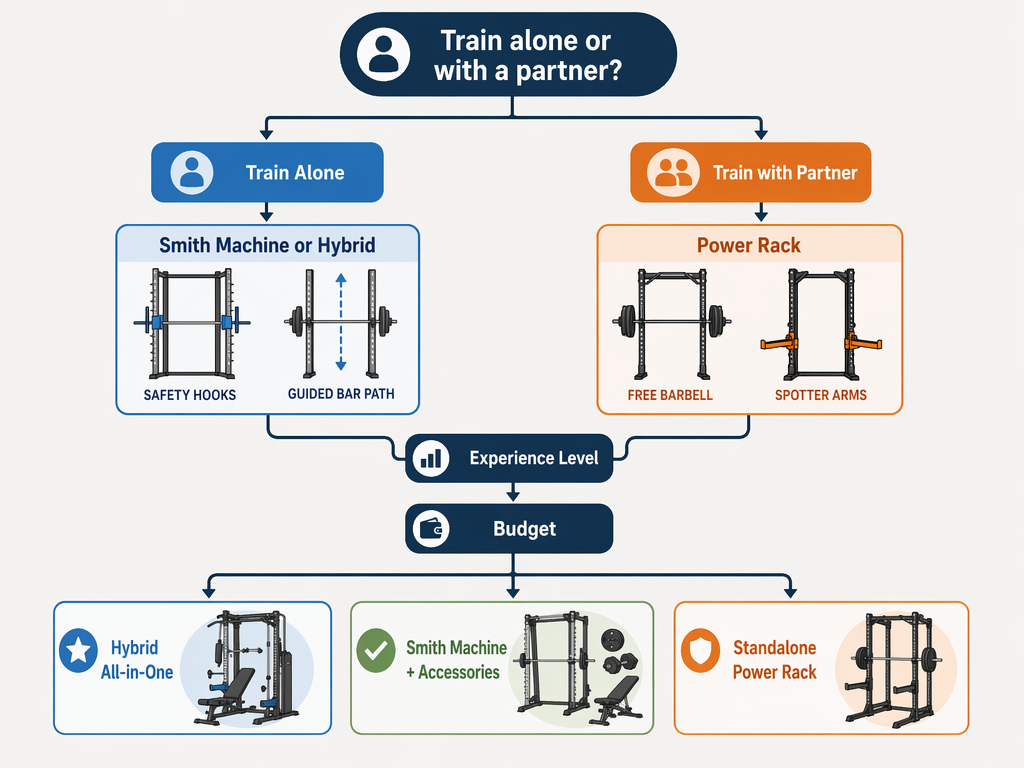
- Do you train alone? Yes → Consider a Smith machine or hybrid all-in-one for the safety hooks and guided bar path. No → A power rack is a strong option if you have a reliable spotter.
- What is your primary goal? Hypertrophy → A Smith machine or hybrid is excellent for controlled, high-volume work. Strength sport → A power rack is essential for free-bar technique.
- What is your experience level? Beginner → A Smith machine or hybrid offers a lower learning curve and safer progression. Intermediate/advanced → A power rack or hybrid provides the versatility you need to continue progressing.
- What is your budget? Under $1,000 → A basic power rack is the most cost-effective starting point. $1,000–$2,000 → A standalone Smith machine or a budget hybrid (e.g., RitFit PSR05 2.0 at ~$540) is viable. Over $2,000 → A hybrid all-in-one (e.g., Force USA G3, Major Fitness B17) offers the best value.
- How much space do you have? Limited (under 50 sq ft) → A compact Smith machine or a hybrid all-in-one maximizes functionality per square foot. Ample (over 60 sq ft) → A power rack with separate attachments gives you maximum flexibility.
Frequently Asked Questions
Can you build a powerlifting total on a Smith machine?
Not effectively. Powerlifting requires the ability to squat, bench, and deadlift with a free barbell. The Smith machine's fixed bar path does not replicate the technique demands of a competition lift, and it does not develop the stabilizer coordination needed for a heavy free-weight squat or bench press.
Is a Smith machine safer for bench press than a power rack?
Yes, for solo training. The safety hooks on a Smith machine allow you to rack the bar at any point by rotating your wrists. In a power rack, you must set spotter arms at the correct height before benching. If you fail a rep and the bar misses the arms, you can get pinned. That said, a power rack with properly set spotter arms is still very safe.
Can you do pull-ups on a Smith machine?
Most standalone Smith machines do not include a pull-up bar. Some hybrid all-in-one models include a pull-up bar as part of the rack structure. If pull-ups are important to you, check the specs before buying.
How much space do I need for each?
A typical Smith machine footprint is about 69" W x 52" D. A power rack footprint varies from 48" W x 48" D (compact) to 72" W x 60" D (full-size). Hybrid all-in-one machines are usually in the 70"–80" W x 50"–65" D range. You will also need additional space for loading plates, moving around the machine, and performing exercises outside the rack (e.g., deadlifts).
Do I need a spotter with a power rack?
No, if you set the spotter arms at the correct height. A power rack with properly adjusted safety arms is safe for solo training. However, it requires more setup discipline than a Smith machine. You must check the arm height before each exercise, and you need to be comfortable with the idea of failing a rep onto the arms.
This result comes from one real apartment under the stated conditions — it is a strong signal, not a guarantee your space will measure identically.
Builds this evidence supports
Garage Gym Equipment Tier System: What to Buy First, Second, and Third Based on Your Training Goals
A practical guide for beginners and intermediate home gym builders that uses a community-backed tier system (must-have, should-have, nice-to-have, avoid) to help you buy equipment in the right order—so every purchase serves a real training need and nothing is wasted.
Spot something off?
If this result didn't match your own space, let us know — floor-damage and noise claims carry real deposit-risk consequences if we get them wrong.