
Home Gym Cable Machine Buying Guide: Pick Your Format First, Then Your Brand
This guide helps intermediate home gym enthusiasts choose the right cable machine by focusing on format first — rack-mounted, standalone functional trainer, single-stack tower, portable/smart, or crossover — before comparing brands. It includes footprint data, price bands, pulley ratio explanations, and plate-loaded vs. weight stack trade-offs to prevent buyer regret.
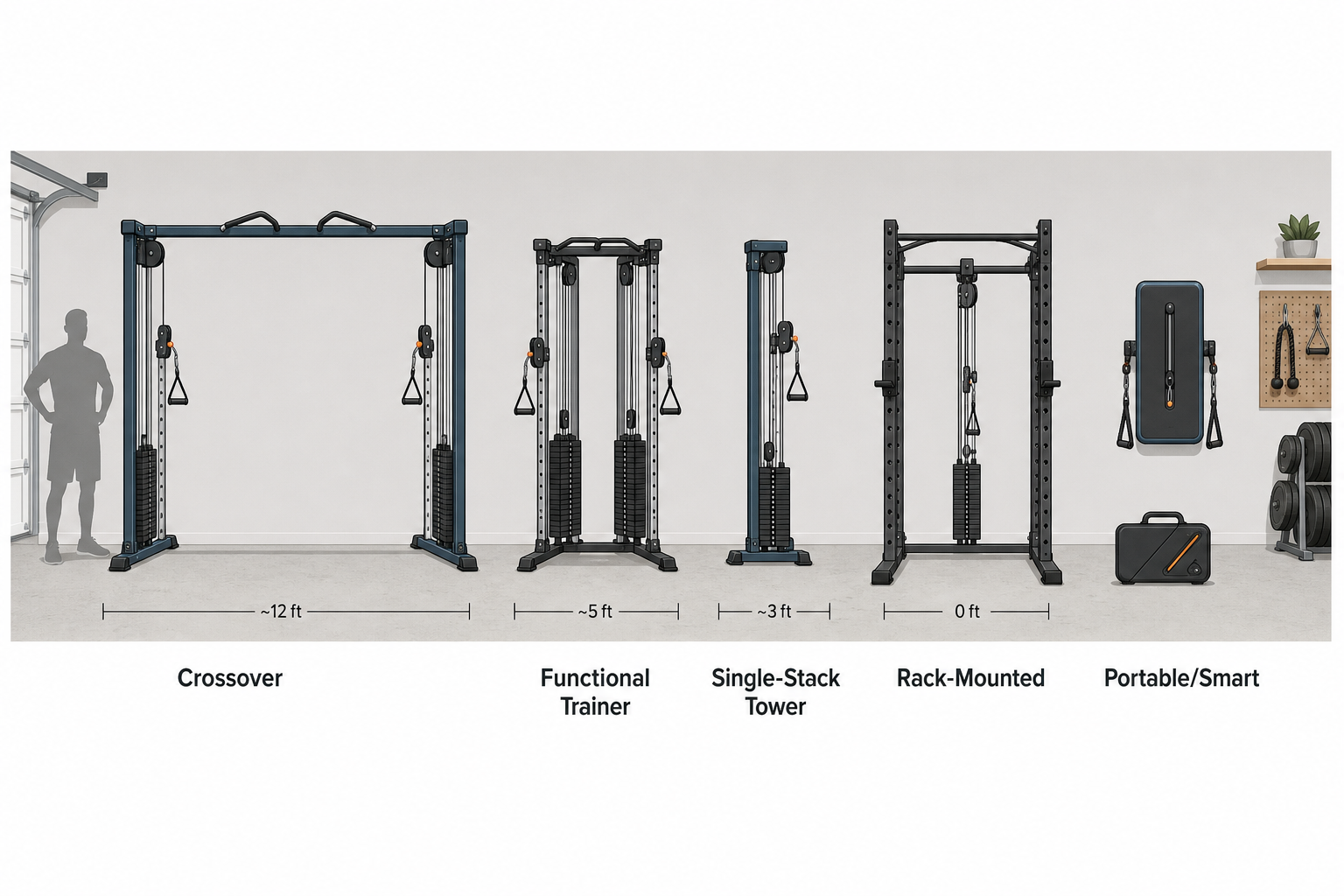
Why Format-First Beats Brand-First
Walk into the cable machine section of any home gym forum and you will find the same pattern: someone posts a budget, someone replies with a brand name, and six comments later the thread is arguing about pulley ratios without ever asking where the machine will sit. That is the root of most buyer regret in this category.
A cable machine is not a single product category. It is five distinct formats that share a common movement principle but differ completely in footprint, installation requirements, exercise range, and compatibility with the equipment you already own. The REP Ares 2.0 and the Tonal 2 both let you do cable flyes. One requires a specific power rack and a 4' x 4' floor area that is already occupied by that rack. The other requires a stud-finder, a drywall patch kit when you move out, and a $59/month subscription with a 12-month minimum. They serve different people.
The average cable machine costs around $2,265 and carries industry reference dimensions of roughly 25.6" x 31.8" x 49.4", according to data from Garage Gym Reviews. But that average is misleading — it blends a $419 single-stack tower with a $4,295 wall-mounted smart unit. Format determines usable footprint more than any single spec. A rack-mounted attachment adds zero floor space to your existing rack. A standalone functional trainer consumes 30–40 sq ft of dedicated floor area. A cable crossover needs nearly 12 ft of wall width. These are not interchangeable.
This guide is written for intermediate home gym enthusiasts who already own a rack, barbell, and plates. You are not deciding whether to buy a cable machine. You are deciding which format belongs in your space, and which specific product in that format gives you the best combination of smoothness, weight range, and long-term value. The sections below walk through each format with real product picks, footprint data, and price bands so you can make that call with confidence.
5 Questions to Determine Your Cable Machine Format
Before reading the deep-dives, run through these five questions. Your answers will route you to the format that fits your situation, saving you hours of cross-shopping products that were never right for your setup in the first place.
- Do you already own a compatible power rack? If you own a REP PR-4000 or PR-5000, rack-mounted systems like the REP Ares 2.0 or REP Athena add cable functionality with zero added floor footprint. If you own a different rack brand, your options narrow significantly — most rack-mounted cable attachments are brand-specific.
- How much dedicated floor space can you spare? Zero sq ft (rack-mounted) → go to Section 3. Under 6 sq ft (single-stack tower) → go to Section 5. 30–40 sq ft (standalone functional trainer) → go to Section 4. 40+ sq ft and 11+ ft of wall width (crossover) → go to Section 7.
- Do you need portability or apartment-friendly installation? If you rent, move frequently, or cannot bolt things to walls, portable units like the MAXPRO SC ($749) or Beyond Power Voltra I ($2,199) are your only realistic options. Wall-mounted smart units like the Tonal 2 require permanent installation and leave holes when you leave.
- What is your budget for the cable system alone? Under $1,000 → single-stack towers and portable units. $1,000–$3,000 → rack-mounted systems and entry-level functional trainers. $3,000+ → premium functional trainers, crossovers, and smart units. Be honest about whether that budget includes installation, shipping, and potential subscription costs.
- Do you want to keep using your rack for barbell work? Rack-mounted systems occupy the space inside your rack and can interfere with squatting, benching, and pull-ups. If your rack is your primary training station and you cannot afford to lose it for cable work, a standalone format is the better choice.
Rack-Mounted Cable Attachments: Zero Added Floor Space
Rack-mounted cable attachments bolt onto or sit inside an existing power rack, using the rack's structure as their frame. They add cable functionality without consuming any additional floor area — the rack's footprint is already accounted for in your gym layout. This makes them the most space-efficient cable format available, provided your rack is compatible.
The trade-off is significant: once installed, the rack's interior space is partially or fully occupied by the cable system. You lose the ability to squat, bench, or perform pull-ups inside the rack while the cable attachment is in place. Some systems are designed to be removed, but the process is not quick — you are effectively choosing between barbell work and cable work for a given training session, not switching mid-workout.
Top Picks and Key Specs
| Product | Price | Resistance Type | Weight per Side | Pulley Ratio | Compatibility | Cable Positions |
|---|---|---|---|---|---|---|
| REP Ares 2.0 | $2,999+ | Selectorized stack | 260 lb (upgradeable to 310 lb) | 2:1 | REP PR-4000 / PR-5000 only | Dual columns, full height |
| REP Athena | ~$1,500 | Plate-loaded | Unlimited (your plates) | 1:1 (lat/low row) + 2:1 (adjustable column) | REP racks only | 21 |
| Bells of Steel Cable Crossover Attachment | $587.99 | Plate-loaded | 160 lb max per side | 1:1 | Select BoS racks only | Per side: 26" x 40" x 84.5" |
The REP Ares 2.0 is the standout in this category. It scored 94/100 from Strong Home Gym's testing, with dual 260-lb selectorized stacks (upgradeable to 310 lb), a 2:1 cable ratio, and aluminum pulleys with brass bushings that deliver commercial-grade smoothness. The system adds only a few inches to the front of a REP PR-4000 or PR-5000 rack. The catch: it only fits those two rack models. If you own a different rack, the Ares 2.0 is not an option.
The REP Athena takes a different approach: it is plate-loaded, uses a single-column design, and offers both 1:1 (for lat pulldown and low row) and 2:1 (for the adjustable column) ratios across 21 cable positions. It also requires a REP rack. The plate-loaded design keeps the upfront cost lower than the Ares 2.0 and lets you use plates you already own, but you lose the quick weight-change convenience of a selectorized stack.
The Bells of Steel Cable Crossover Power Rack Attachment is the budget entry at $587.99. It is plate-loaded with a 160-lb max per side and a 1:1 ratio. Each side occupies 26" x 40" x 84.5" of space. It is only compatible with select Bells of Steel racks. At this price point, you are getting basic cable functionality without the smoothness or convenience of the higher-end options.
Standalone Functional Trainers: Best Pulley Smoothness, Biggest Footprint
Standalone functional trainers are the closest thing to a commercial gym cable station you can put in a home gym. They come as a single unit with two independent weight stacks, two adjustable cable columns, and a footprint that typically runs 30–40 sq ft. They offer the best pulley smoothness in the home market — most use aluminum pulleys with sealed bearings — and allow true dual-cable movements like cable flyes, face pulls, and woodchoppers that rack-mounted systems cannot replicate.
The cost is correspondingly high: expect to spend $2,500 to $3,300 for a quality unit. You also need dedicated floor space that cannot be shared with other equipment. If you have the room and the budget, a functional trainer is the format that will make you happiest long-term.
Top Picks and Key Specs
| Product | Price | Footprint | Weight per Stack | Pulley Ratio | Pulley Material | Warranty |
|---|---|---|---|---|---|---|
| Titan Fitness Functional Trainer | $2,999.99 | 44" x 64" x 82" | 200 lb | 2:1 | Aluminum | Standard |
| Gronk Fitness Functional Trainer | $3,299 | 41" x 61" x 83" | 200 lb | 2:1 | Aluminum | Standard |
| Force USA G12 | ~$3,000 | 33 sq ft | 200 lb | 1:1 | Steel | 10-year moving parts |
| Body-Solid GFT100 | $2,315 (160 lb) / $2,545 (210 lb) | 57"W x 45"D | 160 or 210 lb | 2:1 | Nylon | Lifetime |
The Titan Fitness Functional Trainer and Gronk Fitness Functional Trainer are nearly identical on paper: both use aluminum pulleys, dual 200-lb stacks at a 2:1 ratio, and occupy roughly the same floor area (41–44" wide, 61–64" deep). The Gronk unit is $300 more and stands 83" tall versus Titan's 82" — a meaningful difference if your ceiling is exactly 84" (standard 7-ft). The Titan unit scored 4.1/5 from Garage Gym Reviews; the Gronk scored 4.4/5.
The Force USA G12 is a different beast — it is an all-in-one machine that combines a functional trainer with a power rack, Smith machine, and leg press in a 33-sq-ft footprint. It uses a 1:1 pulley ratio and dual 200-lb stacks, and carries a 10-year warranty on moving parts. Strong Home Gym scored it 90/100. The trade-off is that the G12 is not a pure cable machine — you are paying for features you may not need if you already own a rack and barbell.
The Body-Solid GFT100 is the narrowest functional trainer at 57" wide, making it a strong option for tighter spaces. It offers 19 cable arm positions, 360-degree swiveling pulleys, and a 2:1 ratio. The 160-lb stack version costs $2,315; the 210-lb version costs $2,545. Everything Gyms notes that the GFT100 delivers roughly 80% of cable crossover functionality in about half the width of a full crossover unit.
Single-Stack Cable Towers: Compact and Budget-Friendly
Single-stack cable towers are the sweet spot for home gym owners who want real cable functionality without dedicating 30+ sq ft or spending over $2,500. These units consist of a single weight stack and cable column, typically occupying about 6 sq ft of floor space. They offer 30+ cable positions, enough for lat pulldowns, rows, triceps pushdowns, bicep curls, face pulls, and most single-cable exercises.
The limitation is obvious: you only get one cable. True crossover movements and dual-cable exercises are not possible without a second unit. But for the majority of home gym users, a single-stack tower covers 80% of cable exercises at 20% of the cost of a premium functional trainer.
Top Picks and Key Specs
| Product | Price | Footprint | Max Weight | Cable Positions | Pulley Ratio | Adapter Option |
|---|---|---|---|---|---|---|
| Bells of Steel Cable Tower 2.0 | $419 (plate-loaded) / ~$1,200 (selectorized) | 6 sq ft | 250 lb | 33 | 2:1 | 1:1 adapter available |
| Body-Solid S2CCX/1 | $3,010+ | 36" x 36" | 210 lb | Standard | 2:1 | None |
The Bells of Steel Cable Tower 2.0 is the standout value pick in the entire cable machine category. Strong Home Gym scored it 87/100 overall and 96/100 for value. The plate-loaded version starts at $419, making it the cheapest way to get a real cable tower in your home gym. The 250-lb capacity, 33 cable positions, and 2:1 ratio (with an optional 1:1 adapter) give it surprising versatility for the price. The selectorized version costs around $1,200 and adds the convenience of a weight stack.
The Body-Solid S2CCX/1 is a different proposition entirely — it is a commercial-grade single-stack column with a 36" x 36" footprint and a price tag over $3,000. It is built to last decades, but for most home gym owners, the Bells of Steel tower delivers comparable functionality at a fraction of the cost.
Portable and Smart Cable Machines: Niche but Powerful
Portable and smart cable machines serve a narrow but real set of use cases: apartment dwellers who cannot bolt equipment to walls or floors, travelers who want cable training on the road, and home gym owners whose space is already fully occupied by other equipment. These units use digital or magnetic resistance instead of weight stacks or plates, and they range from wall-mounted smart trainers to devices that fold down to the size of a laptop.
The trade-offs are significant: digital resistance cannot replicate the feel of a real weight stack, subscription costs add to total cost of ownership, and maximum resistance is capped at 200–300 lb depending on the unit. But for users who literally cannot install a traditional cable machine, these are the only options that work.
Top Picks and Key Specs
| Product | Price | Footprint | Max Resistance | Resistance Type | Subscription | Best For |
|---|---|---|---|---|---|---|
| Tonal 2 | $4,295 | 5.25" x 21.5" x 50.9" (wall-mounted) | 250 lb | Digital electromagnetic | $59/mo (12-month minimum) | Permanent home installation, smart features |
| Beyond Power Voltra I | $2,199 | 12.71" x 5.49" x 3.94" | 200 lb | Digital electromagnetic | None | Portability, travel |
| MAXPRO SC | $749 | Folds to 16" x 10" x 4" (laptop size) | 300 lb | Magnetic | None | Ultimate portability, budget |
The Tonal 2 is the most polished smart cable machine on the market. It scored 4.3/5 from Garage Gym Reviews and 88/100 from Strong Home Gym. The wall-mounted unit protrudes only 6" from the wall and delivers up to 250 lb of digital electromagnetic resistance. The guided workout platform is genuinely good — it auto-adjusts weight between sets and tracks your progress across hundreds of exercises. But the $4,295 price tag is just the start. The mandatory $59/month subscription with a 12-month minimum adds $708 in the first year alone, bringing year-one cost to $5,003. Professional installation is required, and the unit leaves wall anchors and holes when removed.
The Beyond Power Voltra I ($2,199) is a truly portable smart cable machine — it fits in a backpack at 12.71" x 5.49" x 3.94" and delivers up to 200 lb of digital resistance. It scored 4.3/5 from Garage Gym Reviews. No subscription is required. The trade-off is that 200 lb is the ceiling, and the digital resistance feel is not identical to a weight stack. It is best for travelers and apartment dwellers who need cable training in hotel rooms or small living spaces.
The MAXPRO SC ($749) is the budget portable option. It folds to laptop size (16" x 10" x 4") and delivers up to 300 lb of magnetic resistance. Strong Home Gym scored it 85/100. No subscription is required. The magnetic resistance is smoother than elastic bands but still does not replicate the feel of a weight stack. It is best for users who want cable functionality in a truly portable form factor and are willing to accept the resistance trade-off.
Cable Crossovers: The Full Commercial Experience
Cable crossovers are the largest and most expensive cable machine format. They consist of two independent cable columns spaced several feet apart, connected by a top crossbar. This design allows true crossover movements — cable flyes, cross-body chops, and any exercise where the cables meet at an angle in front of or behind the user. The feel is identical to what you would find in a commercial gym.
The space requirement is the biggest barrier. A full crossover like the Body-Solid GDCC250B needs approximately 11.5 ft of wall width and about 40 sq ft of floor space. Most home gyms simply do not have that kind of dedicated area. If you have the space and the budget, a crossover is the ultimate cable machine. If you do not, a functional trainer delivers most of the same functionality in roughly half the width.
Top Picks and Key Specs
| Product | Price | Width | Footprint | Weight per Stack | Pulley Ratio | Resistance Type |
|---|---|---|---|---|---|---|
| Body-Solid GDCC250 | ~$2,700+ | ~11.5 ft | 40 sq ft | 210 lb | 1:1 | Selectorized stack |
| Body-Solid GDCC250B | $2,700 | 138" (11.5 ft) | 40 sq ft | 210 lb | 1:1 | Selectorized stack |
The Body-Solid GDCC250 and GDCC250B are the same machine in different colorways. Both use dual 210-lb selectorized stacks with a 1:1 pulley ratio, meaning the weight you select is the weight you feel at the handle — no ratio math required. Strong Home Gym scored the GDCC250 88/100. The 40-sq-ft footprint and 11.5-ft width requirement mean this is a format for dedicated home gym spaces only.
Everything Gyms notes that a functional trainer like the Body-Solid GFT100 delivers roughly 80% of cable crossover functionality in about half the width. If you are on the fence between a crossover and a functional trainer, ask yourself how often you will actually do true crossover movements. If the answer is "a few times per week," the crossover is worth the space. If the answer is "occasionally," a functional trainer is the smarter choice.
1:1 vs 2:1 Pulley Ratios Explained
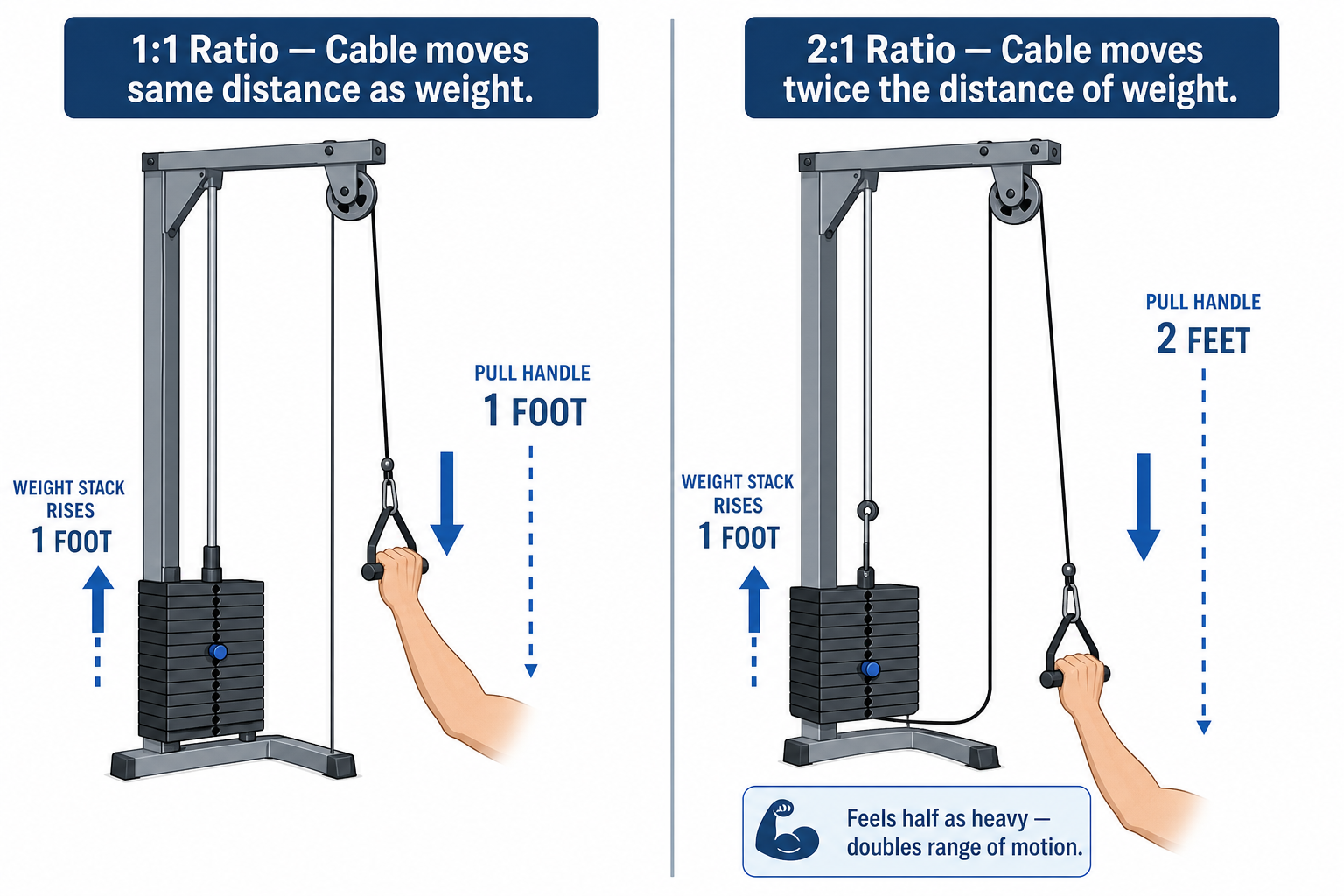
Pulley ratio is one of the most misunderstood specs in cable machines, yet it directly affects how every exercise feels. The ratio describes the relationship between the distance the handle moves and the distance the weight stack moves.
In a 1:1 system, the cable runs directly from the handle to the weight stack through a single pulley. When you pull the handle 12 inches, the weight stack moves 12 inches. The weight you select is the weight you feel at the handle — 100 lb on the stack feels like 100 lb. This gives a heavier, more direct feel that many lifters prefer for compound movements like lat pulldowns and rows.
In a 2:1 system, the cable routes through an additional pulley before reaching the weight stack. When you pull the handle 12 inches, the weight stack moves only 6 inches. The mechanical advantage means 100 lb on the stack feels like 50 lb at the handle. This makes the movement feel lighter and smoother, which is preferable for isolation exercises like cable flyes, face pulls, and triceps pushdowns where you want controlled, continuous tension.
The practical implication: a 2:1 machine with a 200-lb stack gives you an effective working resistance of 100 lb per side. If you are a strong lifter who needs heavy lat pulldowns, a 2:1 machine may leave you wanting more weight. Some machines, like the Bells of Steel Cable Tower 2.0, offer an optional 1:1 adapter that changes the cable routing to give you the full stack weight.
Plate-Loaded vs. Weight Stack: Which Is Right for You?
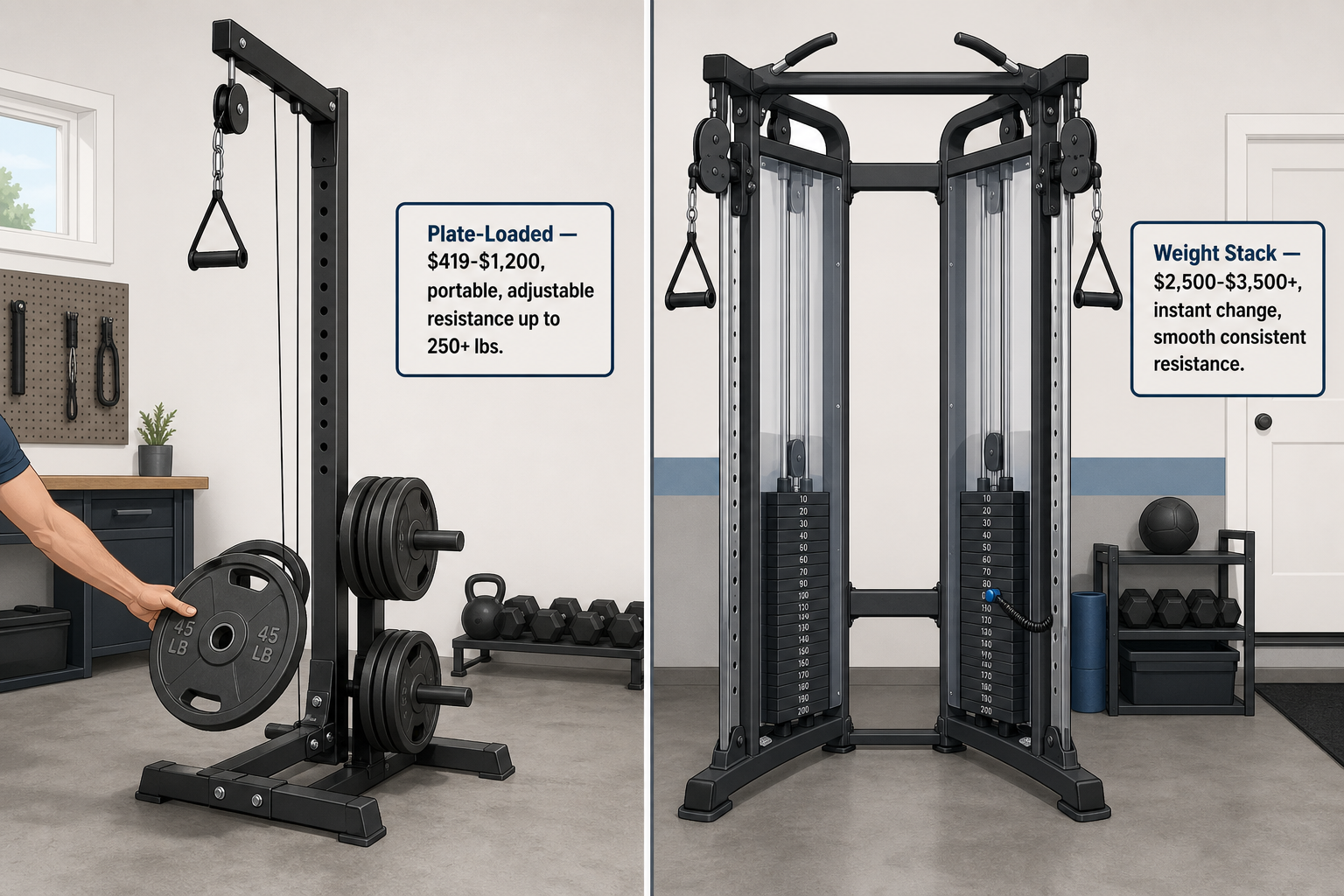
Every cable machine uses one of two resistance systems: plate-loaded, where you add iron plates to a peg or sleeve, or selectorized weight stack, where you insert a pin into a stack of weight plates. The choice between them affects cost, convenience, smoothness, and long-term flexibility.
| Factor | Plate-Loaded | Selectorized Weight Stack |
|---|---|---|
| Upfront cost | Lower ($419–$1,500) | Higher ($1,200–$4,295+) |
| Weight range | Unlimited (use your plates) | Capped at stack weight (160–310 lb) |
| Weight change speed | Slow (load/unload plates) | Fast (move a pin) |
| Smoothness | Lower (plate wobble, cable slack) | Higher (guided stack, consistent tension) |
| Maintenance | Minimal (wipe plates) | Periodic (cable tension, guide rod lubrication) |
| Compatibility | Uses plates you already own | Proprietary stack, no cross-compatibility |
| Best for | Budget builders, heavy lifters | Convenience seekers, commercial feel |
Plate-loaded systems are the budget-friendly choice. The Bells of Steel Cable Tower 2.0 starts at $419 in its plate-loaded version, and the Bells of Steel Cable Crossover Attachment costs $587.99. If you already own a set of plates, you are not paying for weight you already have. The downsides are real: loading and unloading plates between sets is slow, the plates can wobble during reps, and the cable can go slack between plate changes.
Selectorized weight stacks cost more upfront but deliver a noticeably better user experience. Changing weight takes one second — pull the pin, move it to the new weight, done. The guided stack provides consistent tension throughout the movement, and there is no plate wobble. The trade-off is that you are capped at the stack's maximum weight (typically 160–310 lb), and upgrading means buying a heavier stack or an add-on kit.
Bells of Steel's comparison of the two systems notes that plate-loaded is cheaper and can go as heavy as needed, but requires manual loading and is less smooth. Weight stacks offer fast weight changes, smoother resistance, and a commercial gym feel, but have a higher upfront cost and capped weight. Your choice depends on whether you value convenience and smoothness (weight stack) or cost savings and unlimited weight potential (plate-loaded).
Key Specs Comparison Across All Formats
The table below brings together every recommended product from the deep-dives above. Use it as a final reference to compare across formats before making your decision.
| Product | Format | Price | Footprint | Pulley Ratio | Resistance Type | Max Weight | Subscription | Best For |
|---|---|---|---|---|---|---|---|---|
| REP Ares 2.0 | Rack-mounted | $2,999+ | Zero added (rack only) | 2:1 | Selectorized stack | 260 lb (upgradeable to 310) | No | REP rack owners, zero footprint |
| REP Athena | Rack-mounted | ~$1,500 | Zero added (rack only) | 1:1 + 2:1 | Plate-loaded | Unlimited | No | REP rack owners, budget |
| Bells of Steel Cable Crossover Attachment | Rack-mounted | $587.99 | 26" x 40" per side | 1:1 | Plate-loaded | 160 lb per side | No | BoS rack owners, entry-level |
| Titan Fitness Functional Trainer | Standalone | $2,999.99 | 44" x 64" x 82" | 2:1 | Selectorized stack | 200 lb per side | No | Dedicated space, commercial feel |
| Gronk Fitness Functional Trainer | Standalone | $3,299 | 41" x 61" x 83" | 2:1 | Selectorized stack | 200 lb per side | No | Dedicated space, premium smoothness |
| Force USA G12 | All-in-one | ~$3,000 | 33 sq ft | 1:1 | Selectorized stack | 200 lb per side | No | Multi-function, 10-year warranty |
| Body-Solid GFT100 | Standalone | $2,315–$2,545 | 57"W x 45"D | 2:1 | Selectorized stack | 160 or 210 lb | No | Narrow spaces, 80% crossover function |
| Bells of Steel Cable Tower 2.0 | Single-stack tower | $419 (plate) / ~$1,200 (selectorized) | 6 sq ft | 2:1 (1:1 adapter available) | Plate-loaded or selectorized | 250 lb | No | Budget, small spaces, value |
| Body-Solid S2CCX/1 | Single-stack tower | $3,010+ | 36" x 36" | 2:1 | Selectorized stack | 210 lb | No | Commercial-grade single stack |
| Tonal 2 | Smart / wall-mounted | $4,295 | 5.25" x 21.5" x 50.9" | Digital | Digital electromagnetic | 250 lb | $59/mo (required) | Smart features, permanent install |
| Beyond Power Voltra I | Portable smart | $2,199 | 12.71" x 5.49" x 3.94" | Digital | Digital electromagnetic | 200 lb | No | Travel, portability |
| MAXPRO SC | Portable | $749 | Folds to laptop size | Digital | Magnetic | 300 lb | No | Ultimate portability, budget |
| Body-Solid GDCC250 / GDCC250B | Crossover | ~$2,700+ | ~11.5 ft wide, 40 sq ft | 1:1 | Selectorized stack | 210 lb per side | No | Large dedicated space, true crossovers |
What to Look For at Each Price Tier
Your budget determines which formats are realistic and what trade-offs you will need to accept. Here is what to expect at each price tier.
Under $1,000: Budget Plate-Loaded Towers and Portable Units
At this price point, you are looking at plate-loaded single-stack towers (Bells of Steel Cable Tower 2.0 at $419) and portable units (MAXPRO SC at $749). You will not get a selectorized weight stack or commercial-grade smoothness. What you get is functional cable training at a fraction of the cost of higher-end systems. The trade-offs are slower weight changes (plate-loaded) or digital/magnetic resistance that does not feel like a real stack (portable).
If you are in this tier, prioritize compatibility with plates you already own and verify that the unit's maximum resistance meets your training needs. A 250-lb plate-loaded tower is fine for most upper-body cable work but may be light for heavy lat pulldowns.
$1,000–$3,000: Mid-Range Rack Attachments and Entry-Level Functional Trainers
This is the most competitive price band. You can get a selectorized rack-mounted system (REP Ares 2.0 at $2,999+), a plate-loaded rack attachment with dual ratios (REP Athena at ~$1,500), or an entry-level functional trainer (Body-Solid GFT100 at $2,315–$2,545).
At this tier, you should expect aluminum pulleys (not nylon), a selectorized stack on at least one option, and a warranty of at least 5 years on structural components. The Body-Solid GFT100 offers a lifetime warranty. The REP Ares 2.0 offers the best pulley smoothness in this range. The key question is whether you have the rack compatibility (for rack-mounted) or the floor space (for functional trainers) to make the format work.
$3,000+: Premium Functional Trainers, Crossovers, and Smart Units
Above $3,000, you enter the territory of premium standalone functional trainers (Titan Fitness at $2,999.99, Gronk Fitness at $3,299), all-in-one machines (Force USA G12 at ~$3,000), cable crossovers (Body-Solid GDCC250 at ~$2,700+), and smart units (Tonal 2 at $4,295).
At this tier, you should expect aluminum pulleys with sealed bearings, dual selectorized stacks of at least 200 lb per side, a 1:1 or 2:1 ratio that matches your training style, and a warranty of at least 5 years (the Force USA G12 offers 10 years on moving parts). The Tonal 2 is the exception — you are paying for the smart platform and compact wall-mounted design, not for traditional cable machine specs.
Frequently Asked Questions and Common Mistakes
Can a cable machine replace free weights?
A 2023 meta-analysis by Haugen et al. found little difference in muscle growth between free-weight and machine-based training when volume and intensity are matched. Cable machines can absolutely build muscle and strength. However, they cannot replicate the stabilization demands of barbell squats, deadlifts, or overhead presses. For most home gym owners, a cable machine is a complement to free weights, not a replacement.
Do I need a 1:1 or 2:1 ratio?
It depends on your training style. If you do heavy lat pulldowns, rows, and triceps pushdowns with high weight, a 1:1 ratio gives you the full stack weight at the handle. If you prioritize cable flyes, face pulls, and controlled isolation work, a 2:1 ratio provides smoother, more continuous tension. The ideal setup is a machine that offers both ratios, like the REP Athena (1:1 for lat/low row, 2:1 for the adjustable column) or the Bells of Steel Cable Tower 2.0 (2:1 with an optional 1:1 adapter).
Can I mount a rack attachment on any rack?
No. Rack-mounted cable attachments are almost always brand-specific. The REP Ares 2.0 and REP Athena only fit REP PR-4000 and PR-5000 racks. The Bells of Steel Cable Crossover Attachment only fits select Bells of Steel racks. There is no universal rack-mounted cable system. If you own a Rogue, Titan, or other brand rack, your rack-mounted options are extremely limited.
How much ceiling height do I need?
Most cable machines stand 82–85 inches tall. Standard 8-foot (96-inch) ceilings provide plenty of clearance. Seven-foot (84-inch) ceilings leave only 1–2 inches of clearance, which can be problematic for overhead handle arc on exercises like lat pulldowns. If you have 7-ft ceilings, measure the exact height of the machine you are considering and account for the arc of the handle above your head.
Is a subscription worth it for smart units?
Only if you will actually use the guided workout platform. The Tonal 2's $59/month subscription adds $708 in the first year and $708 every year after that. Over five years, that is $3,540 in subscription costs on top of the $4,295 purchase price — a total of $7,835. The Beyond Power Voltra I and MAXPRO SC have no subscription and cost significantly less upfront. If you are the type of lifter who follows your own programming, skip the subscription and buy a non-smart unit.
Common Mistake: Buying a format that does not fit your space
The most common cable machine purchase error is buying a standalone functional trainer or crossover without measuring the space first. A functional trainer that is 44" wide may fit in your room, but can you still access your rack and barbell? A crossover that needs 11.5 ft of wall width may force you to rearrange your entire gym layout. Measure your space, account for clearance around the machine, and verify that the format you choose does not make your existing equipment unusable.
This result comes from one real apartment under the stated conditions — it is a strong signal, not a guarantee your space will measure identically.
Builds this evidence supports
Where to Spend vs. Save on Affordable Home Gym Equipment: A Quality Tradeoff Guide
A practical guide for budget-conscious buyers (under $1,000) that reveals which equipment categories demand a higher investment for safety and durability, and where cutting costs is a smart move.
Spot something off?
If this result didn't match your own space, let us know — floor-damage and noise claims carry real deposit-risk consequences if we get them wrong.