
Compact Home Gym Buyer's Guide: 8 Questions to Answer Before Buying a Single Piece of Gear
Most compact home gym purchases fail not because of bad products, but because buyers skip the constraint-framing step. This guide helps complete beginners with limited space ask the right questions about noise, space, training style, budget, and growth plans before evaluating any gear.
- Budget tier
- under $300
- Space type
- apartment
Items included: —
Why Most Compact Home Gym Purchases Fail (And It's Not the Product)
Walk into any home fitness forum and you'll find the same story: someone bought a compact all-in-one gym, set it up in their spare room, used it for three weeks, and now it's a very expensive clothes rack. The instinct is to blame the product — it was too bulky, too noisy, not enough resistance. But the real culprit is almost never the gear itself. It's a mismatch between what the buyer assumed they needed and what their actual living situation, training preferences, and long-term goals could support.
This guide exists to flip that script. Instead of starting with product specs and price tags, you'll start with eight questions that define your personal constraint envelope — the space you have, the noise your neighbors will tolerate, the training style you actually enjoy, the budget that covers everything including hidden costs, and how your needs might change a year from now. By the time you finish reading, you won't have a shopping list. You'll have a decision framework that tells you which category of compact home gym to explore first, and which ones to rule out entirely.
Question 1: How Much Floor Space Can You Really Dedicate?
This sounds obvious, but most beginners underestimate the space a gym actually consumes. There are three distinct measurements you need to account for, and confusing them is the most common source of post-purchase regret.
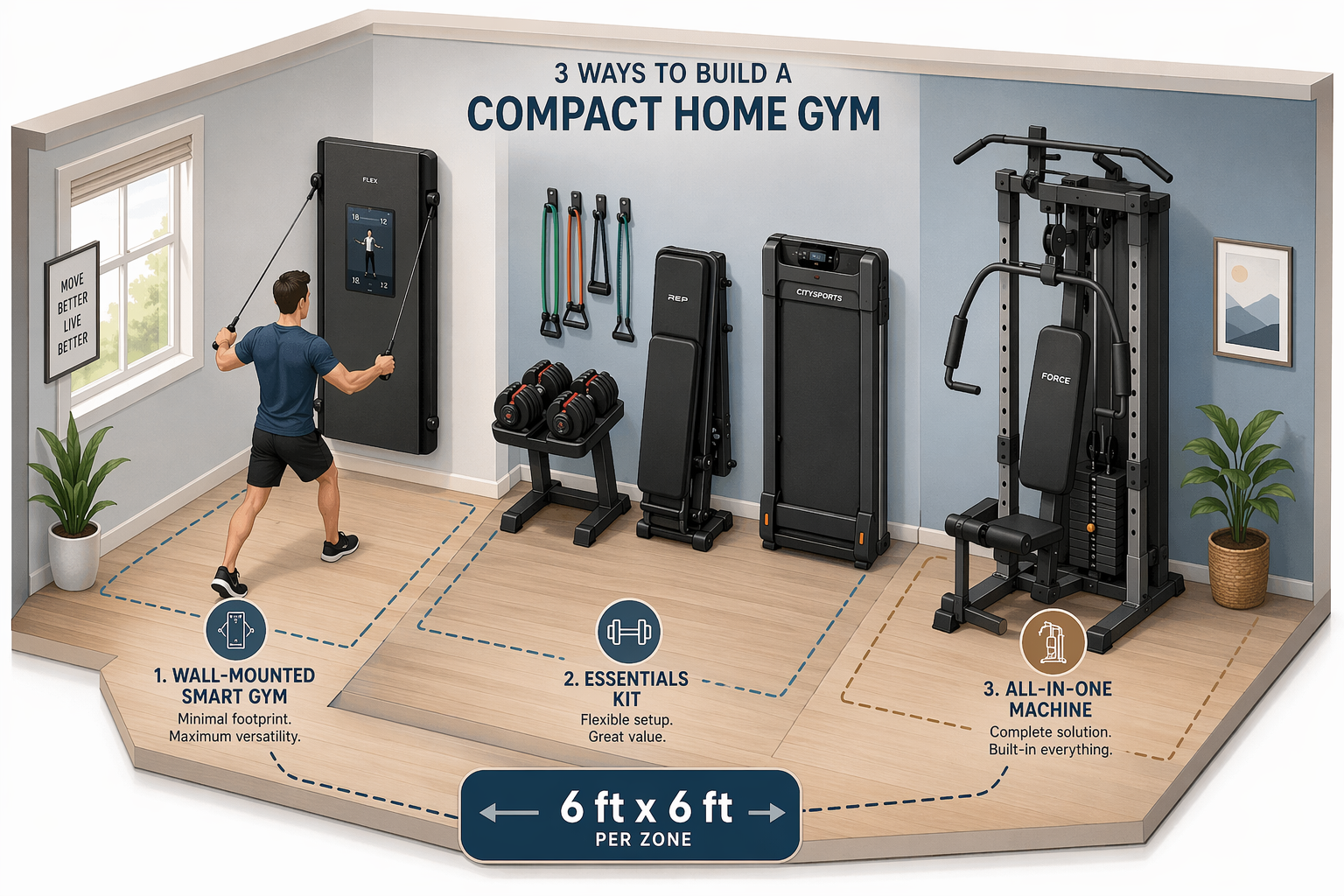
First is the equipment footprint — the physical dimensions of the machine or rack when installed. A wall-mounted smart gym like the Tonal 2 has a footprint of just 5.25 inches deep by 21.5 inches wide by 50.9 inches tall. That's tiny. But the second measurement — the clearance zone — is where things get tricky. The Tonal 2 requires a full 7 feet by 7 feet of clear space around the unit to perform cable exercises safely. That's 49 square feet of usable floor area that can't have furniture, a yoga mat, or a storage rack in it. Many buyers see the slim wall footprint and assume the gym will fit in a corner of their bedroom, only to discover they can't open their closet door while using it.
| Measurement Type | What It Means | Example: Tonal 2 | Example: PRx Profile PRO |
|---|---|---|---|
| Equipment footprint | The physical dimensions of the unit itself | 5.25" D x 21.5" W x 50.9" H | Folds to 12" wall depth |
| Clearance zone | Open space needed to use the equipment safely | 7 ft x 7 ft (49 sq ft) | Varies by exercise; typically 4 ft x 6 ft |
| Storage footprint | Space taken when not in use (if foldable) | N/A (permanent mount) | 12" wall depth when folded |
The third measurement is the storage footprint — how much space the equipment occupies when not in use. This matters most for foldable or portable gear. The PRx Profile PRO Squat Rack, for example, folds to just 12 inches of wall depth when stored, making it viable for a garage where you also park a car. A folding bench like the Ironmaster Super Bench Pro V2 stores at 50.5 inches long by 21 inches wide by 16.9 inches high — roughly the size of a small end table.
For a deeper look at how different equipment types handle these three space dimensions, including wall-mounted racks, all-in-one machines, and minimalist setups, read our Four Strategies for a Compact Home Gym comparison.
Question 2: Do You Live Above or Below Someone?
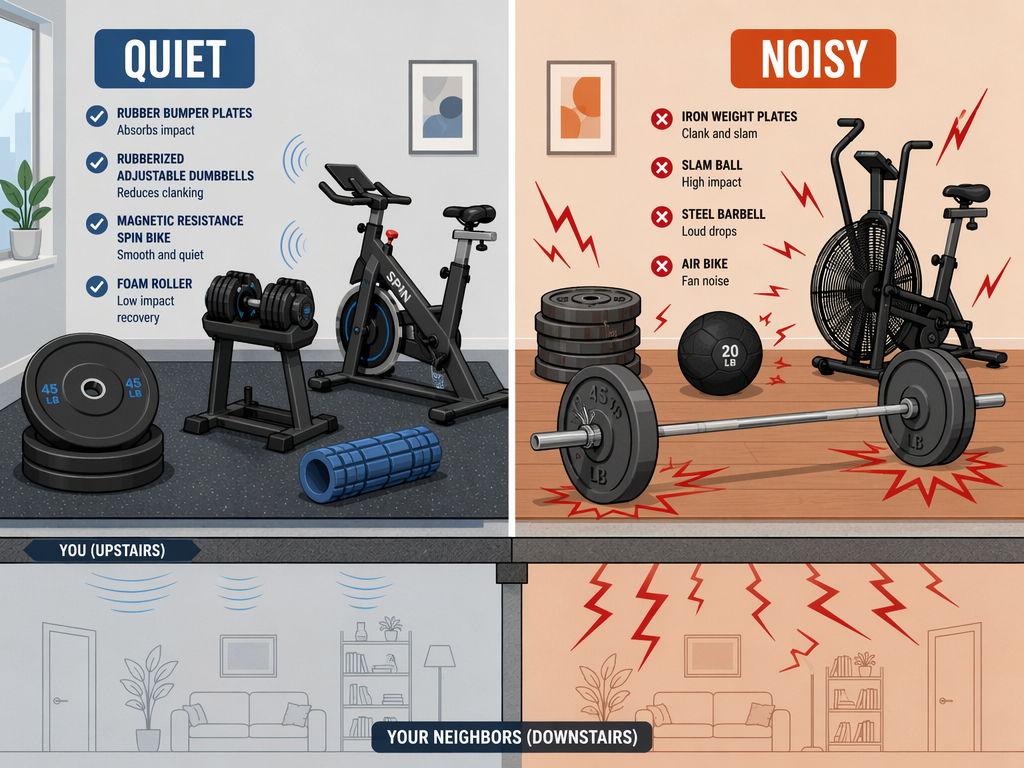
Noise is the single most overlooked constraint in compact home gym planning, and it's the one that causes the most neighbor complaints, lease violations, and abandoned equipment. The problem isn't just volume — it's the type of noise. A loud but consistent sound, like a magnetic resistance bike's fan, is far less disruptive than the sudden thud of a dropped barbell or the percussive slam of a medicine ball.
If you live in an apartment, condo, or any shared-wall dwelling, your equipment choices need to be drop-tolerant and vibration-minimizing. Rubber bumper plates, rubberized adjustable dumbbells, and magnetic-resistance cardio machines are your friends. Iron plates, slam balls, air bikes (like the Concept2 RowErg, which uses air resistance and can be loud), and heavy Olympic lifts are likely out of the question unless you have a ground-floor unit with concrete subfloors.
| Equipment Type | Noise Profile | Neighbor-Friendly? | Best For |
|---|---|---|---|
| Rubber bumper plates | Muffled thud on drop | Yes (with deadlift mat) | Strength training in apartments |
| Rubberized adjustable dumbbells (e.g., REP QuickDraw) | Minimal clank, drop-tested | Yes | General strength, small spaces |
| Magnetic resistance bike | Quiet whir, consistent | Yes | Cardio in shared walls |
| Air resistance rower (e.g., Concept2) | Loud whoosh, variable | Moderate (can be loud) | Cardio, ground floor preferred |
| Iron plates / steel barbell | Loud clang on drop | No | Garage gyms only |
| Slam ball | Loud percussive thud | No | Garage or outdoor use |
Flooring matters almost as much as the equipment itself. A 3/8-inch rubber mat (often called stall mats) can dampen vibration and protect your floors, but it won't eliminate the sound of a dropped iron plate. For upstairs apartments, even rubberized dumbbells should be set down gently rather than dropped. The REP Fitness guide for apartment dwellers explicitly notes that plyometrics and heavy Olympic lifts may be out of the question for upstairs apartments.
Question 3: What Training Style Do You Actually Enjoy?
This question cuts deeper than it seems. Most beginners pick equipment based on what they think they should do — heavy squats, deadlifts, bench press — rather than what they actually look forward to doing. The result is a gym that collects dust because the workouts feel like a chore.
Your training preference dictates your equipment type more than your budget does. A person who loves high-intensity interval training (HIIT) will get far more use out of a magnetic resistance bike and a set of adjustable dumbbells than a power rack and barbell. Someone who enjoys slow, controlled strength work will be miserable on an air bike and thrilled with a wall-mounted rack and weight stack.
- Strength training (squats, presses, rows): Look for a wall-mounted rack or a compact all-in-one with a weight stack. Adjustable dumbbells and a sturdy bench are non-negotiable.
- HIIT / metabolic conditioning: Prioritize a magnetic resistance bike, a jump rope, and a set of rubberized adjustable dumbbells. Avoid equipment with long setup transitions.
- General fitness / bodyweight: A folding bench, resistance bands, and a pull-up bar may be all you need. Smart gyms with guided programming can add structure.
- Cardio / endurance: A magnetic resistance bike or a compact rower that stores upright (like the Concept2 RowErg) fits small spaces. Noise considerations apply.
- Bodybuilding / hypertrophy: Adjustable dumbbells up to 60-80 lbs, a bench with 1,000 lb capacity, and a cable attachment or resistance bands for isolation work.
If you're not sure what you enjoy, start with the most versatile setup: a pair of adjustable dumbbells (like the REP QuickDraw, which replaces up to 12 pairs of fixed dumbbells) and a quality bench. That combination supports strength, HIIT, and general fitness with minimal space and maximum flexibility.
Question 4: How Much Weight Resistance Do You Realistically Need?
Beginners consistently overestimate the resistance they need and underestimate how quickly they'll outgrow it. A set of adjustable dumbbells that goes up to 60 pounds per hand will cover the vast majority of exercises for most people for at least one to two years of consistent training. The REP QuickDraw adjustable dumbbells, starting at $335.99 for a 5-60 lb pair, are a strong example of this sweet spot — they replace up to 12 pairs of fixed dumbbells, are drop-tested, and carry a lifetime warranty.
For bench and squat movements, the bench itself needs to handle far more weight than you'll ever lift. The Ironmaster Super Bench Pro V2 ($499) supports 1,000 pounds in the flat position and 600 pounds in the incline position, with a storage footprint of 50.5 inches long by 21 inches wide by 16.9 inches high. That's a compact footprint that doesn't compromise on capacity — you won't need to upgrade the bench even if you eventually move to a garage gym setup with a barbell.
| Resistance Range | Who It Serves | Example Product | Approximate Cost |
|---|---|---|---|
| 5-60 lbs per hand | Most beginners, 1-2 years of training | REP QuickDraw Adjustable Dumbbells | $335.99 |
| 10-125 lbs per hand | Intermediate to advanced lifters | REP x Pépin FAST Series Dumbbells | $500+ |
| Up to 210 lbs total (power rods) | General strength, upper body focus | Bowflex Xtreme 2 SE | $1,499 |
| Up to 250 lbs total (digital) | Full body, guided programming | Tonal 2 | $3,545 (on sale) |
| Up to 220 lbs per side (weight stack) | Serious strength, cable exercises | REP Athena wall-mounted cable system | $1,500+ |
Question 5: Do You Want Guided Programming or Self-Directed Training?
This is a personality question as much as a practical one. Some people thrive with a coach in their ear telling them what to do next. Others prefer to design their own workouts and move at their own pace. The equipment you choose should match your preferred mode, because the wrong match leads to abandonment.
- Guided programming seekers: Smart gyms like the Tonal 2 ($4,295, on sale for $3,545) and Speediance Gym Monster ($3,199) offer app-guided workouts with automatic resistance adjustment, rep counting, and progress tracking. They require ongoing subscriptions — Tonal's membership is $59.95 per month, and Speediance's is $49 per month. The tradeoff is convenience and structure at a recurring cost.
- Self-directed trainers: A modular setup — adjustable dumbbells, a quality bench, and a wall-mounted rack or cable system — gives you complete control over your programming. There's no subscription, no screen telling you what to do, and no dependency on a company's app ecosystem. The tradeoff is that you need to know (or learn) how to structure your own workouts.
- Hybrid approach: You can pair a self-directed setup with a standalone fitness app (like those compared in our Fitness Apps section) for programming without being locked into a specific hardware subscription.
For a deeper comparison of smart versus traditional equipment, including subscription costs and long-term value, see our Smart Compact Home Gyms vs. Traditional Strength Equipment article.
Question 6: What's Your True All-In Budget (Including Accessories and Subscriptions)?
The price tag on the equipment is only the beginning. The average home gym costs $1,855 according to Garage Gym Reviews, but that figure includes everything — equipment, accessories, flooring, storage, and often a subscription. If you only budget for the main piece of gear, you'll be caught off guard by the hidden costs that turn a $500 setup into a $900 reality.
| Cost Category | Typical Range | Notes |
|---|---|---|
| Main equipment (dumbbells, bench, rack) | $300 - $4,295 | Widest range; depends on type and brand |
| Accessories (mats, clips, straps, bands) | $50 - $200 | Often overlooked; essential for safety and floor protection |
| Storage (dumbbell stand, wall hooks, plate tree) | $50 - $300 | Required for organization; prevents clutter |
| Shipping and assembly | $0 - $250 | Heavy items (weight stacks, racks) often have significant shipping costs |
| Subscription (if smart gym) | $49 - $60/month | Recurring cost; $588-$720/year |
| Total first-year cost (no subscription) | $400 - $1,500 | Realistic range for a quality modular setup |
| Total first-year cost (with smart gym subscription) | $1,000 - $5,000+ | Includes equipment, subscription, and accessories |
If your budget is tight, start with the essentials: a pair of adjustable dumbbells (like the REP QuickDraw at $335.99), a quality bench (like the Ironmaster Super Bench Pro V2 at $499), and a 3/8-inch rubber mat ($30-$60). That's roughly $900 for a setup that covers strength, HIIT, and general fitness with no subscription. You can add a wall-mounted rack or cable system later as your budget allows.
Question 7: How Important Is Portability and Storage?
If you rent, move frequently, or share your living space with others, portability isn't a nice-to-have — it's a requirement. A wall-mounted rack that bolts into studs is a permanent installation that you'll have to patch and paint when you move. A folding bench and a set of adjustable dumbbells that fit in a closet can move with you anywhere.
| Equipment | Portability | Storage Footprint | Stability Tradeoff |
|---|---|---|---|
| PRx Profile PRO Squat Rack ($1,099) | Low (wall-mounted, bolts into studs) | Folds to 12" wall depth | Very stable; 1,000 lb capacity |
| Ironmaster Super Bench Pro V2 ($499) | High (folds, carries like a suitcase) | 50.5" L x 21" W x 16.9" H | Stable; 1,000 lb flat capacity |
| REP QuickDraw Adjustable Dumbbells ($335.99) | High (cradle is 1.2 sq ft) | 1.2 sq ft cradle | Stable; drop-tested |
| Tonal 2 ($4,295) | Very low (permanent wall mount) | 5.25" D x 21.5" W x 50.9" H | Very stable; bolted to wall |
| Concept2 RowErg ($990) | High (57 lbs, stores upright) | Upright storage, ~4 sq ft | Stable; can tip if not stored properly |
The tradeoff is usually between portability and stability. A wall-mounted rack is rock-solid but immovable. A folding bench and adjustable dumbbells are highly portable but may not feel as substantial during heavy lifts. For most beginners, the portability of a modular setup outweighs the stability advantage of a permanent installation — especially in the first year, when you're still figuring out your training preferences and living situation.
Question 8: Do You Plan to Add More Gear Later?
This is the question that separates a smart purchase from a regrettable one. Some compact home gym systems are designed to grow with you; others are dead ends. A modular setup — a wall-mounted rack, adjustable dumbbells, a quality bench — allows you to add pieces incrementally: a cable attachment, a barbell and plates, a rower, a storage solution. Each addition expands your capabilities without requiring you to scrap your existing gear.
All-in-one machines, by contrast, are harder to expand. The Bowflex Xtreme 2 SE ($1,499) offers over 70 exercise combinations and 210 pounds of resistance (upgradable to 410 pounds), but you're locked into the Bowflex ecosystem. If you outgrow the resistance or want to do barbell squats, you can't just add a rack — you'd need to replace the entire machine. Smart gyms like the Tonal 2 have a similar limitation: the digital resistance maxes out at 250 pounds, and there's no way to add a barbell or cable system later.
- Modular setups (wall rack + adjustable dumbbells + bench): Highly expandable. Add a cable system, barbell, plates, rower, or storage as budget and space allow. Best for long-term growth.
- All-in-one machines (weight stack or power rod): Limited expandability. You're locked into the manufacturer's ecosystem. Best for users who want a single, complete solution and don't plan to outgrow it.
- Smart gyms (digital resistance): No expandability. The resistance range is fixed. Best for users who value guided programming over long-term flexibility.
If you're unsure whether you'll want to add gear later, lean toward a modular setup. The REP Fitness PR-5000 wall rack, for example, can be configured with the wall-mounted Athena dual cable system (weight stacks up to 220 lbs per side) or the Ares 2.0 (260 lbs per side, upgradable to 310 lbs). You can start with just the rack and add the cable system later — no need to buy a new machine.
Your Compact Home Gym Cheat Sheet: Match Your Answers to the Right Approach
By now you've answered eight questions about your space, noise tolerance, training preferences, resistance needs, programming style, budget, portability requirements, and growth plans. Here's how to translate those answers into a starting point.
| Your Profile | Key Answers | Best Starting Point | Next Step |
|---|---|---|---|
| Apartment renter with noise concerns | Q2: Live above someone. Q7: Need portability. Q8: May move within 2 years. | Adjustable dumbbells + folding bench + resistance bands + magnetic resistance bike | Read the Renter's Guide for noise-proofing and no-mount solutions. |
| Garage owner with space for a rack | Q1: 6 ft x 8 ft available. Q2: No neighbors below. Q4: Want to lift heavy eventually. | Wall-mounted rack (PRx or REP) + barbell + bumper plates + adjustable bench | Explore the Four Strategies article for wall rack vs. all-in-one comparison. |
| Budget-conscious beginner (under $1,000) | Q6: Total budget under $1,000. Q3: Not sure about training style. Q5: Prefer self-directed. | REP QuickDraw adjustable dumbbells ($335.99) + Ironmaster Super Bench Pro V2 ($499) + rubber mat ($40) | Check the Budget Builds article for complete setups at $500, $1,500, and $3,000. |
| Guided programming seeker with higher budget | Q5: Want app-guided workouts. Q6: Budget over $3,000. Q1: Have 7 ft x 7 ft clearance. | Tonal 2 ($3,545 on sale) or Speediance Gym Monster ($3,199) | Read the Smart vs. Traditional article for subscription cost analysis. |
| Minimalist / general fitness | Q3: General fitness. Q7: Need portability. Q8: Not planning to add gear. | Adjustable dumbbells (5-60 lbs) + folding bench + pull-up bar + resistance bands | Browse the Workout Routines section for bodyweight and dumbbell workouts. |
The compact home gym market is full of excellent products. The challenge isn't finding good gear — it's finding the gear that's good for you. By working through these eight questions, you've already done the hard part. Now go explore the options that fit your constraints.
Some links on this page are affiliate links — they may earn us a commission at no extra cost to you. Our tier and tests are decided before we ever check which links pay; see our full affiliate disclosure.
Spot something off?
Noise and floor-damage claims carry real deposit-risk consequences if we get them wrong — tell us if your experience with this build didn't match what's above.