
Compact Home Gym Budget Builds: Complete Setups at $500, $1,500, and $3,000
Building a home gym in a small space doesn't have to break the bank. This guide provides three complete, ready-to-buy equipment systems at specific budget tiers — $500, $1,500, and $3,000 — with exact product picks and pricing for apartment dwellers and small-space owners.
- Budget tier
- $500–$1,500
- Space type
- apartment
Items included: —
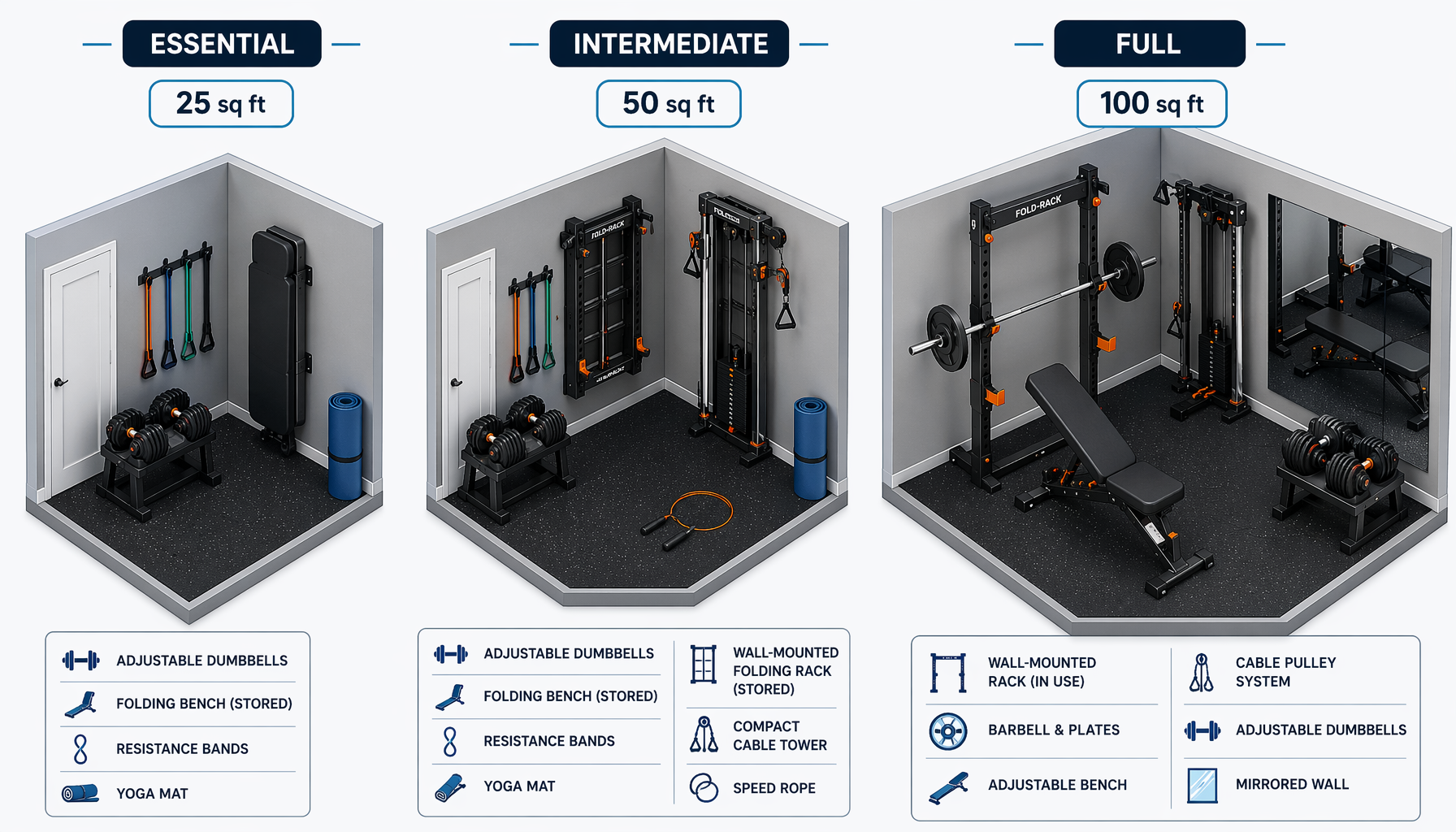
Why Budget Is Your Second Constraint After Space
When you live in an apartment or a small home, square footage is the first filter on what equipment you can realistically own. The second filter — and the one that determines the character of your gym — is budget. A $500 setup looks fundamentally different from a $1,500 setup, and a $3,000 setup unlocks capabilities that neither of the lower tiers can touch. The equipment mix doesn't just scale up linearly; it changes in kind.
This guide presents three complete, ready-to-buy equipment systems at specific price points — $500, $1,500, and $3,000 — with exact product picks and current pricing. Each build is designed for a compact footprint, prioritizing versatility per square foot and noise considerations for shared-wall living. The goal is to give you a concrete shopping list, not a set of vague recommendations.
For context, Garage Gym Reviews tested over 50 home gym machines and found the average price across all tested units to be $1,855. That figure includes everything from budget-friendly cable towers to premium wall-mounted racks, which means a well-planned $1,500 build sits comfortably below the average while still delivering a complete strength-training experience.
The $500 Compact Home Gym Build (~$524)
At the entry-level tier, you cannot afford a bench, a barbell, or a cable machine. The strategy is to invest almost the entire budget in one high-quality, space-efficient tool — adjustable dumbbells — and fill the gaps with accessories that cost very little and store in a drawer.
| Item | Price | Role |
|---|---|---|
| QuickDraw 5-50 lbs Adjustable Dumbbells | $449 | Primary resistance for all upper-body and lower-body exercises |
| Resistance Bands (set of 5-6 bands) | $50 | Adds variable resistance for pull-ups, rows, and banded presses |
| Yoga Mat (73" x 27.5") | $25 | Floor protection, core work, stretching, and band exercises |
| Total | ~$524 |
The QuickDraw 5-50 lbs dumbbells are the centerpiece. They replace 12 pairs of fixed dumbbells in a footprint roughly the size of a small end table. With 50 lbs per hand, you can perform goblet squats, lunges, rows, presses, and curls — enough resistance for most beginners and intermediates to make consistent strength gains for a year or more.
Resistance bands fill the gaps that dumbbells cannot cover. A set of bands with varying tension levels lets you simulate pull-downs, banded push-ups, and assisted pull-ups (if you have a door anchor or sturdy hook). They also work well for warm-up activation and mobility drills. The yoga mat protects your floor from dropped dumbbells and provides a non-slip surface for floor exercises.
The $1,500 Compact Home Gym Build (~$1,378)
The mid-tier build is where a compact home gym starts to feel complete. The addition of a proper bench and a cable tower unlocks dozens of exercises that are impossible with dumbbells alone, while keeping the total footprint under 20 square feet.
| Item | Price | Role |
|---|---|---|
| QuickDraw 5-60 lbs Adjustable Dumbbells | $499 | Primary free-weight resistance; 60 lbs per hand handles most exercises |
| REP Nighthawk Adjustable Bench | $399 | Flat, incline, and decline pressing; stores upright in 1.8 sq ft |
| Bells of Steel Cable Tower (Plate-Loaded) | $434.99 | Cable crossovers, lat pulldowns, rows, tricep pushdowns, face pulls |
| Speed Rope | $20 | Cardio and conditioning in minimal space |
| Floor Mats (4-pack, 24 sq ft) | $25 | Floor protection, noise dampening, equipment stability |
| Total | ~$1,378 |
The QuickDraw 5-60 lbs version adds 10 lbs per hand over the entry-level set, which matters for exercises like rows, deadlifts (dumbbell), and overhead pressing. The REP Nighthawk bench is a space-saver: it stores upright, occupying only 1.8 square feet of floor space when not in use, and adjusts to multiple angles for flat, incline, and decline pressing.
The Bells of Steel Cable Tower (plate-loaded version, starting at $434.99) is the most affordable way to add cable resistance to a compact gym. Its footprint is 31" deep by 28.5" wide by 80.75" tall — roughly the size of a tall bookshelf. With a cable tower, you can perform lat pulldowns, seated rows, tricep pushdowns, cable crossovers, and face pulls, which target muscles that are difficult to reach with dumbbells alone. The plate-loaded version requires you to supply your own weight plates (not included in this build), but you can use the QuickDraw dumbbells as plate substitutes if you have a loading pin.
Floor mats serve a dual purpose: they protect your floor from dropped weights and dampen noise for neighbors below. For apartment dwellers, this is not optional — it is the difference between a gym that works and one that generates complaints.
The $3,000 Compact Home Gym Build (~$2,997)
At the premium tier, you can build a gym that rivals a commercial facility in capability while occupying less than 15 square feet of floor space. The key is a wall-mounted folding rack that disappears when not in use, combined with high-end adjustable dumbbells and a bench that supports heavy loads.
| Item | Price | Role |
|---|---|---|
| PRx Profile PRO Wall-Mounted Rack | $1,099 | Full squat rack with pull-up bar; folds to 4" from the wall |
| REP x PÉPIN FAST 5-85 lbs Adjustable Dumbbells | $899 | Fast-change dumbbells up to 85 lbs; 18.3" length |
| REP BlackWing Adjustable Bench | $599 | Heavy-duty bench for flat, incline, and decline pressing |
| Barbell + Weight Plates (bumper or iron) | ~$400 | Barbell exercises: squats, deadlifts, bench press, rows |
| Total | ~$2,997 |
The PRx Profile PRO rack is the centerpiece. It mounts to the wall and folds down when you need it, then folds back up to a depth of 4 inches from the wall — essentially a shelf when not in use. It has a 1,000-lb weight capacity, which is more than enough for any home lifter, and includes a pull-up bar. When folded, it takes up virtually no floor space, making it ideal for a living room corner or a narrow hallway.
The REP x PÉPIN FAST adjustable dumbbells go up to 85 lbs per hand and are only 18.3 inches long, which means they clear your knees during dumbbell deadlifts and rows — a common problem with longer adjustable dumbbells. The REP BlackWing bench supports heavy loads and adjusts to multiple angles, including a decline position for abdominal work.
A barbell and weight plates round out the build. With a rack, a barbell, and a bench, you can perform the full Big Three — squat, bench press, and deadlift — plus overhead press, rows, and pull-ups. This is the most versatile and time-efficient setup for strength training, and it fits in a space as small as 8 feet by 6 feet.
Home Gym vs. Gym Membership: The Break-Even Math
The most common objection to building a home gym is upfront cost. But when you compare the one-time equipment investment to the ongoing cost of a gym membership, the math shifts dramatically. According to the 2024 U.S. Health & Fitness Consumer Report cited by Garage Gym Reviews, the average gym membership costs roughly $65 per month.
| Build Tier | Upfront Cost | Monthly Cost | Break-Even vs. $65/mo Gym |
|---|---|---|---|
| $500 Build | ~$524 | $0 | ~8 months |
| $1,500 Build | ~$1,378 | $0 | ~21 months (1.8 years) |
| $3,000 Build | ~$2,997 | $0 | ~46 months (3.8 years) |
A $3,000 home gym pays for itself in under 4 years. If you factor in the time saved by not commuting to the gym (average 20-30 minutes round trip), the convenience of training at any hour, and the elimination of membership price hikes, the value proposition becomes even stronger. The $500 build breaks even in under a year, and the $1,500 build in under two years.
Where to Spend and Where to Save at Each Tier
Within each budget, some components matter more than others. Here is how to prioritize spending at each tier.
At $500: Spend on the Dumbbells, Save on Everything Else
The adjustable dumbbells are the only piece of equipment that directly determines how much weight you can lift. Spending $449 on the QuickDraw 5-50 lbs set leaves only $75 for everything else, which is why the remaining items are resistance bands and a yoga mat. Do not compromise on the dumbbells — a cheap set with poor weight-change mechanisms or loose handles will frustrate you and collect dust.
- Spend on: Adjustable dumbbells with a smooth, fast weight-change mechanism (QuickDraw, PowerBlock, or NÜOBELL).
- Save on: Resistance bands (generic sets from Amazon or Fringe Sport are fine), yoga mat (any 73" x 27.5" mat under $30 works), and floor mats (interlocking foam tiles from Amazon Basics cost under $25 for 24 sq ft).
At $1,500: Invest in the Bench and Cable Tower
The bench and cable tower are the two items that expand your exercise library the most. A cheap bench with wobbly legs or limited angle adjustments will limit your pressing and rowing options. The REP Nighthawk stores upright in 1.8 square feet, which is a meaningful space-saving feature for apartment dwellers.
- Spend on: A sturdy, adjustable bench with a small storage footprint (REP Nighthawk or similar) and a cable tower that fits your space (Bells of Steel plate-loaded version at $434.99 is the best value).
- Save on: Speed rope (any $10-20 speed rope works), floor mats (interlocking tiles are fine), and the dumbbells (the QuickDraw 5-60 lbs at $499 is already a value pick).
At $3,000: The Rack and Barbell Are the Foundation
The wall-mounted rack and barbell are the core of a serious strength-training setup. The PRx Profile PRO rack at $1,099 is the most space-efficient option on the market, folding to 4 inches from the wall. The barbell and plates are your primary resistance tools — do not buy a cheap barbell that bends under load.
- Spend on: A wall-mounted folding rack with a high weight capacity (PRx Profile PRO or REP PR-5000 wall-mounted), a quality barbell (REP Colorado Bar or similar), and a heavy-duty bench (REP BlackWing).
- Save on: Weight plates (bumper plates from a reputable brand are fine; you do not need the most expensive calibrated plates), and the dumbbells (the REP x PÉPIN FAST at $899 is already a premium pick).
Financing Options and Sales Timing
If the upfront cost of a $1,500 or $3,000 build feels steep, several financing options can spread the cost over time without interest, provided you pay within the promotional period.
- Affirm and PayPal Credit: Many major fitness retailers (REP Fitness, Rogue, Bells of Steel) offer buy-now-pay-later options through Affirm or PayPal Credit. Typical terms are 6-12 months with 0% APR if paid in full within the period.
- Holiday sales: The best time to buy home gym equipment is during Black Friday (November), New Year sales (January), and Memorial Day (May). Discounts of 10-20% are common on racks, benches, and dumbbells. Plan your build around these windows to save $100-300.
- Used and refurbished equipment: Facebook Marketplace, Craigslist, and OfferUp are excellent sources for used barbells, plates, and racks. Weight plates in particular hold their value poorly on the used market — you can often find them for $0.50-0.75 per pound. Inspect barbells for bent shafts and rust before buying.
A final note on timing: if you are building a $3,000 gym, waiting three months for a Black Friday sale could save you $300-500, which effectively covers the cost of your barbell and plates. Patience pays off at the higher tiers.
Some links on this page are affiliate links — they may earn us a commission at no extra cost to you. Our tier and tests are decided before we ever check which links pay; see our full affiliate disclosure.
Spot something off?
Noise and floor-damage claims carry real deposit-risk consequences if we get them wrong — tell us if your experience with this build didn't match what's above.