
The Renter's Guide to a Compact Home Gym: Solving Noise, Space, and No-Mount Constraints
Most home gym advice assumes you own the walls and the floor. This guide is for apartment renters who can't drill into walls, have downstairs neighbors, and need equipment that disappears between workouts. We cover the three real barriers—structural, acoustic, and storage—and recommend specific products that actually work within them.
- Budget tier
- $300–$1,000
- Space type
- apartment
Items included: —
Why Most Home Gym Advice Fails Apartment Renters
Nearly 39 million Americans live in apartments, according to data from the National Apartment Association. That is a massive population of people who want to work out at home but face a set of constraints that the typical home gym article simply does not address. Scroll through any "best compact home gym" listicle and you will find recommendations for wall-mounted squat racks, plate-loaded all-in-one machines, and smart gyms that require a 7x7 ft clear zone — all of which assume you own the walls, own the floor, and have a permanent space to dedicate.
If you rent an apartment, those assumptions break down immediately. You cannot drill into concrete or studs for a wall-mounted rack without risking your security deposit. Dropping a 45-pound plate on a fourth-floor living room floor will produce a sound that travels through the building structure like a drum hit. And the idea of dedicating a whole room — or even a permanent corner — to gym equipment is a luxury most renters do not have.
The Three Renter Constraints: Structural, Acoustic, and Storage
Before looking at any product, you need to understand the three specific barriers that define whether a piece of equipment will actually work in your apartment. Each one has a different failure point, and a product that solves only one or two of them may still leave you with a problem.
Structural Constraints
Most serious strength equipment assumes you can attach it to a wall or ceiling. Power racks, wall-mounted pull-up bars, cable towers, and smart gyms like the Tonal 2 all require drilling into studs. In many apartment leases, any modification to walls, ceilings, or floors is prohibited. Even if your lease allows it, the construction of apartment walls — often thin drywall over metal studs — may not safely support the dynamic loads of a heavy workout. The PRx Profile PRO Squat Rack, for example, folds to just 9 inches deep but requires wall mounting. For renters, that is a non-starter.
Acoustic Constraints
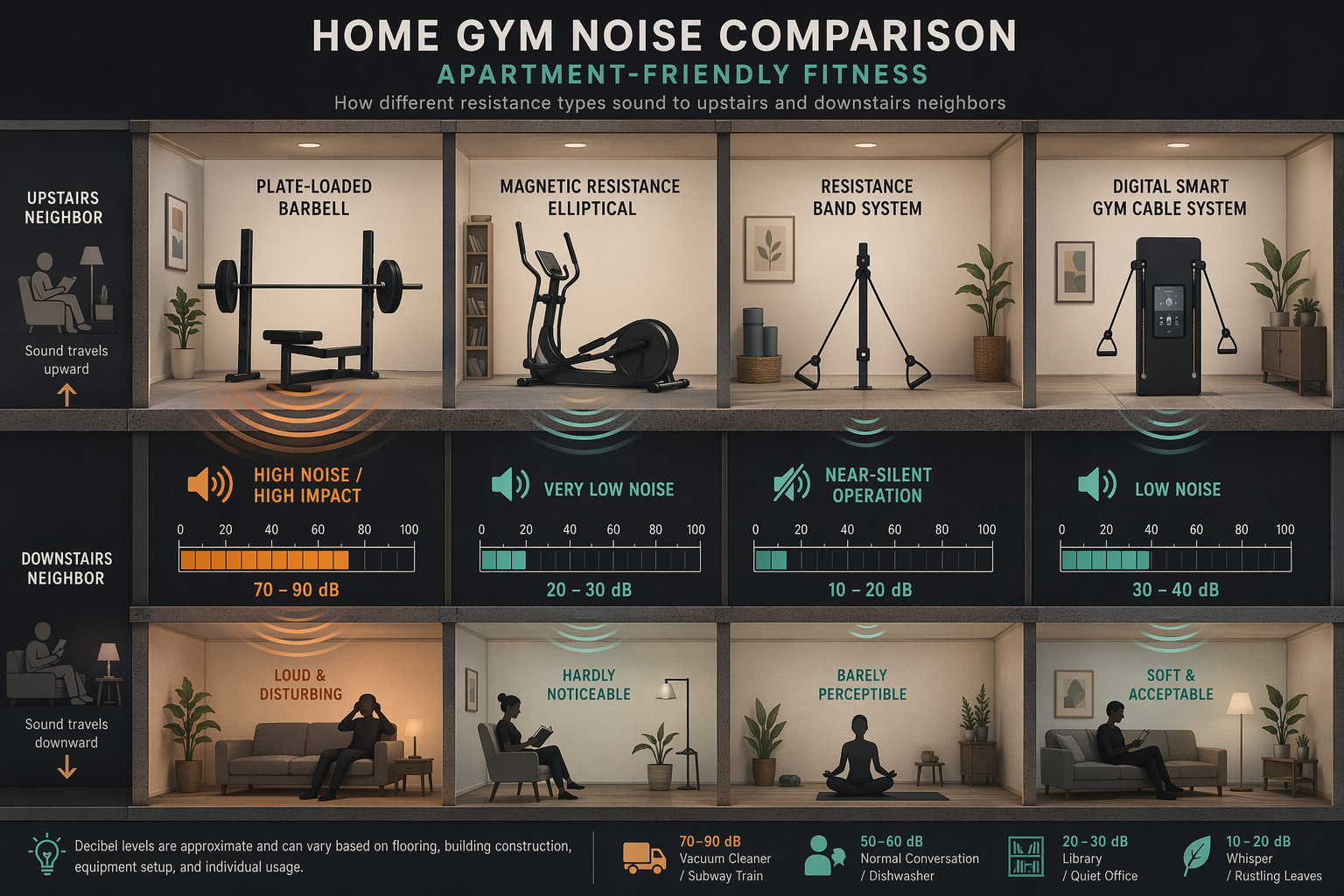
Noise transmission is the most underestimated barrier for upstairs apartments. The problem is not just the volume of the equipment itself — it is how sound travels through building structures. Impact noise (a weight hitting the floor, a machine vibrating against the subfloor) transmits through joists and into the unit below far more effectively than airborne noise. A treadmill, even with a mat, produces rhythmic thumping that can be heard two floors down. Dropping a barbell with bumper plates on a concrete garage floor is fine; doing the same on a wood-frame apartment floor will generate complaints within days.
Storage Constraints
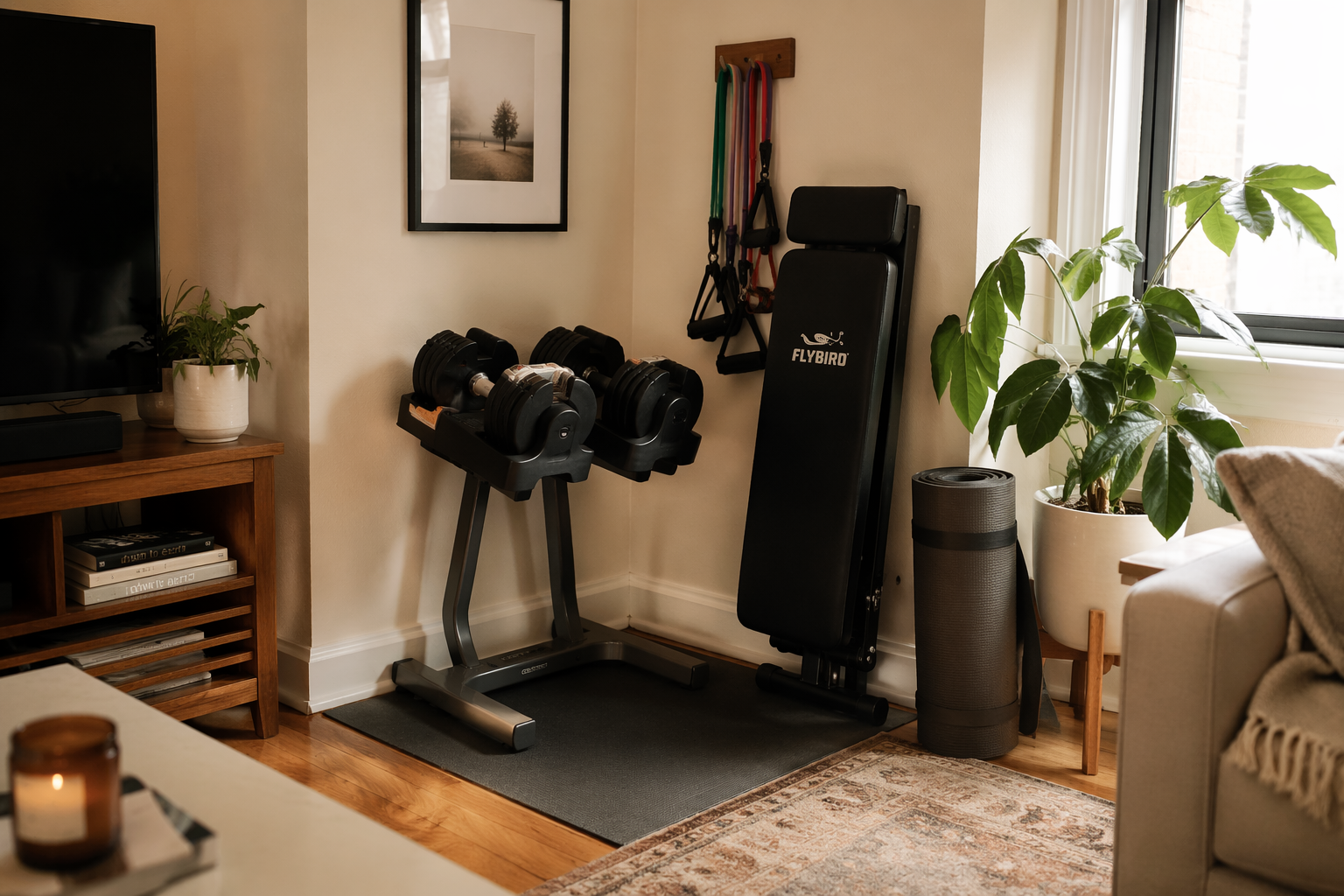
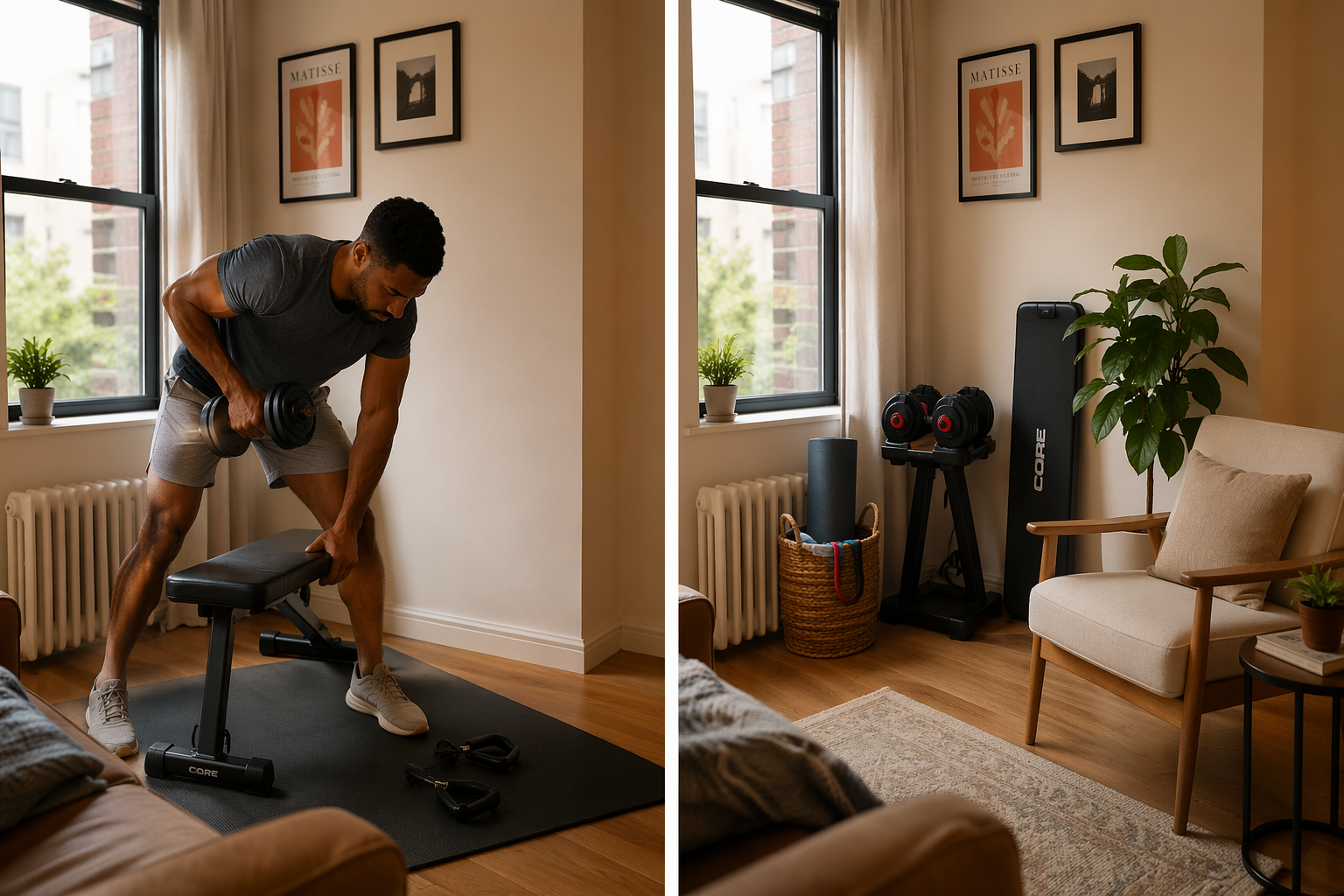
Most apartment rooms serve multiple purposes. A living room is also a dining room, a workspace, and sometimes a guest room. Gym equipment that occupies a permanent footprint — even a compact one — forces you to choose between having a workout space and having a usable living room. The solution is equipment that can be stored away completely between sessions: adjustable dumbbells that sit on a small stand, a folding exercise bike that slides into a closet, or a band-based system that fits under a bed.
- Structural: No wall-mounting, no ceiling anchors, limited electrical access near workout zones.
- Acoustic: Impact noise travels through floors; vibration from machines disturbs downstairs neighbors.
- Storage: Equipment must be storable in a closet, under a bed, or against a wall in a multi-use room.
Noise Comparison: Which Resistance Types Are Quietest for Upstairs Apartments?
Not all resistance types produce the same noise profile. The table below ranks the four main categories by their impact on apartment living, based on product testing data and user reports from independent reviewers.
| Resistance Type | Noise Level | Impact Noise | Vibration Transfer | Best For |
|---|---|---|---|---|
| Band-based (X3 Bar, resistance bands) | Very low | None — no weight drop | Minimal | Upstairs apartments, shared walls |
| Magnetic (Niceday Elliptical, LEIKE bike) | Low | None — smooth rotation | Low | Cardio in multi-story buildings |
| Digital (Tonal 2, Speediance Gym Monster) | Low to moderate | None — cable-based | Low | Renters with 7x7 ft clearance |
| Plate-loaded (barbells, dumbbells, all-in-one machines) | High | High — dropping plates | High | Garages, ground-floor units |
Band-based systems like the X3 Bar ($549, up to 300 lbs resistance) are the quietest heavy-resistance option because they use bands instead of weight plates. There is no slamming, no clanging, and no impact noise. The bar itself weighs only 17–19 lbs and measures 10 inches long by 19 inches wide by 1 inch high — it can be stored under a couch or a yoga mat. Independent testers at Garage Gym Reviews noted that the X3 Bar is "the best equipment for upstairs apartments" precisely because it eliminates the noise problem entirely.
Magnetic resistance equipment, such as the Niceday Elliptical Machine (under $600, 400 lb user capacity, 106 lbs machine weight), produces virtually no impact noise. Testers reported being "shocked at just how quiet it was." The magnetic resistance mechanism creates smooth, silent motion, and the machine is battery-powered — no plug needed, which solves the electrical access constraint many renters face.
Renter-Friendly Equipment Categories: What to Look For
When you filter equipment through the three renter constraints, three clear categories emerge. Each category solves a different combination of the structural, acoustic, and storage problems.
No-Mount Solutions
These products require zero drilling, zero wall anchors, and zero permanent installation. They rely on doorways, floor stands, or body weight for stability. The Perfect Fitness Multi-Gym Doorway Pull Up Bar (under $40, 300 lb capacity) uses pressure against the door frame rather than screws. Resistance band systems with door anchors provide a full-body strength workout without any mounting. Free-standing options like the Bells of Steel Cable Tower (starting at $434.99, 31" D x 28.5" W x 80.75" H) offer cable-based training without wall attachment, though its footprint may be too large for very small apartments.
Quiet Resistance Types
Band-based and magnetic resistance systems are the only types that reliably avoid neighbor complaints in multi-story buildings. The X3 Bar and standard resistance band sets (like the Fringe Sport Latex-Free Strength Bands, set of 6 for $192, resistance 20–175 lbs) produce zero impact noise. Magnetic ellipticals and exercise bikes eliminate the rhythmic thumping that treadmills create. Digital resistance systems like the Speediance Gym Monster ($3,199, 220 lbs digital resistance) are also quiet during operation, but their space requirements and price point make them a niche option for renters with larger budgets and more floor space.
Foldable and Storeable Options
Equipment that can be reduced to a small footprint between workouts is the key to making a home gym work in a multi-use room. NÜOBELL Adjustable Dumbbells ($595, range 5–80 lbs) replace 16 or more pairs of fixed dumbbells and sit on a small stand. The LEIKE Exercise Bike (under $200) folds to 46" L x 16" W x 9" H and weighs only 38.5 lbs — it can be stored in a closet or against a wall. The Speediance Gym Monster folds from 49.21" deep to 14.96" deep, though it remains 72.83" tall and weighs 187 lbs.
Best Equipment for Each Constraint Axis
The following table maps specific products to the three renter constraints. Each product was selected because it solves at least two of the three barriers without introducing a new problem.
| Product | Price | Solves | Key Specs | Renter Verdict |
|---|---|---|---|---|
| X3 Bar | $549 | Acoustic, Storage | Up to 300 lbs resistance, 17–19 lbs, 10" L x 19" W x 1" H, band-based | Quietest heavy-resistance option; stores under a bed or yoga mat |
| NÜOBELL Adjustable Dumbbells | $595 | Storage | 5–80 lbs range, replaces 16+ pairs | Eliminates dumbbell rack; small stand footprint |
| Niceday Elliptical Machine | Under $600 | Acoustic, Structural | 400 lb capacity, 106 lbs, magnetic resistance, 15.5" stride, battery-powered | Ultra-quiet cardio; no plug needed |
| LEIKE Exercise Bike | Under $200 | Acoustic, Storage | Folds to 46" L x 16" W x 9" H, 38.5 lbs, 220 lb capacity | Budget-friendly; folds to closet size |
| Perfect Fitness Doorway Pull Up Bar | Under $40 | Structural | 300 lb capacity, no drilling required | Only viable pull-up option for renters |
| Fringe Sport Strength Bands (set of 6) | $192 | Acoustic, Storage | 20–175 lbs total resistance | Zero impact noise; fits in a drawer |
For readers who want to explore options across different price points, the best home exercise equipment for every budget guide provides a broader view of what is available from $200 to $2,500+.
Sample Apartment Setups: Studio, 1-Bedroom, and Shared-Wall Scenarios
The right setup depends on your specific apartment layout. Below are three common scenarios with equipment lists, total footprint estimates, noise mitigation strategies, and storage plans.
Studio Apartment (Under 500 sq ft)
In a studio, every square foot serves multiple purposes. The goal is equipment that can be completely stowed away.
- X3 Bar ($549) — stores under the bed or behind a couch.
- NÜOBELL Adjustable Dumbbells ($595) — sits on a 2 sq ft stand in a closet.
- Perfect Fitness Doorway Pull Up Bar (under $40) — installed in a closet doorway; removed when not in use.
- Amazon Basics Foam Interlocking Tiles ($25 for 24 sq ft) — laid out during workouts, stacked in a corner after.
Total workout footprint during use: approximately 4 ft x 6 ft. Stored footprint: approximately 2 sq ft for the dumbbell stand, plus the X3 Bar and bands in a drawer or under furniture. Noise mitigation: band-based resistance produces zero impact noise; foam tiles absorb any incidental floor contact.
1-Bedroom Apartment (500–800 sq ft)
A 1-bedroom gives you more flexibility. You can dedicate a corner of the living room or bedroom to equipment that stays set up, as long as it is visually unobtrusive and quiet.
- Niceday Elliptical Machine (under $600) — placed in a living room corner; battery-powered, no cord needed.
- NÜOBELL Adjustable Dumbbells ($595) — on a stand next to the elliptical.
- Fringe Sport Strength Bands (set of 6, $192) — stored in a drawer; used for warm-ups and accessory work.
- 1/4-inch rubber mat (approx. $40 for 4 ft x 6 ft) — under the elliptical to absorb vibration.
If you prefer cycling over elliptical training, the best exercise bikes for small spaces and apartments guide covers folding and low-footprint options that work well in this scenario.
Shared-Wall or Ground-Floor Apartment
If you are on the ground floor or have concrete subfloors, your acoustic constraints are significantly reduced. You can consider slightly heavier equipment, but structural and storage constraints still apply.
- X3 Bar ($549) — primary strength training.
- Niceday Elliptical Machine (under $600) — cardio.
- LEIKE Exercise Bike (under $200) — alternative cardio; folds flat when not in use.
- 1/2-inch rubber stall mats (approx. $50–$70 each) — under all equipment to protect floors and reduce residual vibration.
Even on the ground floor, avoid plate-loaded barbell setups and slam-based cardio. The noise may not travel downward, but it will travel laterally through shared walls to adjacent units.
What to Avoid: Equipment That Doesn't Work in Apartments
Some equipment categories are fundamentally incompatible with apartment living. Knowing what to skip is as important as knowing what to buy.
- Plate-loaded all-in-one machines. Machines like the Bowflex PR1000 (103" L x 80" W x 82" H) or the Body-Solid series require significant floor space and produce impact noise every time you rack a weight. They are designed for garages and basements, not second-floor apartments. For readers with more space who are curious about these machines, the all-in-one home gym comparison guide covers the options for those who have the room.
- Wall-mounted racks and pull-up stations. The PRx Profile PRO Squat Rack ($1,099.99, folds to 9" depth) is an excellent product for homeowners, but it requires drilling into studs. Most apartment leases prohibit this, and even if yours allows it, the installation must be perfect to avoid safety risks. The same applies to wall-mounted cable towers and folding squat racks.
- Slam-based cardio and plyometric equipment. Medicine ball slams, battle ropes, plyometric boxes, and even some types of rowing machines produce impact noise that travels through floors. If your workout involves dropping, slamming, or jumping, your downstairs neighbors will hear it.
- Smart gyms that require 7x7 ft clearance. The Tonal 2 ($4,295, $49/month subscription) and Speediance Gym Monster ($3,199) are quiet and can be wall-mounted or folded, but both require significant clear space for safe cable operation. Tonal 2 specifically requires 7x7 ft of open floor space — a constraint that eliminates most apartment living rooms. The Speediance Gym Monster, at 187 lbs and 72.83" tall, is difficult to move and may not be practical for renters who move frequently.
Building a home gym in an apartment is not about finding the smallest version of a traditional gym setup. It is about working within a different set of rules — structural, acoustic, and storage — that most equipment manufacturers and content creators do not account for. The products and setups in this guide were chosen because they respect those rules. Start with the constraint that matters most in your specific apartment, choose equipment that solves it without creating a new problem, and build from there.
Some links on this page are affiliate links — they may earn us a commission at no extra cost to you. Our tier and tests are decided before we ever check which links pay; see our full affiliate disclosure.
Spot something off?
Noise and floor-damage claims carry real deposit-risk consequences if we get them wrong — tell us if your experience with this build didn't match what's above.