
5 Strength Exercises Noah Lyles and Sha'Carri Richardson Both Use
Discover the five strength movements that elite sprinters Noah Lyles and Sha'Carri Richardson both rely on, and get practical substitutions to perform them in a small home gym with basic equipment.
- Equipment tier required
- $0-100
- Duration
- 30 min
- Difficulty
- beginner
- Target area
- full body
- Space footprint needed
- small
- Noise level
- low
For anyone searching noah lyles sha'carri richardson training 2026, the useful answer is narrower than the headline usually promises. As of mid-2026, public reporting on Noah Lyles under Lance Brauman at Pure Athletics and Sha'Carri Richardson under Dennis Mitchell at Star Athletics points to overlap in five sprint-relevant strength patterns: squat, hinge, explosive pull, horizontal push, and resisted horizontal force. It does not prove they share a program, train side by side, or use identical loading.
Lyles' weight-room material is unusually concrete. Published reporting lists power clean for 3 sets of 4 to 6 reps, box squat for 3 sets of 4 to 6 reps, bench press for 3 sets of 8 to 10 reps, and hip thrust for 3 sets of 8 to 10 reps as part of his strength work.[1][2] That gives us actual movements and rep ranges, not just a montage of chalk, chains, and dramatic lighting.
Richardson's public record is less complete on the lifting side. Runner's World described her gym work through visible arm-swing training and a body-part split organized around chest, back, legs, shoulders, arms, and core, with that split also tied to her own Instagram training organization.[3] MileSplit separately documented an early-season track session built around descending intervals of 1 x 600, 1 x 500, 1 x 400, 1 x 300, and 1 x 200, which shows the larger sprint program context but does not publish her weight-room sets and loads.[4]
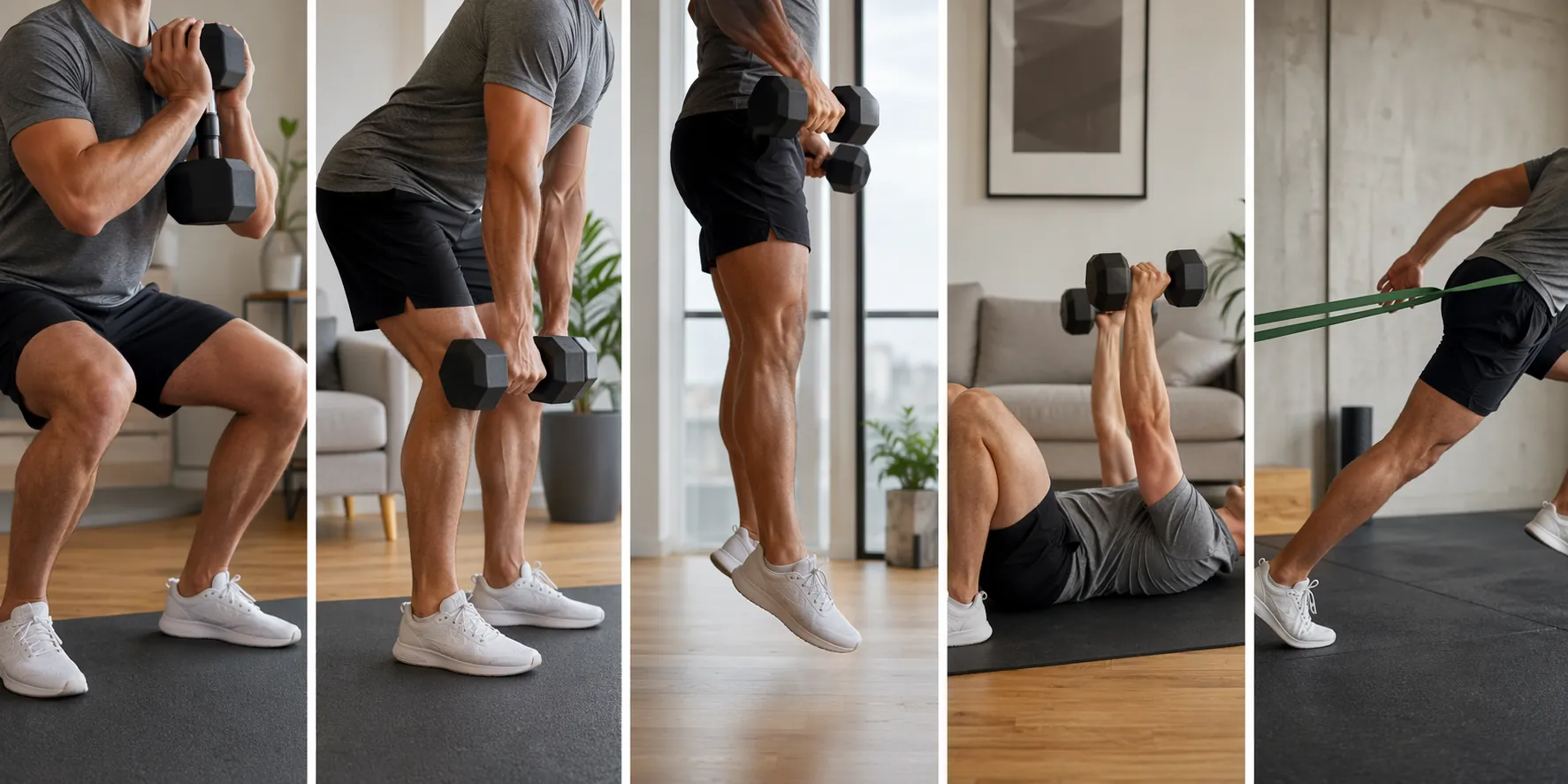
The Five Patterns That Actually Survive the Translation
A home-gym version should not pretend an adjustable dumbbell is the same as a fully equipped performance center. The point is to preserve the main job of each pattern: where force is produced, how quickly it needs to appear, and whether the substitute still asks the body to solve a sprint-related problem.
| Pattern | Elite evidence | Small-home-gym version | What must be preserved |
|---|---|---|---|
| Squat | Lyles' box squat, 3 x 4-6; Richardson's documented leg-day structure | Goblet squat, dumbbell front squat, box squat to a bench or sturdy box | Heavy knee-and-hip extension without turning it into a slow endurance set |
| Hinge | Lyles' hip thrust, 3 x 8-10; sprint programs commonly separate hip extension from squatting | Dumbbell Romanian deadlift, barbell Romanian deadlift, hip thrust from a couch or bench | Strong hip extension with control through the hamstrings and glutes |
| Explosive pull | Lyles' power clean, 3 x 4-6; Richardson's gym work supports power training but not a published clean prescription | Dumbbell high pull, hang dumbbell clean, band-resisted explosive pull | Fast force expression, not just lifting a weight from floor to shoulder |
| Horizontal push | Lyles' bench press, 3 x 8-10; Richardson's chest-day split | Dumbbell floor press, push-up, band-resisted push-up | Upper-body force that supports arm drive and trunk stiffness |
| Resisted horizontal force | Elite sprint training literature emphasizes resisted sprinting; Richardson's track work confirms serious sprint-specific sessions | Band-resisted marches, wall drives, sled push if space allows, heavy suitcase drag where safe | Forward force into the ground, not random conditioning fatigue |
1. Squat: Build the Leg Drive Without Chasing a Max Every Week
The squat pattern matters because sprinting asks the hip, knee, and ankle to extend hard against the ground. Lyles' box squat prescription, reported as 3 sets of 4 to 6 reps, sits in the useful middle ground for power athletes: heavy enough to demand force, not so high-rep that the set turns into a breathing contest.[1][2]
Richardson's exact squat sets are not public in the same way. What is public is a leg-day slot within her training split, plus visible gym work around sprint mechanics and power development.[3] That supports the shared category, not a claim that she uses Lyles' box squat prescription.
At home, the cleanest swap is a goblet squat if you have one heavy dumbbell, or a double-dumbbell front squat if your adjustable pair is heavy enough. If you own a barbell and can use it safely without shaking the building, a box squat to a stable bench or plyo-box substitute is closer to the reported Lyles pattern.
- Use 3 to 5 hard sets of 3 to 6 reps when the goal is strength and power, not leg burn.
- Stop each rep with the same torso angle and foot pressure you started with; folding forward turns the lift into a different task.
- If load is limited, slow the lowering phase and stand up aggressively instead of adding sloppy reps.
- Use a box only if it is stable and quiet; tapping the box is enough for most home setups.
2. Hinge: Train Hip Extension, Not Just a Heavy-Looking Deadlift
Lyles' listed hip thrust work, 3 sets of 8 to 10 reps, is the obvious hinge-side anchor here.[1][2] It trains hip extension with less technical demand than a maximal deadlift and less need for a full rack setup. For a sprinter, that matters because the glutes and hamstrings have to help project the body forward while the trunk stays organized.
The home version depends on what you can load. A dumbbell Romanian deadlift is usually the easiest serious option in a small room. A hip thrust with shoulders on a couch or bench works if the furniture is stable and the dumbbell can sit securely across the hips. A banded hip thrust is quieter, but the resistance curve can feel odd; it is useful when the alternative is doing nothing, not when you have enough weight for a clean hinge.
What cannot disappear is the hip-dominant action. A squat with a little forward lean is not automatically a hinge. In a Romanian deadlift, the hips move back, the knees soften, the spine stays steady, and the hamstrings take tension before the weight returns upward. In a hip thrust, the ribs stay down and the top position comes from hip extension, not an arched lower back.
3. Explosive Pull: The Power Clean Has a Job
The power clean is not in Lyles' program because it looks athletic on camera. His reported 3 sets of 4 to 6 reps put it in a low-rep explosive slot, where the athlete has to produce force quickly enough to move the load with speed.[1][2] Brauman's public explanation of sprint performance leans on the basic force equation, force equals mass times acceleration, which is a useful way to understand why a sprinter's lifting cannot be all slow grinding.[9]
This is where bad home-gym translation usually gets lazy. A power clean does not become any dumbbell move that involves the arms. The substitute needs an explosive pull: hips extend, feet push the floor, the weight travels fast, and the upper body guides rather than curls the load.
- Best small-space substitute: hang dumbbell clean from above the knees, 3 to 5 sets of 3 to 5 reps per side or with two dumbbells.
- Simpler substitute: dumbbell high pull, keeping the weight close and using the hips before the arms.
- Low-noise substitute: band-resisted explosive pull from a hinged position, with a fast finish and controlled return.
- Poor substitute: slow upright rows done to fatigue; they miss the speed and hip-extension demand.
If you have never learned the Olympic-lift family, keep the load modest and the reps crisp. Once every rep starts to look like a reverse curl with a shrug attached, the set is over.
4. Horizontal Push: Pressing Supports the Sprint, It Does Not Replace It
Lyles' bench press shows up as 3 sets of 8 to 10 reps in the published weight-room list.[1][2] Richardson's public split includes a chest day, which is enough to place horizontal pushing in the shared pattern column, but not enough to assign her a bench variation, weight, or rep range.[3]
For sprinters, pressing is not about bodybuilding theater. The arms do not create the main sprint force, but they help transmit rhythm, counterbalance the legs, and keep the torso from becoming a loose passenger at high speed. A stronger upper body can support that job, provided the pressing work does not eat the recovery needed for the track or lower-body power work.
A dumbbell floor press is the most apartment-friendly bench substitute. The floor limits shoulder extension, the setup is quiet, and failed reps are easier to manage than with a barbell bench in a cramped room. Push-ups work too, especially if you add a band across the back or elevate the feet, but they should still be loaded or progressed with intent rather than turned into a daily max-rep test.
5. Sled or Resisted Force Work: Keep the Direction of Force
This is the least convenient pattern for an apartment, and also the one most likely to be replaced badly. Sled work is not just conditioning with a tougher personality. The point is resisted horizontal force: pushing or driving into the ground in a way that resembles acceleration mechanics.
The broader sprint-training literature cited by 1080Motion notes that resisted sprinting may outperform traditional strength training for horizontal force production, while also emphasizing recovery spacing around high-intensity work.[8] That does not mean every reader needs a sled in a hallway. It means the replacement should preserve forward drive, body angle, and force into the floor.
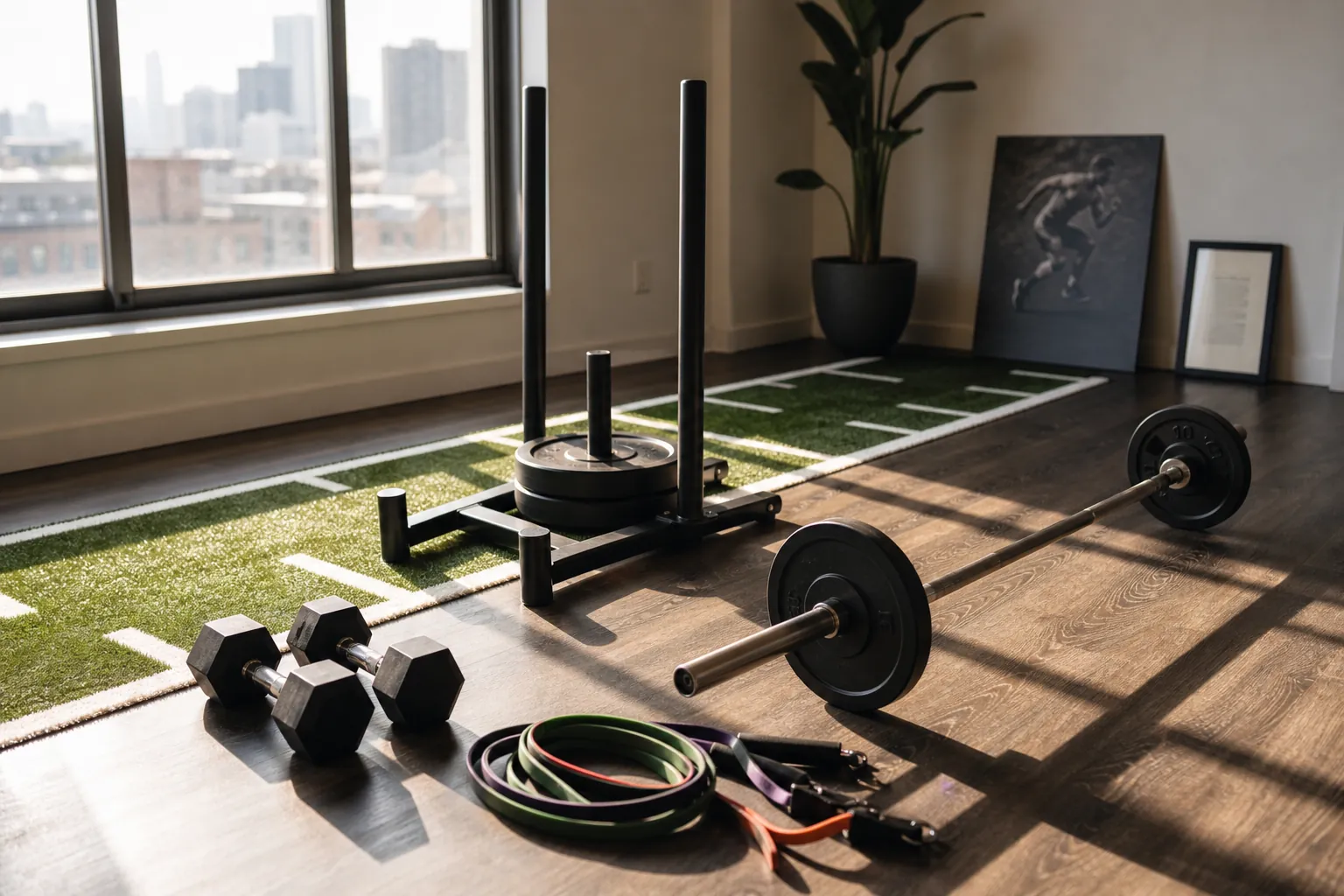
If you have a garage, turf strip, driveway, or very forgiving flooring, a small sled push or drag is the cleanest home option. If you live above someone else, use band-resisted marches, wall drives, or a partner-anchored band if that partner knows how to hold steady. A heavy suitcase drag can work on durable flooring, but only if it does not gouge the floor or yank your shoulder into a weird position.
- For acceleration practice: lean forward, keep the ribs stacked, and drive the ground back.
- For band-resisted marches: pause between steps so each rep is forceful rather than frantic.
- For sled pushes: keep the distance short enough that posture does not collapse.
- For apartments: choose quiet force over noisy speed; downstairs neighbors are a real programming variable.
How to Program the Five Without Turning Them Into a Daily Challenge
The mistake is to see five elite-looking patterns and stack them every day. Sprint training already taxes the nervous system. High-output lifting, jumps, resisted starts, and true speed work all compete for the same recovery budget.
Mass General Brigham's sprinter-training guidance from Mark Murphy, DPT, recommends a 6- to 8-week resistance block and gives squat strength targets of 1.5 to 2.5 times body weight for men and 1 to 1.75 times body weight for women.[5] Those numbers are standards to build toward over time, not an invitation to load a bar you cannot control in a spare bedroom.
SimpliFaster's home-training guide, from 2016 Olympian and Brown University coach Gabriel Mvumvure, is useful because it shows that meaningful sprint-support work can be organized with dumbbells and body weight rather than full facility access.[6] StrengthLog's sprinting strength material also lays out the same kind of movement-category logic in a 12-week off-season template, though the full program sits behind a paywall.[7]
| Training day | Main emphasis | Home-gym example |
|---|---|---|
| Day 1 | Lower-body force plus explosive pull | Goblet or box squat; dumbbell clean or high pull; short band-resisted marches |
| Day 2 | Upper body plus hinge | Dumbbell floor press; Romanian deadlift or hip thrust; trunk work |
| Day 3 | Acceleration-oriented power | Sled push, band-resisted wall drive, or low-volume explosive pull; optional light squat pattern |
That three-day outline is not Lyles' program and not Richardson's program. It is a way to distribute the same categories without pretending your living room is Pure Athletics. Keep at least one easier day between high-intensity lower-body sessions. The sprint-training science summarized by 1080Motion cites a 48-hour central nervous system recovery guideline between high-intensity sessions, along with a 2:1 periodization approach.[8]
Progression That Makes Sense With Limited Equipment
Small-space training usually runs into a load ceiling before motivation disappears. Once your dumbbells are no longer heavy enough to make a squat or hinge challenging, do not automatically add more reps. For sprint carryover, a set of 25 tired goblet squats is solving a different problem than a heavy, crisp set of 5.
- Add load first when you can do it safely and quietly.
- Add speed only when technique stays consistent.
- Add range of motion or pauses when equipment is too light.
- Add volume cautiously; power work gets worse when fatigue becomes the main stimulus.
- Deload when jumps, pulls, or resisted starts feel slow for more than one session.
A practical session might pair one heavy pattern, one explosive pattern, and one support pattern. For example: dumbbell front squat, hang dumbbell clean, and floor press. Another day might use Romanian deadlift, band-resisted wall drives, and push-ups. You do not need all five patterns every session; you need them represented across the week with enough recovery to keep the fast work fast.
What This Does and Does Not Let You Claim
It is fair to say Lyles' documented strength work includes squat, hinge, explosive pull, and horizontal push patterns, with exact reported sets and reps for several lifts.[1][2] It is fair to say Richardson's public training material supports leg work, chest work, arm-drive emphasis, broader gym organization, and serious track work, while leaving her exact weight-room prescriptions unpublished.[3][4]
It is not fair to say these are the only five exercises either sprinter uses, or that Richardson performs the same Lyles lift list. The better conclusion is that their publicly available training points toward the same sprint-strength categories. Those categories are specific enough to train at home if the substitutions preserve the job of the original movement.
For a renter with adjustable dumbbells, bands, and maybe a barbell, that is already enough to build a credible home-gym speed-strength foundation: squat hard, hinge with control, pull explosively, press with purpose, and find a quiet way to practice resisted forward force. The rest is loading, spacing, and restraint.
References
- Noah Lyles Interview Speed Training, Men's Health
- Olympic champion Noah Lyles shares, Yahoo Sports
- Track Athletes Strength Exercises, Runner's World
- Workout Wednesday: Sha'Carri Richardson Runs Early Season Intervals, MileSplit
- Sprinter Training to Increase Power, Mass General Brigham
- A Sprinter's Home Training Practical Guide, SimpliFaster
- Strength Training for Sprinting, StrengthLog
- The Science and Best Practice of Training Elite Sprinters, 1080Motion
- Meet Lance Brauman, the Coach Behind the Fastest Sprinters on Earth, Muscle & Fitness
What a small equipment investment adds
Cable Machine Alternatives That Save Space and Money
Compare the best cable machine alternatives for home gyms – from resistance bands and pulley systems to suspension trainers and compact digital units – and find the right option for your space and budget.
Small Treadmill Buying Guide: 7 Critical Specs to Check Before You Buy
A cross-category spec primer for apartment and small-space dwellers comparing walking pads, ultra-compact folding treadmills, and full-size folding treadmills. Learn the concrete thresholds for motor HP, deck length, noise, warranty, and subscription lock-in so you can compare apples to apples.
How to Practice Basketball at Home Without Noise Complaints
Learn how to run a full basketball workout in a small apartment without noise complaints. This guide covers no-dribble handling drills, wall form shooting, and silent ball options that let you train without disturbing neighbors.
How often should you repeat this?
See our recovery and rest reference for citation-anchored rest-interval guidance.
Spot something off?
Tell us if a movement, tier assumption, or duration didn't match your experience.