
Best Exercise Bikes for Small Spaces and Apartments: Folding, Compact, and Low-Footprint Options Compared
A dedicated comparison guide for apartment dwellers and small-home owners with under 10 sq ft of available floor space. We compare folding bikes, compact non-folding spin bikes, and under-desk options using footprint dimensions, noise levels, and storage requirements as the primary filter — not price tier.
Why Spatial Constraints Matter More Than Price for Apartment Bike Buyers
Most exercise bike buying guides organize their recommendations by price tier or resistance type. That approach works well if you have a dedicated home gym or a spare room. But if you live in an apartment, a condo, or a small home, the primary constraint isn't your budget — it's your floor plan. A bike that costs $1,500 and delivers a smooth ride is useless if it dominates your living room or can't be stored when guests visit.
This guide treats spatial constraints as the primary filter. We focus on bikes with a footprint under 10 square feet — the threshold that separates a manageable piece of home fitness equipment from a permanent room fixture. Within that constraint, we compare folding bikes, compact non-folding spin bikes, and under-desk options using concrete measurements: footprint dimensions, folded size, noise output, and storage requirements. Price is secondary to fit.
Step 1: Measure Your Space — What You Need to Know Before You Buy
Before you compare any spec sheets, take 10 minutes to measure your available space. Three measurements matter: the floor area where the bike will sit, the clearance needed for pedaling and dismounting, and the width of your doorways for delivery.
- Floor footprint: Measure the length and width of the spot where the bike will live. Add 6 inches on each side for air circulation and easy access. A compact spin bike like the Yosuda (40.5"L x 21.5"W) needs about 6 square feet. A recumbent bike like the Schwinn 290 (64.5"L x 28.5"W) needs nearly 13 square feet — more than double.
- Pedaling clearance: You need at least 2 feet of clearance behind the bike for your heels and 1 foot on each side for your elbows during out-of-saddle climbs. Measure from the back of the bike's rear stabilizer, not from the seat position.
- Doorway width: Standard interior doors are 30 to 32 inches wide. Most folding bikes (e.g., Marcy Foldable at 31"L x 15.5"W when folded) fit through easily. Full-size spin bikes like the Schwinn IC4 (48.7"L x 21.2"W) may require tilting through doorways — check the bike's assembled weight before committing.
- Ceiling height: If you plan to ride out of the saddle, add your height plus 12 inches. A 5'10" rider needs at least 82 inches of ceiling clearance on a bike with a 44-inch handlebar height.
For a broader look at how exercise bikes compare to other small-space equipment options, see our Best Home Fitness Equipment for Small Spaces guide, which covers treadmills, rowers, and multi-gym machines alongside bikes.
Folding Exercise Bikes: Maximum Space Savings, Measured Trade-Offs
Folding exercise bikes are the most space-efficient option for apartment dwellers who need to reclaim their floor after each ride. These bikes typically use a hinge mechanism that allows the frame to fold in half, reducing the footprint by roughly 50% for storage in a closet, under a desk, or against a wall.
The trade-off is measurable: folding bikes generally have lower weight capacities, fewer resistance levels, and less structural stability during high-intensity efforts compared to non-folding models. The following table compares the top folding options currently available.
| Model | Footprint (L x W) | Folded Size | Weight | Max User Weight | Resistance Levels | Price |
|---|---|---|---|---|---|---|
| Marcy Foldable Upright | 31" x 15.5" | ~15.5" x 15.5" (half size) | 37 lbs | 250 lbs | 8 | $162 |
| Exerpeutic Folding Magnetic | 32" x 22" | ~16" x 22" | 42 lbs | 300 lbs | 8 | $180 |
| XTERRA FB150 Folding | 33" x 21" | ~17" x 21" | 39 lbs | 240 lbs | 8 | $150 |
The Marcy Foldable stands out for its exceptionally small footprint — 31"L x 15.5"W — and its ability to fold to roughly half that size. At 37 lbs, it is light enough to move between rooms without transport wheels. However, its 250 lb weight capacity and 8 resistance levels limit its suitability for heavier riders or those seeking progressive overload. The Exerpeutic model offers a slightly higher weight capacity (300 lbs) but has a larger unfolded footprint.
Compact Non-Folding Spin Bikes: Smallest Footprints Without the Fold
If you have 6 to 10 square feet of dedicated floor space and don't need to store the bike after every ride, a compact non-folding spin bike offers a better ride experience than any folding model. These bikes use heavier flywheels, magnetic resistance systems, and sturdier frames that deliver smooth, quiet pedaling and support higher intensity efforts.
The key metric here is footprint in square inches. The smaller the footprint, the easier it is to fit the bike into a corner, along a wall, or next to a sofa without dominating the room.
| Model | Footprint (L x W) | Footprint (sq in) | Weight | Max User Weight | Resistance Type | Resistance Levels |
|---|---|---|---|---|---|---|
| Yosuda Indoor Cycling Bike | 40.5" x 21.5" | 871 | 62 lbs | 275 lbs | Felt friction | Infinite (manual) |
| Schwinn IC4 / BowFlex C6 | 48.7" x 21.2" | 1,036 | 106 lbs | 330 lbs | Magnetic | 100 |
| Sunny SF-B1709 | 42" x 22" | 924 | 58 lbs | 275 lbs | Felt friction | Infinite (manual) |
The Yosuda Indoor Cycling Bike has the smallest footprint among non-folding spin bikes tested by Outdoor Gear Lab at just 871 sq in. Its 40.5-inch length means it fits in spaces where a 48-inch bike like the Schwinn IC4 would not. The trade-off is a felt friction resistance system (quieter than air but not as silent as magnetic) and a manual resistance knob rather than magnetic or electronic control.
The Schwinn IC4 (also sold as the BowFlex C6) occupies 1,036 sq in — about 19% more floor space than the Yosuda — but delivers 100 levels of magnetic resistance, Bluetooth connectivity for apps like Peloton and Zwift, and a 330 lb weight capacity. At 106 lbs, it is significantly heavier and harder to move, but its front transport wheels make relocation manageable on hard floors.
Under-Desk and Portable Options for Absolute Minimum Space
For readers with less than 6 square feet of available floor space — or those who need a bike that disappears entirely into a closet or under a desk — under-desk peddlers and portable mini bikes offer a compromise. These are not substitutes for a full-size bike if your goal is structured cardio or high-intensity training, but they provide light movement and mobility support in extreme space constraints.
- Under-desk peddlers: Compact units that sit on the floor and use a belt or magnetic resistance system. Footprint is typically 20"L x 16"W or smaller. Best for light pedaling while working at a standing desk or watching TV. Most models cap at 50-80 watts of output.
- Portable mini bikes: Slightly larger than peddlers, with a small seat and handlebars. Footprint is roughly 24"L x 18"W. Suitable for gentle cardio and mobility work but lack the flywheel weight and resistance range needed for progressive training.
- Folding pedal exercisers: Designed to sit on a table or the floor, these are the most portable option at under 10 lbs. Useful for short mobility breaks but not for sustained cardio.
Noise Comparison: Which Resistance Type Is Quietest for Shared Walls?
Noise is a critical consideration for apartment dwellers with shared walls, thin floors, or downstairs neighbors. The three main resistance types produce very different sound profiles, and the difference between a quiet bike and a loud one can be the difference between a harmonious living situation and a complaint from the neighbor below.
Garage Gym Reviews tested multiple bikes under consistent conditions and recorded the following decibel levels:
| Resistance Type | Example Model | Measured dB | Comparison | Best For |
|---|---|---|---|---|
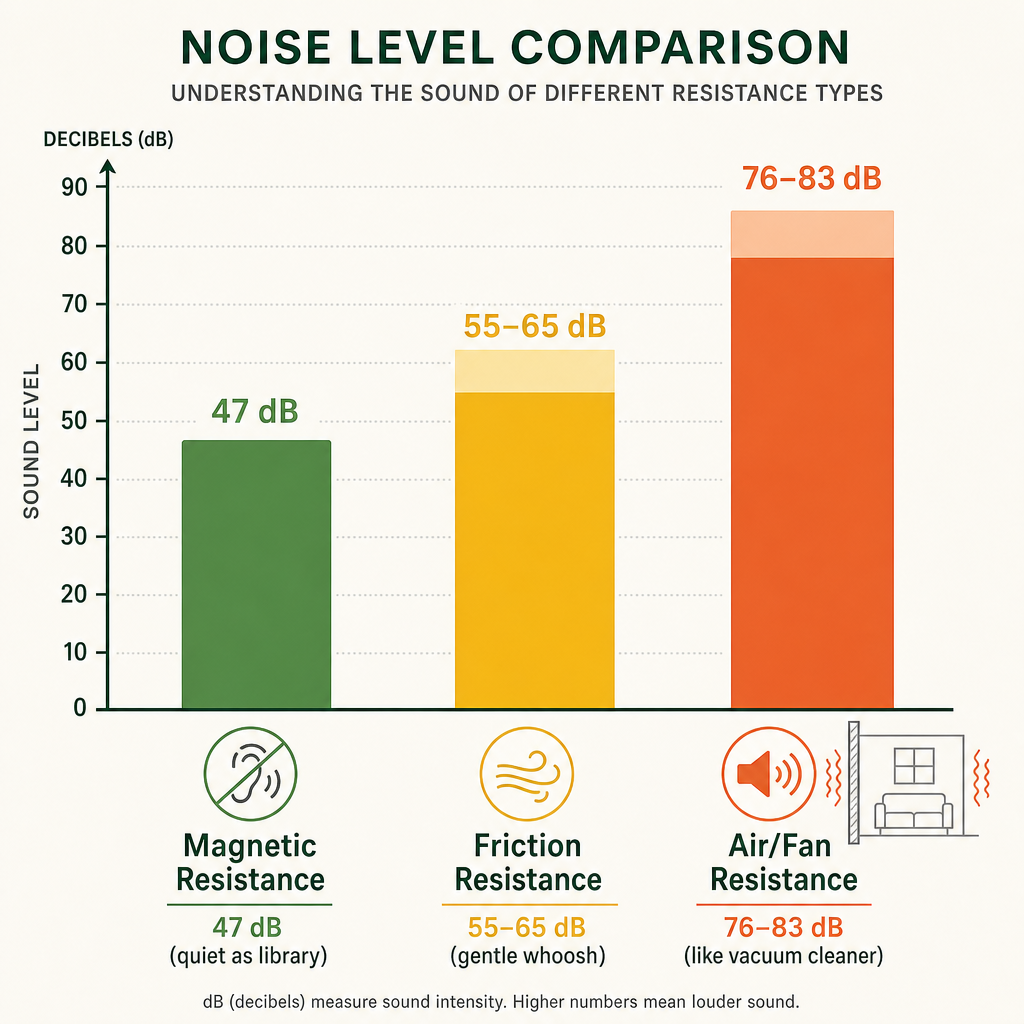
| Magnetic | Sunny SF-B1002 | 47.4 dB | Just above room noise (40.7 dB) | Shared walls, thin floors, early morning/late night rides |
| Felt friction | Yosuda / Sunny SF-B1709 | 55-65 dB (estimated) | Gentle whoosh sound | Apartments with moderate soundproofing |
| Air / Fan | Rogue Echo Bike | 76.3 dB | Similar to a vacuum cleaner | Garages, basements, or detached spaces only |
The Sunny SF-B1002 recorded 47.4 dB during testing — just 6.7 dB above the ambient room noise of 40.7 dB. That is quiet enough that someone in the next room would not hear it over normal conversation or television. In contrast, the Rogue Echo Bike produced 76.3 dB at highest intensity — loud enough to be clearly audible through standard apartment walls and similar in volume to a household vacuum cleaner.
Storage and Mobility: Transport Wheels, Felt Weight, and Vertical Storage
Even a compact bike becomes an obstacle if you cannot move it easily. Two factors determine how practical a bike is for regular relocation: whether it has front transport wheels, and its felt moving weight — the actual effort required to tilt and roll it.
| Model | Total Weight | Felt Moving Weight | Transport Wheels | Vertical Storage |
|---|---|---|---|---|
| Concept2 BikeErg | 68 lbs | 26 lbs | Yes (front) | Yes (stands on end) |
| Schwinn IC4 / BowFlex C6 | 106 lbs | ~50 lbs (estimated) | Yes (front) | No |
| Marcy Foldable | 37 lbs | 37 lbs (carry) | No | Yes (folds flat) |
| Yosuda Indoor Cycling | 62 lbs | ~35 lbs (estimated) | No | No |
The Concept2 BikeErg is the standout for portability. At 68 lbs total weight, its felt moving weight is just 26 lbs — meaning when you tilt it onto its front wheels, only 26 lbs of force is required to roll it. It can also be stored vertically on its end, reducing its floor footprint to roughly 2 square feet when not in use. This makes it the best option for apartment dwellers who need to move the bike between rooms or store it in a closet.
The Schwinn IC4, at 106 lbs, is significantly harder to move despite having front transport wheels. Its felt moving weight is roughly 50 lbs — manageable for occasional relocation but impractical for daily storage. The Marcy Foldable, at 37 lbs, is light enough to carry but lacks transport wheels entirely. The Yosuda has no transport wheels and requires lifting to move.
- If you need to move the bike daily (e.g., from living room to closet), prioritize models with front transport wheels and a felt moving weight under 30 lbs — the Concept2 BikeErg is the clear winner here.
- If the bike will stay in one spot permanently, transport wheels are less important. Focus on stability and ride quality instead.
- If vertical storage is essential, only the Concept2 BikeErg and folding bikes (Marcy, Exerpeutic) offer that capability. Most spin bikes cannot be stored vertically without risking damage to the flywheel or frame.
How to Choose: A Decision Framework Based on Your Space and Priorities
The following decision framework routes you to the right bike type based on your specific spatial constraints and priorities. Use it as a quick reference after you have measured your space.
| Your Situation | Recommended Bike Type | Top Pick | Key Trade-Off |
|---|---|---|---|
| Under 6 sq ft of floor space, need to store bike after every ride | Folding bike | Marcy Foldable ($162) | Lower weight capacity (250 lbs), only 8 resistance levels |
| 6-10 sq ft of dedicated floor space, want best ride quality | Compact non-folding spin bike | Yosuda (871 sq in) or Schwinn IC4 (1,036 sq in) | Yosuda: smaller footprint but felt resistance; IC4: larger footprint but magnetic resistance |
| Shared walls or downstairs neighbors, need quiet operation | Magnetic resistance bike | Schwinn IC4 (47-50 dB) or Sunny SF-B1002 (47.4 dB) | Magnetic bikes cost more than felt friction models |
| Need to move bike between rooms or store vertically | Lightweight with transport wheels | Concept2 BikeErg (26 lb felt weight, vertical storage) | Air resistance is loud (76 dB) — not suitable for shared walls |
| Less than 6 sq ft, only want light movement | Under-desk peddler or portable mini bike | Various under $100 options | Not suitable for structured cardio or high-intensity training |
The exercise bike market offers genuine options for every spatial constraint, from the 871 sq in Yosuda that tucks into a corner to the folding Marcy that disappears into a closet. The key is to measure first, filter by footprint and noise second, and compare price and features third. That order — space, then sound, then spend — is what separates a bike that enhances your apartment living from one that becomes a source of frustration.
This result comes from one real apartment under the stated conditions — it is a strong signal, not a guarantee your space will measure identically.
Builds this evidence supports
Cable Machine Alternatives That Save Space and Money
Compare the best cable machine alternatives for home gyms – from resistance bands and pulley systems to suspension trainers and compact digital units – and find the right option for your space and budget.
How to Choose a Compact Home Gym That Works for Your Space, Budget, and Noise Tolerance
This article provides a structured decision framework for apartment dwellers and small-space residents to match their specific floor footprint, noise sensitivity, and budget to the most suitable compact home gym strategy — whether that's an all-in-one machine, modular build, smart digital system, or band/bodyweight setup.
The Garage Gym Reality Check: What Equipment Actually Fits in a Single-Car Garage
Most garage gym guides assume a two-car space. This article uses real dimensions, real equipment footprints, and three layout templates to show what fits—and what doesn't—in a single-car garage (10x20 to 12x20 ft).
Spot something off?
If this result didn't match your own space, let us know — floor-damage and noise claims carry real deposit-risk consequences if we get them wrong.