
Best Home Fitness Equipment for Small Spaces: A Space-Tiered Buying Guide
A constraint-first buying guide for apartment dwellers and small-space residents evaluating home fitness equipment — organized by available square footage, noise profile, stowability, and renter restrictions so every recommendation matches your actual situation, not a generic ranked list.
- Budget tier
- under $200, $200–$500, $500–$1,000
- Space type
- apartment, spare room
Items included: —
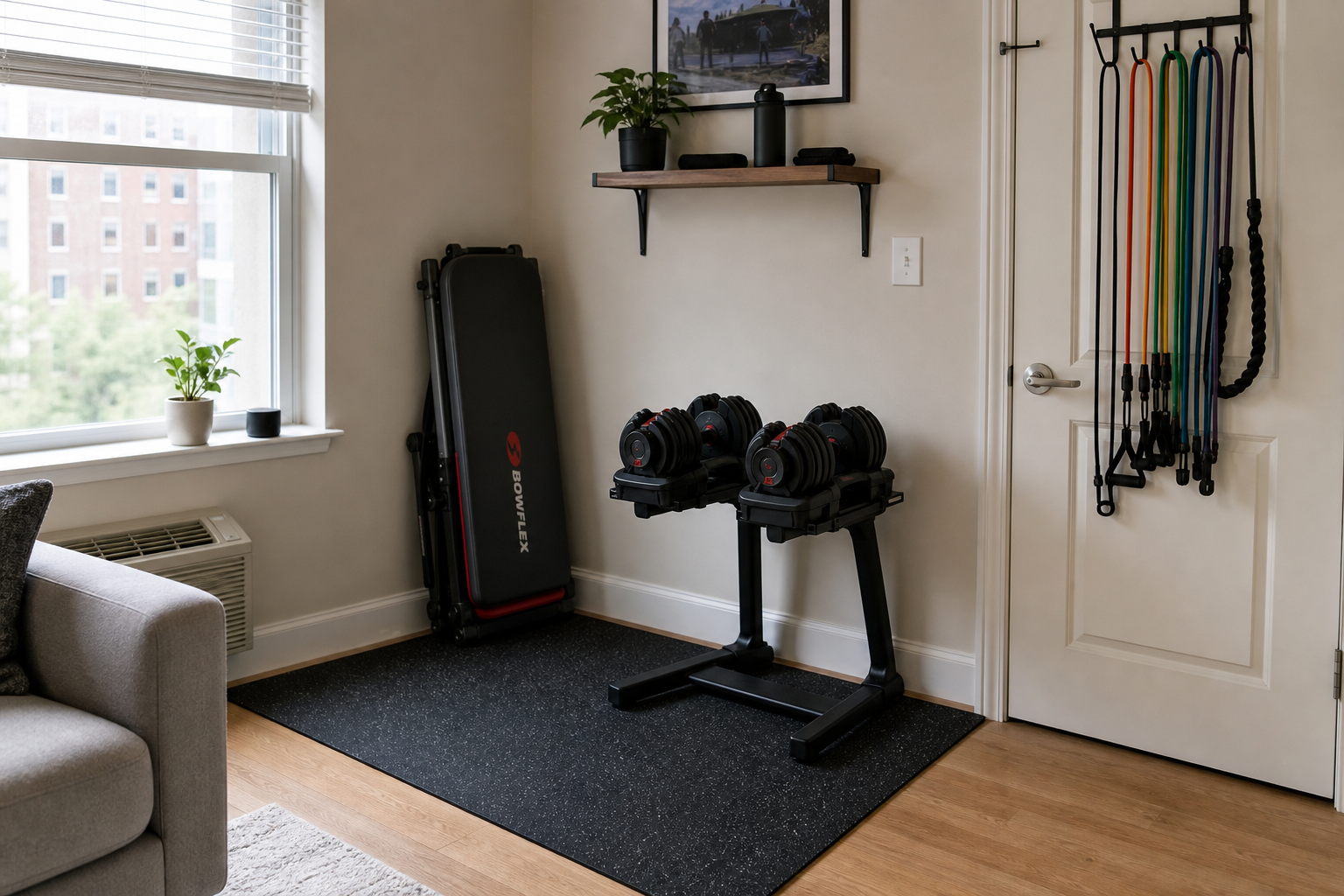
Why Most 'Best Home Gym' Lists Fail Small-Space Buyers
Pick up almost any home gym roundup and you will find a ranked list of products — treadmills, power racks, all-in-one cable machines — with prices, star ratings, and affiliate links. What you will not find is the floor area each piece of equipment actually occupies, how loud it is when running, or whether it requires a wall stud that your lease prohibits you from touching.
That omission is not a minor oversight. For a buyer working with 80 square feet of living room floor, the difference between a foldable magnetic-resistance bike and a belt-driven non-foldable one is the difference between a functional setup and a piece of furniture you cannot use. Noise classification and stowability are not secondary specifications — they are the primary purchase filters for anyone in an apartment or shared-wall building.
This guide uses a constraint-first framework instead. Every recommendation is organized by available square footage first, then filtered by noise profile, stowability, and renter restrictions. Products appear within a space tier because they fit that tier — not because they rank well on an affiliate index.
Four Constraint Axes to Assess Before You Buy Anything
Skipping this step is the most common reason small-space buyers end up with equipment that does not fit, violates their lease, or generates a noise complaint within the first week. Work through these four filters before you look at a single product.
- Available floor tier — measured, not estimated. Measure the actual rectangle of floor you can dedicate to training. Include the clearance you need to move through an exercise, not just the equipment footprint. A practical pre-purchase check: mark a 6×4 ft rectangle on the floor with painter's tape and live with it for a day or two before ordering anything. If you cannot move around comfortably inside it, the space tier you thought you had is smaller than it is.
- Noise tolerance and neighbor situation. Assess your floor type (hardwood transmits vibration more than carpet), whether you have neighbors directly below, and whether your building has quiet hours that affect when you can train. This determines whether you are limited to magnetic-resistance and no-impact equipment or whether you have more flexibility.
- Lease and structural limits. Review your lease before purchasing anything that requires wall mounting, stud anchoring, or floor bolting. Folding racks, wall-mounted smart gyms, and some doorframe pull-up bars require structural attachment that many leases prohibit. No-drill alternatives exist for most categories — know your restrictions before you buy.
- Budget ceiling with total cost of ownership. Set a ceiling that includes any subscription cost, not just the equipment price. A smart gym priced at $500 may carry a $39/month subscription that adds $468 over the first 12 months. Factor that in before comparing it to a one-time-cost alternative.
Space-Tiered Equipment Recommendations
The four tiers below are defined by the floor area you have available for training — not your total room size. Each tier lists equipment matched to its real constraints: what fits, what folds, how loud it is, and what it costs.
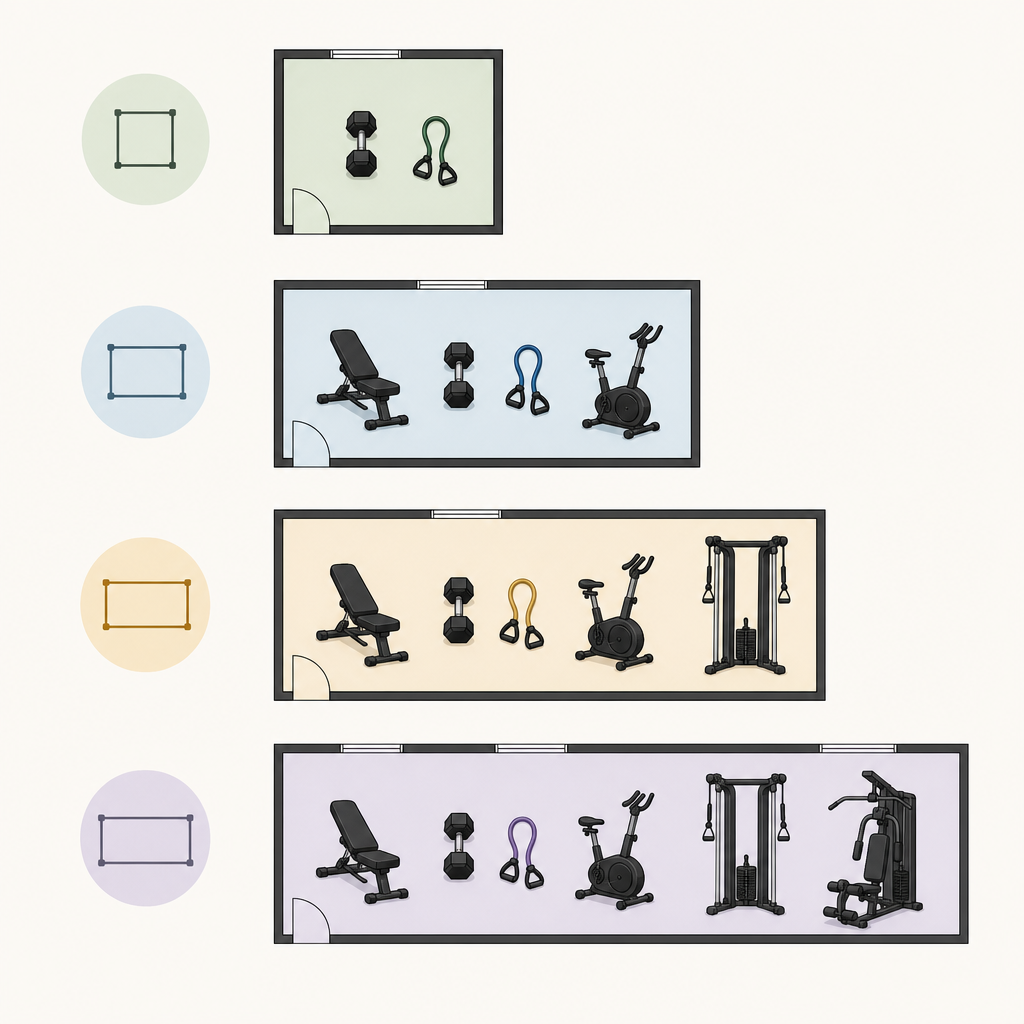
Tier 1: Under 50 sq ft — Storable-Only Setups
A 6×8 ft zone (48 sq ft) is enough to train effectively if every piece of equipment stores completely when not in use. Nothing stays on the floor. This tier is defined by storable equipment only — no machines, no benches that need to stay out.
- Adjustable dumbbells. A quality adjustable dumbbell set (such as the NÜOBELL, at approximately 17" L × 7.5" W × 7.5" H per handle) replaces a full rack of fixed weights and stores on a compact stand or shelf. Noise class: quiet, provided you set them down with control. No dropping.
- Resistance band set. A full set of latex resistance bands stores in a drawer or on a closet shelf. Combined with a door anchor, they cover pressing, pulling, rows, and core work from any doorway — no floor space required when stored. Noise class: silent.
- Doorframe pull-up bar (no-drill). A tension-mounted doorframe bar (such as the Perfect Fitness Doorway Pull-Up Bar, rated to 300 lbs) requires no stud installation and stores behind a door. Renter-safe. Noise class: quiet.
- Exercise mat. Defines the training zone and provides basic floor protection. Rolls up and stores vertically. Noise class: silent.
Tier 2: 50–100 sq ft — Foldable Plus Storable
An 8×10 ft zone (80 sq ft) opens up foldable equipment that can stay in the room between sessions without taking over the floor. The key word is foldable — not just compact. Everything in this tier needs to collapse to a manageable footprint.
- Foldable adjustable bench. A quality foldable bench folds flat and stores upright against a wall, typically occupying under 2 sq ft when stored. Paired with adjustable dumbbells, it unlocks incline and decline pressing, step-ups, and supported rows. Noise class: quiet.
- Foldable magnetic-resistance exercise bike. A foldable bike (such as the LEIKE, approximately 46" L × 16" W × 9" H folded) stores in a closet or corner when not in use. Magnetic resistance is the critical spec here — belt-driven bikes generate significantly more noise. Noise class: quiet (magnetic resistance only).
- Compact elliptical with magnetic resistance. A compact elliptical with a small stride length and magnetic resistance system provides low-impact cardio with minimal vibration transmission. Noise class: quiet.
Tier 3: 100–150 sq ft — Foldable Plus Compact Machines
A 10×10 ft zone (100 sq ft) is the practical standard for most home gym configurations. At this tier, compact cable towers and folding racks become viable — with important caveats for renters.
- Compact cable tower. A freestanding compact cable machine (such as the Speediance Gym Monster, approximately 49" D × 28" W × 73" H unfolded, 15" D × 28" W × 73" H folded) provides a full cable stack in a small footprint. No subscription required on some models. Noise class: quiet (digital/magnetic resistance). No wall mounting needed — renter-safe.
- Folding squat rack. A wall-mounted folding rack (such as the PRx Profile PRO, which folds to approximately 9" off the wall) is highly space-efficient but requires stud mounting. Noise class: moderate (barbell work). Renter caveat: requires lease review, stud location, and professional installation consideration. Not appropriate for most renters without explicit landlord approval.
Tier 4: 150+ sq ft — Compact Machines Plus Limited Full-Size Options
A 12×12 ft zone (144 sq ft) supports one main strength station, adjustable cardio equipment, a dumbbell rack, and a floor training zone simultaneously. At this tier, compact all-in-one trainers, rowing machines, and non-folding cardio become viable — though noise and vibration management remain important considerations in any multi-unit building.
A vertical-storage rower is worth noting at this tier: when stored upright, it occupies approximately 2 sq ft of floor space. It provides a full-body cardio and strength stimulus in a minimal footprint, and pulls out for use in a few seconds.
Noise and Vibration: The Filter Most Lists Skip
For apartment renters, noise classification is not a secondary spec — it is a lease-compliance issue. Floor vibration transmits through hardwood and concrete to the unit below. A neighbor complaint or a formal lease violation is a real outcome of choosing the wrong equipment type.
The noise profile of fitness equipment is determined primarily by its resistance type and impact level, not its size. A compact belt-driven bike is louder than a full-size magnetic-resistance elliptical. A small set of fixed dumbbells that gets set down hard is louder than a heavy adjustable set placed quietly.
- Quiet tier: Magnetic resistance cardio equipment, digital resistance systems (no physical weight stacks), resistance bands, adjustable dumbbells placed with control, bodyweight exercises on a mat. These are the only appropriate choices for buildings with thin floors or direct-below neighbors.
- Moderate tier: Belt-driven cardio machines, light jumping (with impact-absorbing mat), barbell work with controlled lowering. Manageable in many buildings with appropriate flooring, but not appropriate during building quiet hours.
- Loud tier: Dropped free weights, plate-loaded barbell work with any drop, impact cardio without mat absorption, heavy jump rope on bare floors. These generate impact noise and vibration that transmits through most residential floor structures.
Flooring Options and What They Actually Do
Flooring protects your floor and reduces vibration transmission — it does not eliminate noise from loud-tier activities. The two main options serve different purposes:
- Foam interlocking tiles: More affordable, portable, and easy to configure for any space shape. Good for floor protection and light impact absorption. Less effective at dampening low-frequency vibration from heavy equipment.
- Rubber mats (dense, 3/8" or thicker): Better sound and vibration dampening than foam. More expensive and heavier. The better choice if you are running any cardio machine or doing any moderate-tier activity.
What to Skip in Small Spaces — and Why
Several popular equipment categories are structurally incompatible with the space tiers this guide defines. The reasons are specific, not subjective.
- Large all-in-one Smith machine combos. A full-size all-in-one Smith machine (such as the Major Fitness B17, approximately 68" D × 78.7" W × 88.1" H) requires over 37 sq ft of floor area and more than 88 inches of ceiling clearance. This exceeds the total available floor area in Tiers 1 and 2 and consumes most of Tier 3. Incompatible with standard residential ceiling heights in many apartments.
- Non-foldable treadmills. A standard treadmill deck occupies 25–35 sq ft and cannot be reconfigured when not in use. It also generates significant belt-drive noise and vibration. Even in Tier 4, a compact magnetic-resistance bike or walking pad is a more practical cardio option in a multi-unit building.
- Plate-loaded racks without wall-mounting capability. A freestanding plate-loaded power rack requires side clearance for bar loading beyond its stated footprint, plus ceiling height for overhead pressing. In Tiers 1–3, this clearance requirement eliminates the space for any other equipment. The noise profile (barbell drops, plate clanking) is incompatible with most apartment buildings regardless of tier.
- TRX-style suspension trainers requiring stud anchoring. Suspension trainers that require a wall stud or ceiling mount are not renter-compatible without landlord approval. A resistance band set with a door anchor covers most of the same movement patterns without any structural attachment.
Budget Overlay: Under $200, $200–$500, and $500–$1,000
Budget is a filter applied on top of the space-tier framework — not a replacement for it. The configurations below represent the highest training value achievable within each spend range, assuming you have already identified your space tier and constraint profile.
Under $200: Full-Body Capability in a Drawer
A resistance band set (five resistance levels, door anchor included) plus a quality exercise mat covers full-body strength and cardio capability for under $50. Adding a single adjustable kettlebell or a set of light fixed dumbbells brings the total under $200 and adds dynamic loading for swings, goblet squats, and carries. This configuration fits entirely in a closet shelf and occupies zero permanent floor space.
$200–$500: The Complete Storable Setup
Adding a quality adjustable dumbbell set (5–50 lbs range) and a no-drill doorframe pull-up bar to the under-$200 foundation produces a complete storable setup for most training goals. Adjustable dumbbells replace a full rack of fixed weights in the footprint of two handles. The pull-up bar stores behind a door. Total floor space required when in use: under 25 sq ft. This configuration is appropriate for Tiers 1 and 2.
A platform like Tempo Move falls in this price range for the equipment component (under $500), but requires a subscription after the first year. Factor that into your actual budget before comparing it to one-time-cost alternatives in the same price range.
$500–$1,000: Foldable Cardio Plus Strength Foundation
At this tier, a foldable adjustable bench plus a compact magnetic-resistance cardio machine (foldable bike or compact elliptical) can be added to the adjustable dumbbell foundation. This configuration covers strength training, cardio, and flexibility work across all primary training goals — and remains appropriate for Tier 2 and Tier 3 spaces.
Smart Gym Subscription TCO: What the Sticker Price Omits
Smart gym and subscription-connected equipment deserves its own note because the equipment price is not the full cost. For context:
- Tonal 2: Listed at $4,295 for the equipment. Requires professional delivery and installation (not included in the list price). Requires a subscription for full functionality. Wall-mounted — requires stud installation and lease review. Verify current subscription pricing before purchase.
- Tempo Move: Equipment cost under $500. Subscription required after the first year at approximately $39/month — adding roughly $468 annually to the ownership cost. Over 24 months of ownership, the subscription cost alone approaches the equipment price.
- Speediance Gym Monster: Freestanding compact cable system, no subscription required on current models. Verify at time of purchase as subscription models can change between product generations.
Full Spec Comparison Table
| Equipment | Space Tier | Footprint (In Use) | Footprint (Stored) | Noise Class | Stowability | Price Range | Primary Training Value |
|---|---|---|---|---|---|---|---|
| Resistance band set + door anchor | Tier 1+ | ~6 sq ft (mat zone) | Drawer / shelf | Silent | Complete | Under $50 | Full-body strength, cardio, core |
| Adjustable dumbbells (e.g., NÜOBELL) | Tier 1+ | ~4 sq ft (stand) | Compact stand or shelf | Quiet | High | $300–$500 | Strength, hypertrophy, functional |
| No-drill doorframe pull-up bar | Tier 1+ | Doorframe only | Behind door | Quiet | Complete | Under $40 | Upper body pulling, core |
| Exercise mat | Tier 1+ | ~14 sq ft | Rolls to ~3 sq ft | Silent | Complete | $30–$80 | Floor work, yoga, bodyweight |
| Foldable adjustable bench | Tier 2+ | ~8 sq ft (open) | ~2 sq ft (upright) | Quiet | High | $100–$250 | Pressing, rows, step-ups |
| Foldable magnetic-resistance bike (e.g., LEIKE) | Tier 2+ | ~5 sq ft (open) | ~4 sq ft (folded) | Quiet | High | $200–$400 | Cardio, low-impact |
| Compact magnetic elliptical | Tier 2+ | ~10–14 sq ft | Limited fold | Quiet | Medium | $300–$600 | Low-impact cardio, full-body |
| Compact cable tower (e.g., Speediance Gym Monster) | Tier 3+ | ~10 sq ft (folded depth 15") | ~6 sq ft (folded) | Quiet | Medium | $1,000–$2,000 | Full cable stack, strength, functional |
| Folding squat rack (e.g., PRx Profile PRO) | Tier 3+ | ~20 sq ft (open) | ~4 sq ft (folded, 9" depth) | Moderate | High (wall-mounted) | $600–$1,200 | Barbell strength, squat, press |
| Vertical-storage rower | Tier 4 | ~14 sq ft (in use) | ~2 sq ft (vertical) | Quiet–Moderate | High | $300–$700 | Full-body cardio, rowing strength |
FAQ: Noise, Renter Rules, Subscriptions, and Resistance Band Limits
How do I manage noise complaints from neighbors?
Start with equipment selection — magnetic resistance and digital resistance systems are the quietest cardio options available, and adjustable dumbbells placed with control generate far less impact noise than fixed dumbbells. Add a dense rubber mat (3/8" or thicker) under any cardio machine or training zone to reduce vibration transmission. Avoid training during building quiet hours. For exercises with any jumping or impact component, a thick mat is not optional — it is the minimum noise mitigation measure.
What are my options if my lease prohibits wall mounting?
Most wall-mounting use cases have renter-safe alternatives:
- Pull-up bar: Tension-mounted doorframe bars (such as the Perfect Fitness Doorway Pull-Up Bar) require no stud installation and no wall damage. They are the standard renter-safe solution.
- Folding rack: If a wall-mounted folding rack is not an option, a compact freestanding cable tower covers most of the same functional training movements without any structural attachment.
- Mirrors: For form-checking, use leaning placement or temporary adhesive mounting strips (designed for no-damage removal) rather than wall-anchored mirror installations.
- Smart gyms (Tonal 2): Tonal 2 requires wall mounting and professional installation. If your lease prohibits wall modifications, it is not a viable option without explicit landlord approval.
What does a smart gym subscription actually cost over two years?
The two-year total cost of ownership calculation for subscription-connected equipment looks different from the sticker price. Using Tempo Move as an example: equipment at under $500, plus approximately $39/month after the first year, means the subscription alone adds roughly $468 in year two. Over 24 months, the total cost of ownership approaches $1,000 or more — comparable to a one-time-cost foldable cable machine that requires no ongoing subscription.
The framing question to ask: does the subscription-connected platform provide enough training value over two years to justify the premium over a one-time-cost alternative that covers the same movement patterns? For some users the answer is yes — guided programming has real retention value. But the decision should be made with the full 24-month cost visible, not the equipment price alone.
Can resistance bands replace free weights entirely?
For beginners and early intermediates: yes, for most practical purposes. A full resistance band set covers the primary movement patterns — push, pull, hinge, squat, carry — with enough resistance variation for meaningful progression at early training levels.
Beyond the beginner-intermediate level: no, not fully. Resistance bands have a non-linear resistance curve (tension increases as the band stretches) that does not replicate free-weight loading mechanics. Maximum tension is capped by the band's resistance rating, which limits progressive overload for experienced lifters. Bands also do not develop the grip strength, stabilizer recruitment, or loading patterns that come from free-weight training.
The practical recommendation: start with bands if space and budget require it, and plan to add adjustable dumbbells once you have outgrown the resistance ceiling. The two tools complement each other well — bands for warm-up, activation, and accessory work; dumbbells for primary loading.
Some links on this page are affiliate links — they may earn us a commission at no extra cost to you. Our tier and tests are decided before we ever check which links pay; see our full affiliate disclosure.
Spot something off?
Noise and floor-damage claims carry real deposit-risk consequences if we get them wrong — tell us if your experience with this build didn't match what's above.