
How to Start Working Out at Home: A Beginner's Guide
A practical starting guide for adults with little or no exercise history who want to work out at home — walks you through assessing your space, time, and goal to find the right starting point, then gives you a usable 4-week bodyweight plan with clear weekly progression.
Why Home Workouts Work — and Why Most Beginner Guides Don't
If you've been putting off starting because you don't have a gym membership, a dedicated workout room, or any equipment — you don't need any of those things. A 2020 study published in the Journal of Sports Science and Medicine found that bodyweight training produced similar improvements in muscle strength and endurance over 8 weeks compared to traditional strength training. What determined results wasn't location or equipment — it was consistency and progressive challenge.
Home-based exercisers also tend to stick with it longer. Research cited by DailyBurn found that people who exercise at home report higher adherence rates and greater long-term compliance than gym-based exercisers. The barrier to starting is lower, the commute is zero, and you don't need more than a 6×6 foot cleared floor space.
The problem isn't home workouts. The problem is how most beginner guides present them.
Most beginner articles hand you a single circuit — ten exercises, three rounds, go — with no context for your actual situation. They don't ask how much space you have, how much time you can realistically commit, or what you're actually trying to accomplish. They assume everyone starts from the same place, which means the routine fits almost no one well.
This guide works differently. Before you touch a single exercise, you'll assess three real constraints — your space, your available time, and your primary goal. That assessment maps directly to a starting workout type and a 4-week progressive plan you can follow immediately.
Before You Start: Assess Your Three Constraints
Three variables determine what kind of starting routine actually fits your life right now. Get these right and the rest of the decision becomes straightforward.
Constraint 1: Available Space
You need a minimum of about 6×6 feet of clear floor space — roughly the size of a yoga mat with a little room on each side. That's enough for squats, push-ups, planks, lunges, and most foundational bodyweight movements.
- Mat-sized space (6×6 ft): Covers all floor-based and standing exercises in place. You'll avoid lateral jumps and wide-stance movements.
- Open room (10×10 ft or more): Adds lateral movement, walking lunges, and higher-intensity cardio options like jumping jacks or skaters.
Constraint 2: Available Time Per Session
Be honest about what you can reliably protect, not what you'd like to have on a perfect day. A 20-minute session you actually complete beats a 45-minute session you keep skipping.
- 20–25 minutes: Warm-up, one full-body circuit (2 rounds), cool-down. Effective starting point for most beginners.
- 30–45 minutes: Warm-up, two full-body circuits or a split focus (upper/lower), cool-down. Appropriate once the habit is established.
Constraint 3: Primary Goal
Your goal shapes which exercises you emphasize and how you structure your sessions. Pick the one that's most true right now — you can adjust as you progress.
- General fitness: Build baseline movement quality, endurance, and consistency. Full-body circuits work well.
- Fat loss: Higher-rep circuits with shorter rest periods, incorporating cardio-style movements. Consistency over intensity at this stage.
- Building strength: Lower reps with controlled tempo, emphasis on compound movements (squats, push-ups, hinges). Progressive overload is the priority.
Matching Your Constraints to a Starting Point
| Space | Time Available | Primary Goal | Starting Workout Type |
|---|---|---|---|
| Mat-sized | 20–25 min | General fitness | Bodyweight full-body circuit, 2 rounds, low-impact |
| Mat-sized | 20–25 min | Fat loss | Bodyweight circuit with active rest (marching, step-touches) |
| Mat-sized | 20–25 min | Strength | Bodyweight strength circuit, slow tempo, 2 rounds |
| Open room | 20–25 min | General fitness | Bodyweight full-body circuit with lateral movements |
| Open room | 30–45 min | Fat loss | Bodyweight HIIT-style circuit, 3 rounds, moderate rest |
| Open room | 30–45 min | Strength | Bodyweight strength circuit, 3 rounds, controlled tempo |
Choosing Your Starting Workout Type
Every starting point in the table above begins with zero equipment. That's intentional. Bodyweight training is the default because it removes cost and logistics from the equation entirely, and it's fully sufficient for building strength and fitness as a beginner.
Once you've completed the 4-week plan below and want to add variety or additional resistance, two low-cost options are worth considering:
- Resistance bands ($15–30): Add adjustable resistance to squats, rows, and presses without taking up floor space. A good first upgrade for small spaces.
- Light dumbbells ($30–60 for a pair): Extend the range of exercises available and make progressive overload more precise. Useful once you've outgrown bodyweight progressions.
Safety First: Warm-Up, Cool-Down, and Listening to Your Body
Warm-ups and cool-downs are not optional extras. They're the bookends that make the workout itself safer and more effective — especially if you've been sedentary.
Dynamic Warm-Up (5–7 Minutes)
A proper warm-up boosts athletic performance by up to 20% by dilating blood vessels, raising muscle temperature, and activating the motor units you'll need during the workout. It also reduces injury risk — particularly important for beginners whose bodies aren't yet adapted to regular loading.
- Brisk walking or marching in place — 60 seconds
- Shoulder rolls and arm circles — 30 seconds each direction
- Torso twists — 30 seconds
- Hip circles — 30 seconds each direction
- Bodyweight squats at slow, controlled pace — 10 reps
- Leg swings (front-to-back, side-to-side) — 10 reps each leg
Cool-Down (3–5 Minutes)
After your workout, static stretching helps reduce muscle soreness and begins the recovery process. Hold each stretch for 20–30 seconds without bouncing.
- Standing quad stretch — 20 seconds each leg
- Standing hip flexor stretch (lunge position, back knee down) — 20 seconds each side
- Seated hamstring stretch — 20 seconds each leg
- Chest opener (clasp hands behind back, open chest) — 20 seconds
- Child's pose — 30 seconds
Pain vs. Discomfort: Know the Difference
"Discomfort is normal, pain is not. It's okay to feel challenged in an exercise, but if you're experiencing sharp pain, that's your body's way of telling you to pull back."
That distinction, from sports medicine physician Dr. Rosa Pasculli at Emory Orthopaedics & Spine Center, is the most practical safety rule for beginners. Muscular fatigue and mild burning during a set are normal. Sharp, shooting, or joint-specific pain is a signal to stop.
Your First 4-Week Home Workout Plan
This plan requires no equipment and a single mat-sized space. Sessions run 20–25 minutes including warm-up and cool-down. The goal of the first four weeks is to build consistent movement habits and establish correct form — not to exhaust yourself.
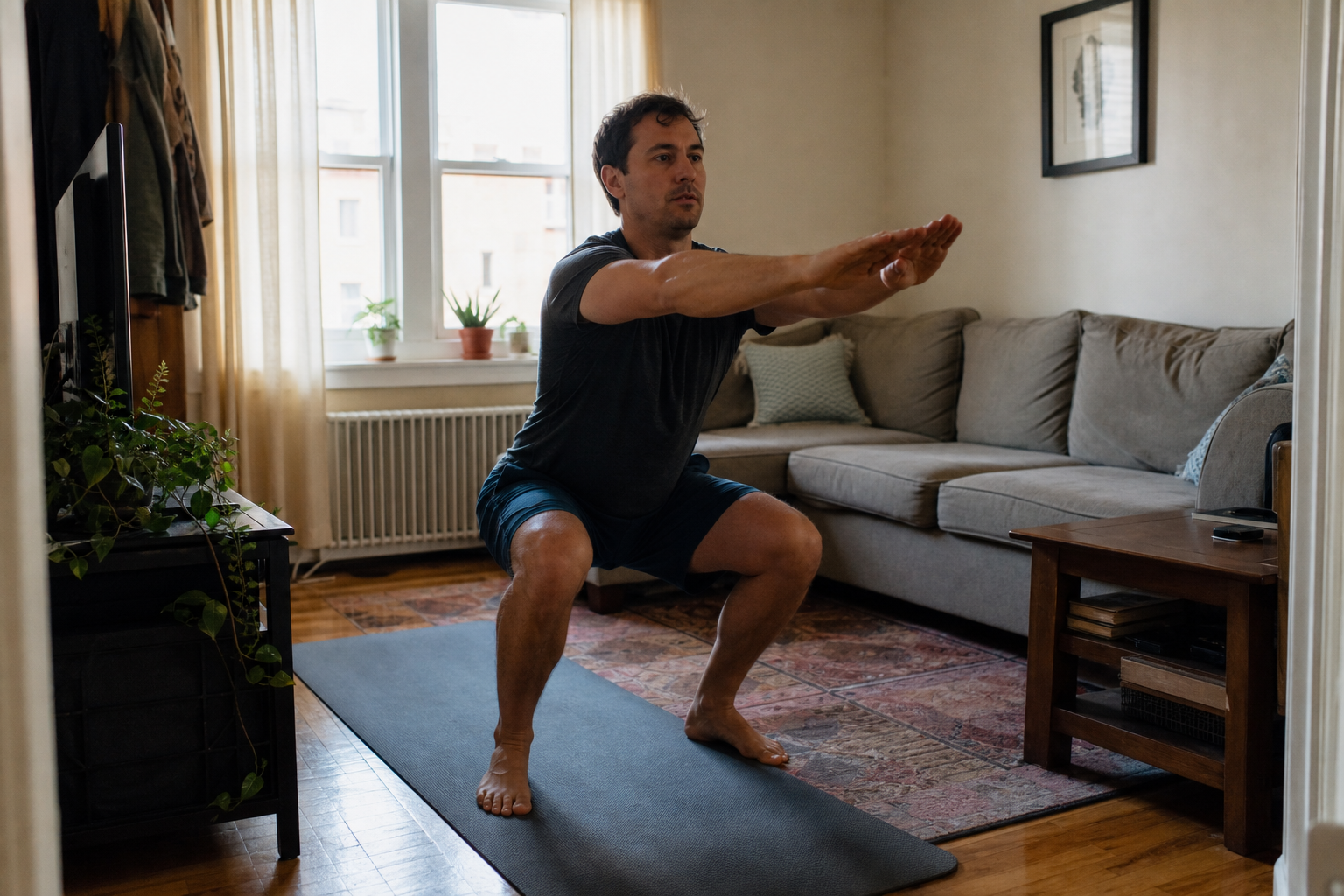
Aim for 2–3 sessions per week with at least one full rest day between sessions. This frequency gives your muscles time to recover and adapt — which is where actual strength gains happen.
Week 1: Foundation
Focus entirely on form this week. Use the easiest variation of each exercise. Moving correctly matters more than moving fast or doing more reps.
| Exercise | Sets | Reps / Duration | Rest | Beginner Modification |
|---|---|---|---|---|
| Wall push-up or incline push-up | 2 | 8–10 reps | 60 sec | Use a higher surface (wall or countertop) to reduce load |
| Bodyweight squat | 2 | 10 reps | 60 sec | Hold a stable surface lightly for balance if needed |
| Glute bridge | 2 | 10 reps | 60 sec | Keep feet flat, press through heels |
| Reverse lunge | 2 | 8 reps each leg | 60 sec | Step back only as far as comfortable; hold a wall for balance |
| Plank (from knees) | 2 | 15–20 sec | 60 sec | Keep hips level, don't let lower back sag |
Week 2: Add Volume
Same exercises, slightly more demand. Add 2 reps to each exercise and extend plank holds by 5 seconds. If wall push-ups felt easy last week, move to incline push-ups (hands on a chair or low table).
| Exercise | Sets | Reps / Duration | Rest | Progression from Week 1 |
|---|---|---|---|---|
| Incline push-up | 2 | 10–12 reps | 60 sec | Move from wall to lower surface |
| Bodyweight squat | 2 | 12 reps | 60 sec | Add a 1-second pause at the bottom |
| Glute bridge | 2 | 12 reps | 60 sec | Add a 2-second hold at the top |
| Reverse lunge | 2 | 10 reps each leg | 60 sec | Deepen the step back slightly |
| Plank (from knees) | 2 | 20–25 sec | 60 sec | Focus on a straight line from knees to head |
Week 3: Harder Variations and a Third Round
Introduce more challenging exercise variations and add a third set. Reduce rest to 45 seconds between sets.
| Exercise | Sets | Reps / Duration | Rest | Progression from Week 2 |
|---|---|---|---|---|
| Knee push-up | 3 | 10–12 reps | 45 sec | Move from incline to floor, knees down |
| Paused squat (3-sec hold) | 3 | 10 reps | 45 sec | Hold at 90 degrees for 3 seconds each rep |
| Single-leg glute bridge | 3 | 8 reps each leg | 45 sec | Extend one leg while bridging |
| Reverse lunge with knee drive | 3 | 8 reps each leg | 45 sec | Drive the back knee up to hip height on return |
| Plank (full or from knees) | 3 | 25–30 sec | 45 sec | Progress to full plank if ready |
Week 4: Density and Control
Switch from rep counts to timed work intervals. Work for 40 seconds, rest for 20 seconds. Three rounds. This increases total volume and introduces a conditioning element without requiring more time.
| Exercise | Rounds | Work | Rest | Target Variation |
|---|---|---|---|---|
| Push-up (knee or full) | 3 | 40 sec | 20 sec | Full push-up if ready; knee push-up if not |
| Squat | 3 | 40 sec | 20 sec | Controlled pace, full depth |
| Glute bridge or single-leg bridge | 3 | 40 sec | 20 sec | Single-leg for more challenge |
| Reverse lunge | 3 | 40 sec | 20 sec | Alternate legs each rep |
| Plank | 3 | 40 sec | 20 sec | Full plank; drop to knees if form breaks |
How to Keep Getting Stronger Without Equipment
Progressive overload is the principle behind all strength training: your body adapts to a given challenge, so you need to gradually increase the challenge to keep improving. With weights, you add plates. Without weights, you use four other levers.
- More reps: If you did 10 squats last session, do 12 this session. The simplest progression.
- Slower tempo: Take 3–4 seconds to lower into a squat or descend into a push-up. Slower eccentric (lowering) phase increases time under tension and makes the same exercise significantly harder.
- Shorter rest: Reduce rest intervals from 60 seconds to 45 to 30. Same total work, less recovery — increases cardiovascular and muscular demand.
- Harder variation: Move to a more demanding version of the same movement pattern. The push-up progression is the clearest example.
- Increased range of motion: Squat deeper, lunge lower, hold the end position longer. More range recruits more muscle through a longer movement arc.
Change only one variable per session. An extra rep, a slower tempo, or a harder variation — not all three at once. This lets you track what's actually working and prevents doing too much too soon.
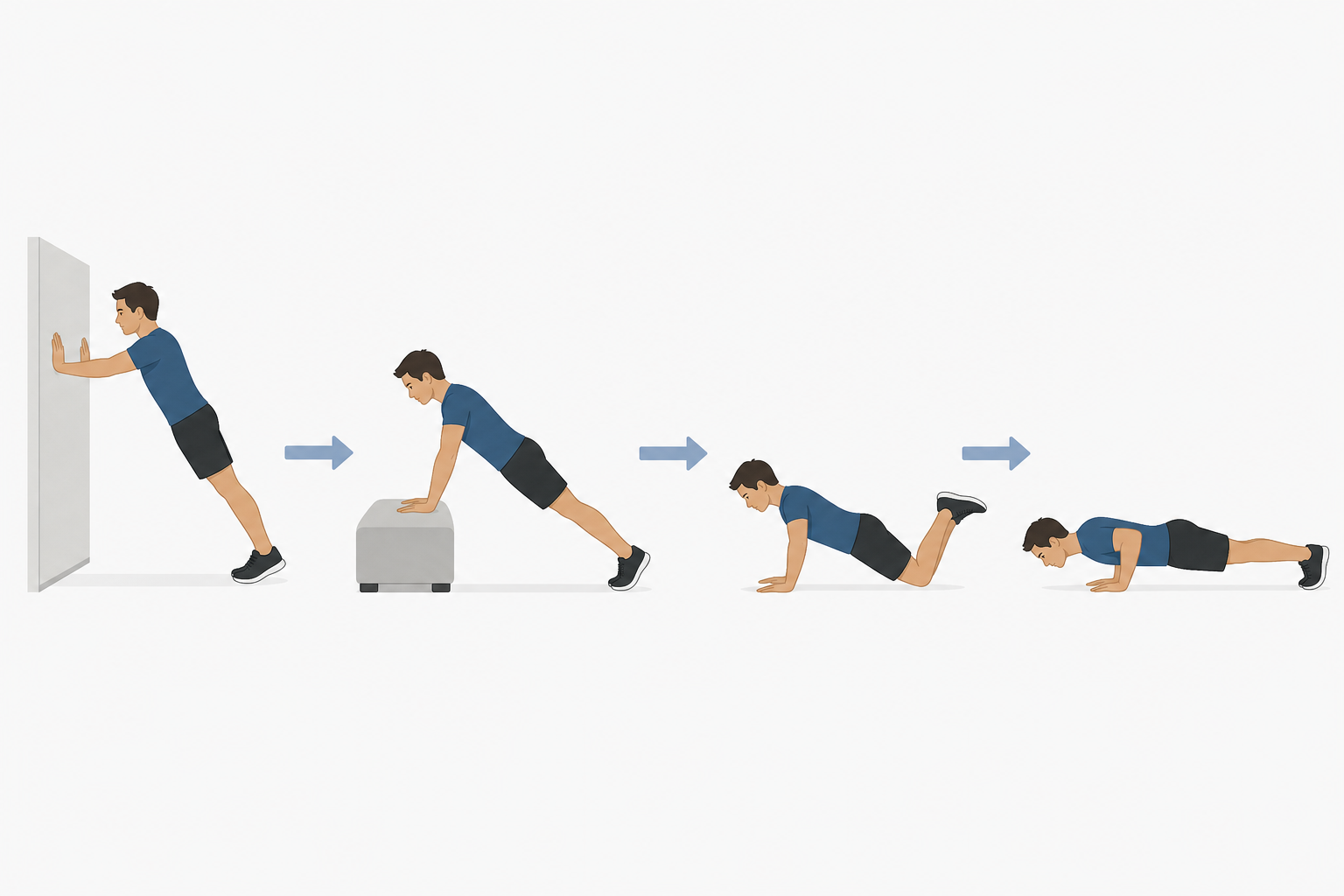
The push-up sequence above is the most practical illustration of bodyweight progression. Most beginners start somewhere on the left side of that ladder. After four weeks of consistent training, most will move at least one step to the right. That movement is strength gain — measurable, real, and achieved without any equipment.
Building the Workout Habit in the First 30 Days
Research from the European Journal of Social Psychology found that forming a new habit takes an average of 66 days. The first 30 days are the highest-dropout window — the period when the behavior hasn't yet become automatic and motivation alone isn't enough to sustain it. Knowing this changes how you approach those first weeks.
Use Scheduling Triggers, Not Willpower
Attach your workouts to something that already happens consistently — right after you wake up, during your lunch break, or immediately after work before you sit down. Same time, same days, every week. When exercise is a scheduled event rather than a decision you make fresh each day, you remove the friction that causes most beginners to skip.
The Minimum Viable Session
On days when motivation is low or time is short, a 10-minute session still counts. The habit is built by showing up, not by hitting a specific duration every time. A short session maintains the behavioral pattern; skipping breaks it.
When You Miss a Session
Resume on your next scheduled day. Do not try to double up or make up for missed sessions — that's how beginners end up doing too much in a single week and getting sore enough to skip the following week. One missed session has no measurable effect on your fitness. A pattern of doubling up to compensate does.
Common Beginner Mistakes to Avoid
Doing Too Much Too Soon
The single most common reason beginners quit within the first two weeks is excessive soreness from starting too hard. Mayo Clinic recommends increasing activity level by no more than 10% per week to prevent injury. The 4-week plan above is intentionally conservative in Week 1 for this reason.
Skipping the Warm-Up
Jumping straight into squats and push-ups with cold muscles increases injury risk and reduces the quality of the workout. The 5–7 minute dynamic warm-up described earlier is not extra time — it's the first part of the session.
Skipping Rest Days
Strength improvements happen during recovery, not during the workout itself. Training every day without rest disrupts the repair process and can lead to overtraining syndrome — a state of hormonal disruption (elevated cortisol, suppressed testosterone) that causes persistent soreness, reduced motivation, and in some cases weeks of forced rest. Two to three sessions per week with rest days between them is the recommended beginner frequency.
Expecting Overnight Visible Results
The timeline for results is predictable, and knowing it prevents early dropout:
- Energy, sleep, and mood improvements: often noticeable within 7–10 days of consistent training.
- Strength improvements (neuromuscular): typically appear in 2–3 weeks — you'll be able to do more reps or use harder variations.
- Visible body composition changes: require a minimum of 6–8 weeks of consistent training and appropriate nutrition.
What to Do After Your First 4 Weeks
Completing this plan means you've established a consistent movement habit and built a foundation of bodyweight strength. The logical next steps depend on what you want to focus on:
- More workout variety: The Workout Routines section of this site contains structured single-session routines organized by fitness level, training style, and duration — useful for adding variety once you've completed this plan.
- A structured multi-week program: If you want a complete week-by-week schedule with built-in progression logic, the Training Plans section covers 4-week, 6-week, and 8-week programs at beginner through intermediate levels.
- Adding equipment to your space: If you're ready to invest in resistance bands, dumbbells, or other equipment, the Small-Space & Home Gym Setup guides cover what to buy based on your room size and budget tier.
- Tracking your training: The Fitness Apps section covers free and paid options for logging workouts and tracking progress, organized by features and platform compatibility.
Frequently Asked Questions
- How many days per week should I work out as a beginner? Start with 2–3 sessions per week with at least one full rest day between sessions. This frequency is sufficient to drive adaptation and low enough to avoid the overuse soreness that causes early dropout.
- How long should each session be? 20–25 minutes including warm-up and cool-down is an effective and realistic starting point. The U.S. Physical Activity Guidelines recommend working toward at least 150 minutes of moderate activity per week total — 3 sessions of 20–25 minutes gets you there.
- Do I need any equipment? No. The 4-week plan above requires nothing. A yoga mat is helpful for floor exercises but not required. Resistance bands and light dumbbells are optional upgrades worth considering after you've completed the initial plan.
- When will I see results? Energy and mood improvements often appear within the first 7–10 days. Measurable strength gains — being able to do more reps or harder variations — typically show within 2–3 weeks. Visible body composition changes require a minimum of 6–8 weeks of consistent training.
This is general fitness education, not medical advice. For diagnosis or treatment of pain or injury, consult a qualified clinician.
Pick your next session
Browse all routines to find an appropriately-spaced next session.
Spot something off?
This content sits adjacent to health guidance — tell us if a citation or figure needs a correction.