
Garage Gym Equipment Tier System: What to Buy First, Second, and Third Based on Your Training Goals
A practical guide for beginners and intermediate home gym builders that uses a community-backed tier system (must-have, should-have, nice-to-have, avoid) to help you buy equipment in the right order—so every purchase serves a real training need and nothing is wasted.
- Budget tier
- $1,000–$3,000
- Space type
- garage
Items included: —
Why a Tier System Beats a Budget Breakdown
Walk into any garage gym discussion online and you will see the same question repeated: "I have $1,000. What should I buy first?" The standard answer is a budget-tier list — $500 gets you this, $1,000 gets you that, $1,500 gets you everything. That approach works if your only constraint is money. But most people building a garage gym have two other constraints that matter more: training goals and available space. A budget-tier list cannot tell you whether to buy a rower or a specialty barbell because it does not know whether you are training for a CrossFit competition or a powerlifting meet.
The community-backed tier system — developed and refined on forums like r/homegym and codified by sites like Garage Gym Athlete — solves this by organizing equipment by training value per dollar, not by price bracket. Every piece of gear falls into one of four tiers:
- Tier 1 — Must-Have: The equipment that covers 80% or more of your training needs with just four categories (rack, barbell, plates, bench) plus floor protection.
- Tier 2 — Should-Have: Affordable, highly versatile additions (bands, rings, kettlebells, jump rope) that unlock new movement patterns and training modalities.
- Tier 3 — Nice-to-Have: Goal-specific expansions (specialty bars, cardio machines, plyo boxes) that add variety and specialization once the foundation is solid.
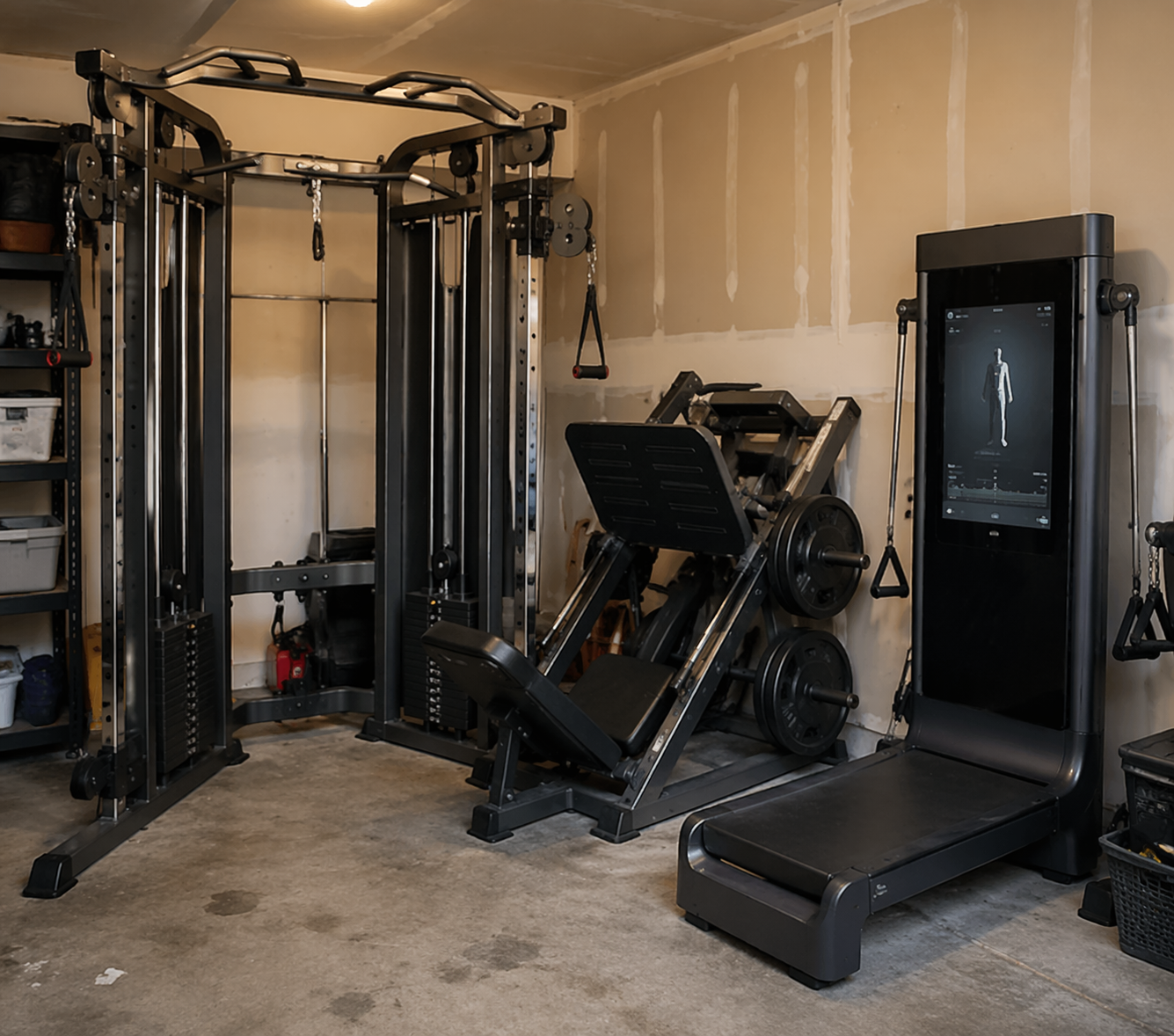
- Tier 4 — Avoid: Expensive, space-hungry equipment with limited utility per dollar (standalone cable machines, leg press, most all-in-one smart gyms with subscriptions).
The logic is simple: buy in the order that maximizes training output per dollar spent. A $380 power rack and a $250 barbell serve every major compound lift. A $1,200 cable machine serves a handful of isolation movements. The tier system forces you to ask "What will I use most?" before asking "What can I afford?"
If you are brand new to home gym planning, you may also want to read The Complete Garage Gym Equipment Checklist for a broader overview before diving into the tiered approach.
Tier 1: The Non-Negotiables (Must-Have Equipment)
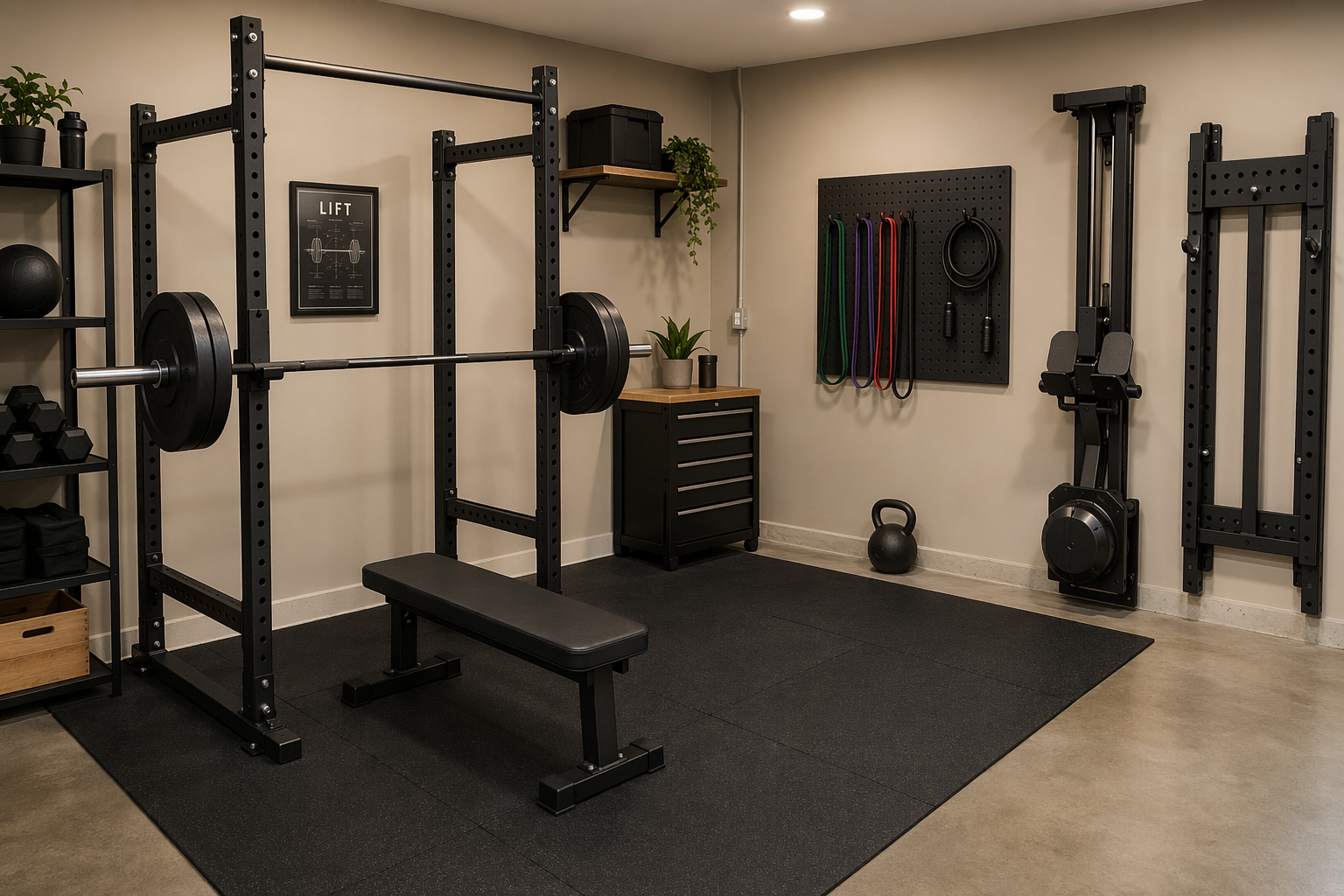
Tier 1 is the foundation. These five items — power rack, barbell, weight plates, flat bench, and floor protection — form a complete strength training setup that can handle every major compound movement: squat, bench press, deadlift, overhead press, and pull-ups (if the rack has a pull-up bar). Everything else you add later is a supplement to this core.
Power Rack
The power rack is the centerpiece of any garage gym. It provides safety catches for squats and bench press, a pull-up bar, and a mounting point for bands and accessories. The REP PR-1100 Power Rack is widely considered the best budget option at roughly $380 with a 700-lb weight capacity. It accepts standard attachments and includes a pull-up bar. If your budget allows, stepping up to a rack with a higher weight capacity (1,000+ lbs) and Westside hole spacing gives you more precise spotter arm placement, but the PR-1100 is sufficient for the vast majority of lifters.
Barbell
A barbell is the single most-used piece of equipment in a strength-focused gym. Joe Gray of Gray Matter Lifting recommends spending between $150 and $200 for a quality barbell that will last. He tested a $45 Walmart barbell that handled 500-lb squats, 330-lb bench presses, and 550-lb deadlifts — but it showed visible wear after a month. That temporary capability is useful if you need to stretch a budget, but a proper barbell in the $150–$200 range (like the Rogue Bar 2.0 at $250, which is above that range but widely considered the gold standard for all-purpose bars) will hold its knurling and spin for years.
Weight Plates
Bumper plates are the standard recommendation for home gyms because they are quieter, more durable on concrete floors, and allow you to drop deadlifts without damaging the plates or the floor. The Fringe Sport Black Bumper Plates (260-lb set) come in at roughly $424 — just over $2 per pound — with a lifetime warranty. If you are on a tighter budget, iron plates are cheaper per pound but louder and harder on floors. Start with a 260-lb set if you are an intermediate lifter; beginners can start with 160–200 lbs and add more later.
Flat Bench
A flat bench is non-negotiable for bench press, dumbbell rows, and seated overhead work. The REP FB-5000 Competition Flat Bench ($245, 1,000-lb capacity) is the top recommendation for its stability, height adjustability, and grippy pad. An adjustable bench is a Tier 3 upgrade — a solid flat bench is the Tier 1 priority.
Floor Protection
Horse stall mats (3/4-inch thick rubber mats available at farm supply stores) are the most economical and durable flooring solution for a garage gym. Two mats, each roughly 4x6 feet, cost about $80 total and protect your concrete floor from dropped weights while providing a stable, non-slip surface. For a detailed breakdown of thickness options and installation, see Home Gym Flooring: A Decision Guide for Thickness, Material, and Budget.
Tier 1 Cost Summary
| Item | Recommended Option | Approximate Cost | Notes |
|---|---|---|---|
| Power Rack | REP PR-1100 | $380 | 700-lb capacity, includes pull-up bar |
| Barbell | Rogue Bar 2.0 or equivalent | $150–$250 | Minimum $150 for long-term durability |
| Bumper Plates | Fringe Sport 260-lb set | $424 | Lifetime warranty, ~$2/lb |
| Flat Bench | REP FB-5000 | $245 | 1,000-lb capacity, competition-grade |
| Floor Mats | Horse stall mats (2 mats) | $80 | 3/4-inch thick, farm supply stores |
| Total | ~$1,279–$1,379 | Prices as of June 2026 |
Tier 2: High-Value Additions Under $150 (Should-Have Equipment)
Once your Tier 1 foundation is in place, Tier 2 items add versatility and new training modalities at a remarkably low cost. According to Garage Gym Athlete, most Tier 2 items can be added for under $150 total. These are not luxury upgrades — they are tools that unlock movements your Tier 1 setup cannot easily replicate.
Resistance Bands
A set of resistance bands ($20–$50) is the most space-efficient Tier 2 purchase. A 2019 systematic review in SAGE Open Medicine found that resistance band training produces similar strength gains to traditional free-weight training, making bands a legitimate training tool, not just a warm-up accessory. Use them for banded pull-ups, banded squats, face pulls, and glute activation work. They store in a drawer and weigh nothing.
Gymnastic Rings
Gymnastic rings ($40) turn your power rack's pull-up bar into a full upper-body training station. Ring rows, ring push-ups, ring dips, and ring muscle-ups (for advanced athletes) build serious shoulder stability and core strength. They are also the most portable piece of gym equipment you can own — they pack into a small bag and can be hung from any sturdy overhead structure.
Kettlebell (Single, at the "10-Not-11" Weight)
A single kettlebell at your "10-not-11" weight — meaning a weight you can clean and press 10 times with your dominant arm but not 11 times — is the most versatile Tier 2 purchase per many garage gym coaches. It enables strength work (swings, cleans, presses), conditioning (snatches, high-rep swings), and power work (kettlebell jumps, explosive swings) in one tool. The Rogue E-Coat Kettlebells start at $48 for 9 lbs and go up to 88 lbs. For most men, a 53-lb kettlebell ($63) is the right starting point; for most women, a 35-lb kettlebell works well.
Jump Rope
A jump rope ($10–$19) is the cheapest cardio tool you can buy. The WOD Nation Double Under Speed Rope ($18.99) is a popular choice with adjustable length and smooth bearings. Ten minutes of jump rope work between sets or as a finisher adds a conditioning component that your barbell work does not provide.
| Item | Approximate Cost | Training Value |
|---|---|---|
| Resistance Bands (set) | $20–$50 | Strength gains comparable to free weights (2019 systematic review) |
| Gymnastic Rings | $40 | Upper-body stability, portability, infinite progression |
| Kettlebell (single) | $48–$63 | Strength + conditioning + power in one tool |
| Jump Rope | $10–$19 | Cheapest cardio tool, high calorie burn per minute |
| Total | ~$118–$172 | Complete Tier 2 set for under $175 |
Tier 3: Goal-Specific Expansions (Nice-to-Have Equipment)
Tier 3 is where your training goals start to dictate your purchases. These items are not essential — you can run a highly effective program with just Tier 1 and Tier 2 equipment — but they add variety, specialization, and convenience. The key rule: do not buy Tier 3 until Tier 1 and Tier 2 are solidly in place.
Specialty Barbells
A safety squat bar, trap bar (hex bar), or Swiss bar can unlock new movement patterns and reduce joint stress. Powerlifters often add a deadlift bar with more whip for competition prep. Bodybuilders may prefer a multi-grip bar for tricep and chest work. These bars cost $200–$500 and take up floor space, so they only make sense if you have a specific training need that your straight barbell cannot meet.
Cardio Machines
An air bike (like the Rogue Echo Bike or Schwinn Airdyne) or a rower (Concept2 RowErg) adds dedicated conditioning work that complements strength training. These machines cost $700–$1,000 and take up significant floor space — roughly 4x8 feet for a rower, 4x5 feet for an air bike. They are Tier 3 because you can achieve excellent conditioning with kettlebells, jump rope, and barbell complexes alone. Buy one only if you have the space and a clear conditioning goal.
Plyo Box and Recovery Tools
A plyo box ($80–$200) enables box jumps, step-ups, and explosive work. Foam rollers, lacrosse balls, and percussion massagers ($30–$200) support recovery. These are genuinely useful but completely optional — you can do box jumps onto a sturdy bench and use a tennis ball for trigger point work.
Tier 4: What to Skip (Equipment to Avoid Until You Have Everything Else)
Tier 4 is the trap zone. These are the machines that look impressive in a commercial gym but make poor early purchases for a garage gym. They are expensive, space-hungry, and have limited utility per dollar compared to Tier 1 and Tier 2 alternatives.
- Standalone cable machines: A dedicated cable crossover machine costs $1,000–$3,000 and takes up 20+ square feet. You can achieve 90% of the same movements with resistance bands anchored to your power rack.
- Leg press machines: These are massive, heavy, and serve one movement pattern. Barbell squats, front squats, and Bulgarian split squats work the same muscles with far less equipment.
- Stair-masters and ellipticals: These are cardio machines that take up significant floor space and provide no strength benefit. A jump rope, kettlebell, or air bike delivers better conditioning per square foot.
- Most all-in-one smart home gyms with subscriptions: Systems like Tonal, Mirror, and others require a monthly subscription ($30–$60/month), have limited weight resistance (often 100–200 lbs), and cannot replicate the full range of barbell training. For the same total cost over 3–5 years, you can build a Tier 1 + Tier 2 setup that serves you indefinitely with no ongoing fees.
For a deeper analysis of why all-in-one systems generally do not compete with separate equipment, see All-in-One Home Gym vs. Separate Equipment: Which Builds a Better Home Gym for Your Money?.
How Your Training Goal Changes the Tier Priority
The tier system is not one-size-fits-all. The priority within each tier shifts depending on whether you train for powerlifting, CrossFit, bodybuilding, or general fitness. A powerlifter needs a competition-grade barbell and a flat bench before anything else. A CrossFitter needs bumper plates and a pull-up bar before a specialty bar. A bodybuilder may prioritize an adjustable bench and cable attachments earlier than a powerlifter would.
The table below shows how the same four tiers reorder based on your primary training style. Items listed higher in each column should be purchased before items listed lower.
| Priority Order | Powerlifting | CrossFit | Bodybuilding | General Fitness |
|---|---|---|---|---|
| Tier 1 (Must-Have) | Barbell (competition-grade), Power Rack, Bumper Plates, Flat Bench, Floor Mats | Barbell, Bumper Plates, Pull-Up Bar (on rack), Kettlebell, Floor Mats | Barbell, Power Rack, Bumper Plates, Flat Bench, Floor Mats | Barbell, Power Rack, Bumper Plates, Flat Bench, Floor Mats |
| Tier 2 (Should-Have) | Resistance Bands, Gymnastic Rings, Kettlebell, Jump Rope | Gymnastic Rings, Resistance Bands, Jump Rope, Multiple Kettlebells | Resistance Bands, Kettlebell, Gymnastic Rings, Jump Rope | Kettlebell, Resistance Bands, Jump Rope, Gymnastic Rings |
| Tier 3 (Nice-to-Have) | Deadlift Bar, Safety Squat Bar, Competition Bench | Rower, Air Bike, Plyo Box, Sandbag | Adjustable Bench, Cable Attachments, Dumbbells (adjustable), Lat Pulldown | Air Bike, Plyo Box, Foam Roller, Adjustable Dumbbells |
| Tier 4 (Avoid) | Cable Machine, Leg Press, Smart Home Gym | Leg Press, Stair-Master, Elliptical, Smart Home Gym | Leg Press, Stair-Master, Elliptical, Smart Home Gym | Cable Machine, Leg Press, Stair-Master, Smart Home Gym |
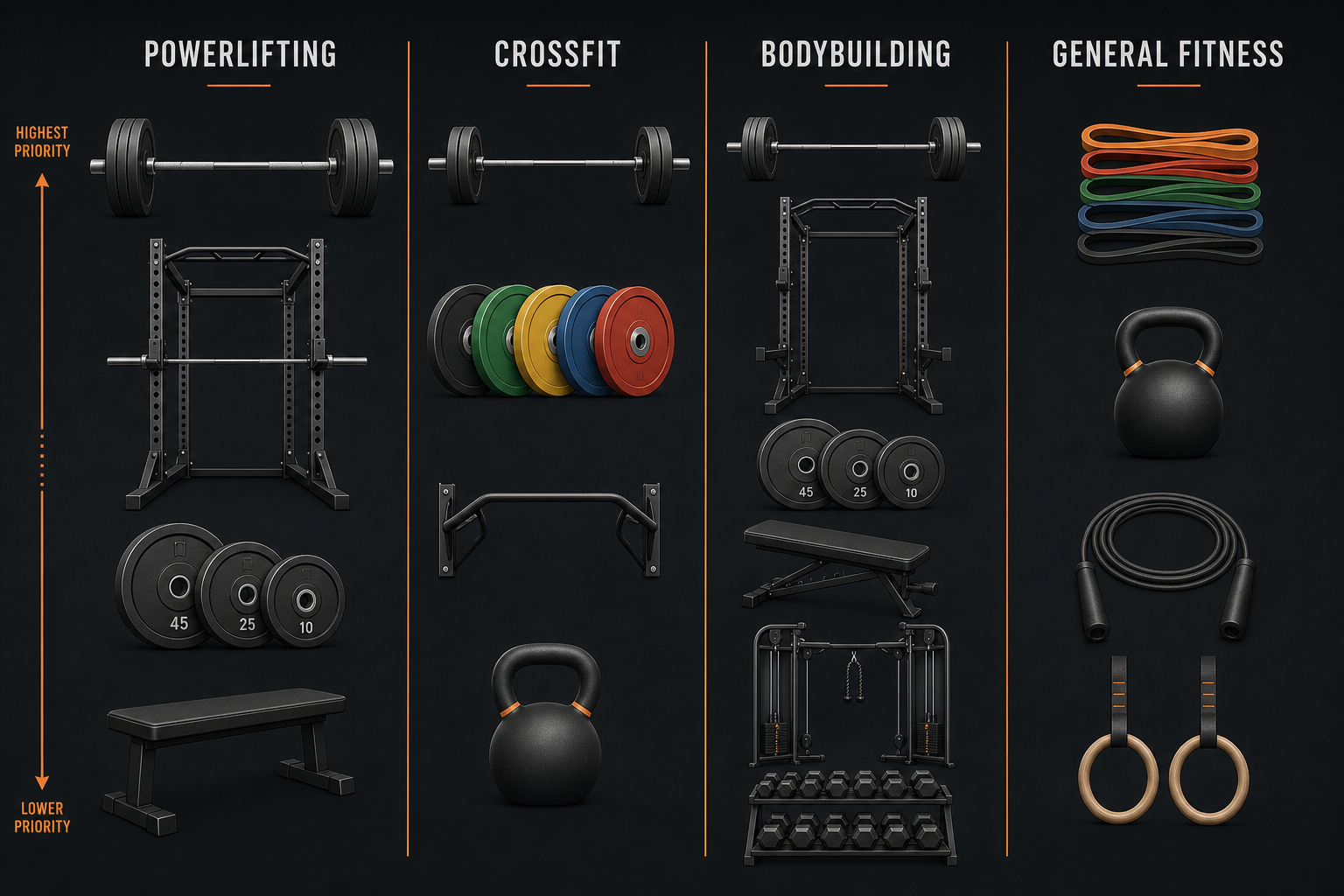
The key takeaway: do not copy someone else's equipment list. A CrossFitter's Tier 3 purchase (a rower) is a bodybuilder's Tier 4 purchase (if they never do cardio). Know your goal, then apply the tier system to your specific needs.
A Sample 6-Month Build-Out Plan
The tier system works best when you treat it as a timeline, not just a shopping list. Here is a realistic 6-month build-out plan that follows the tier order and respects a typical monthly budget of $200–$300.
- Month 1 — Tier 1 Foundation: Buy the power rack ($380), barbell ($200), and floor mats ($80). Total: ~$660. You can now do squats, bench press, and deadlifts with just the bar. Add a cheap set of used plates from Craigslist or Facebook Marketplace if your budget allows.
- Month 2 — Tier 1 Completion: Buy the bumper plate set ($424) and flat bench ($245). Total: ~$669. Your Tier 1 setup is now complete. You can run any beginner strength program (Starting Strength, StrongLifts 5x5, or a 5/3/1 variant) with full equipment.
- Month 3 — Tier 2 Additions: Buy resistance bands ($35), gymnastic rings ($40), a kettlebell ($63), and a jump rope ($19). Total: ~$157. Your training options expand dramatically — conditioning, pull-up variations, banded work, and kettlebell complexes are now available.
- Month 4–5 — Training and Assessment: Train consistently for two months with your Tier 1 + Tier 2 setup. Identify gaps: Do you need more weight on the bar? Is your barbell showing wear? Do you want a dedicated cardio machine? Do not buy anything during this period unless something breaks.
- Month 6 — Tier 3 Goal-Specific Purchase: Based on your training assessment, buy one Tier 3 item. If you are a CrossFitter, get a rower ($900) or air bike ($800). If you are a powerlifter, get a deadlift bar ($300). If you are a bodybuilder, get an adjustable bench ($300–$500) or adjustable dumbbells ($336+).
When and How to Upgrade Gear Over Time
The tier system is not a one-and-done purchase plan. As your training progresses, your equipment needs will change. The key is to upgrade based on training plateaus or goal changes, not budget milestones.
Signs It Is Time to Upgrade
- Barbell: Upgrade when the knurling wears smooth, the shaft starts to bend under heavy loads, or the sleeves stop spinning freely. A $150–$200 barbell should last 3–5 years with regular use. If you bought a budget bar ($45–$100), expect to replace it sooner.
- Rack: Upgrade when you outgrow the weight capacity (e.g., you are squatting 600+ lbs on a 700-lb rack) or when you need features like Westside hole spacing, a monolift attachment, or a spotter platform.
- Plates: Upgrade when you need more weight than your current set allows, or when you want to switch from iron to bumper plates for quieter training.
- Bench: Upgrade when the pad compresses under heavy loads, the frame wobbles, or you need an adjustable bench for incline work.
- Goal change: If you switch from general fitness to powerlifting, your Tier 3 priorities shift. If you add CrossFit-style conditioning, a rower or air bike moves up your priority list.
The most common upgrade mistake is buying a "better" version of something you already own before you have actually outgrown the current version. A $250 Rogue Bar 2.0 does not make your $150 barbell obsolete — it makes a marginal difference in knurling feel and spin. Upgrade only when your current gear limits your training, not when a new model catches your eye.
For a complete breakdown of long-term costs and when replacement makes financial sense, read The Hidden Costs of Home Gym Equipment: A 5-Year Total Cost of Ownership Guide.
The tier system gives you a framework for making these decisions without second-guessing. When you know that Tier 1 covers 80% of your training needs, you can confidently spend months or years training on that foundation before adding Tier 3 items. When you know that Tier 4 items are traps, you can ignore the marketing and focus on what actually moves the needle in your training.
Some links on this page are affiliate links — they may earn us a commission at no extra cost to you. Our tier and tests are decided before we ever check which links pay; see our full affiliate disclosure.
Spot something off?
Noise and floor-damage claims carry real deposit-risk consequences if we get them wrong — tell us if your experience with this build didn't match what's above.