
The Complete Garage Gym Equipment Checklist: What You Actually Need (and Don't Need) in 2026
Overwhelmed by equipment choices? This garage-gym-specific checklist organizes must-have gear by budget tier ($500–$3,000+), explains what to skip, and includes a training-style flowchart to help beginners build a phased, waste-free home gym.
- Budget tier
- $500–$3,000+
- Space type
- garage
Items included: —
Why Garage Gyms Are Booming in 2026
The shift toward training at home has moved past being a pandemic-era trend into a permanent fixture of how people approach fitness. For homeowners and renters with garage access, the appeal is straightforward: no commute, no waiting for a squat rack, and no monthly fee that creeps up year after year. According to the 2024 U.S. Health & Fitness Consumer Report, the average gym membership now costs roughly $65 per month. Over five years, that adds up to nearly $4,000 — before factoring in gas, annual fees, or the inevitable price hikes.
A well-planned garage gym, by contrast, can be built for well under half that amount and retains resale value on most of its components. The real trap, however, is buying too much too fast. The most common mistake among first-time builders is purchasing a long list of equipment before they have a clear sense of what their training actually demands. The smarter approach — and the one this guide is built around — is a phased build: start with the essentials, train for a few months, then add only what fills a genuine gap in your workouts.
The Minimum Viable Garage Gym ($500–$1,000)
The core thesis of a phased build is that four pieces of equipment — a power rack, a barbell, weight plates, and an adjustable bench — can support roughly 90% of effective strength workouts. Everything beyond that is either a convenience upgrade or a tool for a specific training style. At this budget tier, you are not looking for luxury finishes or brand prestige. You are looking for safe, durable gear that will not need replacing in six months.
Here is a realistic breakdown of what a $500–$1,000 build looks like with mid-2026 pricing:
| Item | Recommended Model | Approx. Price | Key Specs |
|---|---|---|---|
| Power Rack | REP PR-1100 | $380 | 700-lb capacity, 14-gauge steel, limited lifetime warranty |
| Barbell | Synergee Games Cerakote Barbell | ~$180 | 190,000 PSI tensile strength, lifetime warranty |
| Bumper Plates (260 lbs) | Fringe Sport Black Bumper Plates | ~$2.20/lb (~$572) | Durometer 90 (10-15 lb plates), lifetime warranty |
| Adjustable Bench | Major Fitness Adjustable Bench | $220 | 1,300-lb weight capacity |
| Total | ~$1,352 |
If $1,350 is over your initial budget, you can trim costs by buying a lighter plate set (e.g., 160 lbs) and adding more later. The REP PR-1100 rack, rated 4.3/5 by Garage Gym Reviews, is widely considered the best value entry-level rack on the market. The Synergee Games barbell, scoring 4.7/5, offers a 190,000 PSI tensile strength that rivals bars costing twice as much. The Major Fitness bench, at $219.99 with a 1,300-lb capacity, is a solid platform that will not wobble under heavy loads.
One critical note: do not buy standard 1-inch hole plates. Olympic plates (2-inch hole) are the industry standard, and every quality barbell and rack in 2026 uses a 2-inch sleeve. Standard plates are a dead end — they will not fit an Olympic bar, and they have almost no resale value.
The Intermediate Upgrade ($1,500–$3,000)
Once you have been training on the minimum viable setup for a few months, you will start to notice specific limitations. Maybe you want to do lateral raises without balancing a dumbbell, or you need a way to add volume to accessory work without spending an hour changing plates. This is the stage where targeted upgrades make sense — not because a marketing list told you to buy them, but because your training is asking for them.
The most common intermediate additions include:
- Adjustable dumbbells — The REP QuickDraw Adjustable Dumbbells (40-lb pair, $416) score 4.5/5 and come with a lifetime warranty that covers drops. They replace an entire rack of fixed dumbbells and take up a fraction of the floor space.
- A cable tower or functional trainer — The REP Ares 2.0, scoring 4.5/5, offers dual 260-lb weight stacks (upgradable to 310 lbs) with a lifetime warranty. The Bells of Steel All-in-One Home Gym starts at $1,299.99 and scored 4.2/5. Both add cable movements — lat pulldowns, rows, tricep pushdowns — that are difficult to replicate with free weights alone.
- Proper flooring — This is not a luxury; it is a safety and noise-control necessity. Tractor Supply 3/4" rubber stall mats cost $2.38 per square foot, score 4.5/5, and are widely considered the best value in garage gym flooring. A 2025 study confirmed that rubber flooring significantly reduces impact noise, which matters if your garage shares a wall with a living space.
At this tier, you should also consider a plate storage tree or wall-mounted plate rack. Keeping plates off the floor reduces clutter and makes it easier to change weights quickly. A simple vertical storage rack costs $50–$100 and is one of the highest-ROI purchases you can make for gym organization.
The Fully Equipped Garage ($3,000+)
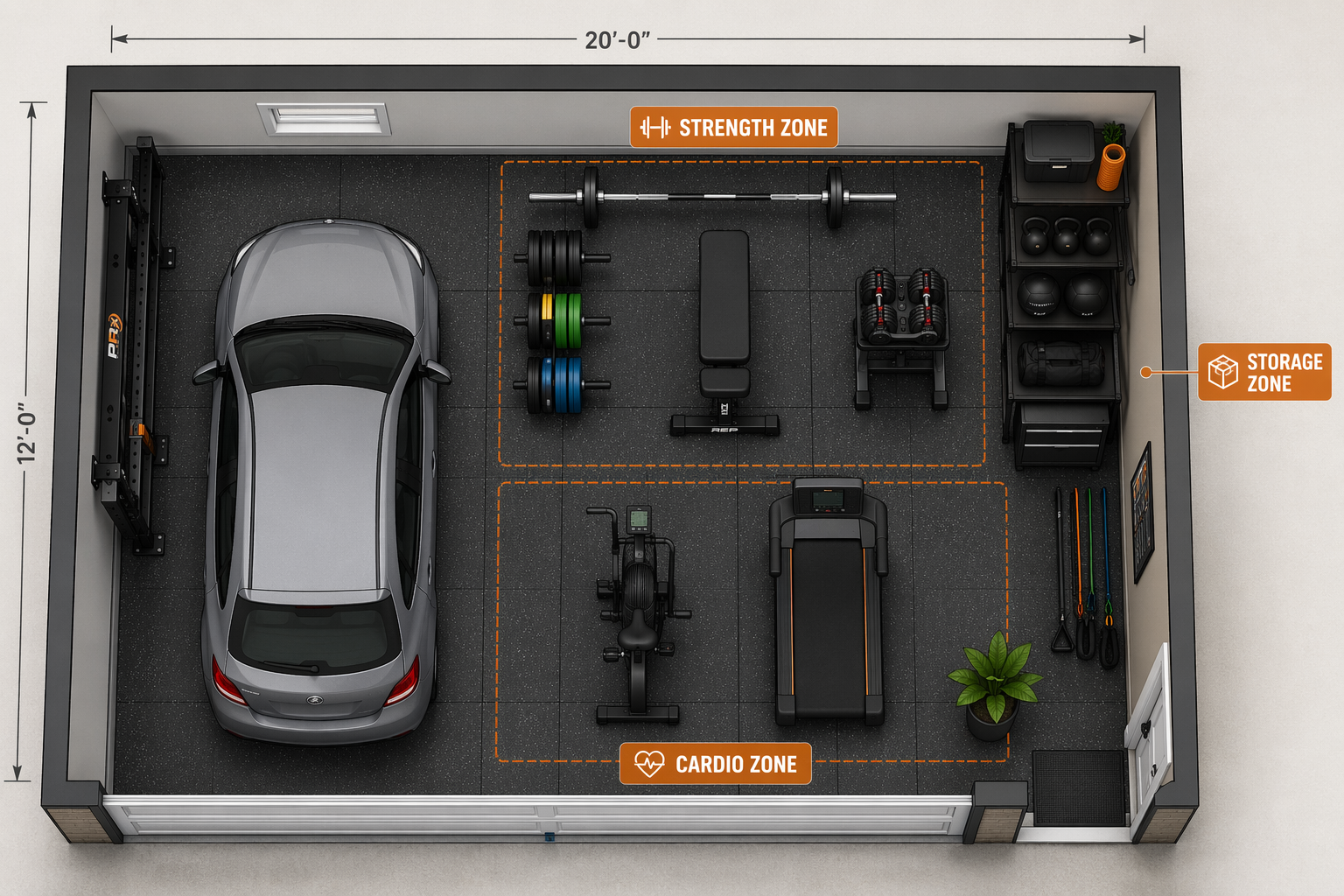
At the $3,000+ level, you are no longer filling gaps — you are optimizing for convenience, space efficiency, and training variety. The defining characteristic of this tier is that every piece of equipment earns its square footage. If you cannot park a car in the garage after the build, you have probably overbuilt.
Key upgrades at this tier include:
- A wall-mounted folding rack — The PRx Profile PRO Squat Rack scores 4.6/5 with perfect marks for footprint, stability, and construction. It has a 1,000-lb weight capacity, folds to just 9 inches deep, and costs $1,099.99. When folded, you can park a car in front of it. This is the gold standard for garage gyms that need to double as parking spaces.
- A dedicated cardio machine — A rower, assault bike, or treadmill fills the cardio gap that free weights alone cannot cover. Choose based on your training style: rowers are low-impact and full-body, assault bikes are brutal for HIIT, and treadmills are best for steady-state work.
- Wall-mounted storage — Pegboards, slatwall panels, or dedicated storage racks for bands, jump ropes, and accessories keep the floor clear and the gym looking organized.
- Specialty bars — A safety squat bar, a trap bar, or a Swiss bar can add variety to your pressing and squatting without taking up much space.
For a deeper look at space-saving layouts and compact equipment strategies, see our Garage Gym Equipment for Small Spaces: Compact Setup Strategies and Gear for Single-Car Garages. If you are comparing wall-mounted racks against free-standing racks or all-in-one machines, the Four Strategies for a Compact Home Gym article breaks down the trade-offs.
Equipment to Skip (and Why)
A garage gym has finite square footage, and every piece of equipment you buy competes for that space. The following items are common pitfalls that waste both money and floor area:
- Bulky all-in-one machines — Most all-in-one gyms with a single weight stack and a dozen cable attachments take up 20–30 square feet but offer less versatility than a power rack plus a separate cable tower. They are hard to repair, difficult to sell, and often have a low weight capacity that you will outgrow. Our All-in-One Exercise Machine vs. Building a Custom Home Gym analysis covers the cost-benefit breakdown in detail.
- Smith machines — A Smith machine locks the bar into a fixed vertical path, which eliminates the need for stabilizer muscles and can create movement patterns that do not transfer well to real-world lifting. They also take up roughly the same footprint as a power rack but offer far less versatility.
- Leg press machines — Dedicated leg press machines are massive, expensive, and single-purpose. You can achieve the same training stimulus with barbell squats, front squats, Bulgarian split squats, and lunges — all of which use equipment you already own.
- Standard 1-inch hole plates — As noted earlier, these are incompatible with Olympic bars and have negligible resale value. If you already own some, use them as ballast on a plate-loaded machine, but do not build your gym around them.
For a ranking-based perspective on what to buy first and what to skip, see our Garage Gym Equipment Priority Tier List.
Which Training Style Fits You? A Decision Flowchart
Your equipment choices should be driven by how you actually train, not by what looks impressive in a showroom. The flowchart below maps four common training styles to their core equipment needs, helping you match your goals to the right budget tier.
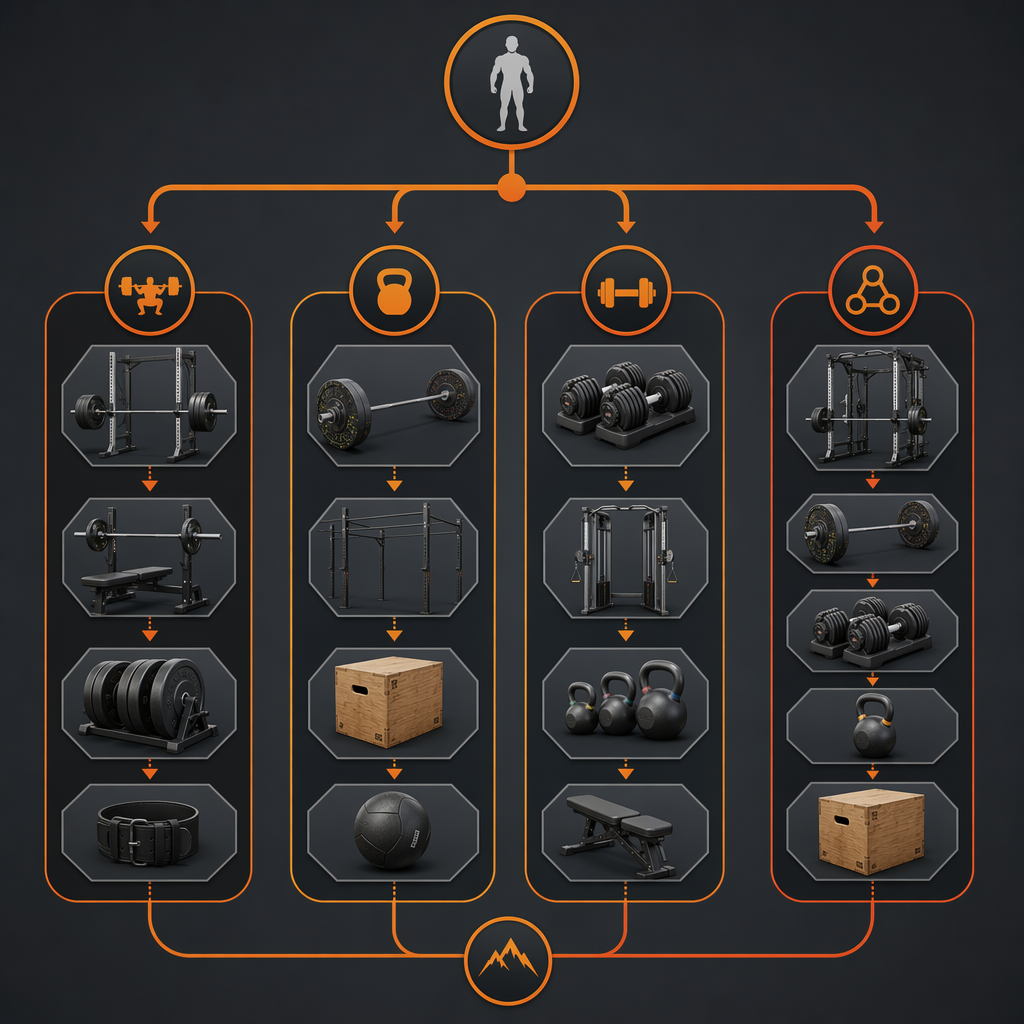
Here is a text summary of the four paths:
- Powerlifting — Core equipment: barbell, squat rack, flat bench, plates. You can compete or train seriously with just the minimum viable setup. Add a deadlift platform or deadlift jack as your total weight increases.
- CrossFit / Functional Fitness — Core equipment: barbell, bumper plates, pull-up rig or rack with pull-up bar, plyo boxes, jump rope. You will need more plate variety (15-lb and 25-lb bumpers for cycling) and a space that allows dropping weights from overhead.
- General Strength & Hypertrophy — Core equipment: adjustable dumbbells, cable tower or functional trainer, kettlebells, resistance bands. This path prioritizes versatility and is the most forgiving of space constraints.
- Hybrid — Core equipment: modular rack with cable system (e.g., REP PR-5000 with Ares 2.0), adjustable dumbbells, barbell and plates, cardio machine. This is the most expensive path but also the most complete — it covers strength, cardio, and accessory work without gaps.
If you are unsure which path fits, start with the minimum viable setup and train for 8–12 weeks. Your training style will reveal itself through the exercises you gravitate toward and the limitations you hit.
Your Phased Build Plan: Next Steps
The phased approach is simple: start with the minimum viable setup, train consistently for at least three months, and add equipment only when your training demands it. This method does three things that a one-time bulk purchase cannot: it saves you money on gear you would not have used, it teaches you what you actually value in a piece of equipment, and it spreads the financial outlay over time.
Here is a summary of the phased build plan:
- Phase 1 ($500–$1,000): Power rack, barbell, plates, adjustable bench. This is your foundation.
- Phase 2 ($1,500–$3,000): Add adjustable dumbbells, a cable tower or functional trainer, and proper flooring. Fill the gaps your training reveals.
- Phase 3 ($3,000+): Upgrade to a wall-mounted folding rack, add a dedicated cardio machine, and invest in storage and specialty bars. Optimize for convenience and space efficiency.
For specific build plans at each tier — including exact product lists and total costs — see our Compact Home Gym Budget Builds: Complete Setups at $500, $1,500, and $3,000. If you are still in the orientation phase and need help deciding between a garage gym and a home gym in a spare room, our Beginner's Hub has decision guides that walk you through the process step by step.
Some links on this page are affiliate links — they may earn us a commission at no extra cost to you. Our tier and tests are decided before we ever check which links pay; see our full affiliate disclosure.
Spot something off?
Noise and floor-damage claims carry real deposit-risk consequences if we get them wrong — tell us if your experience with this build didn't match what's above.