
How to Start a Home Gym in 2026: The Essential Equipment Checklist and Build Sequence
A phased guide for complete beginners on building a home gym without overbuying. Learn the four foundational pieces to start with, when to add more, and how to avoid the most common regret purchases.
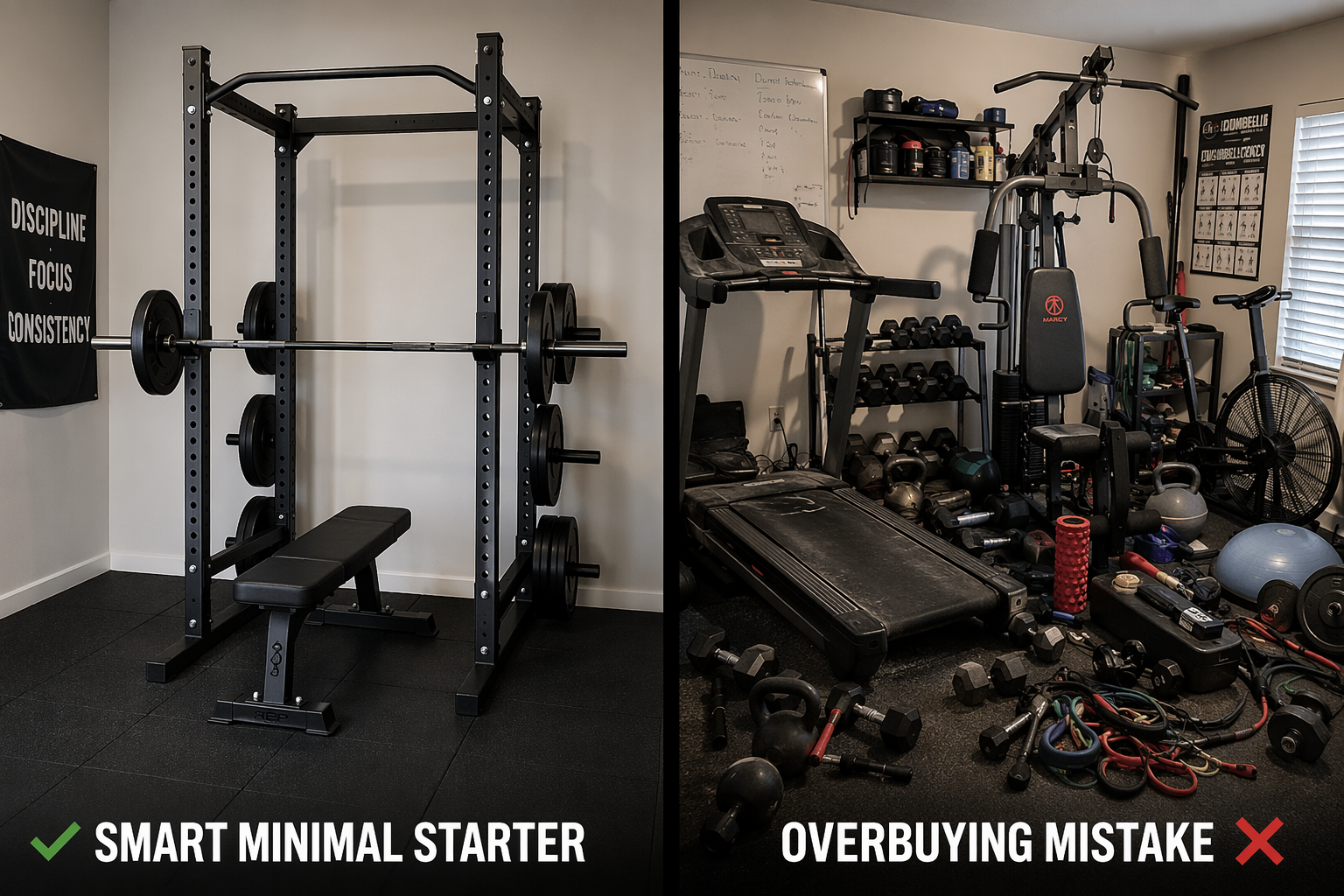
Why Overbuying Is the #1 Mistake New Home Gym Owners Make
Walk into any home gym forum and you will find a recurring confession: "I bought a multi-gym, a treadmill, and a set of fixed dumbbells before I ever touched a barbell. Now half of it is collecting dust." This pattern is so common that it has a name — aspirational overbuying — and it is the single most expensive mistake beginners make.
The evidence for a minimal approach is not theoretical. Coop Mitchell, founder of Garage Gym Reviews, once ran a 90-day experiment using only a barbell, a squat rack, and a pull-up bar. He increased the weight he could lift on nearly every exercise during that period. No cable machine. No leg press. No dedicated cardio equipment. Just the three most versatile pieces of strength equipment in existence.
This article is built around that same principle. Instead of telling you to buy everything at once, it walks you through a phased build sequence: start with four foundational pieces, train consistently, and only add equipment when your actual workouts reveal a gap. The result is a home gym that gets used, not one that gets resold.
Before You Buy: A Decision Tree for Your Goals, Space, and Budget
Before you open a single browser tab, answer three questions. Your answers will determine which phase of the build sequence applies to you and, more importantly, which equipment you can safely skip.
- What is your primary training goal? If you want to build strength and muscle, you need a barbell, rack, plates, and bench — the four foundational pieces. If your goal is general fitness or weight loss, you can start with the same four pieces and add a jump rope or basic cardio option in Phase 2. If your goal is bodyweight-only training, you do not need this guide at all — head to our workout routines section instead.
- How much floor space do you have? A power rack footprint is roughly 4' x 4'. Add a barbell (7' long) and you need about 8' x 8' of clear floor space. If you have less than that, look for a folding rack or a squat stand. If you are in an apartment, read our small-space setup guides before buying anything.
- What is your realistic budget? The four foundational pieces cost roughly $1,000–$1,500. If your budget is under $1,000, consider buying a squat stand instead of a full power rack, or look for used equipment. If your budget is over $2,000, do not spend the extra money on more equipment — spend it on higher-quality versions of the foundational pieces (better barbell, thicker gauge rack).
Phase 1: The Four Foundational Pieces (~$1,000–$1,500)
These four pieces form the core of any serious home gym. Together, they cover every major compound movement — squat, bench press, deadlift, overhead press, and pull-ups — which is more than enough stimulus for years of progress.
| Item | Recommended Pick | Approx. Price | Why It Matters |
|---|---|---|---|
| Power Rack | REP PR-1100 | ~$380 | 700 lb capacity, 14-gauge steel, includes pull-up bar. The safest and most versatile rack at this price point. |
| Olympic Barbell | Synergee Games Cerakote Barbell | ~$180 | 190,000 PSI tensile strength, needle bearings, lifetime warranty. A barbell that will not bend or rust with proper care. |
| Bumper Plates | Fringe Sport Black Bumper Plates | ~$2.20/lb | Virgin rubber, ±1% weight tolerance, lifetime warranty. Start with 260 lbs total (2x45, 2x25, 2x10, 2x5, 2x2.5). |
| Adjustable Bench | Major Fitness Adjustable Bench | ~$220 | 1,300 lb capacity, adjusts from flat to 90 degrees. Essential for bench press, seated overhead press, and dumbbell work. |
This result comes from one real apartment under the stated conditions — it is a strong signal, not a guarantee your space will measure identically.
Builds this evidence supports
Cable Machine Alternatives That Save Space and Money
Compare the best cable machine alternatives for home gyms – from resistance bands and pulley systems to suspension trainers and compact digital units – and find the right option for your space and budget.
How to Choose a Compact Home Gym That Works for Your Space, Budget, and Noise Tolerance
This article provides a structured decision framework for apartment dwellers and small-space residents to match their specific floor footprint, noise sensitivity, and budget to the most suitable compact home gym strategy — whether that's an all-in-one machine, modular build, smart digital system, or band/bodyweight setup.
The Garage Gym Reality Check: What Equipment Actually Fits in a Single-Car Garage
Most garage gym guides assume a two-car space. This article uses real dimensions, real equipment footprints, and three layout templates to show what fits—and what doesn't—in a single-car garage (10x20 to 12x20 ft).
Spot something off?
If this result didn't match your own space, let us know — floor-damage and noise claims carry real deposit-risk consequences if we get them wrong.