
Garage Gym Equipment Priority Tier List: What to Buy First, What to Skip, and When to Upgrade
A tiered priority framework for beginners and intermediate home gym builders that organizes equipment by training versatility, space efficiency, and cost-per-exercise — so you build a garage gym that works immediately and grows intelligently without wasting money on single-purpose machines.
- Budget tier
- $300–$1,000
- Space type
- garage
Items included: —
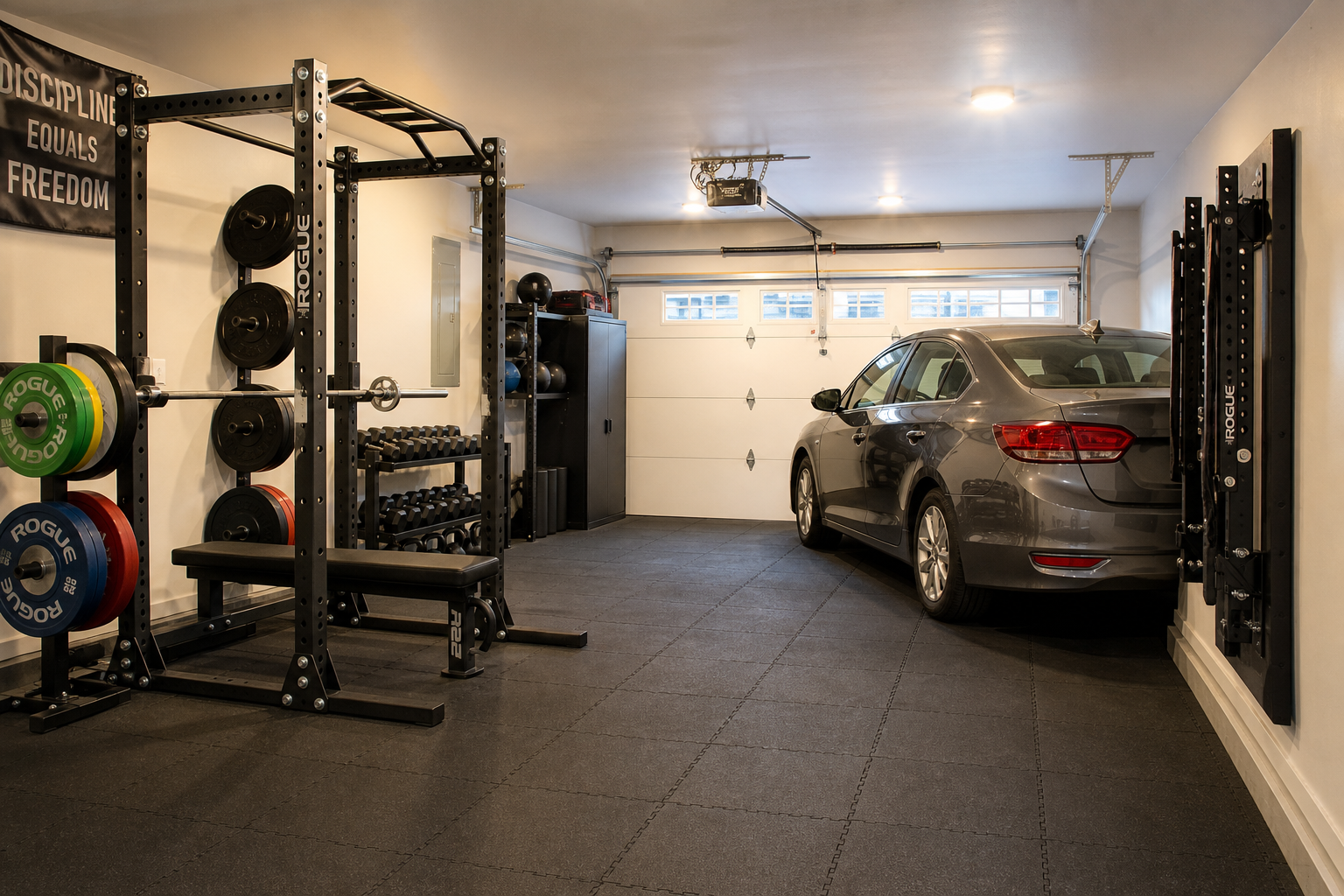
Why a Priority-by-Versatility Framework Beats a Generic Checklist
Walk into any garage gym forum and you'll see the same question: "I have $1,000. What do I buy?" The answers are usually a firehose of brand names, conflicting opinions, and single-purpose machines that look good in a showroom but collect dust after week two. The problem isn't a lack of information — it's a lack of prioritization.
Most guides treat every piece of equipment as equally important. They list "things you need" without explaining why one purchase unlocks 50 exercises and another locks you into five. That's how beginners end up with a Smith machine, a leg press, and a lat pulldown station before they own a decent barbell — and why they stall out six months later.
This article uses a different approach: a priority-by-versatility framework that ranks equipment by three criteria — training versatility (how many exercises it enables), space efficiency (how much floor area it consumes per exercise), and cost-per-exercise (dollars spent divided by usable movements). The result is a tiered system that tells you what to buy first, what to add when you're ready, and what to skip entirely.
Tier 1 — The Four-Pillar Foundation: Rack, Barbell, Plates, Bench
If you buy nothing else, buy these four items. They form the core of every productive garage gym because they unlock the compound lifts — squat, bench press, deadlift, overhead press, and row — that drive the majority of strength and muscle gains. According to Gray Matter Lifting, a rack, bar, bench, and plates are the essential equipment needed to start lifting at home. Everything else is an addition, not a replacement.
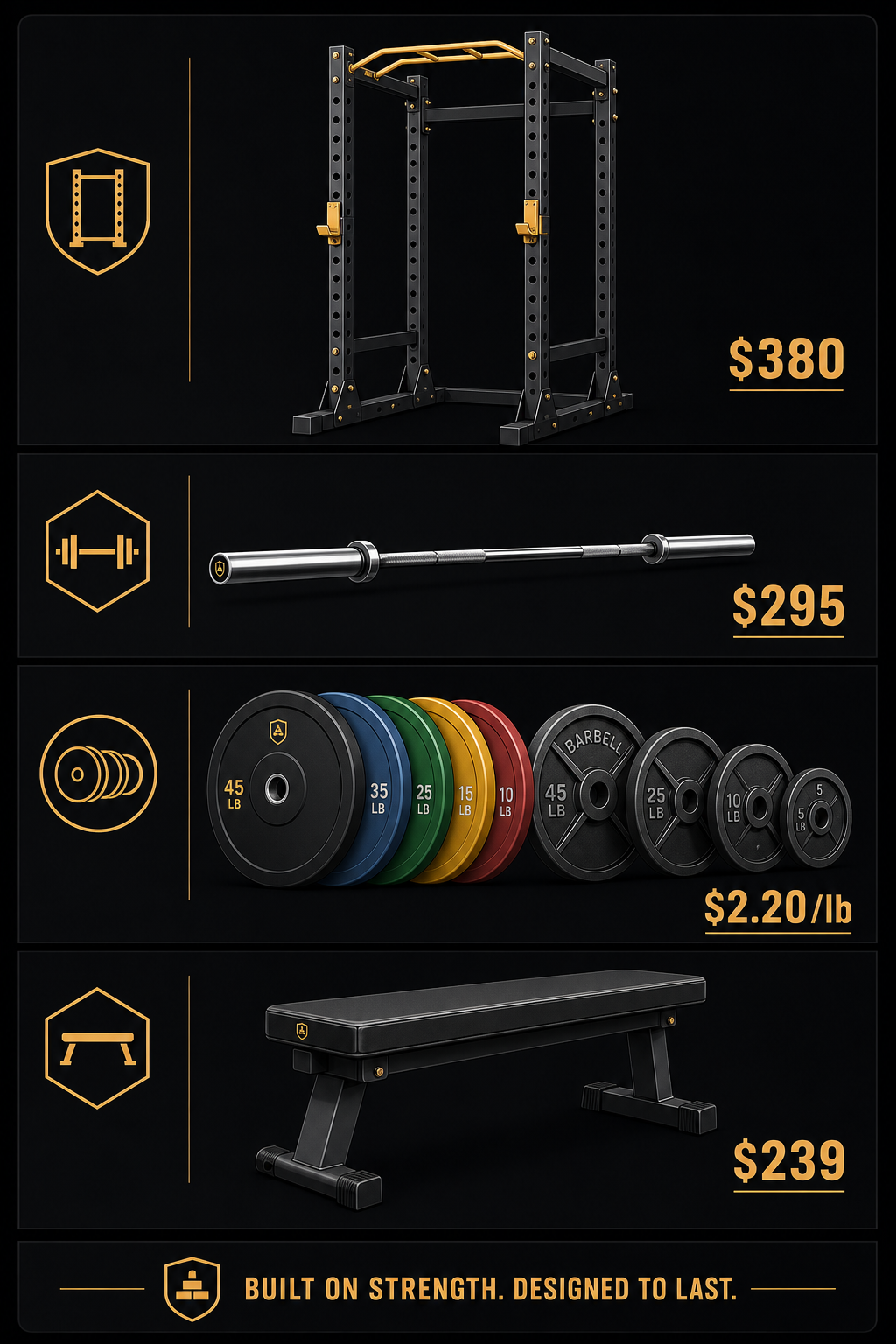
The 2026 Price Floor for a Solid Foundation
You don't need boutique brands to start. The following picks represent the current price-to-performance sweet spot, tested and verified by Garage Gym Reviews in 2026.
| Item | Recommended Pick | Price (2026) | Key Specs | Why It's the Pick |
|---|---|---|---|---|
| Power Rack | REP PR-1100 | $380 | 700-lb capacity, 14-gauge steel, compatible with dip station, lat pulldown, and landmine attachments | Lowest-cost rack that accepts standard attachments; no bolt-down required for most users |
| Barbell | Rogue Ohio Bar | $295–$370 | 190,000 PSI tensile strength (200,000 PSI for stainless), 28.5 mm shaft, dual knurl markings | Gold-standard all-purpose bar; works for powerlifting, Olympic lifts, and general strength |
| Flat Bench | REP FB-5000 | $239 | 11-gauge steel, 1,000-lb capacity, IPF standard dimensions | Overbuilt for the price; will outlast multiple cheaper benches |
| Bumper Plates (pair) | Fringe Sport Black Bumper | ~$2.20/lb | Lifetime warranty, Durometer 90 (10-15 lb) / 85 (others), ±1% weight tolerance | Best warranty in the budget bumper category; deadlift-friendly |
| Iron Plates (set) | REP Old School Iron | Under $1.70/lb | Standard iron, sold in sets | Cheapest per-pound option; ideal if you don't need to drop the bar |
Why does this combination score so high on versatility? A power rack with a barbell allows for every major compound movement: back squat, front squat, bench press, incline press, overhead press, deadlift, Romanian deadlift, bent-over row, Pendlay row, and countless variations. Add a landmine attachment (often included or under $30) and you unlock rotational presses, single-leg work, and core exercises. That's 50+ exercises from four pieces of equipment.
Compare that to a Smith machine, which locks the bar into a fixed vertical path. You lose the stabilizer muscle recruitment, the ability to deadlift, and most free-weight variations. The versatility gap is enormous.
Tier 2 — Expansion: Adjustable Dumbbells, Cable Tower, and a Cardio Piece
Once the four-pillar foundation is in place, the next logical additions fill the gaps that a barbell alone can't cover efficiently: unilateral work, isolation movements, pulling exercises with constant tension, and conditioning.
Adjustable Dumbbells: The Space-Saving Superpower
A full set of fixed dumbbells from 5 to 80 lbs takes up roughly 12 to 16 square feet of floor space and costs well over $2,000. Adjustable dumbbells replace up to 12 pairs of fixed dumbbells in a footprint smaller than a single pair of 50s. The two top-tested options in 2026 are the REP QuickDraw (5–60 lbs, $576) and the Snode AD80 (10–80 lbs in 10-lb increments, $795, rated 4.3/5 by Garage Gym Reviews, with a 2-year warranty covering drops from waist height).
| Model | Weight Range | Increments | Price | Warranty | Best For |
|---|---|---|---|---|---|
| REP QuickDraw | 5–60 lbs | 5 lbs | $576 | Standard REP warranty | Budget-conscious lifters who want quick weight changes |
| Snode AD80 | 10–80 lbs | 10 lbs | $795 | 2-year (drop coverage) | Lifters who need heavier dumbbells and want drop protection |
With adjustable dumbbells, you can perform dumbbell bench press, rows, lunges, bicep curls, tricep extensions, lateral raises, and dozens of other isolation and unilateral exercises. They complement the barbell without duplicating it.
Cable Tower or Lat Pulldown Attachment
A barbell is excellent for horizontal and vertical pressing, but it's limited for pulling movements that require constant tension through a full range of motion. A cable tower or a lat pulldown attachment for your power rack solves this. The REP PR-1100 is compatible with a lat pulldown attachment, which adds pulldowns, seated rows, face pulls, and tricep pushdowns without requiring a separate machine.
If you have more space and budget, a dedicated cable machine offers dual pulleys, more attachment points, and greater exercise variety. For a detailed breakdown of formats and brands, see our Home Gym Cable Machine Buying Guide.
A Simple Cardio Piece
Cardio is the most common place to waste money in a garage gym. Treadmills, ellipticals, and stationary bikes are expensive, bulky, and often underused. The Tier 2 approach is to start with the cheapest, most space-efficient option: a jump rope ($10–$20, zero floor space). If you want more, add a fan bike or a rower — both offer full-body conditioning in a compact footprint. Save the treadmill for Tier 3, if you need it at all.
- Jump rope: $10–$20, zero floor space, infinite intensity scaling
- Fan bike (e.g., Schwinn Airdyne or Assault Bike): $300–$800, 4–6 sq ft, full-body conditioning
- Rower (e.g., Concept2 Model D): $900–$1,000, 8 sq ft, low-impact full-body cardio
Tier 3 — Specialty: Functional Trainer, GHD, and Lever Arms
Tier 3 is for lifters who have maxed out their barbell and dumbbell progress and want to add specialized movements. This is the "nice to have" tier — none of these items are essential for building strength or muscle, but they can add variety and address specific weaknesses.
Functional Trainer
A functional trainer (dual adjustable pulley system) is the ultimate cable machine upgrade. It allows for unilateral cable work, flyes, crossovers, woodchoppers, and hundreds of cable-based exercises. The Titan Fitness Functional Trainer with dual 200-lb weight stacks is priced at $2,999.99. The Bells of Steel All-in-One Home Gym starts at $1,299.99 with a footprint of 54.6" D x 59" W x 81" H, a 300-lb cable capacity, a 2:1 pulley ratio, and a limited lifetime warranty — rated as the best budget home gym by Garage Gym Reviews.
If you're considering a functional trainer versus building out separate components, our Home Gym System vs. Building Your Own: A Total Cost of Ownership Comparison for 2026 can help you evaluate the total cost.
GHD (Glute-Ham Developer)
A GHD is a single-purpose machine, but it's a valuable one for posterior chain development. It allows for GHD sit-ups, back extensions, and glute-ham raises — movements that are difficult to replicate with a barbell alone. If you compete in powerlifting or CrossFit, a GHD is a strong Tier 3 addition. If you're a general fitness lifter, you can probably skip it.
Lever Arms
Lever arms attach to your power rack's uprights and convert it into a plate-loaded functional trainer. They allow for belt squats, landmine presses, and other specialty movements. They're a space-efficient way to add functionality without buying a separate machine, but they require a rack with compatible uprights and a willingness to set up and break down between exercises.
What to Skip — The Single-Purpose Machine Trap
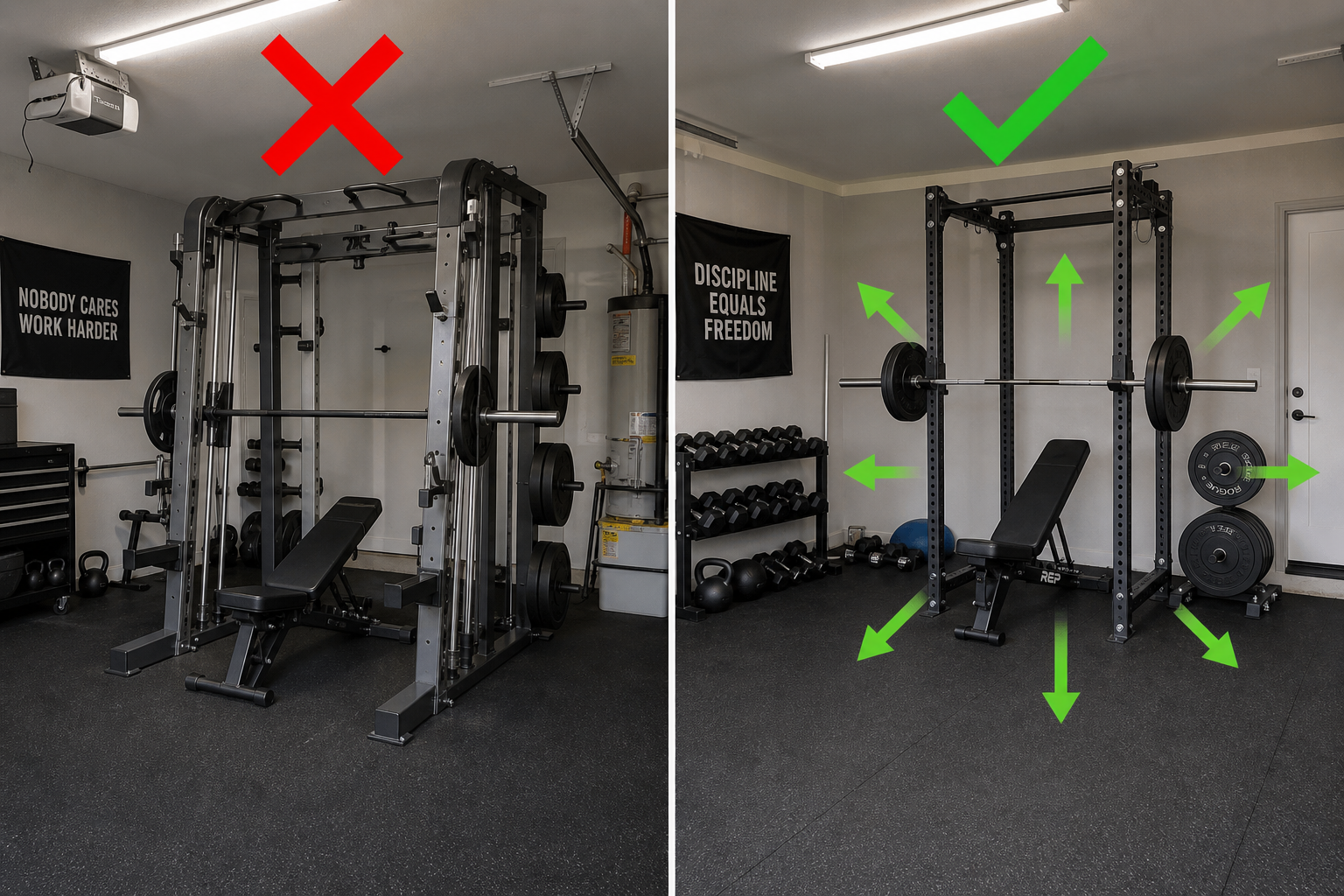
The single most common mistake in garage gym building is buying a single-purpose machine before the core barbell setup. The data is clear: a squat rack and barbell enables 50+ exercises, while most single-station machines (Smith machine, leg press, chest press machine) offer only 10–15 movements. You're paying more for less versatility.
| Machine | Approximate Exercise Count | Floor Space (sq ft) | Cost Range | Versatility Score |
|---|---|---|---|---|
| Power rack + barbell | 50+ | 15–20 | $950–$1,100 | 10/10 |
| Smith machine | 10–15 | 20–25 | $800–$2,000 | 3/10 |
| Leg press machine | 3–5 | 15–20 | $500–$1,500 | 2/10 |
| Chest press machine | 3–5 | 10–15 | $400–$1,200 | 2/10 |
| Adjustable dumbbells | 30+ | 1–2 | $576–$795 | 9/10 |
The Smith machine is the most common trap. It looks like a squat rack, but the fixed bar path eliminates the stabilizer muscle recruitment that makes squats and presses effective. You can't deadlift on a Smith machine. You can't do Olympic lifts. You can't do bent-over rows. It's a machine that teaches you bad movement patterns and limits your progress.
The leg press is another space-waster. It targets only the quads and glutes in a fixed plane, and it takes up as much floor space as a power rack. A barbell back squat or front squat works the same muscles plus your core, back, and stabilizers — and it costs nothing extra if you already own a rack and bar.
Phasing Timeline and Budget Planning Per Tier
The tiered framework is designed to be built over time. You don't need to buy everything at once. Here's a realistic phasing timeline based on common budget scenarios.
| Phase | Tier | Items to Buy | Approximate Cost | Timeline |
|---|---|---|---|---|
| Phase 1: Foundation | Tier 1 | Power rack, barbell, plates, flat bench | $950–$1,100 | Month 1 |
| Phase 2: Expansion | Tier 2 | Adjustable dumbbells, cable attachment or tower, jump rope or fan bike | $600–$1,500 | Months 2–4 |
| Phase 3: Specialty | Tier 3 | Functional trainer, GHD, or lever arms | $1,000–$3,000+ | Months 6–12 |
A functional garage gym can be built for under $1,000 (Tier 1). Expanding to Tier 2 costs an additional $600–$1,500, bringing the total to $1,600–$2,600. A fully equipped Tier 3 gym runs $3,500 or more. The average cost of a home gym, according to Garage Gym Reviews, is about $1,855 — which aligns with a complete Tier 1 + Tier 2 setup.
Budget-Conscious Build Order
- Buy the rack, bar, plates, and bench first. This is non-negotiable.
- Add a landmine attachment (often under $30) to unlock rotational and single-leg exercises.
- Add adjustable dumbbells when you need isolation work or unilateral training.
- Add a cable attachment or tower when you want constant-tension pulling movements.
- Add a cardio piece only after you've established a consistent strength routine.
- Consider specialty equipment (Tier 3) only after you've been training consistently for 6+ months.
The key insight is that Tier 1 alone is enough to make progress for months or even years. A power rack, barbell, plates, and bench cover every major compound lift. Adding Tier 2 and Tier 3 equipment is about convenience and variety, not necessity. Build the foundation first, train consistently, and let your needs — not a shopping list — dictate what comes next.
Some links on this page are affiliate links — they may earn us a commission at no extra cost to you. Our tier and tests are decided before we ever check which links pay; see our full affiliate disclosure.
Spot something off?
Noise and floor-damage claims carry real deposit-risk consequences if we get them wrong — tell us if your experience with this build didn't match what's above.