
Garage Gym Equipment for Small Spaces: Compact Setup Strategies and Gear for Single-Car Garages
A practical guide for homeowners with limited garage space who want a functional gym without sacrificing parking or utility storage. Learn how to fit a complete strength setup into spaces as small as 8'x8' using wall-mounted racks, adjustable dumbbells, all-in-one stations, and intentional zone planning.
- Budget tier
- $300–$1,000
- Space type
- garage
Items included: —
Why Space Constraints Are the Real Challenge in a Garage Gym
Most garage gym advice assumes you have a two-car bay, a dedicated room, or at least a corner you can permanently surrender to a squat rack and a barbell. The reality for a large number of homeowners is different: a single-car garage that also holds a car, a lawnmower, holiday decorations, and a workbench. Or a half-garage that shares space with a washer, dryer, and freezer. In these scenarios, the limiting factor isn't budget or ambition — it's square footage.
The typical single-car garage in the U.S. measures roughly 10 feet by 20 feet, giving you about 200 square feet of total floor area. But the usable workout footprint is smaller once you account for garage door tracks, wall obstructions, and the car itself. A common minimum functional space for strength training is about 8 feet by 8 feet — enough room for a rack, a bench, and a modest range of motion for most lifts. The challenge is fitting that 8'x8' zone into a garage that still needs to serve its primary purpose.
The key insight is that equipment choice matters less than intentional layout. A wall-mounted folding rack, a pair of adjustable dumbbells, and a vertical plate tree can deliver 90% of the training stimulus of a full commercial gym while occupying less than 20 square feet of floor space when not in use. The rest is about zone planning — dividing your available area into dedicated zones for strength, cardio, and storage, and keeping a clear center lane for movement.
Layout Principles: Measure First, Clear a Center Lane, Zone Your Space
Before you buy a single piece of equipment, you need to understand your garage's actual usable footprint. Grab a tape measure and record three things: the total floor dimensions, the ceiling height (most garage gyms need at least 8 feet for overhead pressing and pull-ups), and the location of obstructions like garage door tracks, water heaters, shelving, and electrical panels. Subtract any space that cannot be used for training — for example, the area required to open car doors or access utility panels.
Once you have your usable dimensions, apply three layout rules that apply to any small garage gym:
- Keep a clear center lane. Reserve a 3- to 4-foot-wide path from the garage door to the back wall. This lane lets you move equipment in and out, park a car if needed, and perform exercises that require forward-backward space (lunges, barbell rows, kettlebell swings). Never block this lane with permanent equipment.
- Zone your space. Divide the garage into three zones: a strength zone (rack, bench, plates), a cardio zone (jump rope mat, SkiErg, or foldable rower), and a storage zone (wall-mounted plate tree, pegboard for bands and accessories). Each zone should be self-contained so you don't have to move equipment between exercises.
- Prioritize vertical over horizontal. Every piece of equipment that can be wall-mounted, folded, or stacked should be. Floor space is your most constrained resource — use walls for storage, racks, and accessory organization.
These principles apply whether you have a full single-car garage (10'x20') or a half-garage (8'x12'). The specific equipment you choose is secondary to how you arrange it.
Wall-Mounted and Folding Racks: The Anchor of a Small Garage Gym
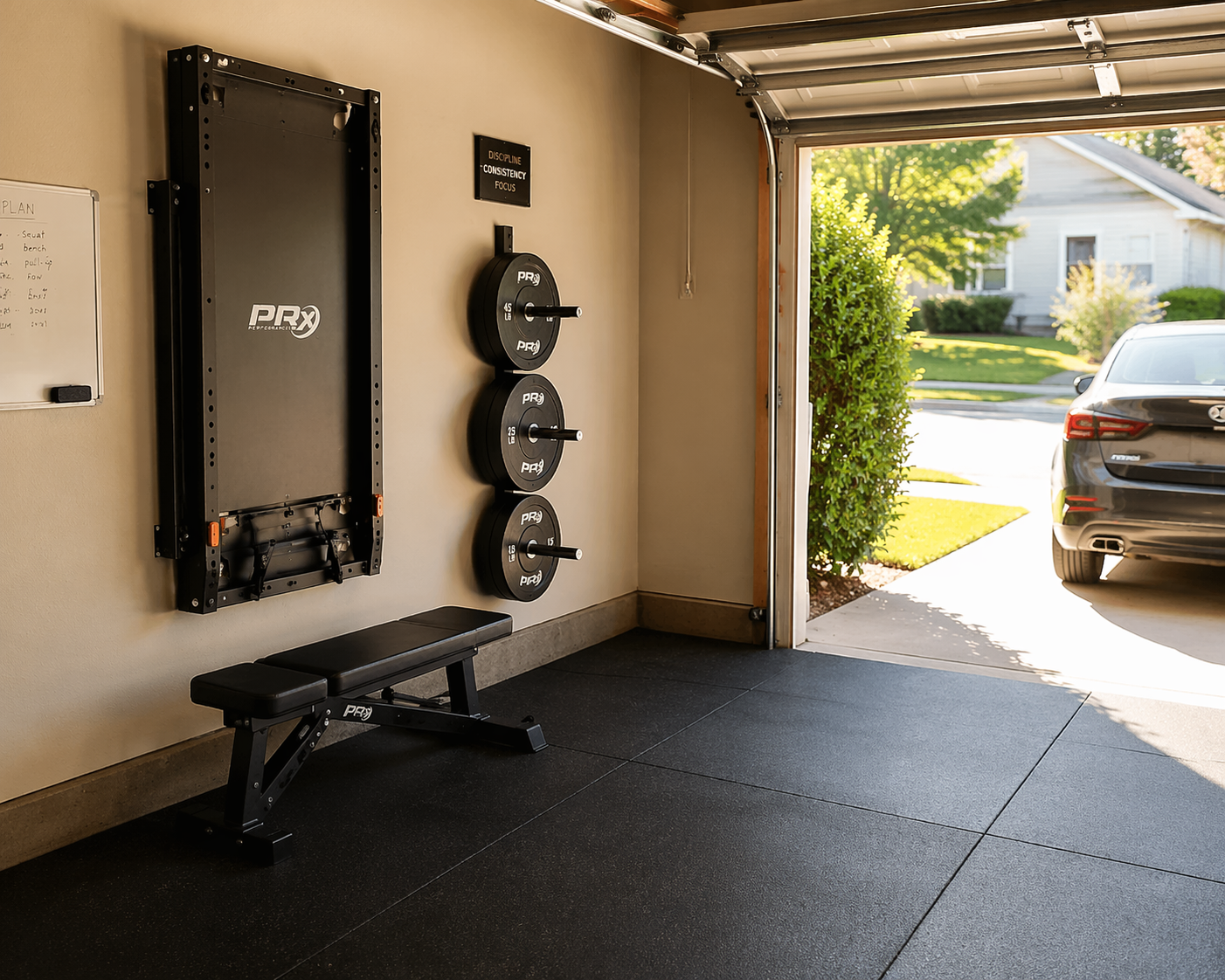
For a small garage gym, a traditional floor-mounted power rack is often a non-starter. It occupies a permanent footprint of roughly 4 feet by 4 feet, blocks access to the wall behind it, and makes it difficult to park a car or use the garage for other purposes. A wall-mounted folding rack solves all of these problems by attaching directly to the wall and folding flat when not in use.
The PRx Profile PRO is the benchmark in this category. It folds to a depth of just 4 to 9 inches from the wall, meaning it occupies essentially zero floor space when stored. Despite its compact folded profile, it has a 1,000-pound weight capacity — enough for heavy CrossFit workouts, powerlifting, and strongman-style training. It carries a Garage Gym Reviews score of 4.6 out of 5 and comes with a 10-year warranty. The trade-off is that it requires a permanent wall mount into studs or concrete, and the installation must be precise to ensure safety under load.
Other folding rack options exist at lower price points, but the key specs to compare are folded depth, weight capacity, and warranty length. The table below summarizes the most relevant options for small garage spaces.
| Rack | Folded Depth | Weight Capacity | Warranty | Best For |
|---|---|---|---|---|
| PRx Profile PRO | 4–9 inches | 1,000 lbs | 10 years | Heavy lifting, CrossFit, parking a car |
| Rogue Monster Lite Fold-Back Rack | 12 inches | 1,000 lbs | Lifetime on frame | Serious powerlifting, larger budget |
| Titan Fitness T-3 Series Fold Back Wall Mount Rack | 12 inches | 1,100 lbs | Lifetime on frame | Budget-conscious heavy lifters |
| Rep Fitness PR-4000 Wall Mount Folding Rack | 11 inches | 1,000 lbs | Lifetime on frame | Versatile accessory compatibility |
When choosing a folding rack, pay attention to the pull-up bar height when folded — some racks extend higher than others, which may interfere with garage door operation. Also consider the depth of the base brackets: a rack that folds to 4 inches is noticeably less intrusive than one that folds to 12 inches, especially if you need to park a car close to the wall.
Adjustable Dumbbells: The Ultimate Space Multiplier
A set of fixed dumbbells from 5 to 60 pounds requires roughly 12 pairs of dumbbells, a dedicated rack, and about 6 to 8 square feet of floor space. A single pair of adjustable dumbbells replaces all of them. This is the single highest-impact space-saving purchase you can make for a small garage gym.
The REP Fitness QuickDraw Adjustable Dumbbells are a strong choice for small spaces. They start at $335.99 for the 5-60 pound per hand set, carry a Garage Gym Reviews score of 4.5, and come with a lifetime warranty. Each dumbbell adjusts in 5-pound increments via a dial mechanism, so you can switch weights between sets in seconds. The cradle that holds the dumbbells is compact enough to sit under a bench or on a wall shelf when not in use.
| Model | Weight Range | Increment | Price (Starting) | Warranty | Footprint Saved vs. Fixed Set |
|---|---|---|---|---|---|
| REP QuickDraw | 5–60 lbs per hand | 5 lbs | $336 | Lifetime | ~6 sq ft |
| Bowflex SelectTech 552 | 5–52.5 lbs per hand | 2.5–5 lbs | $349 | 2 years | ~6 sq ft |
| PowerBlock Elite EXP 90 | 5–90 lbs per hand | 2.5–5 lbs | $599 | Lifetime | ~8 sq ft |
| Nuobell 580 | 5–80 lbs per hand | 5 lbs | $599 | 1 year | ~7 sq ft |
The space savings are not just about the dumbbells themselves. By eliminating a fixed dumbbell rack, you free up wall space for other storage — or you avoid installing a rack altogether. In a single-car garage, that 6 to 8 square feet can be the difference between a cramped setup and a functional one.
Compact All-in-One Stations and Cable Towers
If you want both barbell work and cable exercises but don't have room for a separate rack and cable machine, a compact all-in-one station or a standalone cable tower can bridge the gap. These machines combine multiple functions into a single footprint, which is exactly what a small garage gym needs.
The Speediance Gym Monster is a strong candidate for very tight spaces. Its unfolded footprint is 28.34 inches wide by 49.21 inches deep — smaller than a standard mattress. It folds to just 14.96 inches deep for storage. It provides 220 pounds of digital resistance with no subscription required, which is a significant advantage over subscription-locked smart gyms. Garage Gym Reviews rates it 4.0 out of 5 and recommends it as the best home gym for small spaces. The trade-off is that the digital resistance system does not replicate the feel of free weights, and the maximum resistance of 220 pounds may be insufficient for advanced lifters on compound movements.
For those who prefer a traditional cable setup, the Bells of Steel Cable Tower with Weight Stack is a compact alternative. Its footprint is 31 inches deep by 28.5 inches wide, and it starts at $434.99. It uses a real weight stack (up to 210 pounds) rather than digital resistance, so the feel is closer to a commercial cable machine. It carries a Garage Gym Reviews score of 4.3 and a limited lifetime warranty. The main limitation is that it is a cable-only machine — you would still need a separate rack or dumbbells for barbell and free-weight work.
| Model | Footprint (W x D) | Resistance Type | Max Resistance | Subscription | Price (Starting) |
|---|---|---|---|---|---|
| Speediance Gym Monster | 28" x 49" (unfolded) | Digital | 220 lbs | None | $1,999 |
| Bells of Steel Cable Tower | 28.5" x 31" | Weight stack | 210 lbs | None | $435 |
| RitFit M1 Smith Machine | ~36" x ~48" | Smith + cables | ~200 lbs (cables) | None | $1,300 |
| Tonal | 22" x 50" (wall-mounted) | Digital | 200 lbs | $49/month | $3,495 |
Vertical Storage and Flooring: Making Every Inch Count
Once you have your rack and dumbbells selected, the next priority is keeping the space organized. In a small garage, clutter accumulates fast — loose plates, bands, jump ropes, and accessories can turn a functional 8'x8' zone into a chaotic mess in a single session. The solution is to use vertical space aggressively.
- Wall-mounted plate tree. A vertical plate tree that mounts to the wall stores 300 to 500 pounds of weight plates in about 2 square feet of floor space. It keeps plates off the floor and makes them easy to access during a workout.
- Pegboard or slatwall. Install a 4'x4' section of pegboard or slatwall on an unused wall section. Use it to hang resistance bands, jump ropes, ab wheels, foam rollers, and other accessories. This keeps them visible and accessible without taking up shelf or floor space.
- Overhead storage. If your garage has exposed ceiling joists, install overhead storage racks for items you use infrequently — seasonal decorations, camping gear, extra plates. This frees up wall and floor space for training equipment.
- Flooring. The most economical and effective flooring for a garage gym is 3/4-inch thick rubber stall mats, available at Tractor Supply Co. for approximately $50 per 4'x6' sheet. These mats protect the concrete floor, dampen noise, provide a stable surface for lifting, and are easy to clean. They also help define the training zone visually, which reinforces the zone-planning principle.
Cardio in a Small Garage: Compact Options That Work
Cardio equipment is often the biggest space offender in a garage gym. A treadmill takes up 30 to 40 square feet. An elliptical takes up even more. In a small garage, you need cardio options that do not compete with the strength zone for floor space.
- Jump rope. A speed rope costs under $20 and requires only enough ceiling height to swing it. It provides high-intensity cardio in a 4'x4' area. Store it on a pegboard hook when not in use.
- SkiErg. The Concept2 SkiErg mounts to the wall and extends about 24 inches from it. It provides full-body cardio without taking up any floor space. When not in use, it folds flat against the wall.
- Foldable rower. Rowers like the Concept2 RowErg can be stored upright or folded, reducing their footprint to about 2 feet by 2 feet. They provide low-impact, full-body cardio that complements strength training well.
- Compact exercise bike. A folding exercise bike or a compact spin bike with a small footprint (roughly 2 feet by 4 feet) can be stored in a corner or against a wall. Some models have wheels for easy relocation.
The key principle is that cardio equipment should not occupy permanent floor space in the strength zone. Choose equipment that can be stored on a wall, folded, or moved out of the way when not in use. Your strength zone should remain clear and ready for your next session.
Two Real-World Layout Examples: Single-Car Garage and Half-Garage
To make the principles concrete, here are two layout examples based on common garage configurations. Both use the same core equipment strategy — wall-mounted folding rack, adjustable dumbbells, vertical storage, and a clear center lane — adapted to different dimensions.
Layout A: Full Single-Car Garage (10' x 20')
This layout assumes you park a car in the garage and need to reclaim the space for training when the car is out. The folding rack is the anchor.
- Strength zone: PRx Profile PRO folding rack mounted on the back wall (10-foot wall). Adjustable bench stored under the rack when folded. REP QuickDraw dumbbells on a shelf beside the rack. Wall-mounted plate tree next to the rack.
- Cardio zone: SkiErg mounted on the side wall (20-foot wall). Jump rope stored on a pegboard hook. Foldable rower stored upright in the corner.
- Storage zone: Pegboard on the opposite side wall for bands, ab wheel, foam roller. Overhead storage racks for seasonal items and extra plates.
- Center lane: 4-foot-wide clear path from garage door to back wall. This lane is used for parking the car and for exercises that require forward-backward space.
Layout B: Half-Garage or Shared Space (8' x 12')
This layout is for a half-garage that also houses a washer, dryer, freezer, or workbench. The space is tighter, so every inch must be intentional.
- Strength zone: PRx Profile PRO folding rack mounted on the 8-foot wall. Adjustable bench stored under the rack. REP QuickDraw dumbbells on a wall shelf. No plate tree — use a compact plate storage system that mounts directly to the rack or wall.
- Cardio zone: Jump rope only — no permanent cardio equipment. Use the center lane for jump rope intervals.
- Storage zone: Pegboard on the wall above the washer/dryer for bands and accessories. Overhead storage above the freezer for extra plates.
- Center lane: 3-foot-wide clear path. This is tight but workable for most exercises. Avoid exercises that require wide lateral movement (e.g., lateral lunges, wide-stance deadlifts).
Both layouts demonstrate the same principle: a folding rack and adjustable dumbbells form the core, vertical storage keeps the space organized, and a clear center lane preserves functionality. The specific dimensions change the proportions, but the strategy remains the same.
Frequently Asked Questions About Small Garage Gyms
Below are answers to the most common questions from homeowners planning a small garage gym.
- What is the minimum space needed for a functional garage gym? A minimum of 8 feet by 8 feet of clear floor space is recommended for basic strength training. This allows room for a folding rack, a bench, and a modest range of motion for most lifts. If you plan to do Olympic lifts or use a barbell, you will need more depth — at least 10 feet.
- Can I still park my car in the garage with a gym setup? Yes, if you use a wall-mounted folding rack and keep all other equipment on walls or in storage. When the rack is folded, it protrudes only 4 to 12 inches from the wall, leaving the entire floor area free for parking. Adjustable dumbbells and a wall-mounted plate tree do not interfere with parking.
- What is the best flooring for a garage gym? 3/4-inch thick rubber stall mats from Tractor Supply Co. are the most economical and effective option. They cost approximately $50 per 4'x6' sheet, protect the concrete floor, dampen noise, and provide a stable surface for lifting. They are also easy to clean and durable enough to handle dropped weights.
- How do I handle ventilation and temperature in a garage gym? Garages are typically not climate-controlled. In hot weather, use a high-velocity fan or a portable air conditioner. In cold weather, a space heater can take the edge off, but dress in layers and warm up thoroughly before lifting. A dehumidifier can help manage moisture if your garage is damp. Always ensure adequate ventilation, especially if you are using a heater or doing high-intensity cardio.
- Do I need a separate cable machine, or can I get by with just a rack and dumbbells? You can get a complete full-body workout with just a folding rack, a barbell, and adjustable dumbbells. Cable exercises are valuable for accessory work and isolation, but they are not essential for strength or hypertrophy. If you have room for a compact cable tower like the Bells of Steel Cable Tower, it adds versatility, but it is not a requirement.
Building a garage gym in a small space is an exercise in trade-offs, but the trade-offs are manageable. By prioritizing a wall-mounted folding rack, adjustable dumbbells, vertical storage, and intentional zone planning, you can create a training space that supports serious strength work without sacrificing the garage's primary functions. The key is to measure first, plan your zones, and choose equipment that earns its footprint.
Some links on this page are affiliate links — they may earn us a commission at no extra cost to you. Our tier and tests are decided before we ever check which links pay; see our full affiliate disclosure.
Spot something off?
Noise and floor-damage claims carry real deposit-risk consequences if we get them wrong — tell us if your experience with this build didn't match what's above.