
Where the 7-Minute Workout Came From
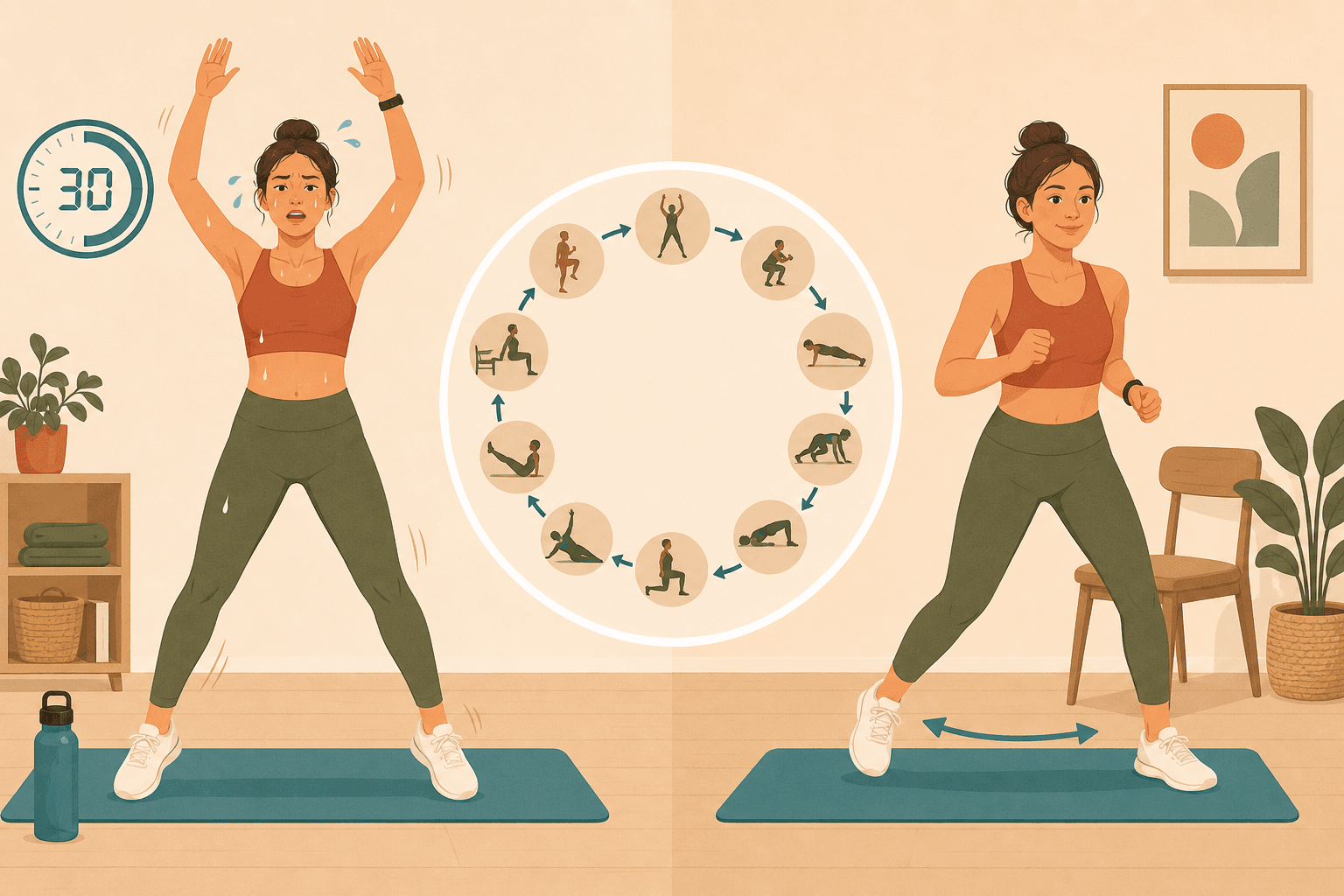
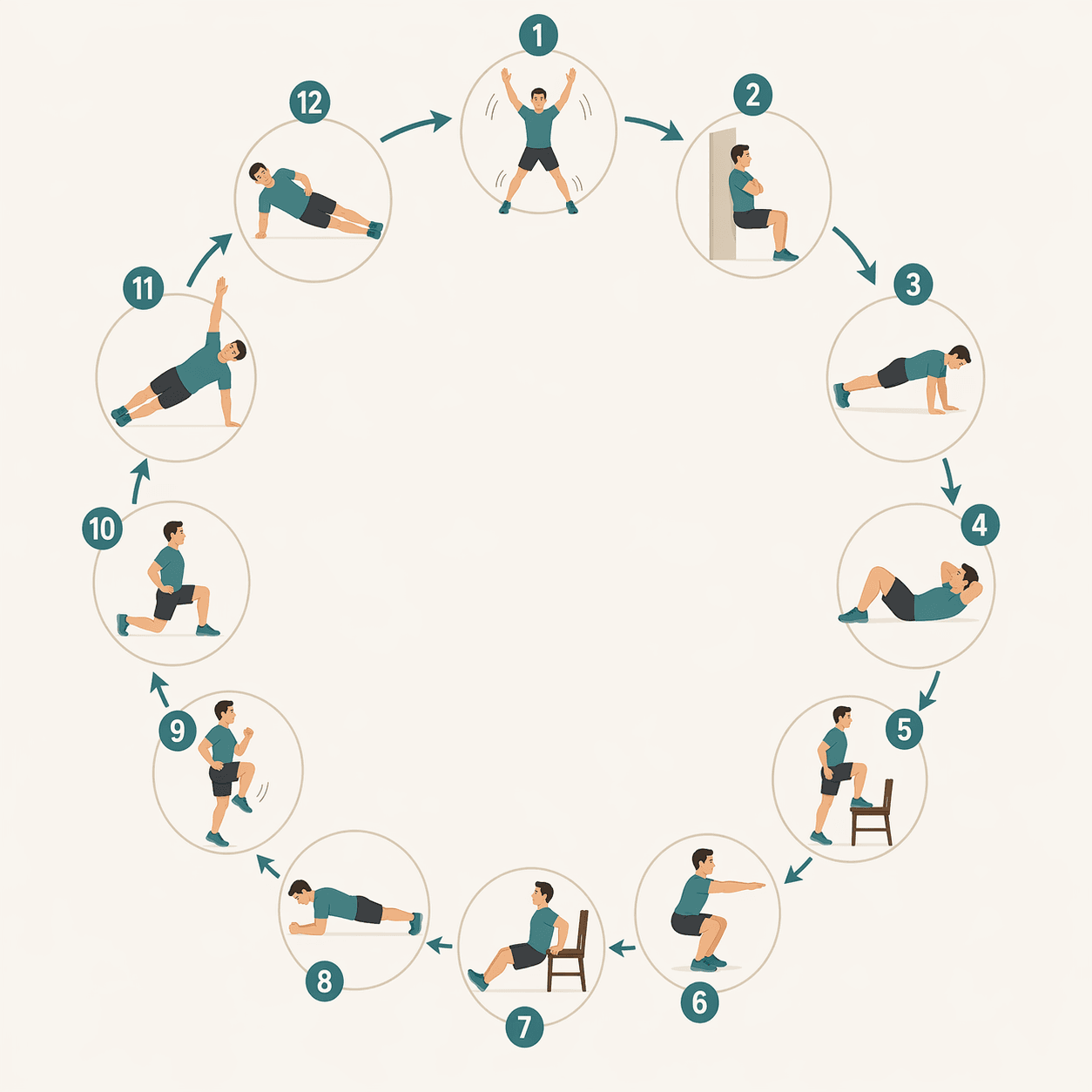
In 2013, exercise physiologist Chris Jordan and researcher Brett Klika published a paper in ACSM's Health & Fitness Journal describing a protocol they called High-Intensity Circuit Training (HICT). The design was straightforward: 12 bodyweight exercises performed for 30 seconds each, separated by 10 seconds of transition time, for a total circuit duration of approximately 7 minutes. The exercises — jumping jacks, wall sit, push-up, abdominal crunch, step-up onto a chair, squat, triceps dip, plank, high knees, lunge, push-up with rotation, and side plank — were chosen to alternate between upper body, lower body, and core movements so that one muscle group could recover while another worked.
The paper was explicit about one detail that most popular coverage has since dropped: "The circuit can be repeated 2 to 3 times." The intended total time commitment was 14 to 21 minutes, not 7. The New York Times picked up the story in May 2013, and the "7-minute workout" label stuck in the public imagination. Within months, it had become one of the most-shared fitness concepts on the internet, spawning apps, YouTube videos, and countless adaptations.
What the Studies Actually Measured
Since the 2013 paper, several peer-reviewed studies have tested variations of the 7-minute workout against different outcomes. The table below summarizes the key studies, their designs, and their primary findings. This is not an exhaustive list, but it covers the most frequently cited research on the protocol.
| Study | Population | Protocol | Duration | Primary Findings |
|---|---|---|---|---|
| Mattar et al. (2017) | Overweight adults | Daily 7-minute circuit (1 round) | 6 weeks | Mean 4 cm decrease in waist circumference; reduced fat mass without dietary changes |
| Schmidt et al. (2016) | Recreationally active college students | 7- or 14-minute circuit, 3×/week | 8 weeks | Significant improvements in muscular strength and endurance |
| Armas et al. (2020) | 12 healthy young adults (6 M, 6 F) | 7-minute bodyweight circuit (HICE) vs. 7-minute HIIT cycling (HIIE) | Single session (crossover) | HICE produced higher average HR (145.2 vs. 126.3 bpm); significantly lower post-exercise diastolic BP |
| Riegler et al. (2017) | Healthy adults | 7-minute bodyweight circuit vs. HIIT cycling | Single session (crossover) | HIIT cycling produced higher peak VO₂, HR, and RPE than the bodyweight circuit |
| Poon et al. (2023) | Sedentary men and women | 7-minute workout vs. moderate cycling vs. traditional interval cycling | Single session | Participants reported enjoying the 7-minute workout more and finding it "less boring" than cycling |
What Works: Measurable Benefits You Can Expect
The evidence supports several real, measurable outcomes from consistent use of the 7-minute workout protocol. These are not dramatic transformations, but they are meaningful for a routine that requires no equipment and fits into a busy schedule.
- Body composition changes: The Mattar et al. (2017) study reported a mean 4 cm reduction in waist circumference over 6 weeks of daily practice, along with reduced fat mass — and participants did not change their eating habits. This suggests the protocol can shift body composition even without dietary intervention, though the effect size is modest.
- Blood pressure reduction: The Armas et al. (2020) crossover study found that the 7-minute bodyweight circuit produced a significantly lower post-exercise diastolic blood pressure compared to a HIIT cycling protocol of equal duration. Diastolic BP was 5.018 mmHg lower immediately after the bodyweight circuit (p = 0.001), and the overall post-exercise difference was significant (p = 0.002). This is a meaningful cardiovascular benefit, particularly for individuals with elevated resting BP.
- Muscular strength and endurance: Schmidt et al. (2016) demonstrated that 8 weeks of circuit training — using either the 7-minute or 14-minute version, performed 3 times per week — produced significant improvements in muscular strength and endurance in recreationally active college students. This confirms that the protocol can serve as a maintenance or modest improvement tool for general muscular fitness.
- Cardiovascular response: The Armas study also showed that the bodyweight circuit produced a higher average heart rate during activity (145.2 ± 16.9 bpm) compared to HIIT cycling (126.3 ± 12.1 bpm, p = 0.005). This indicates that the circuit can elicit a substantial cardiovascular demand, despite being bodyweight-only.
What Doesn't Work: Where the Claims Fall Short
The 7-minute workout has been marketed as a complete fitness solution, and that overreach has created a gap between what the science actually shows and what many people expect. Here are the areas where the evidence is weaker or the claims are overstated.
- Weight loss is not guaranteed: The Mattar study showed body composition changes (waist circumference reduction, fat mass decrease), but these were modest and occurred with daily practice over 6 weeks. No study has demonstrated significant weight loss from the 7-minute workout alone without accompanying dietary changes. The calorie burn from a single 7-minute round is relatively low compared to longer-duration exercise.
- It is not equivalent to true HIIT: The Riegler et al. (2017) study directly compared the 7-minute bodyweight circuit to a HIIT cycling protocol and found that cycling produced higher peak VO₂, heart rate, and perceived exertion. The bodyweight circuit, while demanding, does not reach the same physiological intensity as a properly executed HIIT cycling session. Calling it "HIIT" is technically imprecise — the original paper describes it as HICT (high-intensity circuit training), which is a distinct modality.
- Insufficient for absolute strength or power: As the Intermountain Healthcare blog notes, the protocol "may not be as good for developing absolute strength and power." Bodyweight resistance has a ceiling — once you can perform 15–20 reps of push-ups or squats, the stimulus for further strength gains diminishes. The protocol is not designed for progressive overload in the way that weighted strength training is.
- The intensity requirement is often understated: Chris Jordan has stated that each exercise should feel like "about an 8 on a scale of effort from 1 to 10." That is genuinely hard work. Many popular descriptions gloss over this, leading beginners to perform the circuit at a moderate pace and then wonder why they don't see results. If you are not pushing to an 8, you are not doing the protocol as designed.
The '7 Minutes' Caveat: Why the Name Is Misleading
The most persistent misconception about this workout is embedded in its name. The original 2013 ACSM paper explicitly states that the circuit should be repeated 2 to 3 times. A single 7-minute round is one pass through the 12 exercises. The intended protocol is 2 to 3 rounds, totaling 14 to 21 minutes of work.
The "7-minute" label came from the New York Times article that popularized the workout. The article accurately described the circuit as taking about 7 minutes per round, but the shorthand stuck. As exercise physiologist Katie Lawton of the Cleveland Clinic puts it: "The seven-minute workout isn't actually seven minutes long. You're actually supposed to repeat it two to three times."
Who This Workout Is For — and Who Should Skip It
The 7-minute workout is not a one-size-fits-all solution. Its usefulness depends heavily on your current fitness level, goals, and physical health. Here is a clear breakdown of who should use it and who should look elsewhere.
- For: Time-constrained beginners who can modify. If you are new to exercise but have reasonable baseline fitness, starting with 1 round and building to 2–3 over several weeks is a viable entry point. The low-impact modifications (stepping instead of jumping, knee push-ups) make it accessible.
- For: Travelers needing a no-equipment option. The circuit requires only a wall and a sturdy chair. It is a practical way to maintain some fitness momentum when you have no access to a gym.
- For: Experienced exercisers as a filler or active recovery. Katie Lawton's assessment is accurate: "It's not going to replace your other fitness routines, but it can be a good filler workout." Use it on days when you are short on time or as a light session between heavier training days.
- Not for: Absolute beginners with low cardio endurance. WebMD advises that the workout is "not for beginners — it's too intense." If you cannot sustain a brisk walk for 20 minutes, start with walking and basic bodyweight movements before attempting the circuit.
- Not for: Anyone with joint or back problems. WebMD specifically warns: "If you have joint or back problems and are not already active, this is not the workout for you — at least not yet." The explosive movements (jumping jacks, high knees) and isometric holds (plank, wall sit) can aggravate existing conditions.
- Not for: Anyone seeking significant strength or performance gains. The bodyweight resistance ceiling and lack of progressive overload make this protocol unsuitable as a primary strength or power program.
How to Make the 7-Minute Workout Work for You
If the 7-minute workout fits your situation, here is how to use it effectively based on the available evidence and expert guidance.
- Start with 1 round and build up. If you are new to the protocol, begin with a single 7-minute circuit. After 2–3 weeks, add a second round with a 1-minute rest between circuits. Progress to 3 rounds as your conditioning improves. The Cleveland Clinic recommends that beginners take longer rest periods — up to 20 seconds between exercises instead of the standard 10.
- Use low-impact modifications. Step your feet instead of jumping during jumping jacks. Perform knee push-ups instead of standard push-ups. March in place instead of doing high knees. These modifications reduce joint impact while maintaining the circuit structure. Chris Jordan himself emphasizes that "everyone's 7-minute workout should be customized to them."
- Monitor your perceived effort. The target is approximately 8 out of 10 on a perceived exertion scale. Jordan notes that this is "your perception of an eight" — it is subjective, but it should feel hard. If you are not breathing heavily and your muscles are not fatigued by the end of each 30-second interval, you are likely working below the intended intensity.
- Always warm up and cool down. WebMD and the Cleveland Clinic both recommend a brief warm-up (2–3 minutes of light movement like arm circles, leg swings, and marching in place) before the circuit, and a cool-down (gentle stretching) afterward. This is not optional — jumping into high-intensity work cold increases injury risk.
- Use it as a supplement, not a primary program. For experienced exercisers, the 7-minute workout is best used as a filler on busy days, a travel workout, or an active recovery session. It should not replace a well-structured strength or cardio program. If you are looking for other no-equipment routines to complement this one, explore our guide to best free workout apps for small spaces for apartment-friendly programs that work with minimal equipment.
- Track your recovery. Because the protocol demands high effort, monitoring your recovery is important — especially if you are doing multiple rounds or using it daily. Our guide on how heart rate fitness trackers measure recovery explains how HRV, resting heart rate, and heart rate recovery can help you gauge whether you are recovering adequately between sessions.
For post-workout recovery strategies that pair well with bodyweight circuits, see our guide on how to recover from a bodyweight workout at home — no equipment needed.
The Bottom Line
The 7-minute workout is a legitimate, evidence-supported fitness protocol — but it is not magic, and it is not 7 minutes. The research shows real benefits for body composition, blood pressure, muscular endurance, and cardiovascular response when performed consistently and at the correct intensity. It is also clear about the limitations: it is not a weight loss solution on its own, it is not equivalent to true HIIT cycling, it is not sufficient for building strength or power, and it is genuinely hard work that is not appropriate for everyone.
The most honest assessment comes from the protocol's own creator. Chris Jordan told the Washington Post in 2025 that the workout "became a phenomenon, introducing millions to the benefits of brief, intense interval training." That is a fair summary. It is a useful tool in the right context — but it is one tool among many, not a complete fitness solution.
Comments
Join the discussion with an anonymous comment.