
Leg Workouts at Home: Three Complete Programs by Training Goal
Most home leg workout content gives you exercises without a program — this guide organizes home leg training by what outcome you actually want, delivering three distinct, complete frameworks for strength and muscle building, conditioning and fat loss, and mobility and functional strength, each with rep and rest prescriptions, progression rules, and a weekly scheduling template.
- Duration
- 30 min
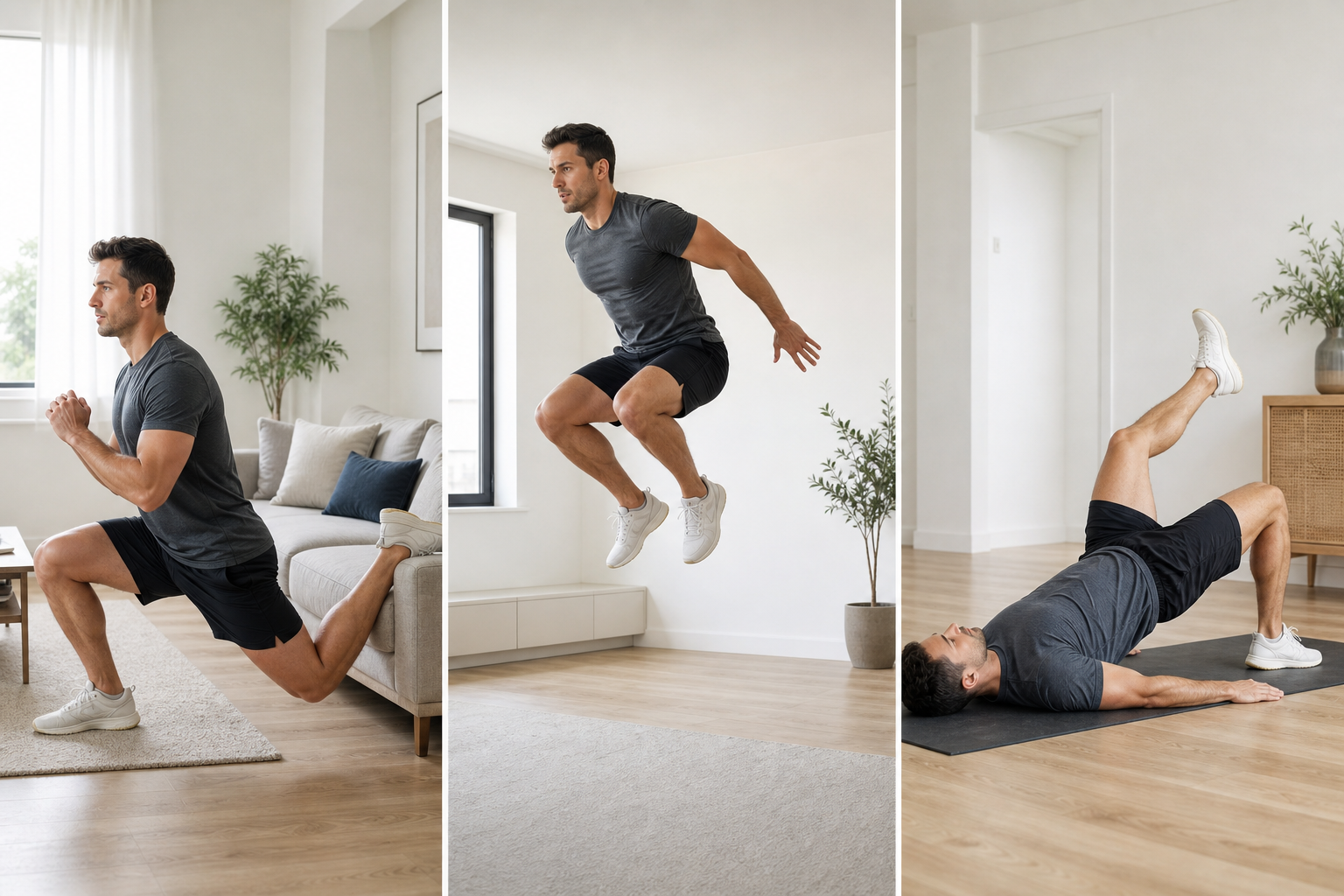
Why Generic Home Leg Workouts Fail You
Pick up almost any home leg workout article and you will find the same thing: a list of exercises, maybe organized by muscle group, with a rep range attached. Squats, lunges, glute bridges, step-ups — do three sets of twelve. That is not a program. It is a collection of movements with no logic connecting them to what you actually want to accomplish.
Rep ranges, rest periods, exercise order, and tempo are not neutral variables. A 90-second rest period that works well for a conditioning circuit will undermine strength development on a heavy compound set. A slow, 4-second eccentric that builds muscle control becomes a liability when the goal is elevating heart rate for calorie expenditure. The programming decisions that serve one goal actively work against another.
This article is organized around three training goals — strength and muscle building, conditioning and fat loss, and mobility and functional strength — each with its own complete programming framework. If you are looking for routines organized by what equipment you own, the companion article on home leg workouts by equipment tier covers that axis. This article covers the goal axis — and the two are designed to be used together once you know what you are training for.
Identify Your Training Goal Before You Start
Each of the three frameworks in this article demands something different from your body and your schedule. Before choosing a program, it helps to understand what each goal actually requires at a programming level — not just what it sounds like.
| Goal | Primary Training Variable | Rest Between Sets | Sessions Per Week | Key Movement Type |
|---|---|---|---|---|
| Strength and Muscle Building | Progressive overload — more reps, harder variation, or slower tempo over time | 2–3 minutes between compound sets | 2 days | Squats, hinges, lunges, unilateral exercises |
| Conditioning and Fat Loss | Volume and heart rate — more total work in less time | 30–60 seconds between exercises | 3 days | Compound circuits, explosive movements |
| Mobility and Functional Strength | Time under tension and movement control | 45–90 seconds between sets | 2 days | Single-leg stability, slow eccentric movements |
A simple way to self-select: if your primary frustration is that your legs don't look or feel stronger, choose Goal 1. If your primary frustration is that you feel out of breath climbing stairs or you want to reduce body fat, choose Goal 2. If your primary frustration is stiffness, poor balance, or movement quality that limits other activities, choose Goal 3. You can always transition between frameworks — the process for doing that is covered later in this article.
Goal 1: Strength and Muscle Building
Building stronger, more muscular legs at home without a barbell is entirely achievable — but only if the programming is structured around the variables that actually drive muscle growth. Research consistently shows that training volume — total sets multiplied by reps — is the primary driver of hypertrophy, not frequency alone. That means a well-structured 2-day-per-week program can produce meaningful muscle and strength gains, provided the volume per session is sufficient and progressive overload is applied consistently.
Exercise Selection Rationale
The exercise selection for strength-focused leg training follows a clear hierarchy. Compound movements — squats, hip hinges, and lunges — activate the largest muscle groups simultaneously and provide the most return on training time. Compound movements like squats engage several large muscle groups at once, making them the foundation of lower body strength development. Hip hinge variations, including single-leg glute bridges and Romanian deadlift variations, target the posterior chain in ways that squats do not.
When external load is unavailable or limited, unilateral exercises become the primary progressive overload tool. The Bulgarian split squat, reverse lunge, and single-leg glute bridge each dramatically increase the demand on one limb while simultaneously engaging stabilizer muscles. Moving from a bilateral squat to a Bulgarian split squat is a meaningful progression even if no weight is ever added — the movement itself is harder, and that additional difficulty drives adaptation.
Sets, Reps, Rest, and Tempo
| Exercise Type | Sets | Reps | Rest | Eccentric Tempo |
|---|---|---|---|---|
| Compound (squat, hinge) | 3–4 | 6–10 | 2–3 minutes | 2–3 seconds down |
| Unilateral (split squat, reverse lunge) | 3 | 8–12 per leg | 90 seconds–2 minutes | 2–3 seconds down |
| Accessory (glute bridge, calf raise) | 2–3 | 10–15 | 60–90 seconds | Controlled, 2 seconds down |
The 2–3 minute rest between compound sets is not optional padding — it is what allows you to maintain output across all sets. Longer inter-set rest on heavy compound movements preserves volume and produces meaningful hypertrophy benefits. Cutting rest short on strength days to make the session feel harder is one of the most common programming errors — it shifts the stimulus away from strength and toward conditioning.
A controlled 2–3 second eccentric (lowering) phase is sufficient for hypertrophy and does not require extreme slow-tempo variations. The goal is deliberate control, not artificially slow movement.
Progression Rules
For novice and intermediate trainees, increasing reps produces similar gains in strength and muscle size as increasing load. This is directly relevant to home training where load cannot always be increased. The practical application: pick one progression variable, apply it consistently for an entire training block, and do not switch methods mid-block.
- Add 1–2 reps per set each week until you reach the top of the rep range (e.g., 3 × 10 → 3 × 12).
- Once you consistently hit the top of the rep range with good form, advance to a harder variation (e.g., bodyweight squat → Bulgarian split squat → deficit split squat).
- Alternatively, slow the eccentric from 2 seconds to 3–4 seconds on the same exercise before moving to a harder variation.
- Keep weekly volume increases within approximately 10% to allow for gradual adaptation and minimize injury risk — a guideline consistent with NASM's progressive overload principles.
2-Day Weekly Template
| Day | Session | Notes |
|---|---|---|
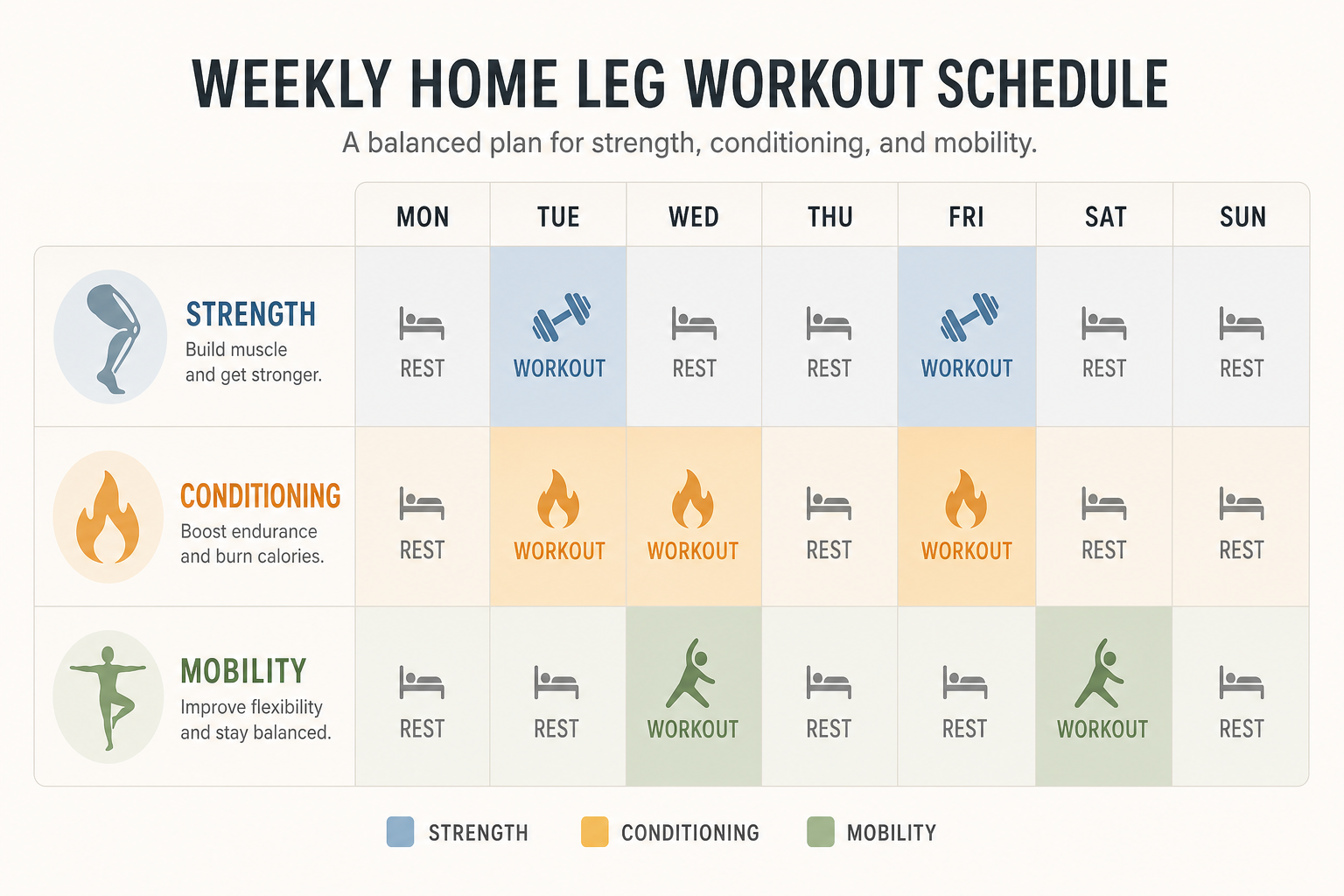
| Monday | Strength Session A | Squat-focused: goblet squat or bodyweight squat, Bulgarian split squat, single-leg glute bridge, reverse lunge |
| Tuesday | Rest or light activity | Walking, stretching — no lower body loading |
| Wednesday | Rest | |
| Thursday | Strength Session B | Hinge-focused: Romanian deadlift variation, step-up, lateral lunge, single-leg calf raise |
| Friday | Rest or light activity | |
| Saturday | Rest | |
| Sunday | Rest |
Goal 2: Conditioning and Fat Loss
Conditioning-focused leg training uses the same compound movements as strength training — squats, lunges, step-ups, hip thrusts — but reorganizes the programming variables to prioritize calorie expenditure and cardiovascular demand over maximum strength output. The logic is straightforward: large muscle groups burn more energy than small ones, and compound movements engage more muscle mass per exercise than isolation work.
Circuit Structure and Work Formats
Conditioning sessions use two primary formats: EMOM (every minute on the minute) and AMRAP (as many rounds as possible). Both formats create a sustained metabolic stimulus without requiring equipment.
- EMOM example: Perform 10 jump squats at the start of each minute. Rest for the remainder of the minute. Repeat for 8–10 minutes. As fitness improves, increase to 12 reps or add a second movement within the minute.
- AMRAP example: Set a 15-minute timer. Complete as many rounds as possible of: 10 reverse lunges per leg, 15 glute bridges, 10 step-ups per leg. Record rounds completed and aim to beat that number each session.
- Timed circuit example: 40 seconds of work, 20 seconds of rest, rotating through 5–6 compound exercises for 3–4 rounds. Rest 60–90 seconds between rounds.
Sets, Reps, and Rest
| Format | Work Interval | Rest Between Exercises | Rest Between Rounds | Sessions Per Week |
|---|---|---|---|---|
| EMOM | Defined reps at start of each minute | Remainder of minute | N/A | 3 |
| AMRAP | Continuous for set time block | Minimal — only as needed | 60–90 seconds between blocks | 3 |
| Timed Circuit | 30–45 seconds per exercise | 15–30 seconds | 60–90 seconds | 3 |
3-Day Weekly Template
| Day | Session | Notes |
|---|---|---|
| Monday | Conditioning Circuit A | AMRAP or timed circuit — squat and lunge emphasis |
| Tuesday | Rest or low-intensity activity | Walking, light mobility work |
| Wednesday | Conditioning Circuit B | EMOM format — hinge and step-up emphasis |
| Thursday | Rest | |
| Friday | Conditioning Circuit C | Full lower body compound circuit — mix of formats |
| Saturday | Rest or low-intensity activity | |
| Sunday | Rest |
Progression Rules
- Add 1–2 reps per exercise per week in EMOM formats, or add one additional round per AMRAP block.
- Reduce rest intervals by 5 seconds per week once the current rest period feels manageable.
- Introduce explosive variations (jump squat, jump lunge) once form is consistent on the standard version — these increase calorie expenditure per minute without adding equipment.
- Track total rounds or total reps per session and aim for consistent improvement over 4-week blocks.
Goal 3: Mobility and Functional Strength
Mobility-focused leg training is not stretching. It is structured work that builds strength through a full range of motion, develops single-leg stability, and improves the quality of movement patterns that carry over into daily activity and other training. The primary training variable here is time under tension — how long a muscle is under load — rather than the amount of load or the speed of movement.
This framework is distinct from the strength goal in its emphasis. Strength training uses controlled tempo to accumulate volume. Mobility training uses slow tempo as the core stimulus — the goal is joint control and movement quality, not progressive load accumulation.
Exercise Selection Rationale
Single-leg exercises dominate this framework because they expose and address asymmetries, require hip and ankle stability, and create significant muscular demand through range of motion without any external load. The 90/90 hip stretch, deep squat hold, single-leg Romanian deadlift, and lateral lunge with a pause at the bottom are representative movements — each requires deliberate control that is impossible to rush through.
Sets, Reps, Rest, and Tempo
| Exercise Type | Sets | Reps / Duration | Rest | Eccentric Tempo |
|---|---|---|---|---|
| Single-leg stability (single-leg RDL, pistol squat progression) | 2–3 | 6–8 per leg | 90 seconds | 3–5 seconds down |
| Controlled range-of-motion (deep squat hold, lateral lunge with pause) | 2–3 | 8–10 or 30–45 sec hold | 60–90 seconds | 3–5 seconds into position |
| Hip mobility (90/90 transitions, hip flexor lunge) | 2–3 | 5–8 per side | 60 seconds | Slow and deliberate throughout |
Progression Rules
- Extend the eccentric phase by 1 second per week (3 sec → 4 sec → 5 sec) before advancing to a harder variation.
- Increase range of motion progressively — for example, a lateral lunge with a 2-inch deficit once full-range form is consistent.
- Progress single-leg stability work by reducing hand support (wall-assisted → fingertip support → unsupported) rather than adding load.
- Add one additional set per exercise every two weeks, up to a maximum of 3 working sets per movement.
2-Day Weekly Template
| Day | Session | Notes |
|---|---|---|
| Tuesday | Mobility Session A | Single-leg RDL, deep squat hold, 90/90 hip transitions, lateral lunge with pause |
| Wednesday | Rest or light activity | Walking, gentle movement — no structured lower body loading |
| Friday | Mobility Session B | Pistol squat progression, hip flexor lunge, single-leg glute bridge with 3-sec hold, controlled step-down |
| Other days | Rest or upper body / core work | Lower body sessions are non-consecutive |
How to Switch Between Goal Frameworks
Transitioning directly from one goal framework to another — for example, from 8 weeks of conditioning circuits to a strength-focused block — without a reset period is a reliable way to accumulate fatigue and stall progress. The cumulative volume from a conditioning block is not the right starting point for a strength block, and the reverse is equally true.
Before switching frameworks, complete a 2-week deload. Reduce total sets by 30–40% and drop intensity to roughly RPE 6 (you could do several more reps than you complete). This allows full recovery before the new stimulus begins, and it resets your baseline for tracking progression in the new framework.
- Complete your current framework for a minimum of 4–6 weeks before considering a transition.
- Run a 2-week deload: same exercise selection, reduced sets (2 instead of 3–4), reduced intensity (RPE 6).
- Begin the new framework at the entry point — do not start at the progression level where the previous block ended.
- Track your performance in week 1 of the new framework as your baseline, and apply progressive overload from there.
Common Mistakes by Goal
Strength and Muscle Building
- Using conditioning-style rest periods (30–60 seconds) on heavy compound sets — this shifts the stimulus away from strength and limits the volume you can sustain across all sets.
- Advancing to a harder unilateral variation before the bilateral version is technically consistent — Bulgarian split squats with poor hip control do not build the strength the exercise promises.
- Switching progression variables week to week (reps one week, tempo the next, variation the next) instead of committing to one variable for a full block.
Conditioning and Fat Loss
- Including too many isolation exercises (leg extensions, calf raises) in circuits — these do not drive calorie expenditure the way compound movements do.
- Treating AMRAP rounds as a competition and sacrificing form for speed — this increases injury risk without proportionally increasing training benefit.
- Running three conditioning sessions per week without managing recovery — if soreness is persisting beyond 48–72 hours, reduce frequency to two sessions before adding the third back.
Mobility and Functional Strength
- Treating mobility sessions as a warm-up rather than a structured training stimulus — these sessions require the same intention and tracking as any other goal framework.
- Rushing through slow-tempo movements to finish the session faster — the slow eccentric is the entire point; speeding it up removes the primary training variable.
- Adding unilateral volume too quickly — single-leg work is demanding on stabilizers and connective tissue. One new single-leg exercise per week is a reasonable ceiling when starting this framework.
Warm-Up Protocol and Safety Cues
The following dynamic warm-up sequence applies to all three goal frameworks. It takes 5–7 minutes and prepares the hips, knees, and ankles for the range of motion and load demands of each session type.
- Leg swings — 10 forward/back and 10 side-to-side per leg. Loosens hip flexors and adductors.
- Hip circles — 10 per direction per leg. Mobilizes the hip joint through its full range.
- Bodyweight squat with 2-second pause at the bottom — 10 reps. Activates quads, glutes, and ankles.
- Glute bridge hold — 3 × 10-second holds. Activates posterior chain before loading.
- Lateral lunge — 8 per side. Opens the adductors and prepares the knee for multi-plane loading.
- Ankle circles and calf raises — 10 reps each. Prepares the ankle for single-leg and explosive work.
Knee Tracking and Form Cues
- On all squat and lunge variations, the knee should track over the second and third toe — not collapse inward. If the knee drifts inward under load, reduce depth or switch to a bilateral variation until hip abductor strength improves.
- On Bulgarian split squats, keep the front shin as vertical as possible and avoid letting the front knee drift forward past the toes under load. The rear foot is on a surface for balance, not to drive force.
- On jump squats, land softly with bent knees — absorb the landing through the entire leg, not the knee joint alone. If landing is loud or stiff, reduce jump height before adding volume.
- On single-leg glute bridges, press through the heel and avoid letting the pelvis rotate — both hip bones should remain level throughout the movement.
Frequently Asked Questions
How many days per week should I train legs?
It depends on your goal. The strength and mobility frameworks in this article use 2 days per week — enough to accumulate the volume needed for adaptation while allowing full recovery between sessions. The conditioning framework uses 3 days per week because the sessions are shorter and lower in absolute intensity. Research supports twice-weekly lower-body training for optimal strength gains, and the Mayo Clinic notes that 2–3 sessions of 20–30 minutes per week produces significant strength improvement for most people. More is not automatically better — recovery between sessions is where adaptation actually occurs.
Can bodyweight-only training build visible muscle in the legs?
Yes, with the right programming. The key condition is progressive overload — the training stimulus must increase over time. Bodyweight training can deliver this through rep progression, variation advancement (bilateral → unilateral), tempo manipulation, and set volume increases. Research shows that smart bodyweight training delivers muscle gains comparable to resistance training when progressive overload is applied consistently. The limitation of bodyweight training is not its potential — it is the tendency to plateau once the available variations are exhausted. At that point, adding minimal load (a resistance band, a single dumbbell held at the chest) extends the progression significantly.
How do I know when to progress?
The general rule: when you can complete all prescribed sets and reps with 2–3 reps remaining in reserve (RPE 7 or below) for two consecutive sessions, it is time to progress. For the strength framework, this means adding reps or advancing the variation. For the conditioning framework, this means adding a round or reducing rest. For the mobility framework, this means extending the eccentric or increasing range of motion. Do not progress based on how the session felt on a single good day.
What if soreness lasts beyond 72 hours?
Muscle soreness that persists beyond 72 hours after a session typically indicates that the training volume or intensity exceeded your current recovery capacity. The appropriate response is to reduce volume in the next session by 30–40% and allow full recovery before resuming normal training. If soreness is accompanied by significant swelling, joint pain, or inability to bear weight, consult a healthcare provider before returning to training. Persistent soreness beyond 72 hours is also a signal to review your sleep, hydration, and overall weekly training load — recovery is a training variable, not an afterthought.
What a small equipment investment adds
We don't have a build tagged to this exact tier yet. Browse all builds.
How often should you repeat this?
See our recovery and rest reference for citation-anchored rest-interval guidance.
Spot something off?
Tell us if a movement, tier assumption, or duration didn't match your experience.