
How to Recover From a Bodyweight Workout at Home (No Equipment Needed)
Bodyweight home workouts create unique recovery demands. This guide covers cool-down protocols, nutrition timing, active recovery strategies, and sleep optimization specifically for people who train with bodyweight only — no foam roller, massage gun, or gym access required.
Why Bodyweight Workouts Need a Different Recovery Approach
If you train with bodyweight exercises at home — think push-ups, squats, lunges, planks, and burpees — your recovery needs differ from someone who lifts heavy barbells in a commercial gym. The distinction matters because the type of fatigue you accumulate is not the same.
Weight training typically produces localized muscle damage. A heavy squat day crushes your quadriceps and glutes, but your upper body might feel fresh the next morning. Bodyweight training, by contrast, tends to be higher in total rep volume and more systemic. A full-body bodyweight circuit can fatigue your chest, back, legs, and core in a single session. You are asking more of your entire system, not just one muscle group.
There is also the frequency factor. Many home exercisers train bodyweight five or six days per week because they lack the equipment to load movements heavily enough to require longer recovery windows. That higher frequency, combined with the systemic nature of the work, means recovery must be intentional — not something you leave to chance.
The core mechanism at play is the same: bodyweight workouts create micro-tears in muscle fibers that require time to repair. According to Healthline, those micro-tears need 24 to 72 hours to fully rebuild, depending on the intensity of the session. A light bodyweight day — say, a 15-minute mobility circuit — may be fully repaired within 24 hours. A high-intensity bodyweight session with maximal push-ups, jump squats, and pull-up alternatives can demand two to three days of recovery.
The Recovery Timeline for Bodyweight Workouts
Knowing how long recovery takes helps you decide when to train again. The timeline depends on the intensity of your session, not the duration alone. A 45-minute bodyweight circuit with minimal rest between exercises creates more systemic fatigue than a 20-minute slow-flow yoga session, even though both are bodyweight.
The table below maps session types to estimated recovery windows, based on the Healthline framework of 24–72 hours for muscle repair.
| Session Type | Example | Estimated Recovery Time |
|---|---|---|
| Light / mobility-focused | 15-min morning stretch, gentle yoga flow | 24 hours or less |
| Moderate strength circuit | 3 sets of 12–15 reps: squats, push-ups, rows, planks | 24–48 hours |
| High-intensity bodyweight | AMRAP circuits, burpee ladders, jump squats, max-rep push-ups | 48–72 hours |
| Full-body endurance | Long-duration bodyweight circuits (40+ min) with short rest | 48–72 hours |
Use this table as a guideline, not a rule. If you complete a moderate circuit and still feel fatigued or sore after 48 hours, give yourself an extra day. The goal is to train consistently over months and years, not to force a schedule that ignores your body's signals.
Your Post-Workout Cool-Down Protocol (5–10 Minutes)
Recovery does not start when you sit down. It starts in the minutes immediately after your last rep. A proper cool-down helps your heart rate return to baseline gradually and prevents blood from pooling in your limbs — a condition that can cause dizziness or fainting after intense exercise.
The Cleveland Clinic recommends spending 5 to 10 minutes on low-intensity movement and stretching after a workout. People who stretch during the cool-down tend to report fewer complaints of muscle soreness and fewer injuries overall. The protocol below requires no equipment and fits in any living room.
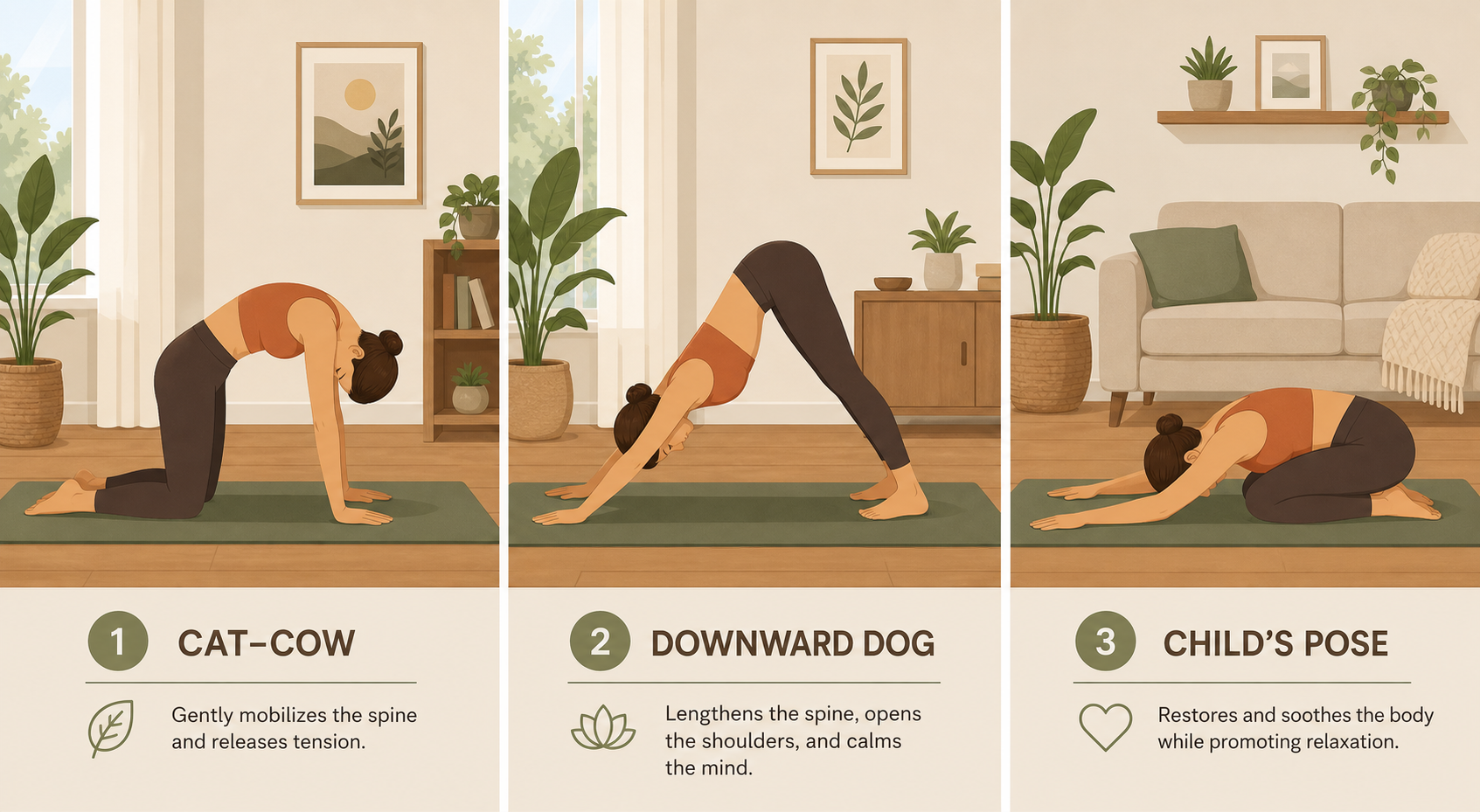
The 5-Minute Cool-Down Sequence
- Walk in place (1–2 minutes). Keep your arms loose at your sides. Breathe deeply. This step gradually lowers your heart rate and prevents blood pooling.
- Cat-cow stretch (1 minute). On hands and knees, alternate between rounding your spine (cat) and arching it (cow). Move slowly with your breath. This releases tension in the back and core after exercises like planks and push-ups.
- Downward dog (1 minute). From hands and knees, push your hips up and back, straightening your legs as much as comfortable. Pedal your feet gently. This stretches the hamstrings, calves, and shoulders.
- Child's pose (1–2 minutes). Kneel on the floor, sit back on your heels, and extend your arms forward on the ground. Rest your forehead on the mat or floor. This is a resting stretch that calms the nervous system.
After the cool-down, take a few slow, deep breaths before moving on to hydration and nutrition. Your body has transitioned from exercise mode to recovery mode.
Hydration and Nutrition for Bodyweight Athletes
Bodyweight training may not feel as metabolically demanding as heavy lifting, but it still depletes glycogen stores and creates a need for protein to repair muscle tissue. The difference is that your nutrition strategy does not need to be complicated or expensive.
Hydration
Water is the most essential recovery nutrient. According to Henry Ford Health, drink 8 ounces of water for every 15 to 30 minutes of exercise. If you weigh yourself before and after a workout, drink 8 ounces of water for each pound lost during the session. Even mild dehydration can impair muscle repair and prolong soreness.
Protein and Carbohydrate Timing
The International Society of Sports Nutrition (ISSN) recommends a daily protein intake of 1.4 to 2.0 grams per kilogram of body weight for individuals engaged in resistance-type exercise. For a 150-pound (68 kg) person, that is roughly 95 to 136 grams of protein spread across the day.
Timing also matters. Both Mayo Clinic and Cleveland Clinic recommend consuming 20 to 30 grams of protein along with carbohydrates within 30 minutes after exercise. This post-workout window is when your muscles are most receptive to nutrients for repair and glycogen replenishment.
| Food | Protein (approx.) | Carbs (approx.) | Notes |
|---|---|---|---|
| Chocolate milk (1 cup) | 8 g | 26 g | Convenient, no prep needed; contains both protein and carbs |
| Peanut butter on whole-wheat bread (2 tbsp + 2 slices) | 16 g | 30 g | Shelf-stable, requires no cooking |
| Hummus with pita (1/2 cup + 1 large pita) | 10 g | 35 g | Plant-based option, easy to portion |
| Greek yogurt (1 cup plain) | 20 g | 9 g | High protein; add fruit for more carbs |
| Cottage cheese with fruit (1 cup) | 28 g | 15 g | Very high protein; fruit adds natural sugar |
Active Recovery Strategies for Limited-Space Homes
Active recovery — low-intensity movement performed at 30 to 60 percent of your maximum heart rate — is consistently shown to be superior to passive recovery (complete rest) for returning the body to a resting state after intense exercise. The NASM cites a landmark study by Ahmaidi et al. (1996) demonstrating that active recovery leads to faster clearance of blood lactate and a quicker return to homeostasis compared to sitting still.
For home exercisers with limited space, active recovery does not require a treadmill or a pool. The following options work in a small apartment or living room.
- Walking. If you have access to outdoor space or a hallway, a 15- to 20-minute walk at a conversational pace is the most accessible active recovery activity. No equipment, no setup, no cleanup.
- Gentle yoga flow. A slow sequence of sun salutations, standing forward folds, and gentle twists keeps blood moving without raising your heart rate into the training zone.
- Light mobility circuit. Move through joint rotations (ankle circles, arm circles, hip circles) and static stretches held for 20–30 seconds. This is especially useful after high-rep bodyweight sessions that leave joints feeling stiff.
- Self-massage with hands. Without a foam roller, you can use your thumbs and fingers to apply pressure to sore areas — calves, quads, and forearms respond well to manual pressure. The Mayo Clinic notes that massage is the most powerful technique for reducing delayed-onset muscle soreness (DOMS) and fatigue, according to a meta-analysis in Frontiers of Physiology (Dupuy et al., 2018).
Sleep: Your Most Powerful (and Free) Recovery Tool
No recovery strategy — not nutrition timing, not active recovery, not cool-down protocols — can compensate for inadequate sleep. Sleep is when the body releases growth hormone, repairs muscle tissue, and regulates the inflammatory response. Without sufficient sleep, the recovery process is fundamentally compromised.
The Cleveland Clinic recommends 7 to 9 hours of sleep per night for most adults. If you are not getting that consistently, your muscles will not rebuild effectively, regardless of how well you eat or how thoroughly you cool down.
Sleep deprivation impairs muscle recovery by disrupting the body's inflammation response and reducing the production of hormones that aid muscle growth, according to Healthline. For home exercisers who train in the evening — a common pattern for people balancing work and family — sleep hygiene becomes especially important.
Practical Sleep Hygiene Tips for Evening Exercisers
- Finish your workout at least 60–90 minutes before bedtime. This gives your core temperature and heart rate time to drop.
- Use the cool-down protocol above to signal to your nervous system that exercise is over.
- Avoid screens for 30 minutes before bed. Blue light suppresses melatonin production, which can delay sleep onset.
- Keep your bedroom cool (65–68°F / 18–20°C). A cooler environment supports deeper sleep stages.
- Be consistent with your wake-up time, even on rest days. A regular circadian rhythm supports hormone regulation for recovery.
5 Signs You Need More Recovery Time
Pushing through fatigue is sometimes necessary in a workout, but pushing through inadequate recovery is counterproductive. The NASM identifies several evidence-based indicators that your body has not fully recovered from previous training sessions. Recognizing these signs early can prevent overtraining and keep you consistent long-term.
- Elevated resting heart rate. If your morning resting heart rate is more than 8 beats per minute above your normal baseline, your body is still under stress from training. Take a rest day or do only light active recovery.
- Performance decline over 7–10 days. If your reps, sets, or workout quality are dropping consistently over a week or more, you are not recovering between sessions. This is one of the clearest signs of accumulated fatigue.
- Disturbed sleep. If you are having trouble falling asleep, waking frequently, or feeling unrefreshed despite spending enough time in bed, your recovery is compromised. Overtraining can disrupt sleep patterns even when you feel physically exhausted.
- Persistent muscle soreness. Some soreness is normal, especially after a new or intense session. But if soreness lasts more than 72 hours or feels worse rather than better each day, you need more recovery time.
- Reduced motivation. A temporary lack of enthusiasm is normal, but a persistent drop in motivation to train — especially when combined with any of the above signs — often indicates that your body needs a break.
Sample Recovery Week for a Bodyweight-Only Home Program
Putting the principles together, here is a sample week that alternates training days with active recovery and full rest. This schedule follows the Cleveland Clinic's basic weekly framework of 3 strength days, 2 active recovery days, and 2 rest days, adapted for bodyweight-only training.
| Day | Activity | Recovery Focus |
|---|---|---|
| Monday | Full-body bodyweight strength (30 min) | 5-min cool-down, 20 g protein within 30 min, hydrate |
| Tuesday | Active recovery: 20-min walk + 10-min gentle yoga | Focus on mobility and blood flow; no intense effort |
| Wednesday | Upper-body bodyweight circuit (25 min) | 5-min cool-down, protein-carb snack, hydrate |
| Thursday | Active recovery: 15-min mobility circuit + self-massage | Joint rotations, light stretching, manual pressure on sore spots |
| Friday | Lower-body bodyweight + core (30 min) | 5-min cool-down, 20 g protein within 30 min, hydrate |
| Saturday | Full rest day | Prioritize 7–9 hours of sleep, light walking if desired |
| Sunday | Full rest day | Sleep, hydration, prepare for the next training week |
This schedule is a template, not a prescription. If you feel recovered and ready to train on an active recovery day, you can swap it for a light strength session. If you feel fatigued on a scheduled training day, swap it for active recovery. The goal is to build a sustainable practice, not to follow a rigid calendar.
Recovery after bodyweight workouts at home does not require expensive tools or complicated protocols. It requires understanding the unique demands of high-rep, full-body training and applying consistent, evidence-based practices: a proper cool-down, strategic nutrition timing, active recovery on off days, and sufficient sleep. Master those four elements, and your body will adapt, strengthen, and stay resilient session after session.
This is general fitness education, not medical advice. For diagnosis or treatment of pain or injury, consult a qualified clinician.
Pick your next session
Browse all routines to find an appropriately-spaced next session.
Spot something off?
This content sits adjacent to health guidance — tell us if a citation or figure needs a correction.