
Apartment-Friendly Cardio: Effective No-Jumping Home Workouts for Small Spaces
A complete guide to effective, low-noise cardio for apartment dwellers. Learn how compound bodyweight movements and timing protocols like Tabata and EMOM can elevate your heart rate without a single jump, plus a sample 15-minute workout and progression plan.
- Duration
- 15 min
The Noise Problem: Why Jumping Matters Acoustically
If you live in an apartment, you already know the sound profile of a jumping workout: the thud of a landing, the vibration through the floor, the inevitable knock on the door or text from the downstairs neighbor. This isn't just about being polite — it's physics. When you jump, your body exerts multiple times your bodyweight in force on the floor surface. That force transfers directly into the building structure, turning your living room into a percussive instrument for everyone below.
Most home cardio content ignores this reality. It prescribes burpees, jump squats, and high knees without acknowledging that those moves are effectively unusable for a significant portion of the population. The result is that apartment dwellers either skip cardio entirely or attempt modified versions that don't deliver the intended stimulus. Neither outcome serves your fitness goals.
The good news is that jumping is not a prerequisite for effective cardiovascular training. The entire premise that you need plyometric impact to raise your heart rate is a misconception rooted in gym-class conditioning, not exercise physiology. There is a well-documented alternative path that works better for apartment settings and, in many cases, produces equivalent results.
The Solution: Compound Multijoint Moves at High Density
The principle is straightforward: elevate your heart rate by recruiting large muscle masses through compound movements performed with minimal rest, rather than by adding impact. Exercise physiologist Noam Tamir, CSCS, founder and CEO of TS Fitness in New York City, explains it directly: "When you jump, you are using a lot more force — it's multiple times your bodyweight that you are handling, so your heart rate is going to go up, and it's going to be a lot more on your muscles and your joints. However, doing moves that are multijoint, where hips, knees, shoulders, and everything is involved, are going to be more beneficial to get your heart rate up when you can't do impact."
The key variable is work density — the amount of work performed per unit of time. A squat, a lunge, or a push-up performed at a controlled tempo with short rest intervals demands significant oxygen delivery to working muscles. When you chain these movements together without the recovery that comes from bouncing or pausing, your heart rate climbs into the same training zones you would reach with jumping exercises.
This approach has additional advantages beyond noise reduction. It places less stress on your joints, making it accessible for people with knee, ankle, or hip concerns. It also allows for better movement control — you can focus on form and muscle engagement rather than bracing for impact. For beginners, this is a safer entry point into high-intensity work.
Low-Impact Home Cardio Moves for Small Spaces
The following exercises are selected specifically for their ability to elevate heart rate without jumping, their minimal floor-space footprint, and their low noise profile. Each movement engages multiple joints and muscle groups simultaneously, which is the mechanism that drives cardiovascular demand.
- Lateral lunges: Step wide to the side, bend the working knee, and keep the opposite leg straight. This movement recruits the glutes, quads, adductors, and core. The lateral plane of motion also adds variety to sagittal-dominant routines.
- Controlled mountain climbers: Place hands on the floor (or on a towel to reduce friction noise) and drive knees toward the chest alternately. The key is control — avoid the explosive, bouncing version. A slow, deliberate tempo keeps the floor quiet and maintains core tension.
- Inchworms: From a standing position, fold forward, walk your hands out to a high plank, then walk your feet back to your hands. This movement cycles through hamstring stretch, plank hold, and shoulder stability with zero impact.
- Plank walks: From a forearm plank, step one hand forward, then the other, then step back. This creates a dynamic core and shoulder challenge without leaving the floor. The movement is silent and requires roughly two square feet of space.
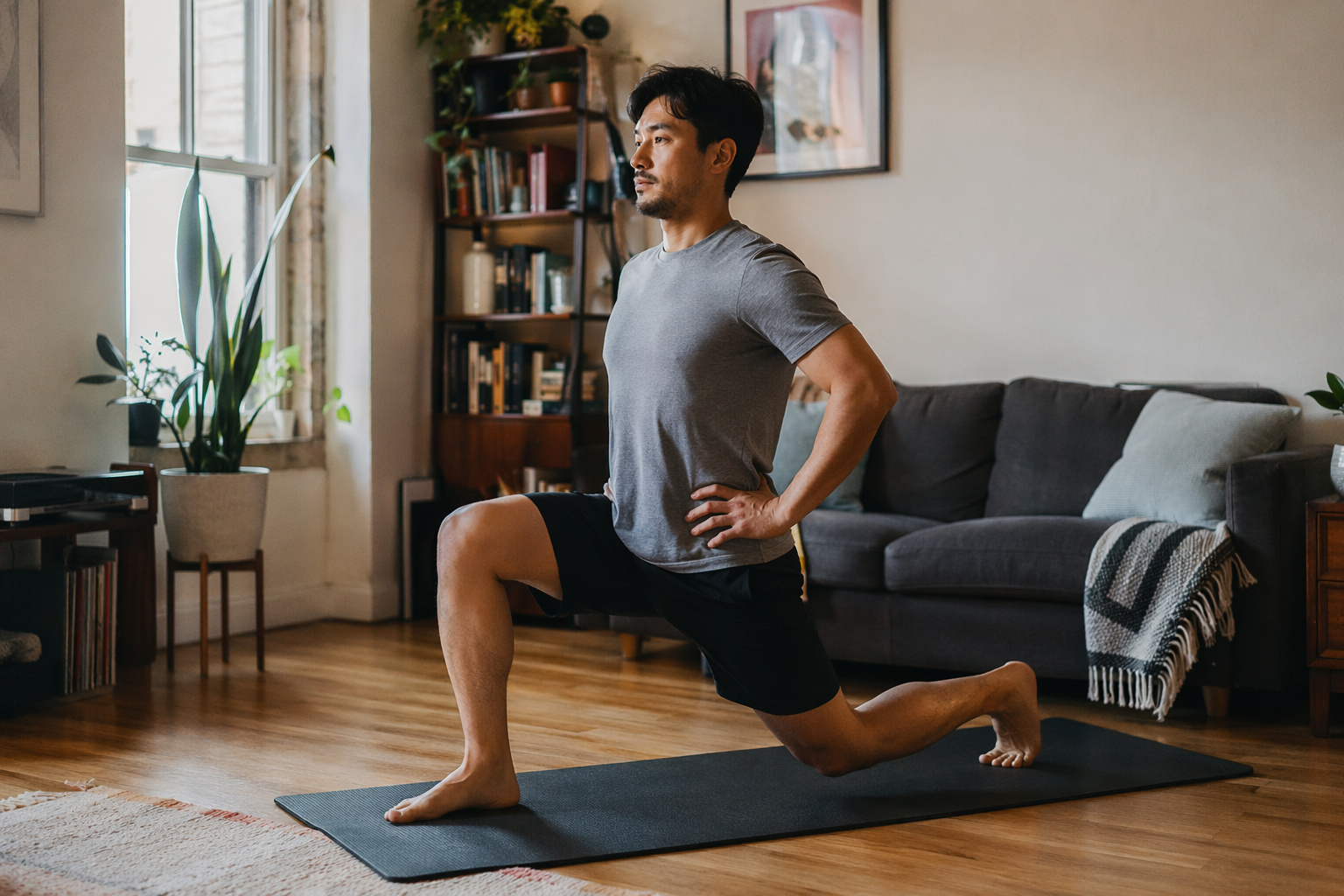
- Forward lunges: Step forward, lower the back knee toward the floor, and drive back up. The glutes and quads do the work. Keep the front knee aligned over the ankle to protect the joint.
- Squat to front kick: Perform a bodyweight squat, then drive one foot forward in a controlled kick as you stand. This adds a dynamic balance and hip-flexor component to a standard squat pattern.
- Standing oblique crunches: Lift one knee toward the same-side elbow while standing, engaging the obliques and hip flexors. This is a low-amplitude movement that can be performed quickly to elevate heart rate.
- Crab walk: From a reverse tabletop position (hands and feet on the floor, hips lifted), walk forward and backward. This movement targets the posterior chain and shoulders while keeping the body low to the ground.
What a small equipment investment adds
We don't have a build tagged to this exact tier yet. Browse all builds.
How often should you repeat this?
See our recovery and rest reference for citation-anchored rest-interval guidance.
Spot something off?
Tell us if a movement, tier assumption, or duration didn't match your experience.