
7 Garage Gym Mistakes That Cost You Money (And How to Avoid Them)
Avoid the most expensive garage gym mistakes before you buy a single piece of equipment. This guide covers ceiling height, flooring, climate control, and other overlooked constraints that can cost you hundreds or thousands of dollars.
- Budget tier
- $300–$1,000
- Space type
- garage
Items included: —
Introduction: The Most Expensive Mistakes Happen Before You Buy Anything
Building a garage gym feels like a straightforward project: clear some space, buy a rack and some weights, and start training. But ask anyone who has done it — especially the DIY-minded homeowners who jump in without a plan — and they will tell you a different story. The real cost of a garage gym is not the equipment itself. It is the money you spend fixing problems you could have avoided before placing a single order.
Those problems are not small. Electrical oversights alone can cost between $500 and $2,000 to retrofit, according to multiple garage gym sources. A power rack that is two inches too tall for your ceiling is not a minor inconvenience — it is a $400 paperweight. A set of plates dropped on bare concrete can chip the floor and damage the plates themselves, turning a $300 investment into a recurring replacement cost.
This article is not a general list of beginner mistakes. We have covered those elsewhere in our 7 Beginner Home Gym Mistakes guide, which focuses on phased buying errors and planning gaps that apply to any home gym. This guide is different. It focuses exclusively on the spatial, environmental, and logistical constraints that are unique to garages — the things that catch first-time builders off guard and turn a $1,500 dream setup into a $3,000 headache.
Mistake 1: Buying Equipment Before Measuring Ceiling Height and Layout
This is the single most common and most expensive garage gym mistake. Standard residential garage ceilings range from 7 to 9 feet, and many power racks require 84 to 96 inches of clearance. A rack that looks perfect in the product photos can be completely unusable in your space.
The problem is not just the rack height. You also need clearance above the bar for overhead pressing, pull-ups, and the lifter's own height. The Graymatterlifting FAQ, written by a r/HomeGym moderator, states that you need about 8 feet by 8 feet of working space minimum to safely handle a barbell. Multiple garage gym communities confirm that ceiling height is the number one overlooked constraint.
How to Avoid This Mistake
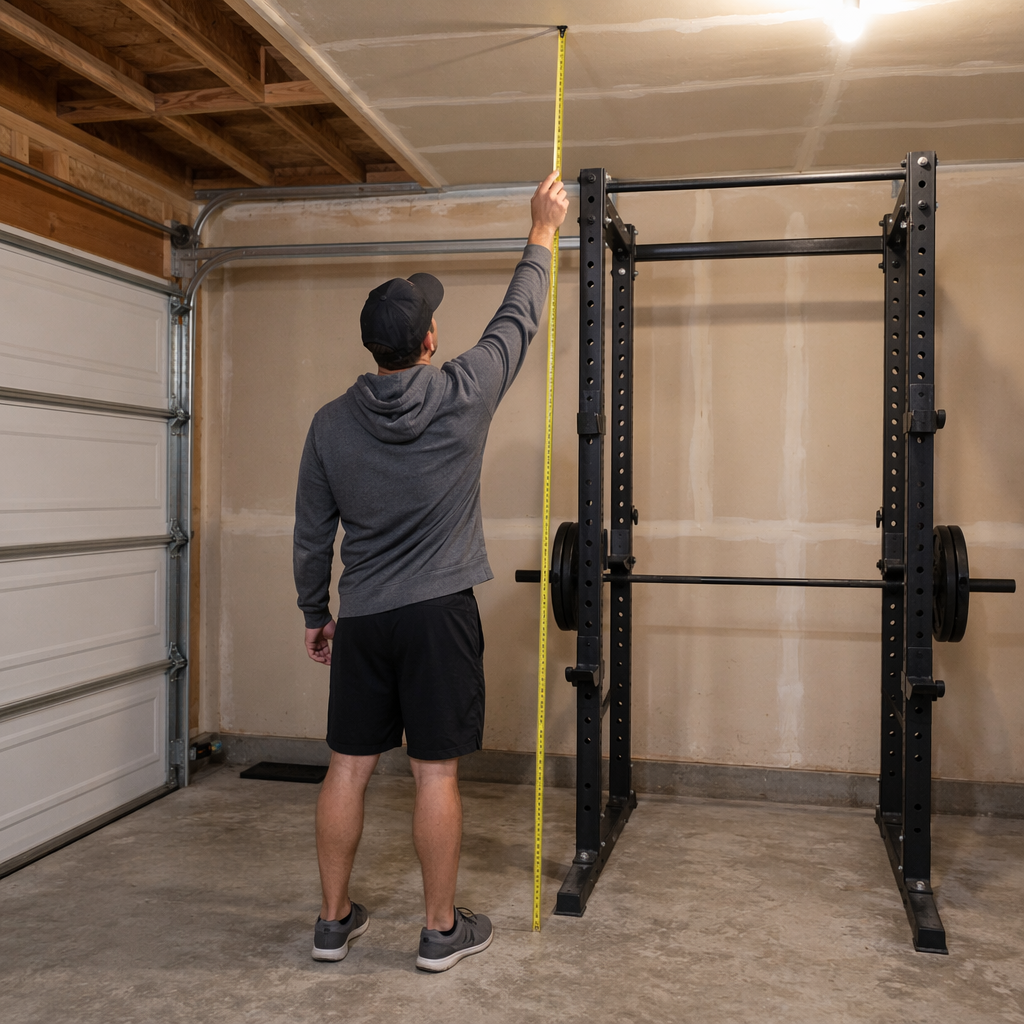
Measure your ceiling height at multiple points across the garage. Garage floors are often sloped toward the door for drainage, which means the clearance at the back wall may be different from the clearance near the garage door. Measure at the lowest point and use that as your working number.
Once you have your ceiling height, subtract the following: the height of the rack, the height of the lifter (from floor to top of head), and at least 12 inches of overhead clearance above the bar for safe pressing and pull-ups. The Any Assembly guide recommends 12 inches of overhead clearance above the bar as a minimum.
| Ceiling Height | What You Can Do | What You Cannot Do |
|---|---|---|
| 7–8 feet | Floor-based exercises, seated pressing, limited pull-ups | Overhead pressing for most users, kipping pull-ups |
| 8–9 feet | Overhead press for shorter users, strict pull-ups | Full range of motion for taller lifters, plyometrics |
| 9–10 feet | Full range of motion for most exercises | Olympic lifts with full extension for tall lifters |
| 10+ feet | All movements including plyometrics and Olympic lifts | Nothing — this is the ideal zone |
If your ceiling is on the lower end, consider a low-profile or folding rack. The PRx Profile PRO, rated 4.6 out of 5 by Garage Gym Reviews, folds to just 4 inches from the wall when not in use and supports 1,000 lbs. The REP PR-1100 Power Rack has a compact footprint of 48.5 inches deep by 58.1 inches wide by 85 inches high, making it a strong option for standard 8-foot ceilings. For a full guide on matching equipment dimensions to your garage, see our Small-Space Home Gym Buyer's Decision Guide.
Mistake 2: Skipping Rubber Flooring and Training on Bare Concrete
Bare concrete garage floors are hard, unforgiving, and destructive to both your equipment and your body. Dropping a loaded barbell on concrete can chip the floor, crack plates, and send fragments flying. Even controlled deadlifts and racked squats create micro-vibrations that gradually degrade the concrete surface over time.
The Garage Gym Reviews flooring guide, updated in May 2026, notes that training on concrete without mats can chip flooring and damage plates. It also cites 2025 research showing that rubber flooring significantly reduces impact noise — an important consideration if your garage shares a wall with a living space or if you have neighbors nearby.
How to Avoid This Mistake
The gold standard for garage gym flooring is the 3/4-inch rubber horse stall mat available at Tractor Supply. These mats are rated 4.5 out of 5 by Garage Gym Reviews, cost approximately $2.38 per square foot, weigh about 100 lbs each, and come with a 5-year limited warranty. A single 4-foot by 6-foot sheet costs roughly $50.
| Flooring Option | Thickness | Cost per Sq Ft | Best For |
|---|---|---|---|
| Tractor Supply 3/4" Stall Mats | 3/4 inch | $2.38 | Heavy lifting, regular weight drops, maximum concrete protection |
| Flooring Inc 8mm Strong Rubber Rolls | 8mm (~5/16 inch) | $2.17 | Commercial-grade coverage, 28 color options, lighter use |
| Living.Fit Rubber Flooring Rolls | Varies | $2.24 | Made in USA, 5-year warranty, moderate lifting |
Olympic weightlifter Caine Wilkes recommends a minimum of 1/2-inch thickness for heavy lifting and prefers 3/4-inch for regular weight drops, according to the Garage Gym Reviews flooring guide. If you plan to deadlift, clean, or snatch — or if you have children who might drop weights — go with 3/4-inch stall mats. They are heavy to install but virtually indestructible once in place.
Mistake 3: Buying Single-Use Machines Over Versatile Equipment
It is tempting to buy the machine you see at the commercial gym — the leg press, the pec deck, the lat pulldown tower — because it looks familiar and promises a direct path to results. But in a garage, every square foot counts. A single-purpose machine that takes up 20 square feet but only works one movement pattern is a poor use of space and budget.
The cost-of-mistake math is straightforward: a $1,500 leg press machine that you replace with a $500 power rack six months later is not a $1,500 purchase. It is a $2,000 mistake, because you now have to sell the leg press at a loss and buy the rack anyway.
How to Avoid This Mistake
Build your garage gym around a core set of versatile equipment that supports hundreds of exercises across multiple movement patterns. The foundation should include:
- A power rack (squat, bench, overhead press, pull-ups, rack pulls)
- An Olympic barbell and weight plates (deadlifts, cleans, rows, presses)
- An adjustable bench (flat, incline, decline pressing and rowing)
- Adjustable dumbbells (accessory work, unilateral training, drop sets)
Adjustable dumbbells are especially valuable in a garage gym because they replace an entire rack of fixed dumbbells. The REP QuickDraw adjustable dumbbells, which start at $335.99 and span 5 to 60 lbs, have been drop-tested and take up about the same space as a pair of shoes. The REP x PÉPIN FAST Series goes up to 125 lbs at only 18.3 inches long, giving you serious weight in a compact form factor.
For a complete list of versatile, multi-purpose equipment that supports progression, see our Complete Garage Gym Equipment Checklist. It breaks down what you actually need based on your training goals and space constraints.
Mistake 4: Ignoring Temperature and Humidity Control
Most garages are uninsulated, unheated, and un-air-conditioned. That means summer temperatures can push past 100°F in many regions, and winter temperatures can drop below freezing. These conditions do not just make workouts uncomfortable — they actively damage your equipment.
Humidity is the primary culprit. The Graymatterlifting FAQ confirms that temperature and humidity issues cause barbell rust, which degrades the knurling and can eventually compromise the bar's integrity. Rust on weight plates is cosmetic but annoying. Rust on a barbell's shaft or sleeves can affect rotation and grip, turning a $200–$300 bar into a safety concern.
How to Avoid This Mistake
Climate control for a garage gym does not require a full HVAC overhaul. The most practical solutions, recommended by the r/GarageGym community and confirmed by Graymatterlifting, include:
- A dehumidifier for humidity control — this is the single most important investment for preventing rust. Set it to maintain 40–50% relative humidity.
- A mini-split unit for year-round temperature regulation — more efficient than window units and does not block a window or garage door.
- High-velocity fans for summer ventilation — moving air makes a significant difference in perceived temperature during workouts.
- A space heater for winter — electric infrared or ceramic heaters work well for small garages. Mini-splits are more efficient but have a higher upfront cost.
A simple first step: buy a cheap digital thermometer-hygrometer for your garage and monitor the conditions for a week before you decide on climate control. You may find that a dehumidifier alone is sufficient, or that your garage stays within a comfortable range most of the year.
Mistake 5: Having No Storage Plan for Plates, Bars, and Accessories
Loose weight plates stacked on the floor, barbells leaning against a wall, resistance bands tangled in a corner — this is the default state of many first-time garage gyms. The problem is not just visual clutter. Loose plates create tripping hazards, barbells on the floor can be stepped on or knocked over, and accessories without a home get lost or damaged.
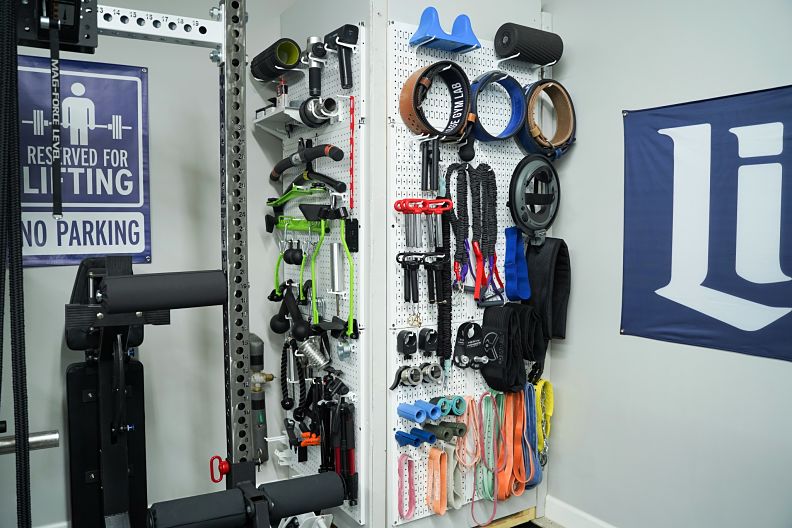
In a small garage, every square foot of floor space is valuable. The solution is to move storage to the walls.
How to Avoid This Mistake
Wall-mounted storage systems keep your equipment accessible while preserving floor space for training. The Garage Gym Lab guide to home gym storage, updated in January 2026, provides specific product recommendations:
| Storage Solution | Price | Capacity | Footprint |
|---|---|---|---|
| Wall Control Pegboard Panels | From $27.97 | Up to 200 lbs when properly secured | Zero floor footprint — wall mounted |
| Rogue v2 Gun Rack | From $75 | Holds 3 or 6 barbells horizontally | Zero floor footprint — wall mounted |
| Titan Mass Storage System | From $254.97 | Rotating shelf, 20-inch depth | 20" deep — compact for a storage unit |
| Wall-Mounted Plate Storage | Varies by brand | Holds standard Olympic plates | Zero floor footprint — wall mounted |
The Wall Control panels are made of 20-gauge steel and can hold up to 200 lbs when properly secured to wall studs. They are excellent for bands, jump ropes, foam rollers, and small accessories. The Rogue v2 Gun Rack holds barbells horizontally on the wall and is available with optional UHMW lining to protect the bar finish. The Titan Mass Storage System has a rotating shelf that can be set at five different angles, making it a good option for larger plate collections.
Mistake 6: Overlooking Delivery Access and Assembly Requirements
This is the mistake that feels obvious in hindsight but catches almost everyone the first time. Heavy equipment — horse stall mats at 100 lbs each, power racks in multiple boxes, barbells that are 7 feet long — may not fit through standard doorways or be deliverable to your garage.
Standard residential doorways are 30 to 36 inches wide. A power rack box can be 40 inches wide. A 7-foot barbell will not fit through a 36-inch door at an angle that allows it to clear both sides. And if you live in a townhouse or have a narrow driveway, delivery trucks may not be able to reach your garage at all.
How to Avoid This Mistake
Before you order anything, measure your doorways, hallways, and any turns the equipment will need to navigate from the delivery point to the garage. Write down the narrowest point and compare it to the box dimensions listed on the product page.
- Confirm delivery options with the seller. Some offer curbside delivery only, which means you are responsible for moving a 300-lb box from the street to the garage. Others offer room-of-choice delivery for an additional fee.
- For heavy items like stall mats and power racks, consider having them delivered to a friend's house with a garage if your own access is limited.
- For complex equipment like cable machines or multi-gyms, factor in professional assembly. The Any Assembly guide warns that incorrect assembly from skipped leveling, forced bolts, or misrouted cables reduces equipment lifespan and voids warranties.
- If your equipment requires a 220V outlet (common for commercial-grade treadmills and some cable machines), have an electrician install it before the equipment arrives.
Mistake 7: Not Planning for Progression — Buying for Where You Are, Not Where You'll Be
The most common progression mistake is buying equipment that matches your current strength level without considering where you will be in six months. A 100-lb weight set feels heavy on day one. By month three, you are repping the top weight for sets of ten and wondering why you did not buy the 300-lb set.
The same logic applies to benches, racks, and barbells. A flimsy bench rated for 300 lbs may feel fine for benching 135, but when you are pressing 225, the wobble becomes a safety concern. A barbell with low tensile strength may bend under heavy deadlifts. Buying twice costs more than buying right once.
How to Avoid This Mistake
Buy equipment with headroom — capacity and quality that exceed your current needs by a reasonable margin. The Garage Gym Reviews budget equipment guide, updated in June 2026, provides specific recommendations:
| Equipment | Budget Pick | Key Specs | Why It Has Headroom |
|---|---|---|---|
| Power Rack | REP PR-1100 | $380, 700-lb capacity, 14-gauge steel | 700 lbs is enough for all but elite powerlifters |
| Barbell | Synergee Games Cerakote | $179.95, 190,000 PSI tensile strength, lifetime warranty | 190K PSI is mid-range but sufficient for years of heavy training |
| Adjustable Dumbbells | REP QuickDraw 5–60 lbs | From $335.99, drop-tested | 60 lbs per hand covers most accessory work for intermediate lifters |
| Flooring | Tractor Supply 3/4" Stall Mats | $50 per 4'x6' sheet | 3/4 inch handles regular weight drops without replacement |
The REP PR-1100 Power Rack at $380 has a 700-lb capacity and is made of 14-gauge steel with a compact 48.5" D x 58.1" W x 85" H footprint. That capacity will serve you through years of strength training without needing an upgrade. The Synergee Games Cerakote Barbell at $179.95 has a 190,000 PSI tensile strength and comes with a lifetime warranty — it is not a competition-level bar, but it will handle everything most home gym users throw at it.
For a step-by-step approach to building out your gym incrementally without overspending upfront, see our Garage Gym Setup on a Budget guide. It covers a phased build from $300 to $1,500, with each phase designed to support the next.
Some links on this page are affiliate links — they may earn us a commission at no extra cost to you. Our tier and tests are decided before we ever check which links pay; see our full affiliate disclosure.
Spot something off?
Noise and floor-damage claims carry real deposit-risk consequences if we get them wrong — tell us if your experience with this build didn't match what's above.