
The First-Time Home Gym Buyer's Decision Framework: How to Choose Equipment by Budget, Space, and Goal
Feeling overwhelmed by home gym equipment choices? This guide rejects generic 'best of' lists in favor of a constraint-based framework that helps you choose the right gear based on your budget, available space, and primary fitness goal.
Why "Best" Is the Wrong Question for Your First Home Gym
Every week, another roundup of "best home exercise equipment" lands in your feed. They rank treadmills, bikes, and smart gyms as if there were a single winner — a universal champion that works for every budget, every apartment, and every fitness goal. That framing is the problem, not the solution.
The reality is that the "best" piece of equipment doesn't exist in absolute terms. The right choice depends on three constraint axes that are unique to your situation: how much you can spend, how much space you have, and what you want to achieve. A $2,500 smart gym is a terrible investment if your goal is daily walking and your budget is $300. A set of resistance bands is a poor choice if your primary objective is building significant lower-body strength.
This guide rejects the generic listicle format entirely. Instead, it provides a structured decision framework that maps your personal constraints — budget, space, and goal — to specific equipment categories. By the end, you'll know exactly which type of gear to research next, and you'll have the context to evaluate it intelligently.
Before diving into the framework, it's worth understanding why most beginners make poor first purchases. A common pattern is buying a single expensive machine — a treadmill or an elliptical — only to find it doesn't fit the space, collects dust, or fails to address the user's actual training needs. The 7 Beginner Home Gym Mistakes article covers these pitfalls in detail. The framework below is designed to prevent them from happening in the first place.
The Three Axes of Your Home Gym Decision
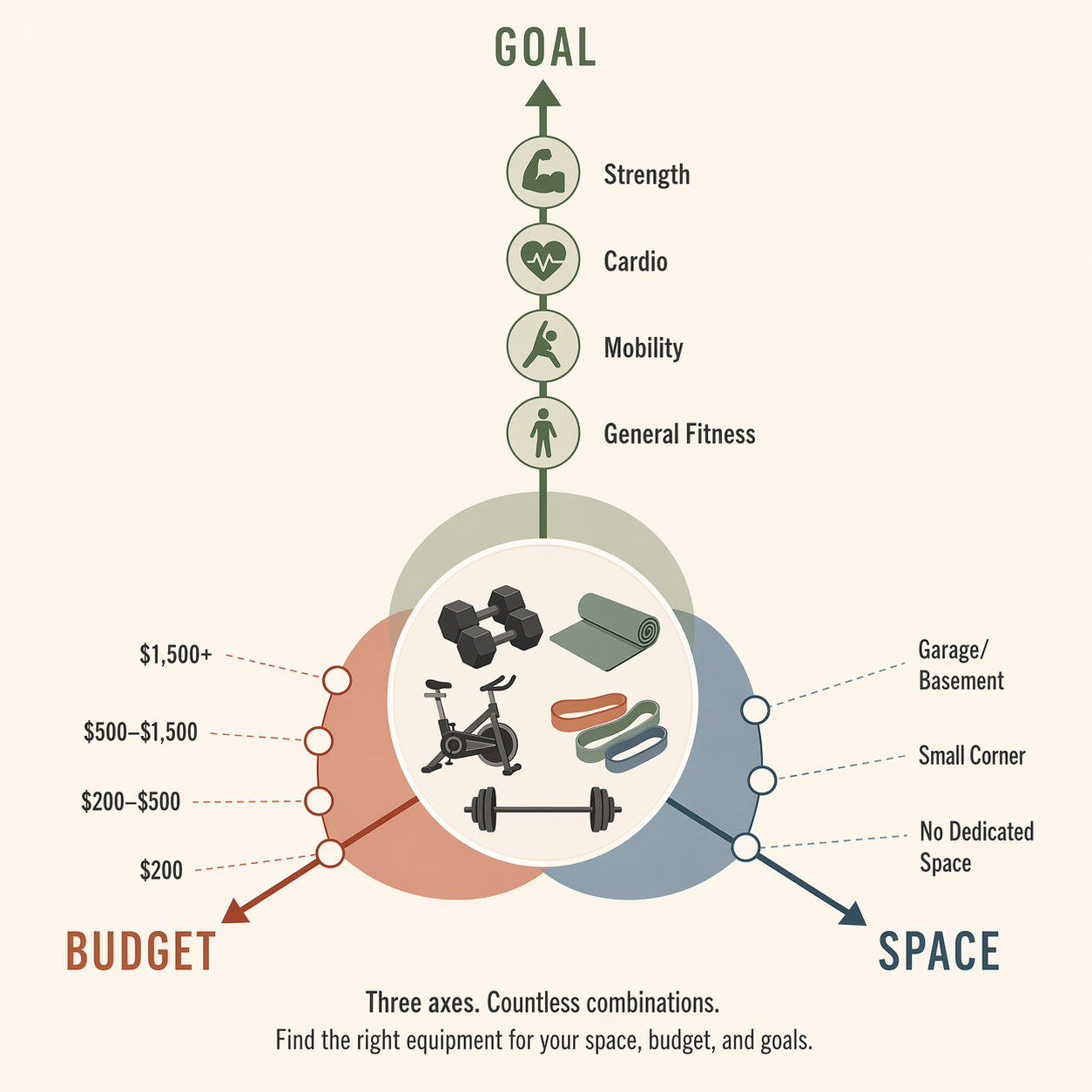
Every home gym purchase decision can be mapped along three independent axes. Your optimal equipment choice sits at the intersection of these three dimensions.
- Budget: How much are you willing to spend on your initial setup? This includes the equipment itself, plus any necessary accessories, flooring, or storage solutions. We'll break this into four tiers: under $200, $200–$500, $500–$1,500, and $1,500+.
- Space: What physical space do you have available? This ranges from no dedicated space (apartment living rooms, shared areas) to a small corner (a 4x6-foot area) to a full garage or basement. Each tier imposes different constraints on equipment size, portability, and storage.
- Goal: What is your primary fitness objective? General fitness and weight loss, strength building, cardio endurance, or mobility and flexibility. Different goals demand different resistance profiles, movement patterns, and training modalities.
These axes are not independent in practice — a low budget may limit your space-efficient options, and a strength goal may push you toward equipment that requires more floor area. The framework helps you navigate these trade-offs explicitly rather than discovering them after you've already made a purchase.
Budget Tiers: What You Can Afford and What It Buys
According to data from PTPioneer and Statista, the largest share of home fitness equipment buyers in the US — 38.6% — spent under $500 on a single piece of equipment. This tells us that affordability is the primary constraint for a huge portion of the market. The good news is that you don't need to spend thousands to build an effective home gym. The key is knowing what each budget tier realistically buys.
| Budget Tier | What It Buys | Best For | Example Cost |
|---|---|---|---|
| Under $200 | Resistance bands, yoga mat, jump rope, foam roller | Mobility, light strength, general fitness | $50–$150 |
| $200–$500 | Adjustable dumbbells, walking pad, kettlebells, pull-up bar | Strength building, cardio, general fitness | $250–$450 |
| $500–$1,500 | Exercise bike, rower, basic power rack, barbell + plates | Cardio endurance, serious strength training | $600–$1,400 |
| $1,500+ | Smart gym (Tonal, Speediance), all-in-one cable machine, premium treadmill | Full-body training, space efficiency, tech integration | $1,500–$3,500+ |
Under $200: The Minimum Effective Dose
If your budget is under $200, you are in the "minimum effective dose" zone. This is not a limitation — it's a smart starting point. As noted by Siwicki Fitness, a mat, resistance bands, and one pair of medium-weight dumbbells cover approximately 90% of effective home training. A complete starter kit in this tier — including a quality yoga mat, a set of fabric resistance bands, a jump rope, and a foam roller — can be assembled for $100–$150.
This tier is ideal for beginners who are unsure about their long-term commitment, have very limited space, or want to build a foundation before investing in larger equipment. The equipment is portable, requires no assembly, and can be stored in a closet or under a bed.
$200–$500: The Sweet Spot for Beginners
This is the most common entry point for first-time buyers. For $200–$500, you can acquire a pair of adjustable dumbbells (which replace up to 12 pairs of fixed dumbbells), a walking pad or compact treadmill, and a few additional accessories. The Siwicki Fitness starter kit — including a Manduka PRO yoga mat ($144), Vergali resistance bands ($19.79), and a set of adjustable dumbbells ($269.99) — totals approximately $470 to $600, landing right at the top of this tier.
Adjustable dumbbells are the standout investment in this range. Models like the REP Fitness QuickDraw (5–60 lbs, 18.5 inches in length) are specifically designed for small spaces and replace an entire rack of individual dumbbells. A walking pad or compact treadmill adds a cardiovascular component without requiring the footprint of a full-size treadmill.
$500–$1,500: Dedicated Equipment for Specific Goals
At this tier, you can purchase a single dedicated piece of cardio or strength equipment. An exercise bike, a rowing machine, or a basic power rack with a barbell and plates all fall within this range. The choice should be driven by your primary goal: an exercise bike or rower for cardio endurance, a power rack for strength training.
The Concept2 RowErg, for example, is a benchmark in this category. It stores vertically, weighs only 57 pounds, and provides a full-body, low-impact cardio workout. The Bells of Steel All-in-One Home Gym starts at $1,300 and combines a cable system with a squat rack, making it a strong option for strength-focused buyers who want versatility in a single unit.
$1,500+: Smart Gyms and All-in-One Systems
Above $1,500, you enter the territory of smart gyms and all-in-one cable machines. These systems — like the Tonal 2 (250 lbs of digital resistance) and the Speediance Gym Monster — integrate digital resistance, guided programming, and small footprints into a single unit. They are expensive, but they replace multiple pieces of equipment and require minimal floor space.
Before committing to a smart gym, read our Smart Home Gym vs. Traditional Home Gym: 5-Year Cost Analysis. The subscription costs alone can add $300–$600 per year, significantly increasing the total cost of ownership over a traditional setup.
Space Tiers: Working with What You Have
Lack of space is a real barrier. According to PTPioneer and Statista, approximately 20% of US exercisers cite lack of space as a significant reason for not owning fitness equipment at home. This section addresses that constraint directly by matching equipment to three common space scenarios.
| Space Tier | Typical Area | Equipment Strategy | Key Considerations |
|---|---|---|---|
| No dedicated space (apartment, shared living room) | 0–10 sq ft | Portable, foldable, storable: bands, mat, adjustable dumbbells, folding treadmill | Noise, weight limits, storage, no permanent installation |
| Small corner (spare room corner, bedroom) | 10–30 sq ft | Compact multi-use: adjustable dumbbells, bench, compact exercise bike, vertical-storage rower | Footprint measurements, ceiling height, ventilation |
| Garage or basement | 100+ sq ft | Full setup: power rack, barbell, plates, multi-station machine, full-size treadmill | Flooring, lighting, temperature control, power supply |
No Dedicated Space: The Portable Gym
If you live in an apartment, a shared house, or a small home where every square foot serves multiple purposes, your equipment must be portable, storable, and quiet. This is the most constrained space tier, but it's also the most common for first-time buyers.
The ideal setup for this tier includes: a high-quality yoga mat (for floor work and noise dampening), fabric resistance bands (quieter than rubber bands, no metal components), a pair of adjustable dumbbells (the REP Fitness QuickDraw is a strong candidate at 18.5 inches long), and a jump rope for cardio. For those who want a cardio machine, the Echelon Stride 6s-10 treadmill folds completely flat for storage, and the Bowflex Max Trainer M6 measures just 46 inches by 26 inches — less than half the length of a standard elliptical.
For a deeper dive into apartment-specific constraints — including noise reduction, floor protection, and no-drill mounting solutions — see our Renter's Guide to a Compact Home Gym.
Small Corner: The Compact Multi-Use Zone
A small corner — roughly 4x6 feet — is enough space for a surprisingly capable home gym. The key is choosing equipment that serves multiple functions and can be stored vertically or folded when not in use.
In this tier, consider: adjustable dumbbells and a folding bench (for strength training), a compact exercise bike or the Concept2 RowErg (which stores vertically and weighs 57 pounds), and a wall-mounted pull-up bar. The PRx Profile PRO Squat Rack is an excellent option for this tier — it mounts to the wall and folds to just 9 inches of depth when not in use, freeing up floor space between workouts.
Garage or Basement: The Full Setup
If you have a garage, basement, or spare room that you can dedicate to fitness, your options expand significantly. This tier allows for a power rack, a barbell and weight plates, a multi-station cable machine, and full-size cardio equipment.
The challenge here shifts from space constraints to prioritization. With a larger space, the temptation is to buy everything at once. Instead, follow a priority-based approach: start with a power rack, barbell, and plates for strength, then add a cardio machine and accessories as your training evolves. Our Garage Gym Equipment Priority Tier List provides a detailed framework for what to buy first, what to skip, and when to upgrade.
Goal Tiers: Matching Equipment to Your Primary Objective
Your primary fitness goal should drive the type of resistance and movement patterns your equipment provides. A strength-focused setup looks very different from a cardio-focused one, and buying equipment that doesn't align with your goal is the fastest path to abandonment.
| Primary Goal | Core Equipment | Secondary Equipment | Training Style |
|---|---|---|---|
| General fitness / weight loss | Exercise bike, adjustable dumbbells, yoga mat | Resistance bands, jump rope | Balanced: cardio + strength + mobility |
| Strength building | Adjustable dumbbells, bench, resistance bands, power rack | Barbell, plates, pull-up bar | Progressive overload, compound lifts |
| Cardio endurance | Exercise bike, rowing machine, walking pad | Jump rope, heart rate monitor | Steady-state and interval training |
| Mobility / flexibility | Yoga mat, foam roller, resistance bands | Massage gun, stretching strap | Dynamic stretching, yoga, myofascial release |
General Fitness and Weight Loss
For general fitness and weight loss, the goal is consistency and variety. You need equipment that makes it easy to start a session and that supports a mix of cardio, strength, and mobility work. Farren Morgan, a British military tactical trainer and personal trainer, recommends three standout beginner pieces: "an exercise bike, adjustable dumbbells and a yoga mat". He notes that "these three items give you a good balance of cardio, strength and flexibility. At the same time, they don't overwhelm you with complexity."
This combination is hard to beat for a beginner. The exercise bike provides low-impact cardio that is gentle on joints, adjustable dumbbells allow for progressive strength training, and the yoga mat enables floor work, stretching, and bodyweight exercises. It's a complete starter gym in three pieces.
Strength Building
If your primary goal is building strength, your equipment needs to support progressive overload — the gradual increase of resistance over time. Adjustable dumbbells are the most space-efficient way to achieve this. A pair that ranges from 5 to 60 pounds (like the REP Fitness QuickDraw) allows you to progress through multiple phases of training without buying additional weights.
A folding bench adds the ability to perform presses, rows, and step-ups. Resistance bands provide variable resistance for accessory work and can be used for pull-up assistance. If you have the space and budget, a power rack with a barbell and plates is the gold standard for serious strength training.
Cardio Endurance
For cardio endurance, the choice is between an exercise bike, a rowing machine, or a walking pad/treadmill. Each has different space requirements and impact levels. Exercise bikes and rowing machines are low-impact and relatively compact. The Concept2 RowErg, for example, stores vertically and provides a full-body cardio workout.
If you are considering an exercise bike, our Exercise Bike Decision Framework breaks down the differences between upright, recumbent, and indoor cycling bikes to help you choose the right type for your goals and comfort.
Mobility and Flexibility
Mobility-focused training requires minimal equipment: a high-quality yoga mat, a foam roller, and resistance bands. This is the most affordable and space-efficient goal tier. A massage gun can be a useful addition for myofascial release, but it is not essential for beginners.
The key insight for mobility-focused readers is that this equipment overlaps significantly with the "minimum effective dose" setup for general fitness. If you start with a mat, bands, and a foam roller, you can later add dumbbells or a bike without having wasted your initial investment.
The Cross-Reference Matrix: Finding Your Intersection
The real power of this framework comes from combining all three axes. A reader with a $500 budget, a small corner, and a strength goal lands on a different recommendation than a reader with the same budget and space but a cardio goal. The matrix below shows the overlap zones for the most common combinations.
| Budget | Space | General Fitness | Strength | Cardio | Mobility |
|---|---|---|---|---|---|
| Under $200 | No dedicated space | Bands + mat + jump rope | Bands + mat | Jump rope + bands | Mat + foam roller + bands |
| $200–$500 | Small corner | Adjustable dumbbells + walking pad | Adjustable dumbbells + bench | Walking pad + bands | Mat + foam roller + bands |
| $500–$1,500 | Small corner | Exercise bike + adjustable dumbbells | Power rack + barbell | Rower or exercise bike | Mat + foam roller + massage gun |
| $1,500+ | Garage/basement | Smart gym or all-in-one | Power rack + barbell + plates | Premium treadmill or bike | Full yoga setup + recovery tools |
This matrix is the key differentiator from simpler decision guides. It acknowledges that a single budget tier produces different recommendations depending on your space and goal. A $500 budget with a strength goal and a small corner points you toward adjustable dumbbells and a bench. The same $500 with a cardio goal and no dedicated space points you toward a walking pad and resistance bands.
Your Decision Flowchart: From Overwhelmed to Ready
Use the following step-by-step flowchart to move from feeling overwhelmed to having a clear equipment category to research. Answer each question sequentially.
- What is your total budget for the initial setup? Under $200 → go to step 2a. $200–$500 → go to step 2b. $500–$1,500 → go to step 2c. $1,500+ → go to step 2d.
- What space do you have available? No dedicated space → go to step 3. Small corner → go to step 3. Garage/basement → go to step 3.
- What is your primary fitness goal? General fitness/weight loss → see matrix row for your budget + space + "General Fitness." Strength building → see matrix row for your budget + space + "Strength." Cardio endurance → see matrix row for your budget + space + "Cardio." Mobility/flexibility → see matrix row for your budget + space + "Mobility."
- Read the corresponding equipment comparison guide. Once you have a specific equipment category (e.g., "adjustable dumbbells" or "exercise bike"), visit our Equipment Comparisons section for detailed spec tables, tiered recommendations, and total cost of ownership notes.
This flowchart is designed to be used alongside the cross-reference matrix above. If you find yourself in a combination that isn't listed — for example, a $1,500 budget with no dedicated space and a mobility goal — use the closest match and adjust based on your specific constraints.
Practical Next Steps for Every Tier
Regardless of which budget, space, and goal intersection you land on, the same principle applies: start small and build from there. The "minimum effective dose" — a mat, resistance bands, and one pair of medium-weight dumbbells — covers approximately 90% of effective home training, according to Siwicki Fitness. Everything beyond that is an enhancement, not a necessity.
- Start with a minimal setup. Buy the core pieces for your intersection point first. Use them consistently for 4–6 weeks before adding anything. This prevents the common mistake of buying equipment that doesn't match your actual training habits.
- Measure your space before buying. Use painter's tape to mark the footprint of any equipment you're considering. This simple step prevents the frustration of a machine that doesn't fit or that makes the room unusable.
- Read the relevant equipment comparison. Once you know your equipment category, visit our Equipment Comparisons section for structured spec tables, tiered recommendations (best overall, best budget, best for small spaces), and total cost of ownership notes. Every comparison page includes a visible last-reviewed date so you know the information is current.
- Consider total cost of ownership. If you're considering a smart gym or subscription-based equipment, factor in the monthly or annual fee. A $2,000 machine with a $40/month subscription costs $4,400 over five years — more than double the upfront price.
- Build your routine around what you own. Once your equipment arrives, visit our Workout Routines section for structured, followable sessions matched to your equipment and level. For a multi-week commitment, explore our Training Plans section for progressive programs.
The decision framework in this guide is designed to be revisited as your situation changes. Your budget may increase, your space may change, and your goals will evolve. When that happens, return to the three axes, find your new intersection, and make your next purchase with the same structured logic.
This is general fitness education, not medical advice. For diagnosis or treatment of pain or injury, consult a qualified clinician.
Pick your next session
Browse all routines to find an appropriately-spaced next session.
Spot something off?
This content sits adjacent to health guidance — tell us if a citation or figure needs a correction.