
Home Fitness Decision Guide: A Step-by-Step Pathway for Complete Beginners
Overwhelmed by where to start with home fitness? This guide walks you through a simple 4-question decision tree to help you choose the right equipment, routine, and budget based on your space, goals, and schedule.
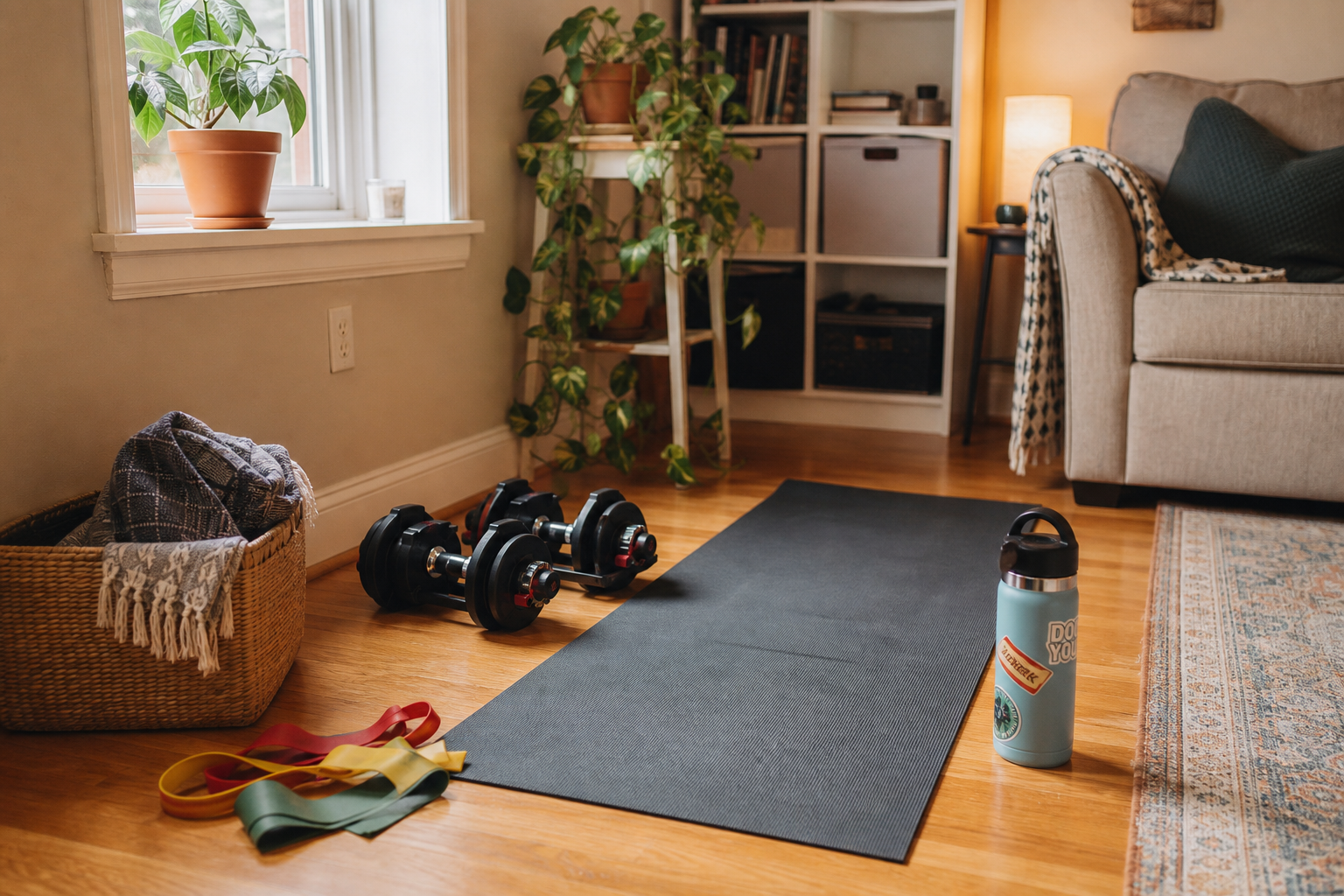
Why Home Fitness? (And Why It Works)
If you are on the fence about whether working out at home can actually deliver results, the data is clear: it can. As of 2023, 51% of U.S. exercisers now prefer at-home workouts, with convenience cited as the primary reason by that same majority. Privacy is the second most common factor, driving about 20% of the preference shift. These aren't fringe exercisers — they are people who have tried both options and made a deliberate choice.
The effectiveness question has been studied directly. Research shows that home-based and gym-based workouts produce similar effects on key health metrics including waist-to-hip ratio, heart rate, and respiratory rate. The variable that matters most is consistency — not the location. A workout you actually do at home three times a week will outperform a gym routine you skip because the commute or the crowd is a barrier.
The 4-Question Decision Framework
The reason most beginners get stuck isn't a lack of motivation — it's the overwhelming number of choices. Do you buy a treadmill or a set of kettlebells? Should you start with a bodyweight program or invest in a smart gym? The answer depends entirely on your personal constraints. This framework breaks the decision into four sequential questions. Answer them in order, and the right path becomes obvious.
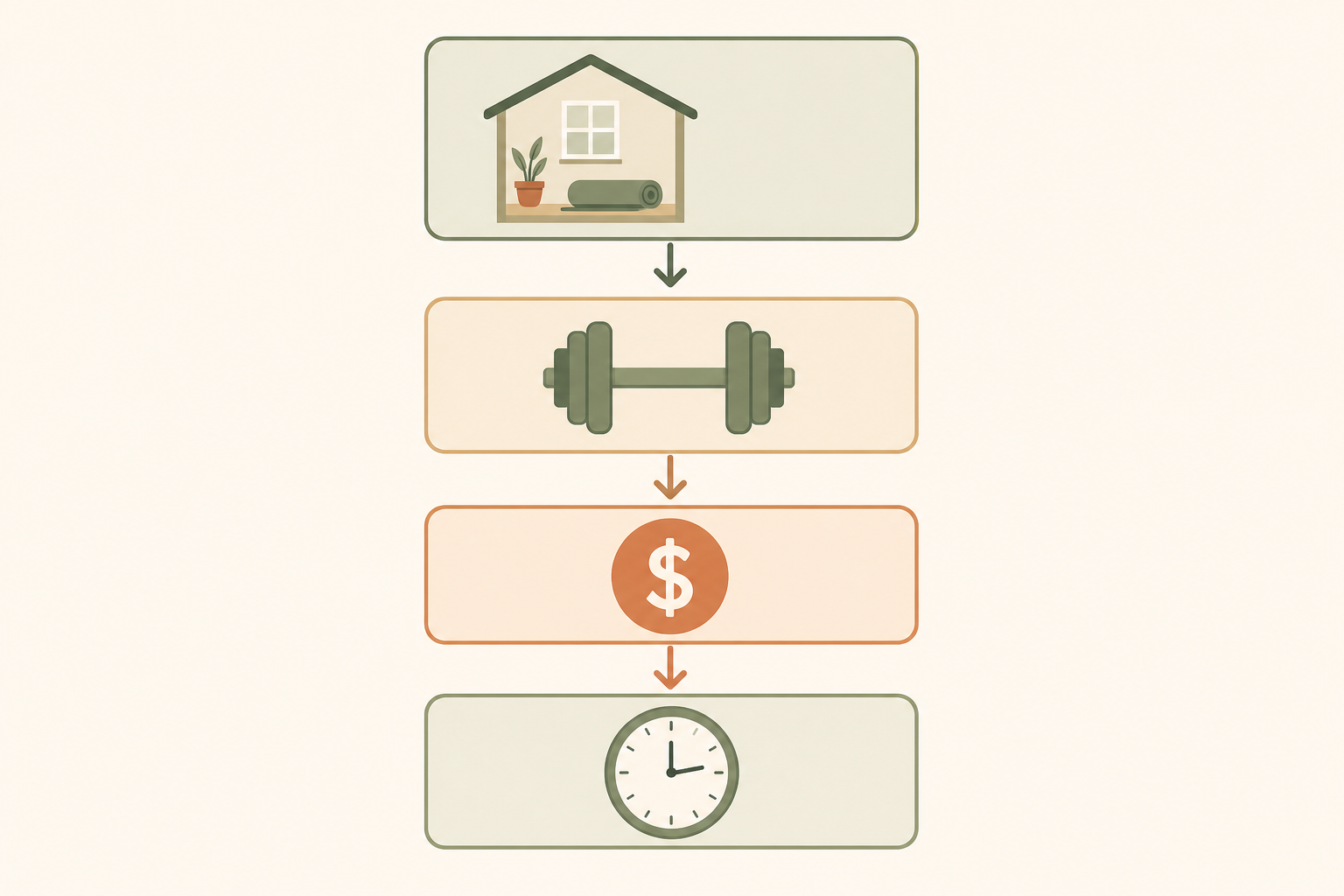
Question 1: How Much Space Do You Have?
Space is the most physically limiting factor. A lack of space is the second most common barrier to owning home fitness equipment, cited by 20% of people. Before you look at any product, measure your available floor area. A yoga mat requires about 6 by 3 feet. A folding treadmill needs roughly 10 square feet when stored and about 30 square feet when in use. A power rack with a barbell needs a dedicated footprint of at least 8 by 8 feet.
If you have less than 20 square feet of clear floor space, your options are bodyweight work, resistance bands, a single pair of dumbbells, and a mat. If you have 20 to 50 square feet, you can add a folding bench, a compact cable machine, or a spin bike. Above 50 square feet, you have room for a multi-station setup or a full rack.
Question 2: What Is Your Primary Goal?
Your goal determines which training style and equipment will serve you best. The most common beginner goals fall into four categories:
- Build strength and muscle: You need resistance training. Bodyweight exercises, dumbbells, kettlebells, resistance bands, or a barbell setup will all work. Progressive overload — gradually increasing the difficulty of your exercises — is the mechanism that drives muscle growth.
- Lose weight and improve cardiovascular health: You need a mix of cardio and resistance work. Walking, jogging, cycling, jump rope, and HIIT circuits are effective. A heart rate monitor or fitness tracker can help you gauge intensity.
- Improve flexibility and mobility: You need stretching, yoga, or Pilates. A mat, foam roller, and perhaps a set of light resistance bands are sufficient. No heavy equipment required.
- General fitness and maintenance: You need variety. A well-rounded approach that includes strength, cardio, and mobility work two to three times per week will maintain health and energy levels.
Question 3: What Is Your Budget?
Cost is the number one barrier to owning home fitness equipment, cited by 35.6% of people. The good news is that you do not need a large budget to start. According to industry data, 38.6% of home fitness equipment buyers spend under $500 on a single piece of equipment. The most popular category of home equipment is weightlifting gear, owned by 30.4% of exercisers — not expensive cardio machines or all-in-one smart gyms.
Be honest about what you are willing to spend. A $50 investment in a mat and resistance bands can produce meaningful results for months. A $300 set of adjustable dumbbells can carry you through years of progressive strength training. You can always upgrade later.
Question 4: How Much Time Can You Commit Per Session?
Time is the resource you cannot buy more of. If you have 15 minutes per session, you need a high-efficiency format like a circuit or a HIIT workout. If you have 45 to 60 minutes, you can run a traditional strength session with warm-up, main lifts, accessory work, and cool-down. Choose a routine length that fits your schedule most days of the week — not the length you wish you had.
Budget Tier Recommendations: What to Buy at Every Price Point
Once you have answered the four questions, the equipment decision narrows dramatically. The table below maps budget tiers to realistic setups based on your space and goal. Prices are approximate and reflect a single purchase — you can start with one item and add more over time.
| Budget Tier | What You Can Buy | Best For | Space Needed |
|---|---|---|---|
| Under $100 | Yoga mat, resistance bands (set of 3–5 levels), jump rope, and a free workout app | Bodyweight training, mobility, light resistance work, cardio | 6 x 3 feet (mat only) |
| $100 – $500 | Adjustable dumbbells (up to 50 lbs each), adjustable bench, pull-up bar (doorway), or a kettlebell set | Strength training, full-body workouts, progressive overload | 10 x 6 feet |
| $500 – $1,500 | All-in-one cable machine, folding treadmill or spin bike, barbell with weight plates, or a power rack half-cage | Serious strength training, dedicated cardio, multi-exercise setups | 20 x 10 feet or more |
| $1,500+ | Smart gym (Tonal, Mirror, Vitruvian), commercial-grade treadmill, full power rack with cable attachment | Full home gym replacement, guided training programs, heavy lifting | 30 x 15 feet or dedicated room |
If you are in the under-$100 tier, a quality set of resistance bands and a mat will let you perform dozens of exercises targeting every major muscle group. Pair that with a free workout app for structure, and you have a complete starter system. In the $100–$500 tier, adjustable dumbbells are the single most versatile purchase — they replace an entire rack of fixed-weight dumbbells and support progressive overload for years.
Starter Routines by Goal
With your equipment decision made, the next step is a routine that matches your goal. Below are three starter templates. Each requires minimal equipment and can be completed in 20 to 30 minutes.
Goal: Build Strength (Bodyweight or Dumbbell)
Perform 3 rounds of the following circuit, resting 60 seconds between rounds:
- Bodyweight squats: 15 reps
- Push-ups (knee or full): 10 reps
- Walking lunges: 10 reps per leg
- Dumbbell rows (use a milk jug or light dumbbell): 10 reps per arm
- Plank: 15–30 seconds
Do this routine 2 to 4 times per week with at least 48 hours of rest between sessions. To build muscle over time, apply progressive overload: increase reps, decrease rest time, perform harder variations (e.g., from knee push-ups to full push-ups), or increase time under tension by slowing down each rep.
Goal: Lose Weight and Improve Cardio (No Equipment)
Perform each exercise for 40 seconds, then rest 20 seconds. Complete all 5 exercises to finish one round. Rest 60 seconds, then repeat for a total of 3 rounds.
- Jumping jacks
- High knees (march or jog in place)
- Bodyweight squats
- Mountain climbers (slow or fast pace)
- Butt kicks
This HIIT-style circuit elevates your heart rate quickly and can be done in any small space. Aim for 3 sessions per week on non-consecutive days.
Goal: General Fitness and Mobility (No Equipment)
Perform each stretch or movement for 30–45 seconds, moving slowly and breathing deeply. Complete the sequence once.
- Cat-cow stretch (on hands and knees)
- Downward-facing dog to plank flow
- Standing forward fold with head release
- World's greatest stretch (lunge with rotation)
- Child's pose
This mobility sequence improves range of motion, reduces stiffness, and can be done daily as a morning routine or post-workout cool-down.
Common Beginner Mistakes (And How to Avoid Them)
Knowing what not to do is just as important as knowing what to do. These are the most frequent pitfalls that cause beginners to stall, get injured, or quit.
- Buying too much equipment too soon: The top barrier to owning equipment is cost (35.6%), and the second is lack of space (20%). Starting with a minimal setup — a mat, bands, and one pair of dumbbells — avoids both problems. You can always add gear later when you know what you actually use.
- Skipping rest days: Muscle growth and recovery happen during rest, not during the workout. Training the same muscle groups every day without adequate recovery leads to overtraining, fatigue, and increased injury risk. Schedule at least one full rest day per week and avoid working the same muscle group on consecutive days.
- Ignoring form for intensity: Performing an exercise with poor form to hit a rep count or use heavier weight is counterproductive. It reduces the effectiveness of the movement and increases the risk of strain. Prioritize controlled, correct movement over speed or load. Watch form videos for each exercise you attempt.
- Expecting overnight results: Visible changes in strength, body composition, or endurance take weeks to months of consistent training. If you judge progress by daily changes, you will be discouraged. Instead, track your workouts — number of reps, weight used, how the exercise felt — and look for trends over 4-week blocks.
- Not having a plan: Walking into your living room without a clear workout plan is the fastest way to waste time and lose motivation. Use a structured routine, a training plan, or a guided app so every session has a purpose and a defined endpoint.
Your Next Steps: From Decision to Action
You now have a decision framework, a budget tier, a starter routine, and a list of common mistakes to avoid. The next step is to take action. Here is a clear sequence to follow:
- Measure your available floor space and write it down.
- Choose your primary goal from the four options above.
- Set your budget and purchase the equipment from the tier that matches your space and goal.
- Pick the starter routine that matches your goal and commit to it for 4 weeks.
- After 4 weeks, evaluate your progress and decide whether to continue, increase difficulty, or try a different routine.
For further guidance, explore these sections of the site:
- Beginner Workout Routines — a library of single-session workouts organized by level, equipment, and duration.
- Equipment Comparisons — side-by-side comparisons of treadmills, exercise bikes, dumbbells, and smart gyms to help you make an informed purchase.
- Training Plans — multi-week progressive programs for users ready to commit to a structured schedule.
- Small-Space & Home Gym Setup — practical guides for planning your space, choosing flooring, and building a setup within real constraints.
You have the framework. You have the plan. The only remaining step is to start.
This is general fitness education, not medical advice. For diagnosis or treatment of pain or injury, consult a qualified clinician.
Pick your next session
Browse all routines to find an appropriately-spaced next session.
Spot something off?
This content sits adjacent to health guidance — tell us if a citation or figure needs a correction.